
Dose 0.3–0.5 mg/L: Chlorine dioxide Legionella control for UK facilities
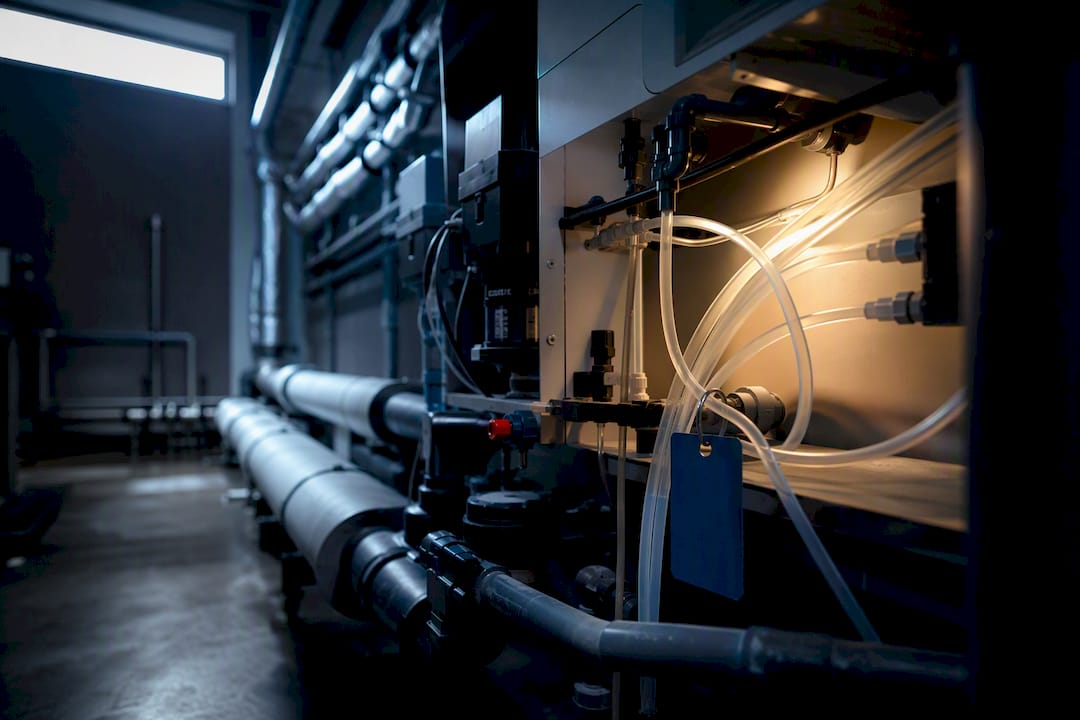
Chlorine dioxide is a solid, evidence-backed choice for Legionella control when continuous chemical treatment beats thermal disinfection, typically in low-temperature systems, complex pipework, or sites with repeated positive samples. Dose continuously at 0.3 to 0.5 mg/L and monitor chlorite as closely as the biocide itself. If positives persist despite correct dosing, the fault usually sits in the pipework, not the chemistry.
TL;DR:
Chlorine dioxide effectively controls Legionella in systems with complex pipework or low-temperature conditions when dosed continuously at 0.3 to 0.5 mg/L and closely monitored for chlorite levels.
Its performance is heavily influenced by water temperature, organic carbon, pH, and stagnation, which can cause dosing to be ineffective despite correct application.
Regular verification of residuals, chlorite, temperature, and system conditions through accredited labs is essential to prevent regulatory breaches and ensure biocide efficacy.
Descaling and immersion disinfection are necessary before chemical dosing to remove biofilm shelters like limescale within outlets, especially in showers and hoses.
Persistent positive samples despite correct dosing often indicate structural issues such as dead legs or poor valve management, requiring targeted engineering remediation beyond chemical control.
Table of Contents
How chlorine dioxide controls Legionella and biofilm
Chlorine dioxide works as an oxidising biocide that penetrates biofilm and is more stable across pH changes than free chlorine. That matters because biofilm is where Legionella actually shelters and multiplies, not floating free in bulk water.
A 17-month hospital evaluation found that a chlorine dioxide treatment system effectively removed Legionella species from the hospital’s water supply, one of the more robust field datasets supporting ClO2 in healthcare settings, where vulnerable patients and complex plumbing make chemical control attractive.
Chlorine dioxide typically outperforms chlorine but not always chloramine. A systematic review of chlorine-based disinfectants found efficacy commonly ranks chloramine above chlorine dioxide, which in turn outperforms straight chlorine, though the gap narrows or reverses depending on the system.
Performance isn’t fixed. It shifts with:
Water temperature (higher heat accelerates ClO2 decomposition)
Total organic carbon, which consumes oxidant demand before it reaches the biofilm
pH, though ClO2 is more pH-stable than chlorine
Stagnation in dead legs and low-use outlets, where residual simply doesn’t arrive
Get any of these wrong and dosing can look correct on paper while doing very little in practice.
Dosing ranges, residuals and what to monitor
HSE’s technical guidance lists chlorine dioxide as an approved biocide for continuous dosing where thermal control isn’t practical, with continuous concentrations typically running 0.3 to 0.5 mg/L. Hot water loops often need higher feed rates simply to compensate for faster decay, since chlorine dioxide breaks down more quickly at elevated temperatures.
Monitoring has to cover more than the residual you’re dosing for. A workable panel looks like this:
Parameter | Typical range | Why it matters |
ClO2 residual | 0.3–0.5 mg/L | Confirms active biocide reaching outlets |
Chlorite | Below 0.7–1.0 mg/L | By-product limit; must not be exceeded |
Temperature | System-dependent | Drives decay rate and chlorite formation |
TOC | As low as practical | High TOC consumes oxidant before it reaches biofilm |
pH | Site baseline | Affects biocide stability and corrosion risk |
Check ClO2 residual and temperature at representative outlets weekly to monthly, depending on risk category.
Send chlorite and full water chemistry to a UKAS-accredited laboratory rather than relying solely on handheld sensors.
Treat on-site probes as a screening tool, not a substitute for accredited lab confirmation when a positive result needs verifying.
Applying chlorine dioxide on site: dosing and outlet maintenance
Continuous dosing suits healthcare premises, care homes and any site with a history of repeated positive samples, where you need round-the-clock protection rather than periodic intervention. It contrasts with remedial approaches like thermal flushing or high-strength chlorination, which are typically one-off shocks used to bring a system back under control before switching to routine management.
Chemical dosing alone rarely fixes a shower head that’s been quietly scaling up for months. The procedure that actually works:
Remove the shower head and hose from the fitting.
Descale thoroughly to remove limescale that shelters biofilm from the biocide.
Immerse in disinfectant for the manufacturer’s stated contact time, never a quick dip.
Rinse thoroughly before refitting.
Repeat disinfection regularly as a baseline, with more frequent flushing for rarely used outlets.
Hoses deserve particular suspicion. They hold standing water and scale internally, and immersion disinfection after descaling proves more reliable than surface spraying, which barely touches what’s built up inside.
Pro Tip: Chemical dosing and descaling are not alternatives; they are sequential steps. Dosing a scaled outlet just wastes biocide on limescale instead of the biofilm underneath it.
Where ClO2 forms part of a wider programme, it needs to sit alongside correctly positioned TMVs and calorifiers managed at temperatures that don’t undermine the chemical control you’re paying for.
Where chlorine dioxide falls short: by-products and safety limits
Chlorine dioxide’s main drawback is what it becomes once it’s done its job. It breaks down into chlorite and chlorate, and regulatory thresholds for chlorite typically sit around 0.7 to 1.0 mg/L in drinking water. Dose too aggressively, or let a hot loop run too warm, and you risk breaching that limit even while the biocide itself looks fine.
Heat is the real enemy here. Thermal instability means ClO2 decomposes faster in hot water systems, so maintaining a usable residual right through to distal outlets while keeping chlorite in check needs proper feed-rate design, not a single dosing point and hope.
Chlorite conversion accelerates with temperature and residence time.
On-site generation and controlled dosing equipment are standard for anything beyond small-scale trial use.
Handling requires trained operators and equipment specified for the site, not off-the-shelf dosing rigged to an existing pump.
None of this rules ClO2 out. It just means the by-products need the same monitoring discipline as the biocide itself, not an afterthought.
Monitoring, verification and when the problem isn’t chemical
A sampling plan needs to be deliberate, not a handful of convenient taps. Sample at representative outlets across the system, including known low-use points and the furthest distal fittings from the dosing point, since that’s where residual runs thinnest.
Take baseline samples before any change to the dosing regime.
Sample again at two weeks post-treatment to catch early failures.
Repeat at six weeks to confirm the result holds rather than reflecting a temporary dip.
Send samples for culture testing under ISO 11731 at a UKAS-accredited laboratory, since on-site kits aren’t a substitute for confirmed results.
Escalate to a structural investigation if positives persist despite verified correct dosing.
That escalation matters more than most facilities teams expect. HSE’s L8 guidance is clear that chemical treatment doesn’t replace the need for a written scheme and engineering remediation where sampling flags a structural issue. Persistent positives with a residual confirmed present at the outlet almost always point to dead legs, poor calorifier design, or a TMV that’s creating a stagnant pocket. A structured investigation tracing dead legs, checking TMVs and inspecting calorifiers usually finds the actual fault, and no amount of extra dosing fixes a design problem.
What years of Legionella compliance work teach you about chemical dosing
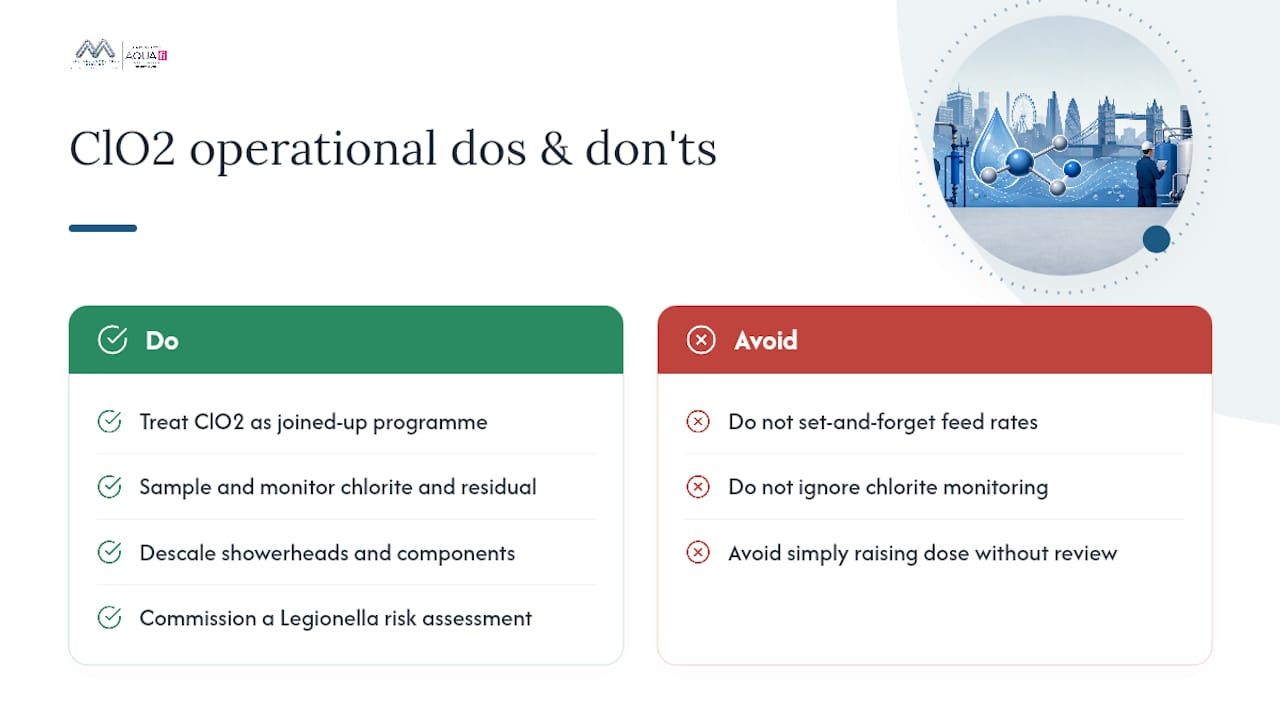
We work across risk assessments, water sampling and analysis, and implementation of control programmes, so the pattern behind most chlorine dioxide failures shows up repeatedly. It’s rarely the chemistry. It’s a feed rate set once and never revisited, a shower head that was dosed but never descaled, or monitoring that checked the residual and ignored chlorite.
The sites that get real value from ClO2 treat it as one part of a joined-up programme, sampling, dosing, descaling and engineering review working together, not a chemical fix bolted onto an unchanged system. If your onsite sampling keeps coming back positive despite dosing that looks correct on paper, that’s the signal to commission a proper Legionella risk assessment rather than simply raising the dose again.
— Sammi
Where to check the guidance for yourself
Before adjusting a dosing regime, verify against primary guidance rather than second-hand summaries:
The 17-month hospital evaluation of ClO2 field performance
Reviewing an existing Legionella risk assessment for common monitoring pitfalls
Get a system that’s actually monitored, not just dosed
We provide risk assessments that check residuals, chlorite, temperature and structural risk together, so problems get caught before they show up as a positive sample. That matters because chemical dosing without proper verification is exactly how sites end up with persistent Legionella despite doing “everything right” on paper.
[
Whether you’re managing a healthcare site with continuous ClO2 dosing or a commercial building weighing up chemical versus thermal control, expert compliance services can review your current programme, sample your system, and identify whether the issue is dosing, descaling, or structural. If your last few samples came back positive, or you’ve never had an independent review of your dosing regime, book a Legionella risk assessment and get a clear answer on what’s actually happening in your system.
Sources
A 17-month evaluation of a chlorine dioxide water treatment … (PubMed)
Kinetics and mechanisms of virus inactivation by chlorine dioxide in water treatment
Cleaning and disinfecting shower heads for legionella - LegionellaCheck
Efficacy of chlorine-based disinfectants to control Legionella within premise plumbing systems
FAQ
What kills Legionella in a shower head?
Descaling followed by immersion disinfection for the manufacturer’s stated contact time removes both the limescale sheltering biofilm and the Legionella living within it; a surface spray alone rarely reaches embedded biofilm.
Does chlorine dioxide kill viruses?
Yes. Laboratory studies show concentrations of 0.5 to 1.0 mg/L can reduce influenza viruses by 99.9% within minutes, though the required dose and contact time vary by virus and water matrix.
Can you drink water treated with chlorine dioxide?
Water dosed within approved limits and monitored for chlorite is safe to drink; the concern isn’t the chlorine dioxide itself but ensuring the chlorite by-product stays below the regulatory threshold of roughly 0.7 to 1.0 mg/L.
What is a disadvantage of using chlorine dioxide for disinfection?
Its main drawback is chlorite and chlorate formation, which requires ongoing monitoring alongside the biocide residual, and thermal instability that makes maintaining a consistent dose in hot water systems harder than in cold ones.
When should a site consider ongoing testing rather than a one-off treatment?
Sites with a history of positive samples, complex or aged pipework, or vulnerable occupants generally need continuous monitoring and dosing rather than a single remedial treatment; a Legionella and water testing programme establishes whether ongoing chemical control is actually needed.
Recommended
Comments