
Digital logbook system compliance management: a practical guide

A digital logbook system for compliance management is a structured, automated tool that produces tamper-proof, audit-ready operational records aligned with regulatory requirements. Unlike a paper log or a basic spreadsheet, a properly architected system generates timestamps, operator attributions, and immutable audit trails automatically at the point of data entry. This satisfies frameworks such as ALCOA+ (Attributable, Legible, Contemporaneous, Original, Accurate) and 21 CFR Part 11, which govern data integrity across pharmaceuticals, water hygiene, maritime operations, and other regulated sectors. Paper logbooks are architecturally incapable of meeting ALCOA+ standards. That single fact explains why compliance managers across the UK are replacing manual records with electronic compliance tracking systems. This guide covers the prerequisites, deployment steps, common pitfalls, and success metrics you need to get it right.
What does a digital logbook system compliance management approach require?
Successful implementation starts before you select any software. Organisational readiness is the foundation. Staff must understand why the system exists, not just how to use it. Without that context, operators treat digital fields as a digital replica of a paper form, which defeats the purpose entirely.
The technical prerequisites fall into three categories:
Secure, networked hardware. Tablets, fixed terminals, or mobile devices with reliable connectivity at every point of operation.
Role-based access controls. Every entry must be attributable to a named individual. Generic logins destroy audit trail integrity.
System-generated timestamps. The system must stamp each entry automatically. Manual time entry does not satisfy ALCOA+ or 21 CFR Part 11.
Immutable records. Role-based access and immutable audit trails satisfy auditor requirements and reduce the risk of data tampering.
Integration capability. The system should connect to existing management dashboards and reporting tools to avoid isolated data silos.
Regulatory considerations vary by sector. Water hygiene operations in the UK must align with HSE L8 and the associated Approved Code of Practice. Maritime operators must satisfy STCW and MLC 2006 conventions. Pharmaceutical facilities must comply with 21 CFR Part 11. Identify your specific obligations before configuring any system.
Pro Tip: Select a system built for compliance by architecture, not one that simply digitises a paper form. If the software does not generate timestamps and operator IDs automatically, it will not satisfy an auditor regardless of how neatly the data is presented.
Process alignment matters as much as technology. Map your existing compliance workflows before configuration. Identify every record type, every responsible role, and every reporting deadline. A system configured around your actual processes will embed compliance into daily operations rather than sitting alongside them as an extra task.

How do you deploy a digital logbook system step by step?
A structured deployment reduces the risk of gaps in your compliance record during the transition period. The five stages below apply across sectors, from healthcare facilities to commercial property management.
Needs analysis. Document every regulatory obligation, record type, and reporting frequency. Include shift handover logs, deviation records, maintenance entries, and any sector-specific forms.
System configuration. Set up user roles, access permissions, mandatory fields, and automated alert thresholds before any live data entry begins.
User onboarding. Train all operators on the system’s purpose, not just its mechanics. Compliance completeness depends on operators understanding what a missing entry costs.
Data migration. Transfer historical records where required by regulation. Confirm the integrity of migrated data before going live.
Live operation with monitoring. Activate automated compliance checks and real-time alerts from day one.
The table below summarises the key features each implementation stage should confirm are active:
Stage | Feature to confirm | Compliance purpose |
Configuration | Role-based access | Attributable records (ALCOA+) |
Configuration | System-generated timestamps | Contemporaneous data capture |
Onboarding | Mandatory field enforcement | Complete records |
Live operation | Real-time alerts | Proactive gap detection |
Live operation | Immutable audit trail | Audit readiness |
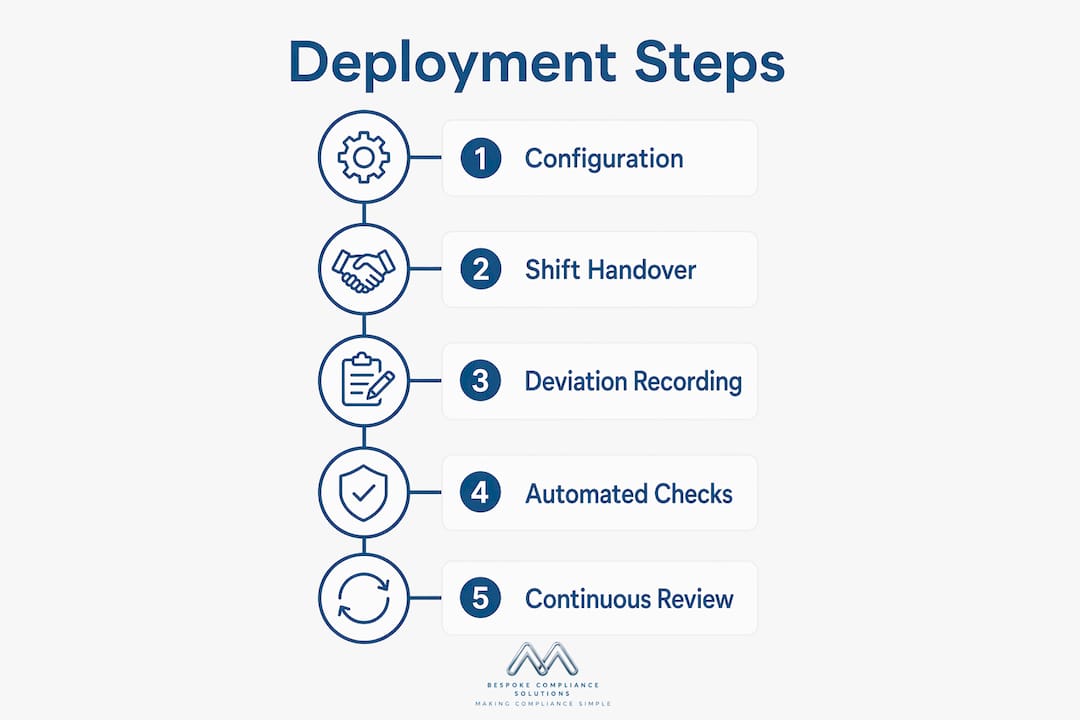
Shift handovers deserve particular attention. Over 40% of industrial incidents occur during shift handovers, which represent less than 5% of operational time. That figure shows exactly where your logbook system must be most disciplined. Automated handover checklists, mandatory sign-off fields, and real-time alerts for incomplete entries close the gap that paper logs leave wide open.
Deviation recording is another critical workflow. When an operator logs a non-conformance, the system should automatically flag it for supervisor review, timestamp the escalation, and track resolution. This creates a closed-loop record that auditors can follow from detection to correction without any manual reconstruction.
Continuous automated compliance checks shift the model from reactive to proactive compliance management, with detection times for violations measured in seconds rather than days. That speed matters when a regulatory inspection arrives without notice.
What are the most common digital logbook compliance pitfalls?
Most compliance failures with digital logbooks are not technology failures. They are process failures enabled by poor system design or inadequate staff discipline.
The most common pitfalls include:
Double data entry. Operators log information in the digital system and then re-enter it into a separate report or dashboard. Integrating logbook data to auto-populate related reports eliminates this risk and creates a single source of truth.
Incomplete data capture. Optional fields get skipped under operational pressure. Every field that matters for compliance must be mandatory, enforced by the software, not by policy.
Over-reliance on manual review. Supervisors cannot read every entry in real time. Automated alerts must flag exceptions so that human review focuses on genuine issues.
Retrospective entries. Operators who fall behind fill in records after the fact. System-generated timestamps expose this immediately, but only if the system enforces contemporaneous entry.
Generic user accounts. Shared logins make attribution impossible. Every operator needs an individual account with a unique credential.
Pro Tip: Design the system so that doing the right thing is the easiest thing. If completing a compliant entry takes longer than a non-compliant shortcut, operators will take the shortcut. Mandatory fields, dropdown selections, and auto-populated data remove the friction from correct behaviour.
The ALCOA+ principle of contemporaneous capture is the one most frequently violated in practice. An entry made three hours after an event is not contemporaneous, regardless of what timestamp the operator types. A system that locks the timestamp at the moment the form is opened, rather than when it is submitted, closes this loophole entirely. This is what compliance by architecture means in practice.
Compliance software must act as a system of action, embedding regulations into operational workflows rather than functioning as a separate record-keeping task. When the logbook is part of the job, not an addition to it, completion rates rise and audit findings fall.
How do you measure and maintain compliance using digital logbook systems?
Measuring compliance effectiveness requires defined metrics, not just a sense that records are being completed. The three core metrics for any water compliance management system or broader regulatory programme are completeness, timeliness, and audit trail integrity.
Key metrics and maintenance practices include:
Completeness rate. The percentage of required entries completed within the specified timeframe. A target of 100% is not aspirational; it is the regulatory baseline.
Timeliness rate. The percentage of entries made within the required window after the triggering event. Late entries, even complete ones, can constitute a compliance failure.
Audit trail integrity score. The proportion of records with unbroken, attributable, timestamped histories. Any gap in the chain is a finding waiting to happen.
Alert response time. How quickly operators and supervisors act on automated compliance alerts. Slow response times indicate a cultural problem, not a technology problem.
Modern compliance platforms monitor thousands of regulatory obligations and assist large numbers of companies with automated tracking and visibility. Automation centralises compliance and reduces manual effort, enabling faster and more reliable reporting across multiple sites.
Continuous compliance dashboards give compliance managers a live view of status across all sites and all record types. Proactive traffic-light indicators signal compliance risk before violations occur, moving the function from passive record keeping to active management. Green means compliant, amber means intervention required, red means a breach is imminent or has occurred.
Regular internal audits, supported by system-generated logs rather than manually compiled reports, are the most reliable way to maintain audit readiness. Schedule quarterly reviews of alert response times, completeness rates, and any open deviations. Regulatory requirements also change. A system that cannot be updated to reflect new obligations becomes a liability rather than an asset.
Key takeaways
A digital logbook system built for compliance by architecture, not just digitised paper, is the most reliable foundation for continuous audit readiness across regulated sectors.
Point | Details |
Compliance by architecture | Systems must auto-generate timestamps and operator IDs; manual entry does not satisfy ALCOA+ or 21 CFR Part 11. |
Shift handover risk | Over 40% of industrial incidents occur during handovers; automated checklists and mandatory sign-off fields close this gap. |
Single source of truth | Integrating logbook data to auto-populate reports eliminates double entry and reduces errors across the compliance record. |
Proactive monitoring | Traffic-light dashboards and real-time alerts detect violations in seconds, shifting compliance from reactive to preventive. |
Metrics that matter | Track completeness rate, timeliness rate, and audit trail integrity as the three core measures of logbook effectiveness. |
Why I think most organisations are still getting this wrong
After working across water hygiene, healthcare, and facilities management compliance, the pattern I see most often is this: organisations invest in a digital logbook system, then use it exactly like a paper log. They digitise the form without changing the process. The result is a more expensive version of the same compliance risk.
The shift that actually matters is cultural, not technological. When operators understand that the logbook is the compliance record, not a summary of it, behaviour changes. Entries become contemporaneous because operators know a late entry is a compliance failure, not just an admin oversight.
The duty of care compliance record is a legal document. Treating it as one, from the moment of implementation, sets the right standard. AI-driven compliance platforms embed regulatory calendars and task workflows directly into daily operations, making compliance a continuous activity rather than a periodic exercise. That is the direction the sector is moving, and organisations that adopt this model now will be significantly better positioned when regulatory scrutiny increases.
The technology is ready. The standards are clear. The gap is almost always in how the system is configured and how staff are trained to use it. Get those two things right, and audit readiness becomes a by-product of normal operations rather than a crisis response.
— Sammi
How Bespokecompliancesolutions supports your compliance record keeping
Bespokecompliancesolutions works with compliance managers and facility operators across the UK to implement logbook systems that are built around your specific regulatory obligations, not generic templates.
From Legionella risk assessments and water sampling to the implementation of bespoke logbook systems and ongoing consultancy, every service is designed to make compliance straightforward and defensible. Whether you manage a healthcare site, a commercial property portfolio, or a housing association, Bespokecompliancesolutions configures solutions that fit your operational reality. Contact the team to discuss a logbook system tailored to your sites, or explore Legionella compliance training to ensure your staff understand the obligations behind every entry they make.
FAQ
What is a digital logbook system in compliance management?
A digital logbook system for compliance management is an automated record-keeping tool that captures operational data with system-generated timestamps, operator attributions, and immutable audit trails. It is designed to satisfy regulatory frameworks such as ALCOA+, 21 CFR Part 11, and sector-specific standards including HSE L8.
How does a digital logbook satisfy ALCOA+ requirements?
ALCOA+ requires records to be Attributable, Legible, Contemporaneous, Original, and Accurate. A compliant system generates timestamps and operator IDs automatically at data entry, making manual attribution and retrospective entries structurally impossible.
What is the biggest risk during shift handovers in digital logbook compliance?
Over 40% of industrial incidents occur during shift handovers, which account for less than 5% of operational time. Automated handover checklists and mandatory sign-off fields in a digital logbook system close the gap that paper records leave unaddressed.
How do compliance dashboards improve audit readiness?
Compliance dashboards provide a live view of completeness rates, open deviations, and alert response times across all sites. Traffic-light indicators flag risk before a breach occurs, so compliance managers can intervene before an auditor does.
Can a digital logbook system work across multiple sectors?
Yes. The core architecture, role-based access, immutable audit trails, and automated alerts applies across water hygiene, healthcare, maritime, pharmaceuticals, and facilities management. Sector-specific configuration maps the system to the relevant regulatory obligations for each site.
Recommended
Comments