
UK Duty Holders: Tackle Expansion Vessel Legionella under HSG274
Yes, expansion vessels can pose a genuine legionella risk where water sits stagnant or warms above ambient. Identify every vessel on site, confirm each has an isolation and drain valve, add them to your written scheme, and schedule flushing and sampling on a rolling basis. HSG274 Part 2 and ACOP L8 both treat this as a control measure, not an optional extra.
TL;DR:
Expansion vessels, especially single-entry diaphragm types, can stagnate and warm water to Legionella growth temperatures, creating health risks.
Proper site inspection involves checking vessel orientation, heat proximity, isolation valves, and physical condition to determine their risk level.
Flow-through vessels and strategic siting in cooler areas with full isolation and drain valves significantly reduce the likelihood of Legionella proliferation.
Regular flushing and sampling, with detailed log-keeping, are essential operational routines to control risks in existing vessels.
Including expansion vessels in the written risk management scheme, with clear assessments, schedules, and escalation triggers, is crucial for legal compliance and safety.
Table of Contents
What is an expansion vessel and how does it behave in water systems?
What design and installation choices reduce legionella risk?
Flushing, sampling and logging: the operational routine that actually works
What should your written scheme show about expansion vessels?
How Bespoke Compliance Solutions approaches expansion-vessel risk
What is an expansion vessel and how does it behave in water systems?
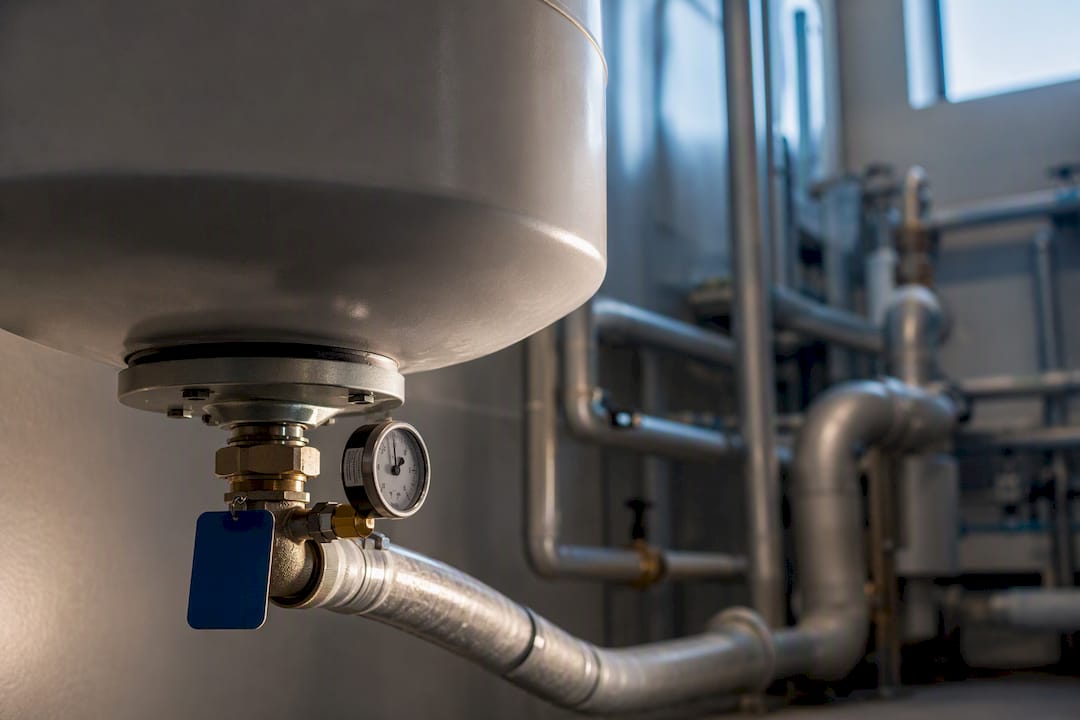
An expansion vessel is a sealed pressure buffer fitted into heating circuits, booster sets and calorifier installations. Inside sits a rubber diaphragm or bladder, with air on one side and system water on the other. As water heats and expands, it pushes into the vessel; as it cools, the water retreats. That back-and-forth sounds like natural turnover, but it isn’t.
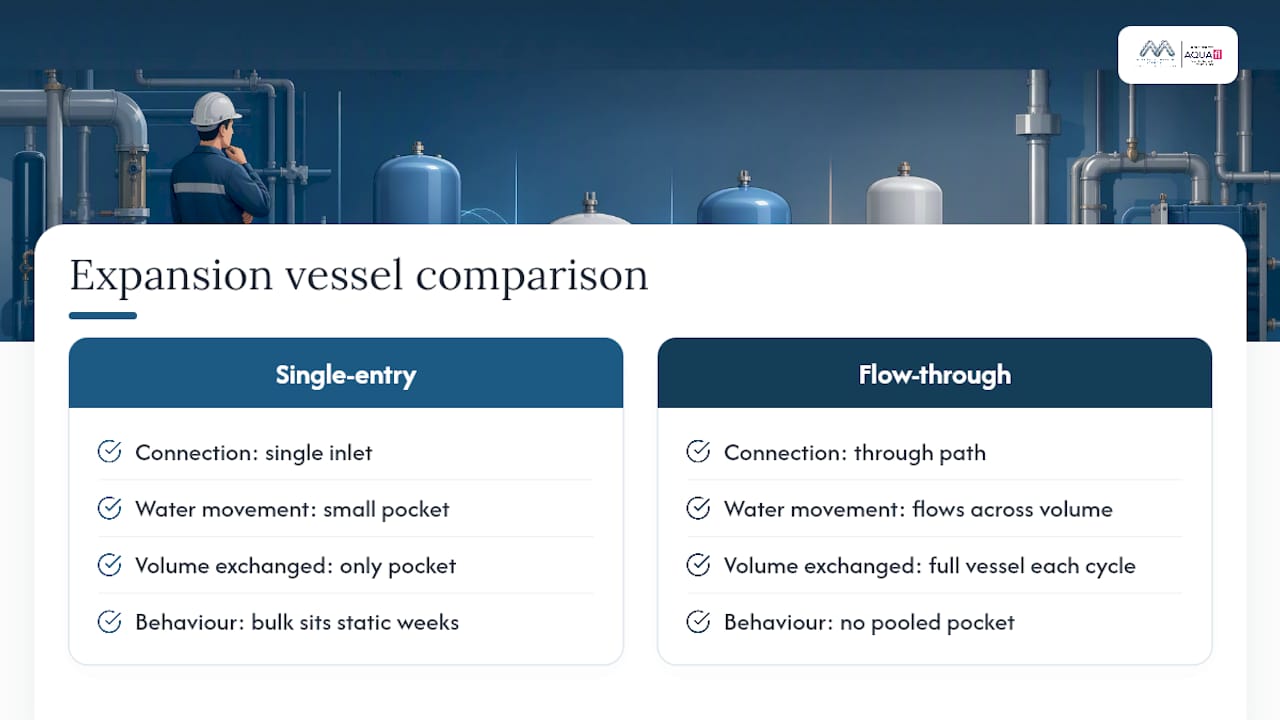
In many designs, only a small pocket of water actually moves in and out with each cycle. The bulk of the volume inside the vessel can sit untouched for weeks. That makes it a dead leg in all but name, connected to the live system but functionally isolated from it.
Two designs dominate UK installations: single-entry diaphragm or bladder vessels, which have one connection point and the stagnation problem described above, and flow-through vessels, which allow water to pass across the full volume rather than pooling in a pocket. The design choice matters enormously for legionella risk management, and it’s the first thing worth checking on any site survey.
Why do expansion vessels create legionella risk?
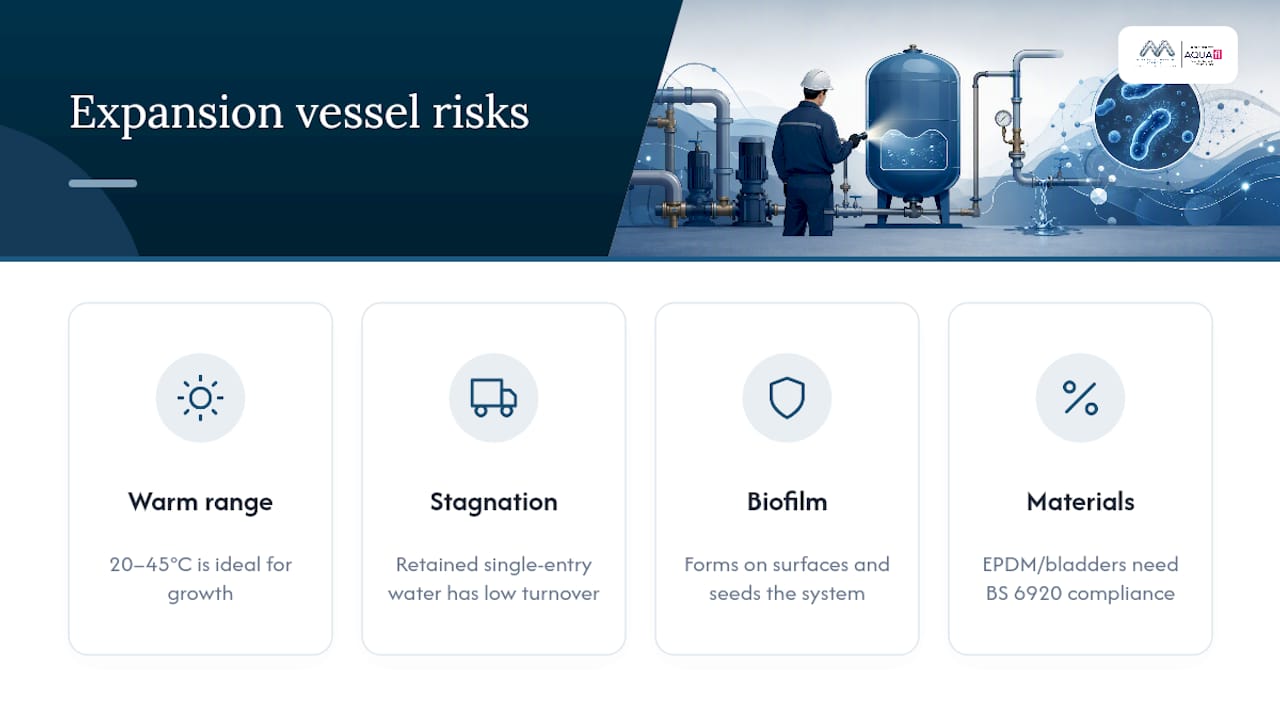
Legionella bacteria multiply fastest between 20°C and 45°C, a window HSE’s guidance identifies as the core temperature range to avoid in any water system. Expansion vessels fitted near boilers, calorifiers or in warm plantrooms often sit comfortably inside that band, even when the wider system runs hotter or colder at the point of use.
Temperature is only half the problem. The retained water inside a single-entry vessel barely exchanges with the rest of the system, so it never gets the flow that would flush out settling organic matter. Low turnover plus warmth is close to a textbook incubator. Add biofilm, which forms readily on internal surfaces given enough time and the right conditions, and you have a reservoir that can seed the wider system every time the vessel finally does exchange water.
Materials compound this. Rubber bladders, particularly older EPDM compounds, can support microbial growth if they aren’t manufactured to the right specification. HSG274 Part 2 flags materials compliance under BS 6920 as a specific installation concern, precisely because a bladder that leaches nutrients or fails to resist microbial colonisation turns a stagnation problem into an active growth problem.
How do you find and inspect expansion vessels on site?
Most estates teams underestimate how many vessels are hiding in their own plantrooms. They typically appear on system schematics near boilers, calorifiers, and cold water booster sets, though older buildings often have vessels added later that never made it onto the drawings.
Physically, look for a spherical or cylindrical tank, usually red, blue or grey, mounted either vertically or horizontally near the pipework it serves. A quick inspection should check:
Orientation — vertical mounting with the connection at the base is preferred; horizontal mounting can trap air pockets and worsen stagnation.
Proximity to heat sources — vessels bolted directly onto or beside boilers run consistently warmer than those sited away from plant.
Isolation and drain valves — without both, routine flushing is impractical, which is exactly the gap HSG274 Part 2 warns about.
Physical condition — corrosion, weeping seals or a soft/bulging shell can indicate bladder failure.
Any vessel failing more than one of these checks should move to the top of your remedial list.
What design and installation choices reduce legionella risk?
Flow-through vessels solve the stagnation problem at source. Because water moves across the full internal volume rather than pooling behind a single connection, retained-volume risk drops sharply compared with standard diaphragm designs. Sector guidance on expansion vessels and legionella consistently points to flow-through and dual-connection vessels as the preferred specification for new installations and higher-risk premises such as healthcare sites.
Siting matters just as much as vessel type. Good practice looks like this:
Locate vessels in cool areas of the plantroom, away from boilers, calorifiers and other heat-emitting plant.
Mount vertically wherever the manufacturer allows, to avoid trapped air and encourage more complete drainage.
Position as close to the incoming cold supply as practicable, minimising the length of any branch that can stagnate.
Fit a full-bore isolation valve and a dedicated drain valve at installation, not retrofitted later as an afterthought.
Confirm any wetted materials carry BS 6920 approval and that fittings meet WRAS requirements before sign-off.
Get this right at procurement stage and you remove most of the ongoing operational burden described in the next section.
Flushing, sampling and logging: the operational routine that actually works
Retrofitting good practice onto an existing vessel is less elegant than specifying a flow-through unit from day one, but it’s achievable with a disciplined routine. Regular flushing is the sensible baseline for most sites, with increased frequency recommended for vessels sited in warm plantrooms or serving low-demand systems where turnover is naturally poor.
Short, regular flushes that draw water until temperature stabilises and the discharge runs clear are more effective, and less disruptive to system pressure, than infrequent long purges. Trying to compensate for months of neglect with one extended flush risks destabilising the whole circuit.
The flushing procedure itself follows a consistent pattern:
Confirm the isolation valve is accessible and the drain valve is fit for purpose before starting.
Open the drain valve and allow water to run until temperature stabilises and visual clarity improves.
Monitor discharge temperature throughout. A vessel that never cools to expected ambient levels needs flagging for remedial attention, not just repeat flushing.
Manage waste water appropriately, particularly where drainage routes to surface water systems.
Record the date, operative, flush duration and any temperature readings in the written scheme immediately afterwards.
Sampling needs a different level of rigour. Samples taken from the vessel drain valve require sterile technique and a trained operative. Ad hoc sampling by whoever happens to be on site isn’t sufficient evidence for a compliance audit, and a lab result taken without a documented chain of custody carries little weight if the Health and Safety Executive ever asks to see it. Log every sample, every result and every corrective action taken in response, in the same written scheme that records your flushing history.
What remedial options exist for high-risk vessels?
Not every problem vessel needs full replacement. Retrofit anti-legionella valves, which use a flow-diversion mechanism to force periodic exchange through the vessel, can reduce stagnation risk in situations where full replacement isn’t immediately practical. Choose WRAS-approved products only, and be honest about their limits: a retrofit valve manages symptoms rather than removing the underlying dead leg entirely.
Bladder replacement is a cheaper middle option where the vessel body itself is sound but the internal diaphragm has degraded. Confirm the replacement material carries BS 6920 approval before fitting; an unapproved bladder can reintroduce the exact materials risk you’re trying to eliminate.
Full replacement becomes the right call when:
The vessel consistently runs warm despite relocation attempts or shielding from heat sources.
The drain valve is missing entirely or physically inaccessible without significant remedial pipework.
Sampling has returned repeated positive results despite increased flushing frequency.
In each of these cases, a flow-through replacement typically offers a more durable fix than continuing to manage a diaphragm vessel through manual intervention alone.
What should your written scheme show about expansion vessels?
Under ACOP L8, duty holders must assess legionella risk across the whole water system and maintain a written scheme documenting how that risk is controlled. Expansion vessels are routinely missed from this documentation, treated as passive plant rather than a component with its own risk profile, which is precisely the gap an HSE inspection is designed to catch.
A written scheme entry for each vessel should include:
Its location on the system schematic, cross-referenced to a physical plantroom reference.
The flushing frequency applied and the date of the last completed flush.
Sampling points and the schedule for microbiological testing.
The name of the person responsible for carrying out and recording each check.
Any remedial history, including bladder replacements or retrofit valve installations.
Escalation should follow a clear trigger. Repeated positive samples, a vessel that can’t be brought below the 20°C to 45°C growth window despite intervention, or an inaccessible drain valve all warrant bringing in a specialist contractor rather than continuing routine monitoring alone. Reviewing an existing risk assessment periodically is the mechanism that catches these triggers before they become incidents.
How Bespoke Compliance Solutions approaches expansion-vessel risk
Our site surveys treat expansion vessels as a distinct risk point, not an afterthought buried in a wider schematic review. Surveyors check orientation, valve provision and proximity to heat sources, then recommend remedial priorities based on what’s actually found rather than a generic checklist. Findings, flushing schedules and sample results go straight into a bespoke logbook system, giving your team an audit-ready record and giving your staff the working knowledge to maintain it between visits.
Why expansion vessels can’t be fit and forget
The most common failure I see isn’t ignorance of the risk. It’s that expansion vessels get commissioned once and then quietly disappear from anyone’s radar, because they don’t fail loudly the way a leaking pipe does. They just sit there, warm and stagnant, until a sample comes back wrong.
Get them into the written scheme properly, with a named responsible person and a real flushing schedule, and that risk becomes manageable rather than mysterious. If you’re not confident your current documentation covers this, that’s worth a professional survey before it becomes a bigger problem.
— Sammi
Book a survey that actually checks your expansion vessels
Most water hygiene reviews skim past expansion vessels because they’re small, unglamorous and easy to miss on a walk-through. Bespoke Compliance Solutions builds vessel identification, valve checks and flushing schedules into every site survey from the outset, so nothing gets left off your written scheme by accident.
[
A typical engagement starts with a full site survey covering every vessel, calorifier and outlet, followed by a tailored remedial plan where vessels need retrofit valves, bladder replacement or full swap-out. We handle the water sampling and laboratory analysis that turns “we think it’s fine” into documented evidence, and we set up the bespoke logbook system your team uses to log every flush going forward. Legionella awareness training is available for staff who’ll be carrying out routine checks between visits.
If you manage a commercial, healthcare or housing site and aren’t certain your expansion vessels are covered, book a legionella risk assessment and get a clear picture of where you stand.
Sources
For the technical detail behind this guidance, consult HSG274 Part 2 on installation and flushing, ACOP L8 on legal duties and written schemes, and HSE’s general legionella guidance for prevention principles. Materials compliance references BS 6920 and BS 6144.
This article is general information, not a substitute for advice from a qualified doctor. Consult a qualified healthcare professional about your own circumstances before acting on anything here.
FAQ
How long should you run taps to check for legionella?
There’s no single universal duration; HSE guidance focuses on flushing until temperature stabilises and water runs clear rather than a fixed number of minutes, since this varies by pipe length and system design.
What happens if an expansion vessel is faulty?
A faulty vessel, particularly one with a failed bladder or no working drain valve, can retain warm stagnant water indefinitely, creating conditions inside the legionella growth range and risking contamination of the wider system when it eventually discharges.
Can you get legionella from a combi boiler?
Combi boilers heat water on demand rather than storing it, which limits the classic stagnation risk, but any expansion vessel or pipework attached to the system can still retain water long enough to pose a risk if not flushed and maintained.
Can daily showering expose you to legionella?
Showers can aerosolise water and are a recognised transmission route if the supply is contaminated, which is exactly why HSE’s prevention guidance focuses on keeping outlets and the systems feeding them, including expansion vessels, free from stagnation and within safe temperature ranges.
Recommended
Comments