
5 Legionella Checks Every Hotel Manager Needs Under ACOP L8
The essential step is a suitable and sufficient Legionella risk assessment, backed by a written scheme of control and managed by a named responsible person. Alongside that, hotels need the 60°C storage, 50°C distribution and below 20°C cold water regime, with routine sentinel monitoring. Where in-house teams lack the technical depth to run this properly, bringing in a specialist consultancy is the safer, cheaper route.
TL;DR:
Properly maintained shower heads and hoses are the biggest aerosol risk for Legionella growth, especially if they are not descaled regularly.
Regular temperature monitoring at outlets, with hot water reaching 50°C within one minute and cold water staying below 20°C, is essential for ongoing control.
Appointing a competent responsible person who understands the site’s water systems and updating risk assessments and control schemes keeps compliance effective.
External specialists can handle sampling and technical assessments, but legal responsibility remains with the hotel operator, requiring clear partnership and documentation.
Stagnant water during closures must be managed through weekly flushing, temperature rechecks, and disinfection where necessary to prevent Legionella proliferation.
Table of Contents
Hotel legionella management: the at-a-glance checklist
Running hotel legionella management well comes down to five recurring jobs, done on a fixed schedule rather than reactively. Miss one and the whole written scheme starts to look thin during an inspection.
Appoint a competent responsible person who understands the site’s water systems and has documented training, not just a job title.
Complete or refresh the risk assessment and written scheme, including an up-to-date schematic of hot and cold water systems.
Check sentinel outlet temperatures monthly: hot water should reach 50°C within a minute at the tap, cold water below 20°C.
Flush unused rooms weekly, run water through every outlet, and check shower heads and hoses for scale or biofilm.
Service TMVs on a set cycle, sample water where indicated, and keep records for the length of time ACOP L8 requires.
None of this is exotic engineering. It’s housekeeping discipline applied to plumbing, and most failures during audits trace back to gaps in the paperwork rather than gaps in the pipework.
Where does Legionella grow in hotel water systems?
Legionella needs three things to thrive: stagnant water, the right temperature band (roughly 20°C to 45°C) and a source of nutrients such as scale, sludge or biofilm. Hotels tend to offer all three somewhere on site, which is why the risk map matters more than any single fix, as stagnant water at certain temperatures combined with nutrients encourages growth.
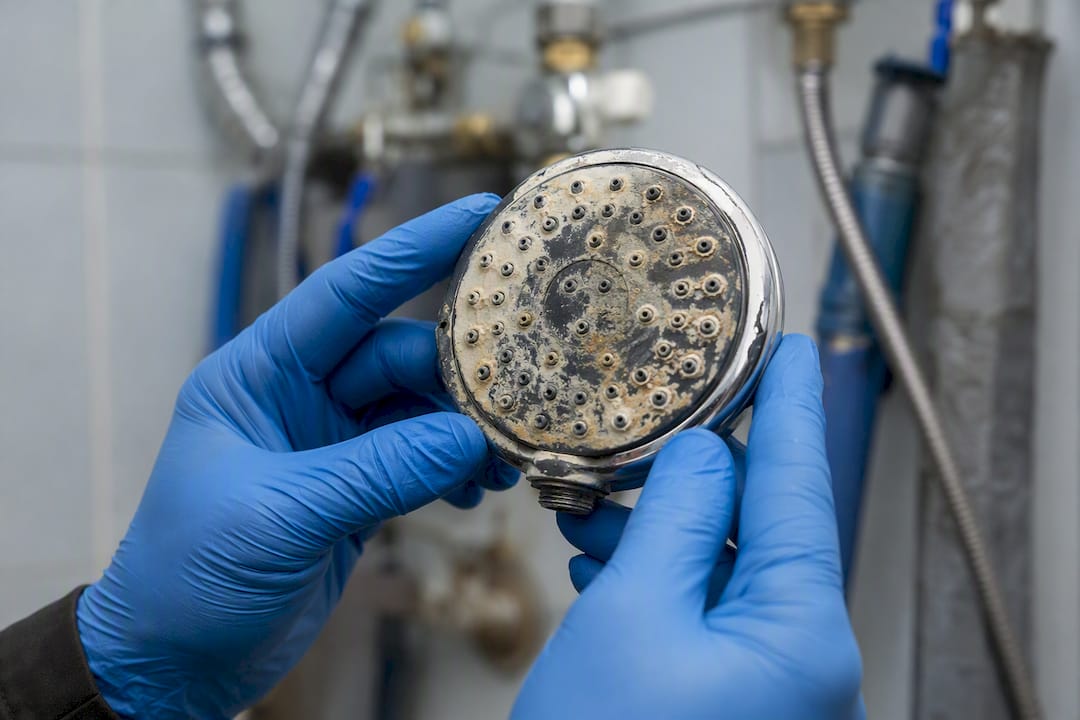
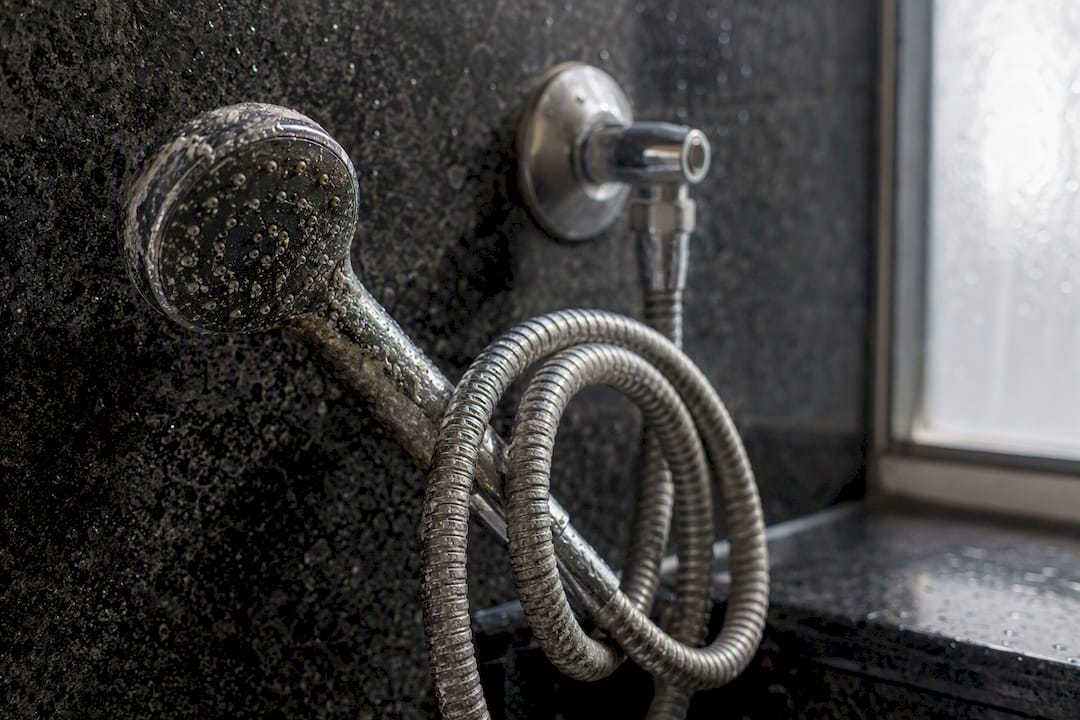
Showers are the biggest aerosol risk. A shower head or flexible hose that hasn’t been descaled turns a routine wash into a fine mist of contaminated droplets, and that mist is the actual transmission route, not the water itself. Hotels with dozens of identical bathrooms multiply this risk across every floor, which is why Legionella Control International’s guidance for hotel managers flags shower heads and hoses as disproportionately important compared with their size.
Calorifiers, tanks and dead legs sit quietly in the background. A hot water calorifier that’s undersized for occupancy, a cold water storage tank with poor turnover, or a dead leg feeding a bathroom that’s rarely booked. All of these let water sit at exactly the wrong temperature for exactly the wrong length of time.
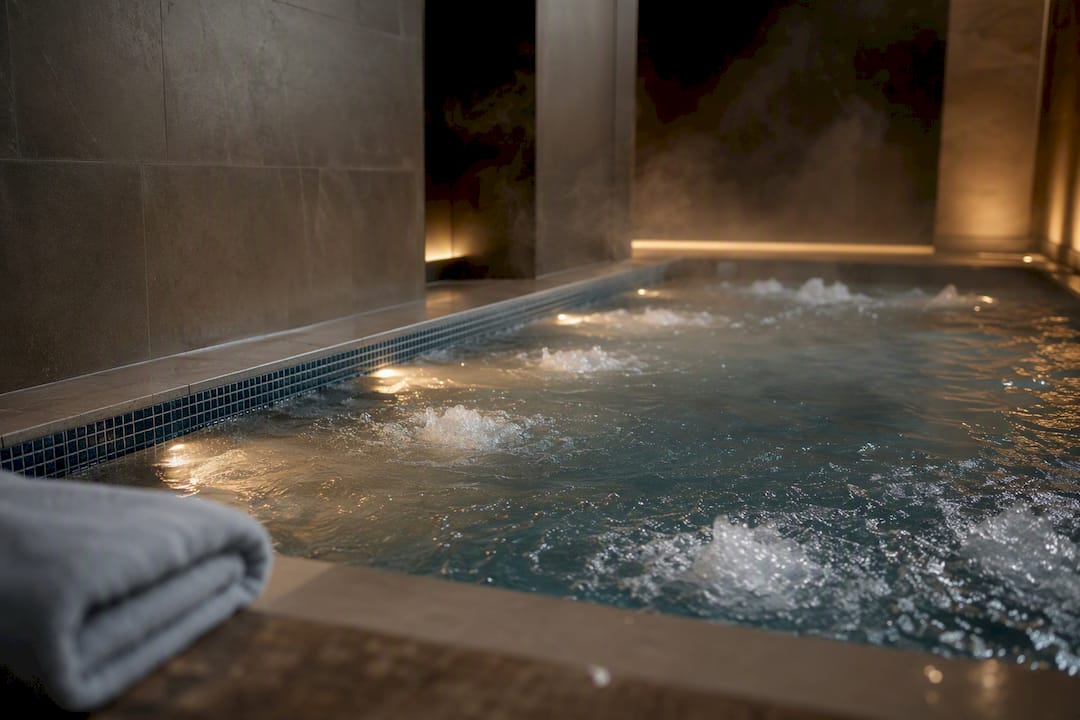
Spa pools, hot tubs and cooling towers carry a different order of risk. These systems aerosolise water constantly, at warmer temperatures, often with more people in close contact. Cooling towers and evaporative condensers must be notified to the local authority as required by law, in addition to the general risk assessment duty.
Plant rooms and seasonal wings create their own blind spots. Poor pipe insulation lets hot water cool in transit and cold water warm up, both push the system into the growth band. A wing mothballed over winter, or rooms kept for low season, are exactly where dead legs, cold spots and stagnation collect until someone reopens the doors without checking first.
What legal duties apply to hotel legionella compliance?
Under the Health and Safety at Work Act and the Control of Substances Hazardous to Health Regulations, hotels have a legal duty to control the risk from Legionella bacteria in their water systems. The Health and Safety Executive’s Approved Code of Practice L8 sets out what that duty looks like in practice: a suitable and sufficient risk assessment, a written scheme of control, a named competent person, and ongoing monitoring with proper records.
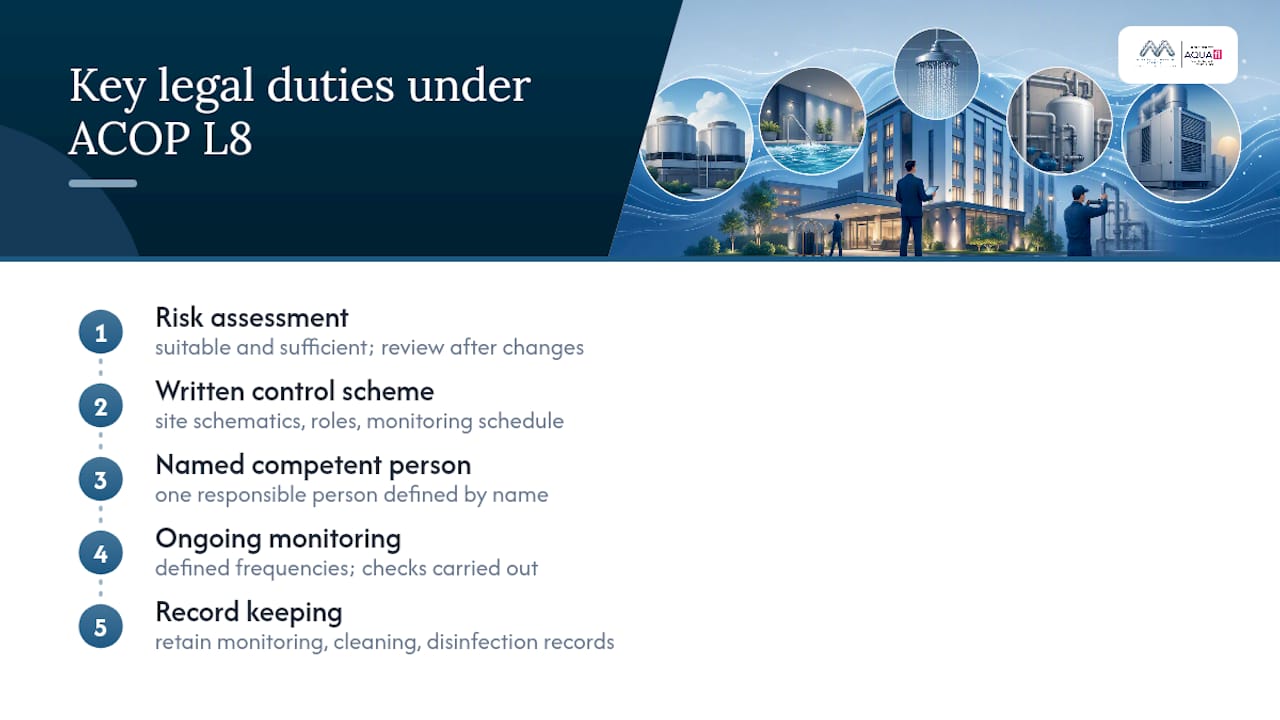
A written scheme that would survive scrutiny needs a schematic of every hot and cold water system on site, the names of everyone with a defined role, a monitoring schedule with defined frequencies, and evidence that checks are actually carried out as scheduled. Our guide to conducting a water risk assessment covers what “suitable and sufficient” means when an assessor actually walks the site.
The risk assessment isn’t a one-off exercise. It needs reviewing whenever something changes: a refurbishment, a new wing, an extended closure, a change of water supply, or simply the passage of time, most guidance points to a periodic review as reasonable practice. Records of monitoring, cleaning and disinfection should be kept for a substantial period, typically several years, as inspectors or environmental health officers may request them.
Here’s the part hotel managers sometimes miss: appointing an external specialist to handle sampling, servicing or technical assessment does not transfer legal responsibility. The dutyholder, meaning the hotel operator, remains accountable even when a consultancy does the hands-on work. That’s precisely why the relationship needs to be a genuine partnership, with the specialist feeding evidence back into a scheme the responsible person actually owns.
What temperature should hotel water systems run at?
The HSE’s standard regime is specific and worth memorising rather than approximating: hot water stored at 60°C or above, distributed at 50°C or above, reaching the outlet within one minute of the tap being turned on. Cold water should stay below 20°C throughout the system.
The numbers that matter: 60°C storage, 50°C at the outlet within one minute, and cold water held below 20°C. Miss any one of the three and you’ve opened a growth window somewhere in the system.
Running water that hot at the tap creates an obvious scalding risk, particularly in bathrooms used by children or elderly guests. That’s where thermostatic mixing valves (TMVs) earn their place: sited close to the outlet so the pipework upstream stays hot enough to control Legionella, while the valve itself blends the water down to a safe temperature at the point of use.
Pro Tip: Service thermostatic mixing valves (TMVs) regularly on a fixed schedule, such as quarterly, rather than reactively, because unnoticed calibration drift can create scald risks and reduce temperature control effectiveness.
Temperature isn’t the only lever available. Where a system can’t reliably hold those targets, chemical dosing (chlorine dioxide, for example) or physical treatments such as copper-silver ionisation can control bacterial growth instead. These need proper validation, meaning documented dosing rates, residual checks and periodic sampling, because a biocide system that isn’t monitored is just an assumption dressed up as a control measure. Whichever method you rely on, the written scheme needs to show why it was chosen and how you know it’s working, not just that it’s installed.
How often should hotels test and maintain water systems?
Monitoring only works as a control if it happens on a schedule tight enough to catch drift before it becomes a problem. HSG274 Part 2 sets out the technical cadence most hotels should be running to:
Monthly sentinel outlet checks, both the outlet nearest the calorifier or cold water tank and the one furthest away, since that pair shows whether the whole loop is holding temperature.
Quarterly TMV servicing, checking calibration and cleaning strainers.
Quarterly to annual cold water tank inspections, depending on system size and risk profile, checking for sediment, insect ingress and lid integrity.
Regular shower head and hose descaling, more frequently in hard water areas where limescale builds fast enough to shelter biofilm.
As indicated by risk assessment environmental sampling, sent to a UKAS-accredited laboratory using recognised ISO detection methods.
Sentinel outlets only earn their name if they’re chosen properly. An insight from HSE’s technical guidance is that most monitoring failures stem from poorly positioned sentinels or gaps in the log, not from a faulty thermostat. Our step-by-step guide to temperature monitoring checks walks through exactly how to position and record these.
Keep every record, temperature logs, cleaning dates, sample certificates, for the retention period your written scheme specifies. Auditors flag gaps far more often than they flag genuine bad results.
Managing seasonal closures, low occupancy and outbreak response
A wing that’s stood empty for a fortnight is a Legionella risk even if it was perfectly compliant the day it closed. Stagnant water loses its temperature discipline fast, and the fix has to be systematic, not a quick tap-run before the first guest checks in.
Flush every outlet weekly in rooms not in regular use, running water for at least two minutes through each fitting.
Recheck temperatures before reopening a mothballed wing rather than assuming the regime held while it was closed.
Disinfect and verify after any extended outage or plumbing work, with environmental sampling 2 to 7 days after disinfection to confirm the treatment worked.
Isolate the outlet and inform environmental health immediately if a guest or staff member reports symptoms consistent with Legionnaires’ disease, and bring in a specialist without delay.
Consider full system disinfection and temporary closure of the affected area when sampling confirms contamination, rather than treating a single outlet in isolation.
Stagnation and temperature drift tend to arrive together during closures, so a combined protocol, flush, recheck, disinfect if the results demand it, gives far more assurance than any single step on its own.
How Bespoke Compliance Solutions supports hotel compliance
Bespokecompliancesolutions builds the operational backbone that turns ACOP L8 requirements into something a hotel team can actually run day to day. That starts with a bespoke risk assessment mapped to your actual water systems, followed by water sampling and analysis, disinfection where results demand it, and TMV servicing kept on a fixed cycle rather than an afterthought.
For the responsible person named in your written scheme, we work alongside them rather than replacing them, providing the technical competence to interpret results and design the method of works while legal accountability stays exactly where the law puts it, with the hotel operator. Legionella awareness training closes the loop, giving housekeeping and maintenance staff the working knowledge to spot a stagnant outlet or a scaled shower head before it becomes a compliance failure. A practical logbook system then keeps every check, sample and service visit in one auditable record.
The gap between having a policy and running one
Most hotels I’ve seen documentation for already have a written scheme sitting in a folder somewhere. Fewer have one that’s actually been touched in the last six months. That’s the real failure point in hotel legionella management, not ignorance of the rules, but a policy that was written once, filed, and never updated as rooms changed use, wings closed for refurbishment, or staff turned over.
The conventional advice treats risk assessment as a compliance milestone: get it done, tick the box, move on. It should be treated as a living document that gets stress-tested every time occupancy patterns change, which in hospitality is constantly. A five-star hotel with year-round demand and a seasonal coastal property have completely different risk profiles, yet they’re often sold the same generic template.
If you take one thing from this article, prioritise the monitoring log over the paperwork. A perfect written scheme with patchy monthly checks behind it is worse than a modest scheme backed by disciplined, unbroken records, because the log is what actually catches drift before it becomes an incident. Everything else follows from that habit.
— Sammi
Book a Legionella risk assessment with a specialist team
Bespokecompliancesolutions gives hotels a direct route to compliance without building an in-house water hygiene team from scratch, which is the alternative most operators end up considering once they realise how much ongoing monitoring the role actually demands. A typical site visit covers a full survey of hot and cold water systems, sentinel outlet identification, sampling where indicated, and a written scheme tailored to your rooms, plant and occupancy pattern, not a generic template.
[
You’ll leave the visit with a clear schedule for monthly checks, TMV servicing and record keeping, plus a named point of contact if a result or a guest report needs urgent attention. If your hotel operates in and around Coventry or the wider Warwickshire area, take a look at our Legionella risk assessments in Coventry page, or get in touch through our main site to request a quote for your property.
Sources
Keep these documents to hand for audits, staff training and technical detail beyond what any single article can cover:
This article is general information, not a substitute for advice from a qualified doctor. Consult a qualified healthcare professional about your own circumstances before acting on anything here.
FAQ
Can you get Legionnaires’ disease from a hotel?
Yes. Outbreaks have been linked to poorly maintained hotel showers, spa pools and cooling towers, which is why the ten-point checklist for commercial accommodation exists specifically for this sector.
What disinfectant kills Legionella?
Chlorine-based disinfectants and chlorine dioxide are commonly used to shock-dose contaminated systems, alongside thermal disinfection that raises water above the temperature bacteria can survive; the right choice depends on the system and should be validated with follow-up sampling.
Can you be exposed to Legionella by showering every day?
The risk comes from inhaling contaminated aerosol, not from the water itself, so a shower with a well-maintained, descaled head running through a system held at the HSE’s temperature targets carries very low risk; the danger rises sharply when hoses and heads are neglected.
Do you legally have to have a Legionella risk assessment?
Yes. Under ACOP L8, every hotel dutyholder must carry out a suitable and sufficient risk assessment and maintain a written scheme of control, regardless of the hotel’s size or occupancy level.
Recommended
Comments