
Legionella testing cost: UK price guide for 2026
Most UK property owners typically pay a range of amounts for legionella risk assessments, with lower costs for single domestic lets or small offices and higher costs for larger or more complex commercial buildings. Microbiological testing, if needed, can add additional fees. Cooling towers and other high-risk equipment generally increase costs further, often starting from a higher baseline.
Your immediate next step isn’t to ring round for the cheapest quote. It’s to work out how complex your system actually is, because that single factor decides which price band you fall into.
Budget for these three things upfront:
The survey and written report — the core cost, covering a site visit, risk scoring, and a schematic.
Microbiological samples, if your risk assessment flags a need for them, with typical costs depending on the test type and turnaround time.
A remedial contingency — money set aside in case the assessment finds a problem that needs fixing.
Not every property needs testing at all. Under HSE guidance, dutyholders must assess the risk, and that assessment should be carried out by a competent person, but sampling itself is only required in specific circumstances.
Key Takeaways
Legionella testing cost depends primarily on system complexity, with sampling fees and lab accreditation influencing whether a quote reflects a thorough job or mere paperwork.
Point | Details |
Domestic assessments start lower | Single lets generally have lower assessment costs; many do not require microbiological sampling. |
Complexity drives commercial pricing | Systems with cooling towers, calorifiers, and numerous outlets typically incur higher costs. |
Sampling is additional | Lab fees apply separately when risk assessment indicates sampling is necessary. |
Testing not legally required for all | HSE does not mandate a “test certificate” for domestic systems; temperature monitoring is often sufficient. |
Bespoke Compliance Solutions prices by scope | Quotes are fixed and based on survey details, system complexity, and use UKAS-accredited labs for testing when needed. |
Table of Contents
What drives legionella testing cost up or down
Two identical-looking buildings can attract wildly different quotes, and the gap almost always comes down to system complexity rather than the assessor’s day rate.
A property with a simple mains-fed hot and cold water system costs far less to assess than one with cooling towers, calorifiers, stored hot water, swimming pools, or thermostatic mixing valves (TMVs). Each of those adds inspection time and, often, a requirement for ongoing sampling. Cooling towers are the single biggest driver of all: they’re notifiable to the local authority, typically need quarterly sampling by a UKAS-accredited lab, and require an ongoing treatment regime rather than a one-off check, according to industry cost data.
The number of outlets matters too. A three-bed house has a handful of taps and showers to check; a 40-bed care home might have hundreds. More outlets means more survey hours, which means a higher labour-based fee.
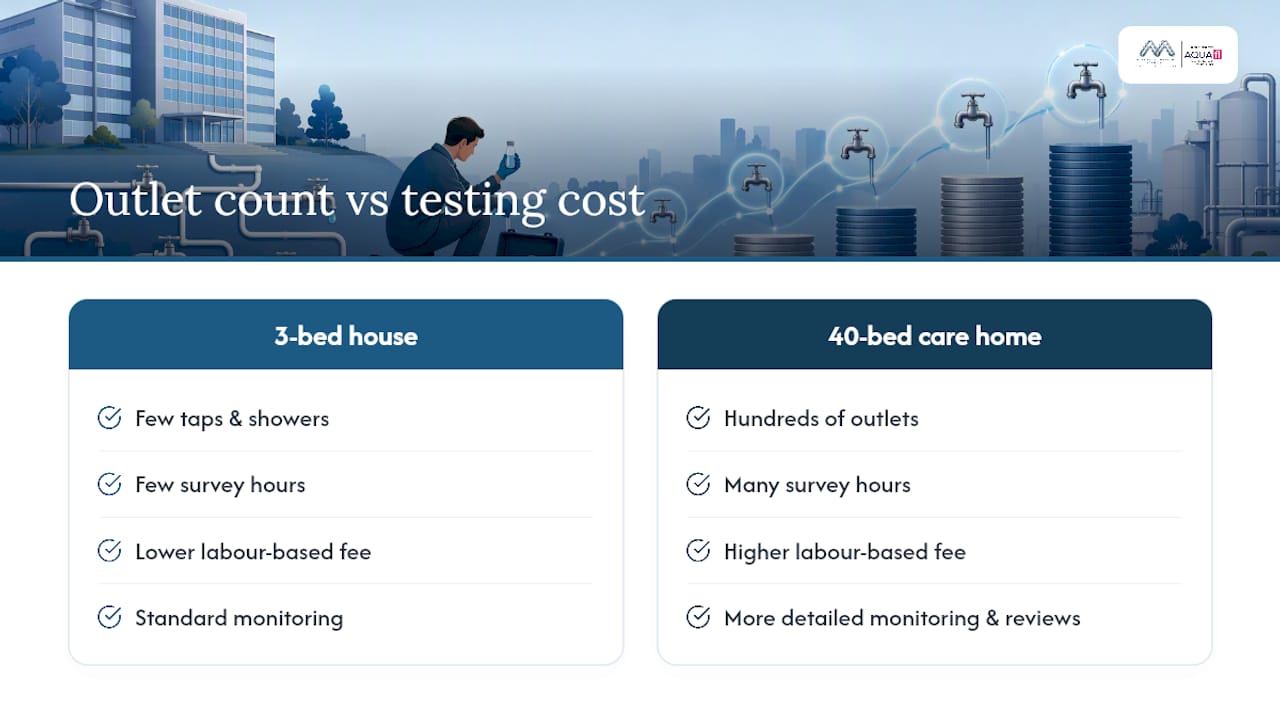
Regulated sectors add scope on top of scope. Care homes and hospitals often need more detailed monitoring schedules and more frequent reviews than a standard office, and HSE’s L8 guidance sets out why: the technical difficulty of interpreting bacteriological results properly. Expect to pay a premium for expedited lab turnaround too, since standard results can take five to ten days.
Pro Tip: Don’t cut sampling on a high-risk system just to save £100. If your risk assessment identifies a genuine need for microbiological testing, skipping it to save money is the definition of false economy. If Legionella takes hold, the disinfection and remedial bill will dwarf what you saved.
Realistic UK price examples by property type
Here’s what these cost bands actually look like when you put a property type against them.
These figures come from industry cost calculators and sector cost guides, and they vary by provider, region, and how much detail the report includes. Landlords managing multiple properties can often negotiate per-unit pricing well below single-property rates. A fixed £65 rate for letting agents shows how portfolio volume changes the economics.
What’s typically extra, on top of any of these bands: microbiological sampling with fees depending on the type of test and turnaround speed, disinfection work, tank cleaning, and any remedial works the assessment recommends. Standard lab turnaround times help keep costs lower, while expedited results often come at a premium.
Do you legally need a risk assessment or a water test?
The legal answer is straightforward: every dutyholder must assess the risk. Whether you also need microbiological testing is a separate question, and for most domestic systems, the answer is no.
HSE does not require landlords to hold a “legionella test certificate”, and testing or sampling is not usually necessary for a domestic hot and cold water system. Temperature monitoring is the standard control method instead, with specific temperature regimes recommended to maintain control.
That’s the position set out in HSE’s landlord guidance, and it surprises a lot of people who assume a lab certificate is mandatory. It isn’t, for a typical rental property.
Microbiological sampling becomes relevant when the risk assessment identifies specific circumstances that call for it, most commonly cooling towers, more complex hot and cold water systems, or where temperature control alone isn’t achievable. HSG274 guidance is explicit that lab results are technically difficult to interpret correctly: a negative sample doesn’t guarantee the system is clear, and a positive one shouldn’t trigger panic remedial action without competent assessment first. Our guide to interpreting Legionella water samples covers what those results actually mean in practice. The statutory backbone behind all of this sits in the Control of Substances Hazardous to Health Regulations, which is why HSE guidance carries legal weight rather than being advisory best practice.
Who’s competent to carry out the work, and what to check
The dutyholder can do the assessment themselves, provided they’re genuinely competent to do so. Most landlords and facilities managers aren’t, and HSE guidance is clear that external expertise should be brought in where internal competence is lacking.
Before you hire anyone, check for:
Legionella Control Association (LCA) membership or equivalent industry accreditation.
UKAS accreditation for any laboratory doing microbiological analysis, non-negotiable if sampling is involved.
Demonstrable experience with systems similar to yours, not just a generic compliance background.
A sample report showing what a completed assessment actually looks like.
Pro Tip: Ask any provider for their LCA membership number and the UKAS accreditation number of their laboratory partner. A legitimate provider gives you both in seconds. Hesitation is the tell.
How to compare quotes without getting stung
Comparing legionella quotes on price alone is how people end up with a paper exercise instead of a proper survey. Compare on scope, deliverables, lab accreditation, sample count and reporting time, and what happens if remedial work is needed.
Ask each provider:
Does the quoted price include a physical site visit, or is this a desk-based assessment?
How many outlets and system types does the survey cover?
Is sampling included, and if so, is the lab UKAS-accredited?
What’s the turnaround time for the written report?
What happens, cost-wise, if the assessment flags remedial work?
Watch for these red flags: a fixed price that seems too low for the property size, no mention of an actual site visit, vague language about “deliverables” with no sample report offered, a laboratory that isn’t UKAS-accredited, or a report with no schematic and no practical control scheme attached. A £90 assessment that’s genuinely a full survey is a bargain. A £90 assessment that’s a template with your address typed in is a waste of money.
A provider’s view: what a proper quote actually includes
Transparent pricing starts with scope, not a flat number. Survey time, outlet count, plant complexity, and any sampling requirement all feed into the final figure.
Our process runs in order: site survey and risk scoring, temperature checks or sampling where the assessment calls for it, a full written report with schematic, then handover with a practical control scheme or logbook system. A typical breakdown might show the base survey as one line, additional microbiological samples as a second, and any tank cleaning or TMV work as a clearly separated third.
Why paying for a proper assessment is worth it
A cheap, paper-only assessment tells you nothing useful. What you’re actually paying for is competent interpretation, from someone who can read a lab result correctly and knows what a genuine risk looks like on your specific system, not a generic checklist.
Get a fixed-price legionella quote from Bespoke Compliance Solutions
Bespoke Compliance Solutions prices every assessment against your actual system, not a generic template, so you get a fixed written quote before any work starts rather than a vague estimate that grows once someone’s on site.
[
Our services cover the full compliance picture:
Bespoke legionella risk assessments for domestic, commercial, and specialist sites
Water sampling and analysis through UKAS-accredited laboratory partners
Remedial works, including tank cleaning, disinfection, and TMV servicing
Legionella awareness training, delivered on-site or online
If you manage offices or commercial premises across England, our commercial compliance packages are built around your building’s actual risk profile. If testing and lab analysis are what you’re after specifically, our water testing service page explains exactly how sampling and reporting work. Book a site survey or request a fixed written quote to see what your property actually needs, rather than guessing from a generic price table.
Sources
For the legal detail behind this guide, go straight to the source: HSE’s guidance on landlord responsibilities, the L8 Approved Code of Practice, and HSG274 technical guidance. Look specifically for the sections on competent persons, monitoring schedules, and when sampling actually applies.
Legionnaires’ disease: what you must do
FAQ
Is legionella testing a legal requirement in the UK?
A legionella risk assessment is legally required for all dutyholders, but microbiological testing is only required in specific circumstances, such as cooling towers or where the assessment identifies a need, according to HSE guidance.
Can a plumber carry out a legionella risk assessment?
A plumber can carry one out only if they’re genuinely competent in legionella risk assessment methodology, which is a distinct skill set from general plumbing; where that competence isn’t demonstrable, HSE guidance says external expertise should be brought in.
Can I do my own legionella risk assessment?
Yes, provided you can demonstrate genuine competence in legionella risk management; most landlords and facilities managers lack this specialist knowledge and use an accredited external provider instead.
How can I test for legionella in the UK?
Testing involves taking water samples and sending them to a UKAS-accredited laboratory for microbiological analysis, typically arranged through a provider like Bespoke Compliance Solutions as part of a wider risk assessment.

Does HSE require a legionella test certificate for landlords?
No. HSE guidance is explicit that landlords don’t need a legionella test certificate for domestic systems; a documented risk assessment and appropriate temperature monitoring normally satisfy the legal duty.
Recommended
Comments