
How often should you test for legionella in England?
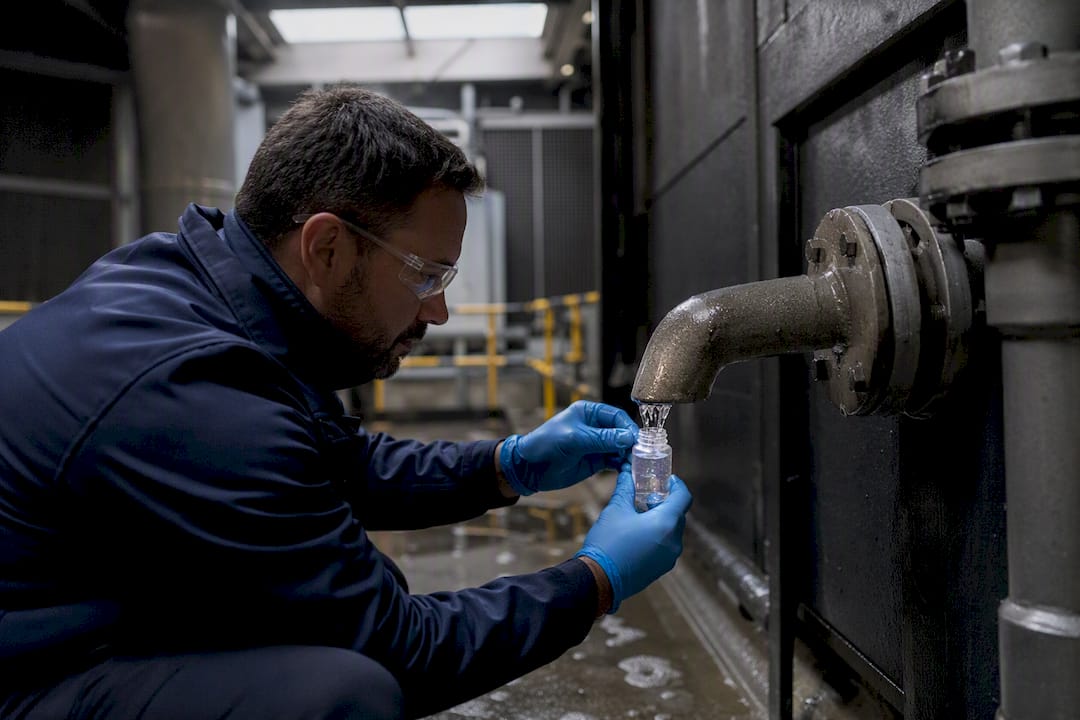
Cooling towers and evaporative condensers need microbiological sampling at least quarterly under HSE HSG274 Part 1. Standard hot and cold water systems in offices, schools and rented properties don’t need routine lab sampling at all. Instead, temperature checks do the work: regular monthly readings at sentinel taps to confirm hot and cold water temperatures meet control criteria, backed by regular flushing of any outlet left unused for several days or more.
Healthcare settings play by different rules entirely. HTM 04-01 pushes hospitals and care homes towards tighter thresholds and more frequent checks, reflecting how much less margin for error you have with vulnerable patients. Bespoke Compliance Solutions builds these cadences into site-specific written schemes rather than applying one blanket calendar.
The minimum actions, by system type:
Cooling towers and evaporative condensers: regular microbiological sampling several times per year, plus routine total viable count monitoring.
Standard hot and cold water systems: regular sentinel temperature checks occur monthly, with flushing of low-use outlets at appropriate intervals, no routine lab sampling.
Hospitals and care homes: monitoring according to HTM 04-01 thresholds, generally involving tighter controls and more frequent checks than standard buildings.
Key Takeaways
Legionella testing frequency in England is risk-based: open systems need quarterly lab sampling, standard water systems rely on monthly temperature checks, and healthcare settings follow stricter HTM 04-01 thresholds.
Point | Details |
Cooling towers need quarterly sampling | Open evaporative systems require microbiological sampling at least every three months under HSG274 Part 1. |
Standard systems rely on temperature | Regular sentinel temperature checks replace routine lab sampling in most buildings. |
Healthcare needs stricter thresholds | HTM 04-01 sets tighter monitoring for hospitals and care homes due to patient vulnerability. |
Flushing and descaling are routine | Flushing of unused outlets frequently and regular showerhead descaling support the temperature-based control regime. |
Results need expert interpretation | A negative sample doesn’t guarantee safety, and a positive one doesn’t mean automatic failure; a competent person must interpret it. |
Bespoke Compliance Solutions builds the scheme | The company carries out risk assessments, sampling, and temperature monitoring setup tailored to each site across England. |
This article is general information, not a substitute for advice from a qualified doctor. Consult a qualified healthcare professional about your own circumstances before acting on anything here.
Table of Contents
What is the right legionella testing frequency for your system type?
The honest answer is: it depends entirely on whether your system is open or closed, and how vulnerable the people using it are. Get that classification wrong and you’ll either waste money sampling water that doesn’t need it, or miss a genuine risk.
Cooling towers and evaporative condensers sit at the sharp end. These open systems spray water into moving air, creating exactly the warm, aerosolised conditions legionella bacteria thrive in. That’s why HSG274 Part 1 mandates regular microbiological sampling several times per year as a baseline, alongside close attention to biocide dosing and pH correction, since poorly balanced chemistry is a frequent cause of persistent contamination in these systems.
Standard hot and cold water systems, the kind found in most commercial buildings, don’t carry the same routine sampling requirement. HSE guidance treats temperature as the primary control: hot water reaching at least 50°C within one minute at sentinel outlets, cold water staying under 20°C. Regular monthly checks at representative taps are the norm, rather than weekly or quarterly lab tests.
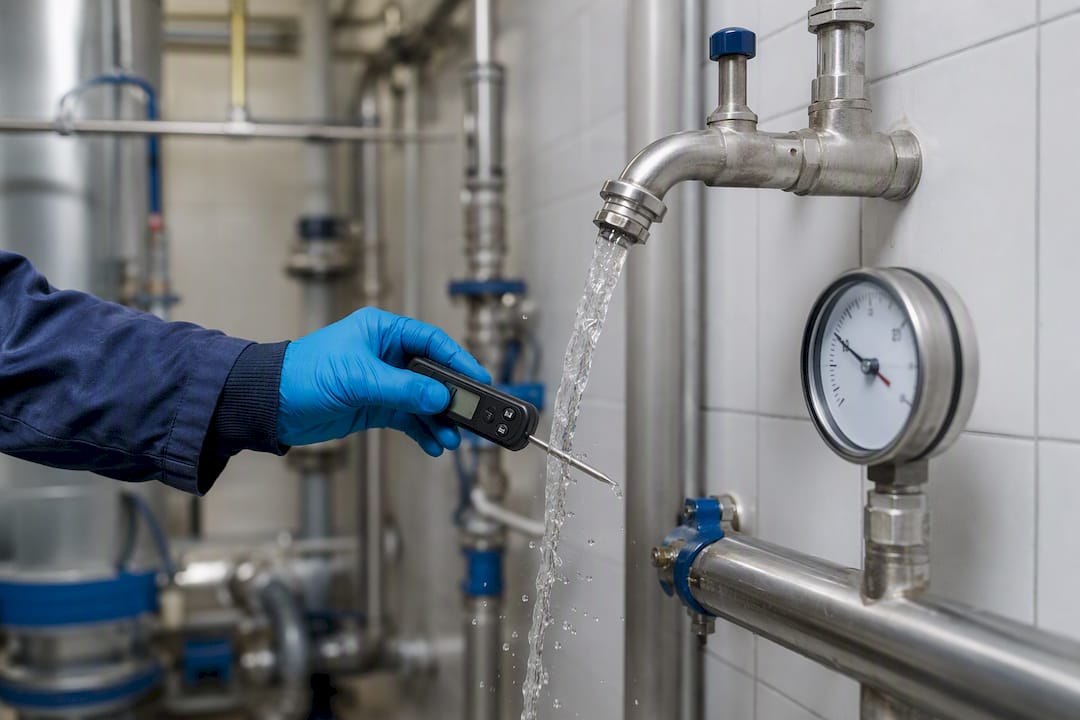
Healthcare and care settings need more. HTM 04-01 sets higher storage and sentinel thresholds because patients are frequently older, immunocompromised, or both, and the consequences of a lapse are far more serious.
Other monitoring worth knowing:
Total viable count testing gives an early signal of biofilm build-up in cooling systems and spa pools, without needing a full legionella-specific test every time.
Microbiological sampling becomes appropriate outside the routine schedule after an outbreak or positive result, prolonged closure before reoccupation, or a sustained temperature control failure.
How do you set a site-specific monitoring schedule?
Start with the risk assessment, not the calendar. A schedule built before you understand your system’s complexity, occupancy pattern and vulnerable users almost always ends up wrong in one direction or the other.
Map the system. Identify every outlet, tank, and any open components like cooling towers or spa pools that carry higher risk.
Use HSG274’s frequency tables as your starting point. These tables in Part 2 are a baseline, not a mandate. If your intervals differ, write down why, and record evidence that your alternative achieves equivalent control.
Build the written scheme. Include sentinel and storage temperature checks, flushing logs, showerhead descaling and disinfection (typically quarterly), TMV servicing dates, and sampling points and frequencies for any open systems.
Set review triggers. A change to the system, a change in occupancy, or an incident should all prompt an immediate review rather than waiting for a fixed date, though many duty holders still find a two-year review cycle a sensible default.
Name a competent person. Someone needs explicit responsibility for interpreting lab results and recommending remedial action when thresholds are breached.
Pro Tip: Don’t treat a clean result as permission to relax the schedule. HSE is clear that a negative sample doesn’t guarantee the system is free of legionella, it only reflects that one sample at one point in time.
What do water hygiene specialists wish more duty holders knew?
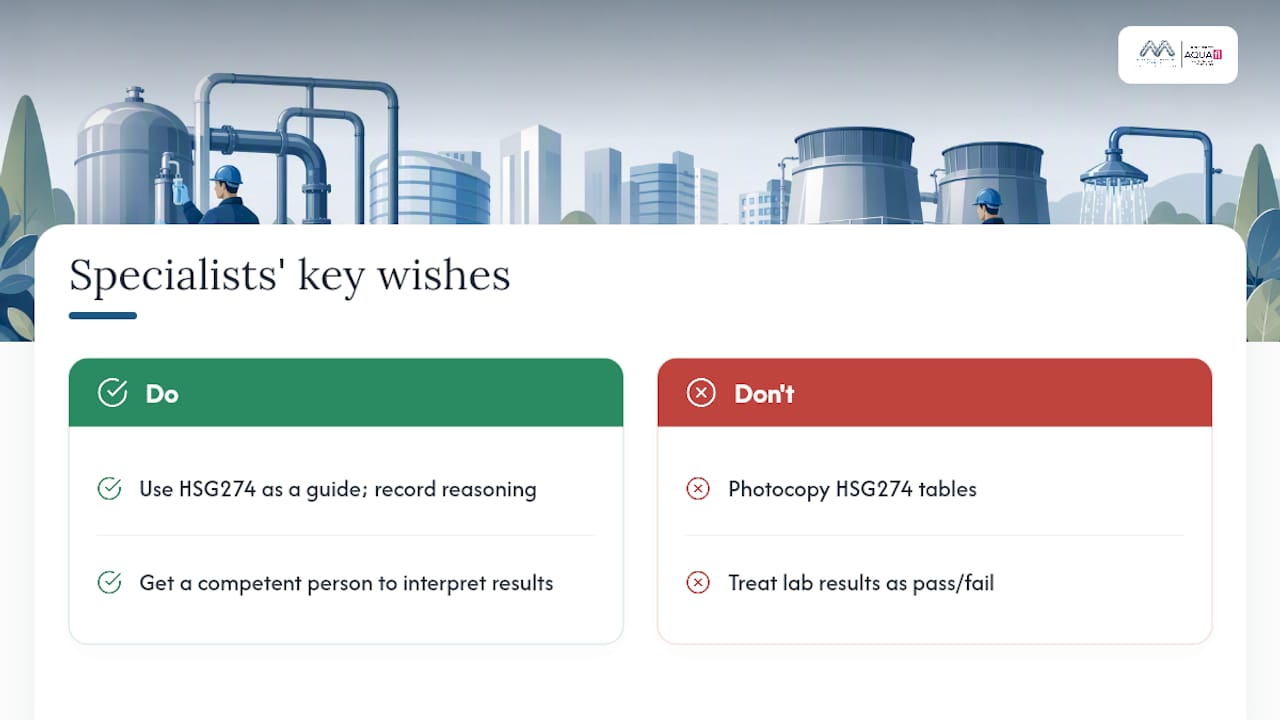
Too many businesses photocopy the HSG274 tables and call it a scheme. The tables are a starting point, not a script, and inspectors want to see your reasoning written down, not just a copied interval.
The bigger trap is treating lab results as pass or fail. A positive doesn’t always mean system failure, and a negative doesn’t mean the risk has gone away. Get a competent person to interpret it properly.
Get your monitoring scheme assessed and implemented properly
Reading the HSE tables is one thing. Turning them into a working, defensible schedule for your specific buildings is another, and it’s where most duty holders in England actually get stuck. Bespoke Compliance Solutions runs bespoke Legionella risk assessments that set the monitoring frequencies your site actually needs, not a generic copy of the HSG274 tables.
[
Beyond the assessment, the team carries out water sampling and laboratory analysis for cooling towers and other open systems, sets up automated temperature monitoring so sentinel checks don’t rely on someone remembering, and delivers the remedial disinfection and training your written scheme will call for. Healthcare providers working to HTM 04-01 thresholds can lean on the same team for the tighter monitoring those settings demand, echoing the standards partner resources on medical equipment storage requirements also point to. Coverage runs across England, including Bedfordshire, Buckinghamshire, Berkshire and Coventry and its surrounding areas.
If your risk assessment is out of date, or you’ve never had one, book a Legionella risk assessment in Coventry and get a written scheme that will hold up under scrutiny, with a competent adviser on hand to interpret whatever the results show.
Sources
Testing and monitoring water systems for legionella — HSE
FAQ
How often should cooling towers be tested for legionella?
At least quarterly, per HSE HSG274 Part 1, alongside routine total viable count monitoring between samples.
Do standard offices need routine legionella lab testing?
No. Most commercial hot and cold water systems rely on monthly sentinel temperature checks rather than routine laboratory sampling.
What temperature should hot water reach to control legionella?
Hot water should reach at least 50°C within one minute at sentinel outlets, while cold water should stay below 20°C.
Does a negative legionella test mean the system is safe?
Not necessarily. HSE notes a negative result doesn’t guarantee the bacteria are absent, so a competent person should interpret results alongside the wider risk picture.
Do care homes need more frequent monitoring than offices?
Yes. HTM 04-01 sets higher monitoring and sampling expectations for healthcare and care settings, reflecting greater occupant vulnerability.
Who can help set up a compliant monitoring schedule?
Bespoke Compliance Solutions carries out risk assessments and water sampling across England and builds the written scheme your site needs.
Recommended
Comments