
Copy Ready Legionella Toolbox Talk for UK Sites in 15 Minutes
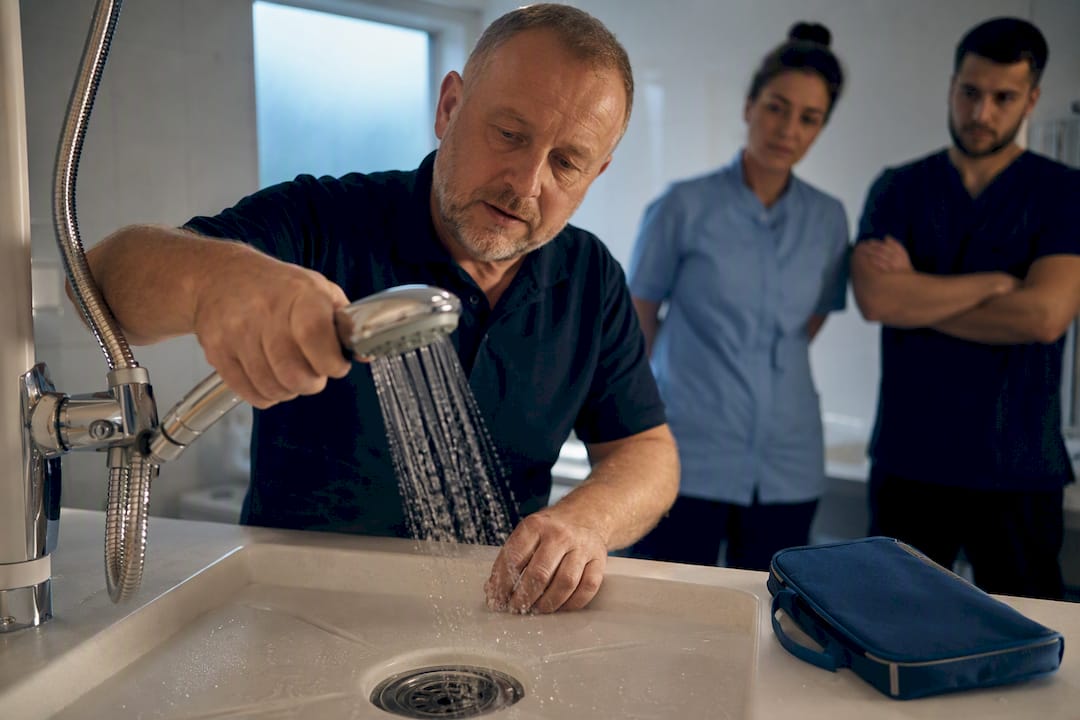
A copy-ready Legionella toolbox talk is available below and should go straight into use once you have edited it against your site’s current Legionella risk assessment and linked it to the written scheme under HSE ACOP L8. Copy the sample outline, swap in your site’s outlets and named responsible person, then run it and record attendance. Treat it as an awareness session, not a substitute for the task-specific competence L8 requires of anyone doing assessment or control work.
TL;DR:
Using an editable Word template ensures you can incorporate site-specific hazards, responsible persons, and risk assessment details, maintaining compliance and record integrity.
Address key water sources like cooling towers, showers, and rarely used outlets with clear instructions to flush, report issues, and prevent bacterial growth in the danger zone.
Keep the toolbox talk under 15 minutes, focusing on practical actions, and document attendance with detailed records linked to the current risk assessment version.
Regularly review and update the talk after system changes or new hazards, including visual aids and site-specific information to enhance staff understanding and recall.
A well-delivered, properly recorded toolbox talk supports audit readiness but does not replace formal competence required for assessment and control tasks under ACOP L8.
Table of Contents
Where to find ready-to-use legionella toolbox talk templates
Most safety officers reach for one of three formats, and each suits a different job. A Word document is the strongest choice for day-to-day use because you can edit it directly, track changes between versions, and keep a proper history when the risk assessment changes. A two-page PDF works well when you just need something to print and hand round quickly, though editing it later usually means starting again. Online toolbox talk creator tools can look polished and on-brand, but check the terms before relying on one: some restrict how much you can customise the content or lock you into their own hosting.
Whichever format you choose, check it against a short list before you use it on site:
Does it include a dedicated attendance register, not just a topic summary?
Is there a clear section for site-specific hazards, rather than only generic wording?
Does it tell staff who to escalate a concern to, by name or role?
Does it reference HSE ACOP L8 or the written scheme, so the talk sits inside your compliance paperwork rather than outside it?
Can you edit and re-save it without losing formatting or version history?
A generic water safety toolbox talk that ticks none of these boxes is a liability at audit time. It looks like training happened, but it proves nothing about whether staff understood the risks on your site.
What must a legionella toolbox talk actually cover?
HSE guidance on workplace risks sets out the minimum: what Legionnaires’ disease is, how the bacteria multiply, where they turn up in building water systems, the control measures in place, and what staff should do if they spot a warning sign. Skip any of these and the talk stops being a genuine legionella awareness training session and becomes a box-ticking exercise.
Start with the biology in plain terms. Legionella bacteria grow fastest in water sitting between 20°C and 45°C, a window commonly called the danger zone, as noted in official HSE guidance. Below 20°C growth slows sharply; above 60°C the bacteria die off. That single fact explains almost every control measure staff will encounter, from why a shower head that has not run for two weeks gets flushed before use to why cold water storage tanks need to stay below 20°C.
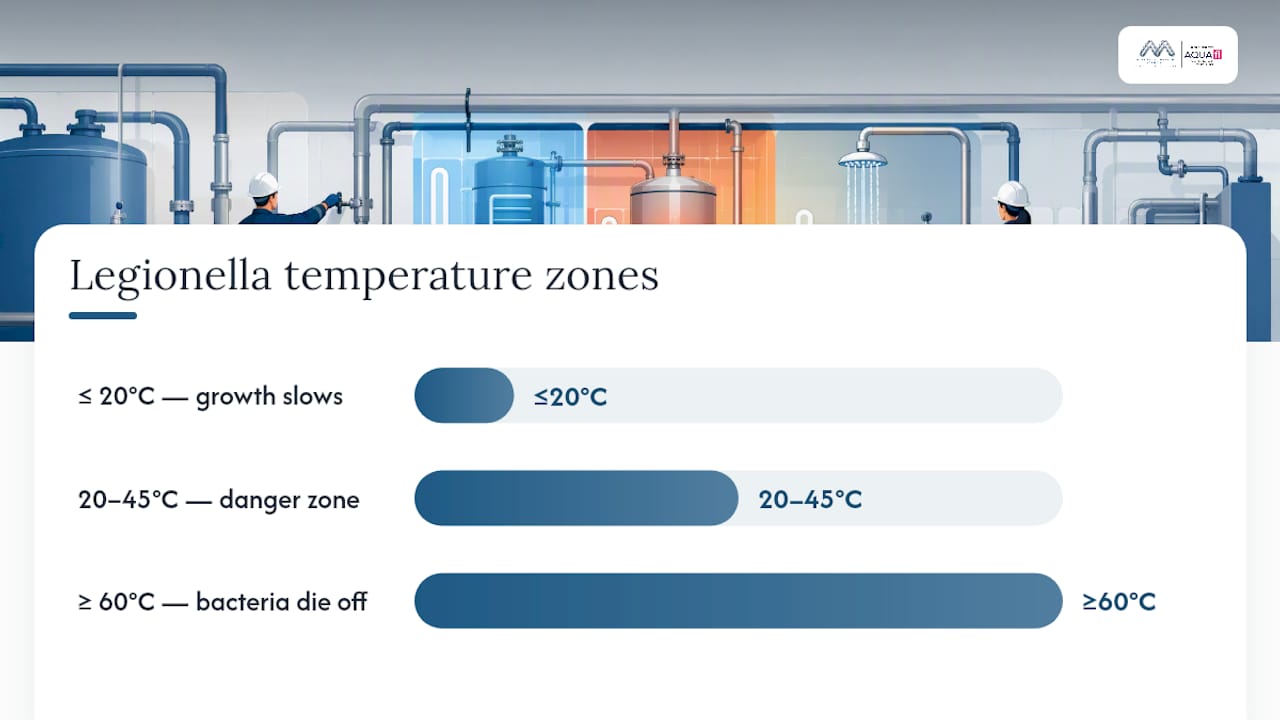
Legionella facts worth stating plainly in the session: cooling towers, hot and cold water systems, showers, spa pools, humidifiers, and infrequently used outlets are the classic sources named in HSE’s dutyholder guidance. Name your own equivalents on the day, whether that is a cooling tower on the roof, a rarely used shower in a changing block, or a decorative water feature in reception.
Cover these points as a working checklist:
A short, jargon-free explanation of the disease and the 20 to 45°C danger zone
The specific sources present on your site, named by location, not just by category
Control measures staff can help with directly: flushing outlets, reporting discoloured or smelly water, never disabling isolated outlets themselves
Who to contact and how, with names and extensions rather than “the facilities team”
What gets recorded: attendance, date, topic covered, site reference and how long the record is kept
That last point matters more than most presenters realise. HSE’s record-keeping guidance treats attendance evidence as part of the audit trail alongside the written scheme itself, not a separate, optional nicety.
How do you adapt a generic template to your own site?
Editing a template properly takes four steps, and skipping any one of them is how “generic” talks end up delivered on sites with genuinely different risks.
Open the current risk assessment first. Pick two or three site-specific hazards flagged in it, whether that is a dead-leg pipe run, a cooling tower due for cleaning, or a TMV with a history of scaling. Reviewing your Legionella risk assessment regularly is what keeps this step accurate rather than guesswork.
Add named responsible persons and local reporting routes. Replace “report to your manager” with the actual name, role, and contact method staff should use on this site.
Rewrite the do and don’t lists against real plant. A talk written for a hotel with a spa pool needs different content to one written for an office with a single hot water cylinder. Match the language to the showers, TMVs and tanks staff actually walk past.
Version and distribute properly. Save the edited file with a date and version number, keep the previous version rather than overwriting it, and send it through whatever channel your site normally uses for safety communications.
Pro Tip: Include a photo or simple sketch of the exact fixture you’re talking about, such as “shower bank B, third cubicle.” Staff remember a picture of the actual tap far better than a paragraph about water systems in general.
Because occupancy and plant change, a talk written a year ago may already be out of date. Reviewing controls after any system change keeps the content honest rather than recycled.
How should you deliver the talk and prove it happened?
Keep the session concise, ideally under 15 minutes, to maintain attention and focus on key actions staff need to take, reflecting best practice in training delivery. Use local photos or point at the actual fixture where possible, and leave time for questions. Staff who ask “what about the tap in the staff kitchen?” are doing your risk assessment a favour.
Your attendance register needs a few fixed fields to hold up as evidence:
Date and duration of the session
Names and signatures of everyone present
The topic covered and a one-line summary
Reference to the risk assessment version the talk was based on
Name of the presenter and their role
Store this alongside the written control scheme, not in a separate folder nobody checks. Run additional talks outside the normal schedule when system conditions change, such as after remedial works, system decommissioning or reinstatement, suspected cases, or occupancy changes, to ensure ongoing awareness and compliance. None of this replaces formal, task-specific competence for staff who actually assess or control risk under ACOP L8. A toolbox talk helps maintain general awareness and vigilance between formal, task-specific training sessions.
Sample two-page toolbox talk you can copy into Word
Paste this outline directly into a document and edit the bracketed sections before use.
Session header: Site name, date, presenter, duration (aim for 10 to 15 minutes), and the risk assessment reference the talk is based on.
Script (read or paraphrase): “Legionella bacteria live in water and grow fastest between 20°C and 45°C. On this site, they could be present in [name your outlets, e.g. the cooling tower, showers in block B, the calorifier]. If water looks discoloured, smells odd, or an outlet hasn’t been used in over a week, don’t use it. Report it to [named person] before anyone runs it.”
Do list: flush outlets not used weekly; report discoloured or smelly water; report faulty TMVs; keep shower heads clean; tell [named person] about any change in water use patterns.
Don’t list: don’t ignore a warning sign; don’t disable or cap an outlet yourself; don’t assume someone else has reported it; don’t skip the flush after holiday closures; don’t remove or block ventilation near cooling systems.
Attendance register columns: Date | Name | Signature | Role | Risk assessment version referenced.
What experienced compliance practitioners want you to know
Toolbox talks work best as one layer in a wider programme, not a standalone tick. The most common failures in Legionella management trace back to weak communication rather than bad engineering, which is exactly the gap a short, well-run talk is designed to close.
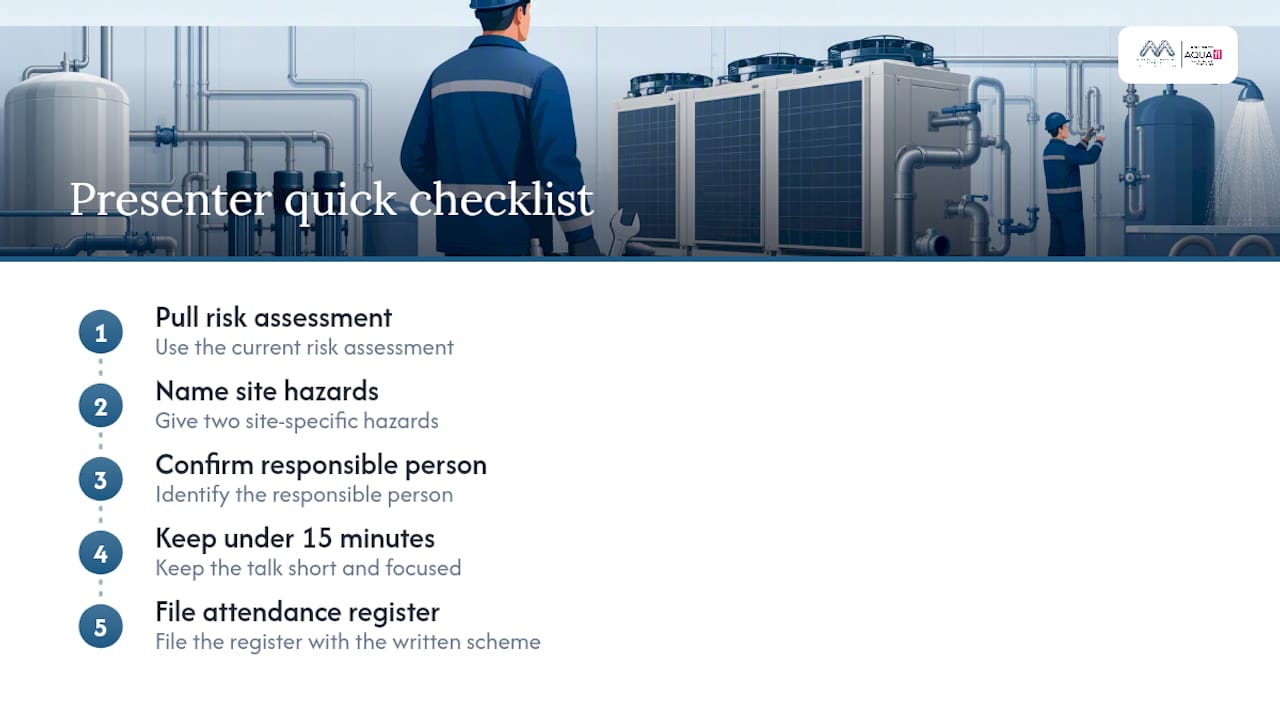
The mistakes worth avoiding are predictable: reusing an unedited generic script, skipping the attendance register, and letting months pass without revisiting the content after a system change. A quick presenter checklist covers most of it: pull the current risk assessment, name two site-specific hazards, confirm the responsible person, keep it under 15 minutes, and file the register with the written scheme. Get those five things right and the talk earns its place in your audit file rather than sitting there as paperwork.
— Sammi
How Bespoke Compliance Solutions supports your toolbox talks
Bespoke Compliance Solutions gives you the one thing a downloaded template can’t: content built from your own site’s risk profile, not a generic script edited from memory. Our Legionella awareness training sessions are delivered against your actual plant and produce the attendance records auditors expect to see, while our Legionella risk assessments give you the site-specific hazards a proper toolbox talk needs to name. Where a talk flags an issue, whether that’s a rarely used outlet or a system that needs attention, our tank cleaning and disinfection service and water testing close the loop with verified results rather than a guess. If you’re building refresher training into a wider programme, a resource like these compliance training video insights is worth a look too. Get in touch to book a site-specific risk assessment or an awareness training session, and we’ll help you turn a generic template into something your next audit will actually thank you for.
FAQ
What is a legionella toolbox talk?
It’s a short, informal briefing that explains Legionella risks, the 20°C to 45°C danger zone, and the actions staff must take, usually delivered in under 15 minutes with an attendance register kept as evidence.
Does a toolbox talk satisfy HSE ACOP L8 training requirements?
No. ACOP L8 requires formal, task-specific competence for anyone doing assessment or control work; a toolbox talk supports general awareness but does not replace that training.
How often should you run a legionella toolbox talk?
Run one on a regular schedule and again after any system change, remedial works, a suspected case, or a shift in occupancy, since HSE guidance treats static, unreviewed content as a weak point.
What must be recorded after a toolbox talk?
Keep the date, attendee names and signatures, topic summary, presenter, and the version of the risk assessment referenced, stored with the written control scheme as audit evidence.
Can I edit a generic legionella toolbox talk template myself?
Yes, provided the format allows it. A Word document gives the easiest editing and version control, so you can name your own outlets, responsible persons, and hazards before every session.
Recommended
Comments