
Three Price Bands for Bespoke Legionella Training in England (ACOP L8)
Bespoke, site-specific Legionella training for dutyholders in England typically costs somewhere between a moderate and high range per session typical of bespoke site-specific training, depending on delegate numbers, site complexity and how much on-site tailoring is involved. That’s higher than an open-access classroom course, because you’re paying for a trainer’s time, travel and preparation against your actual water systems, not a generic slide deck. Every figure quoted here is indicative. The only number that matters is the itemised quote you get after describing your site.
TL;DR:
The cost of bespoke Legionella training varies significantly based on site complexity, delegate roles, training depth, travel distance, and bundled services, with quotes being the most reliable indicator.
Larger or high-risk sites, such as those with cooling towers or complex water systems, generally incur higher fees due to increased preparation and technical content requirements.
When requesting quotes, facilities should provide detailed site information, delegate roles, and specific system types to obtain comparable and accurate pricing from providers.
Training content must directly relate to the site’s actual systems and control scheme, emphasizing risk recognition, monitoring procedures, escalation routes, and record-keeping.
Additional costs like travel, certification, out-of-hours delivery, follow-up sessions, and sampling are common and should be clarified upfront to prevent unexpected expenses.
Table of Contents
How much does legionella training cost for a bespoke, on-site session?
What should a compliant, site-specific course actually cover?
What payment terms are normal for bespoke training bookings?
Why a bespoke training approach favours tailored over generic training
Get a bespoke training quote from Bespoke Compliance Solutions
How much does legionella training cost for a bespoke, on-site session?
Three rough bands cover most enquiries Bespokecompliancesolutions sees from facilities and compliance teams across England.
Sites vary in complexity from small, simple premises with basic water systems, to medium single buildings with plant rooms and several outlets, to complex estates with multiple buildings or high-risk systems like cooling towers, because the trainer needs to cover more technical ground under HSG274.
Published provider pricing for on-site delivery reflects a similar pattern, with fixed day rates for a set delegate cap and add-ons for anything beyond it, which lines up with the example pricing structures many training providers publish for a full day capped around a dozen delegates.
Most quotes bundle in:
Trainer preparation time against your site documentation
On-site delivery, whatever the delegate count agreed
Course materials and handouts
A brief summary report or action notes after the session
Watch for VAT (almost always added on top), whether pricing is per site or per delegate above a threshold, and whether travel is included or billed separately once you’re outside a provider’s core operating area.
What actually drives the price of a bespoke course?
Two sites of similar size can attract very different quotes. The gap almost always comes down to five things.
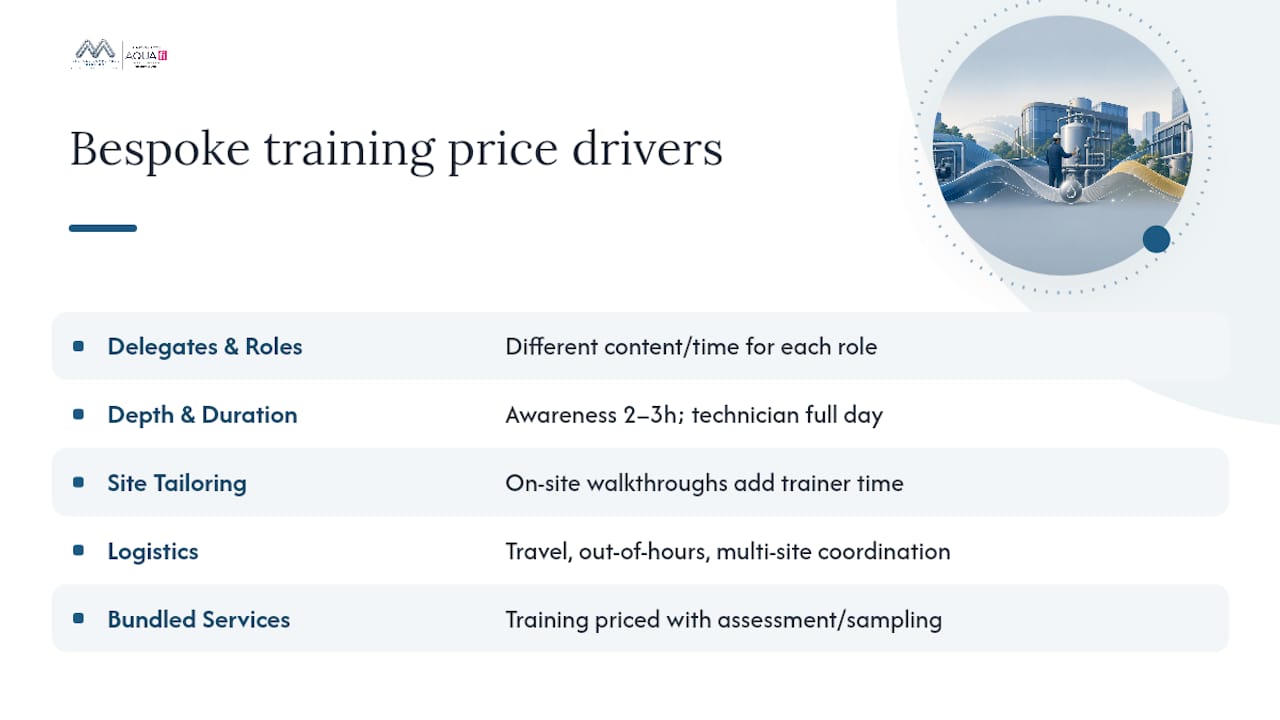
Delegate numbers and roles. Training a designated responsible person under ACOP L8 takes longer and goes deeper than a general awareness session for cleaning or maintenance staff. A mixed group often needs two tiers of content in one visit, which adds time.
Course depth and duration. Awareness training might run two to three hours. Responsible person or technician-level training, with practical system knowledge, can run a full day.
Site tailoring. A trainer who walks your cooling tower, calorifiers or cold water storage tanks with delegates costs more than one delivering a slideshow in a meeting room, but the practical link between theory and your actual plant is usually the whole reason bespoke training earns its price over an e-learning module.
Logistics. Travel distance, out-of-hours delivery (common in healthcare and hospitality, where daytime access to plant rooms is limited), and coordinating across multiple sites all add cost.
Bundled services. Some providers price training alongside a risk assessment, water sampling or logbook setup. Bundling can lower the combined rate versus buying each separately, but always ask for the training line item broken out.
Pro Tip: If you’re training staff across several buildings, ask whether the provider offers a multi-site day rate. Consolidating sessions into back-to-back visits on the same trip usually cuts the per-site travel cost significantly.
How do I put together an RFQ that gets comparable quotes?
An unclear request for quotation is the single biggest reason facilities teams end up comparing three unrelated numbers. Give every provider the same information and you’ll get quotes you can actually put side by side.
Number of sites and addresses, plus a summary of water system types at each (domestic hot/cold, cooling towers, other risk systems).
Number of delegates and their roles, split by responsible person, general staff and any technical/maintenance staff.
Your existing control scheme and logbook status, so the trainer knows what to reference rather than starting cold.
Any known high-risk plant, such as cooling towers or spa pools, flagged upfront.
Preferred delivery window, including whether out-of-hours or weekend delivery is needed.
Once quotes come back, ask each provider:
How does the course map to ACOP L8 and, where relevant, HSG274?
What’s the trainer’s actual competence and experience delivering bespoke, on-site sessions, not just classroom courses?
Can they provide a sample agenda and sight of the materials before booking?
Is a short pre-visit site walk included, or costed separately?
Red flags worth walking away from: quotes with no breakdown between trainer time, materials and travel; providers who won’t offer a site visit option at all; and identical flat pricing regardless of site size or system complexity, which usually signals a generic course dressed up as bespoke. Build in some budgeting margin, roughly 10 to 15 percent, for a follow-up session or refresher if the initial visit uncovers gaps in your control scheme.
What should a compliant, site-specific course actually cover?
Training exists to satisfy a legal duty, not just tick a box. ACOP L8 requires dutyholders to appoint a competent responsible person, keep training records and maintain a written control scheme, and the course content should visibly connect to all three.
For a responsible person, expect the session to cover risk recognition across your actual systems, how to read and update your control scheme, monitoring and recording temperatures or dosing, and what triggers escalation to a competent contractor. For general staff, the bar is lower but still specific: recognising warning signs, reporting faults promptly, and understanding why certain taps or showerheads get flushed on a schedule.
A genuinely bespoke session references your site’s own logbook and control documentation during delivery, not a generic template. That’s the detail separating training that builds real evidence of competence from training that just produces a certificate.
Risk recognition tied to your named systems
Monitoring and recording procedures matching your logbook format
Escalation routes for faults or deviations
Refresher intervals, typically annual or sooner after major site changes
Poor training and communication feature repeatedly as contributory factors in legionella incidents, which is the practical reason refresher training and proper record retention matter as much as the initial session. Keep attendance records, agendas and materials on file. They’re your evidence of competence if HSE ever asks.
What payment terms are normal for bespoke training bookings?
Most providers ask for a deposit to secure a delivery date, typically 20 to 50 percent of the quoted fee, with the balance due on or shortly after delivery. For multi-site bookings spread across several weeks, some providers invoice per session rather than taking one deposit for the whole programme, which is worth asking about if you’re managing a phased rollout.
Cancellation terms vary more than people expect. A trainer who has blocked out a day and arranged travel loses that slot if you cancel late, so most contracts include a cancellation window (commonly five to ten working days) after which some or all of the fee becomes payable regardless. Rescheduling is usually free if you give reasonable notice, but check whether a second reschedule attracts a fee.
For larger organisations running training across multiple sites annually, ask about retainer or framework arrangements. These lock in a day rate for the year and can smooth budgeting considerably, since you’re not requoting from scratch every time a new site needs a session. Get cancellation and rescheduling terms in writing before you sign, not verbally confirmed on a call. A written contract protects both sides if a site closure or staff shortage forces a late change.
Are there hidden costs beyond the initial quote?
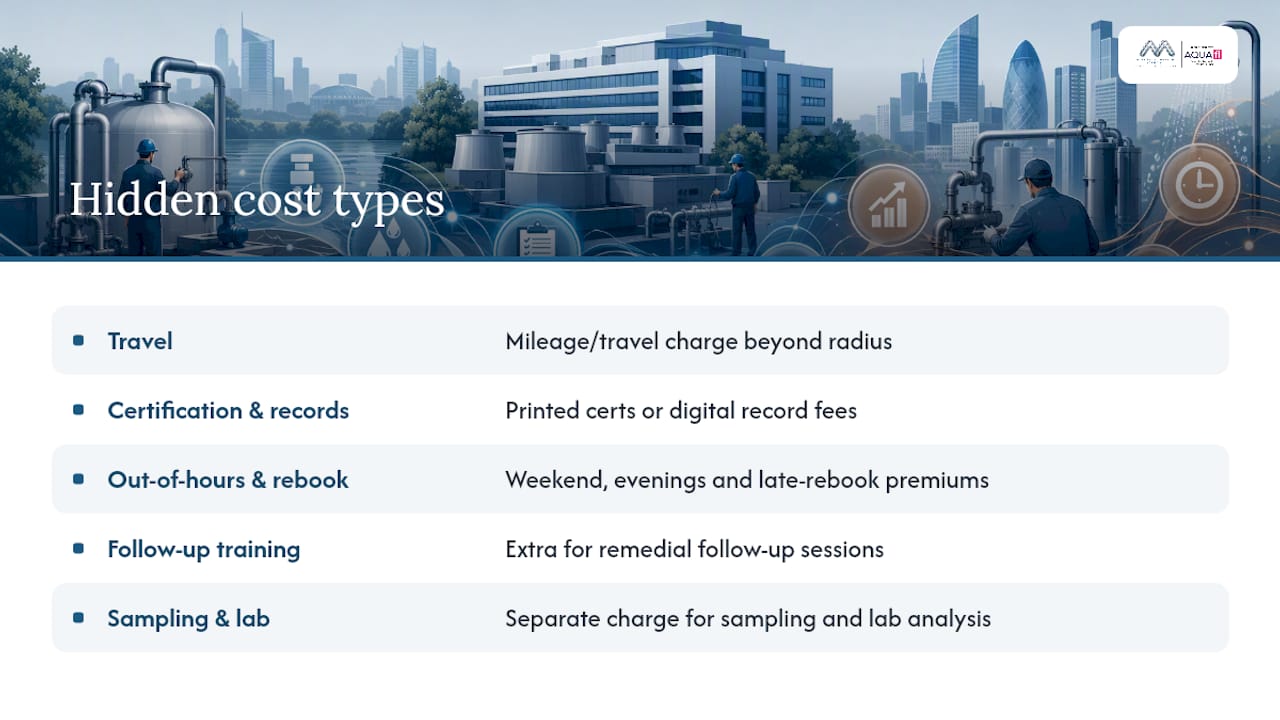
The headline day rate rarely tells the whole story. Travel is the most common add-on, and it’s not always included even when a quote looks complete. Confirm whether mileage or a travel charge applies beyond a certain radius from the provider’s base, particularly if your sites are spread across Bedfordshire, Buckinghamshire or Berkshire rather than clustered in one town.
Certification and record administration can also sit outside the headline price. Some providers charge separately for printed certificates, digital training record uploads, or a formal attendance register beyond a basic sign-in sheet. If your organisation needs auditable digital records for HSE inspection purposes, ask whether that’s included or costed as an extra.
Out-of-hours delivery, weekend sessions, and last-minute rebooking after a cancellation window has passed all typically carry a premium. So does any follow-up session needed because the initial training revealed gaps in your control scheme, such as missing logbook entries or unassessed outlets. Sampling and lab analysis, if a provider recommends validation testing after a disinfection, are priced separately from training and should always be quoted as a distinct line item. Ask for a full breakdown before you sign, and query anything marked “as required” without a number attached.
Why a bespoke training approach favours tailored over generic training
Generic courses teach the regulation. Bespoke sessions teach the regulation against your actual tanks, calorifiers and logbook, which is where most compliance gaps actually surface. The training delivery is often built around that principle, aligning sessions to HSE L8 and HSG274 rather than a standard slide deck.
Pricing models vary by client need: a fixed per-site fee for single locations, per-delegate additions once numbers exceed an agreed cap, and multi-site bundles or annual retainer arrangements for organisations training across several properties each year. Tailored training reduces downstream compliance risk because staff leave able to act on what they saw, not just what they were told.
— Sammi
Get a bespoke training quote from Bespoke Compliance Solutions
Training sessions are typically priced against the actual site, not a fixed catalogue rate, so you’re not paying for depth or duration you don’t need. That matters most when your estate mixes low-risk offices with a single high-risk plant room. A flat course price either overcharges the simple sites or undertrains the complex one.
[
Alongside bespoke Legionella awareness training, Bespokecompliancesolutions runs risk assessments, water sampling, logbook implementation and ongoing consultancy, all of which feed into training that references your real control scheme rather than a generic template. Wider facility hygiene practices, covered in resources like this washroom hygiene guide, often sit alongside legionella controls in a joined-up compliance programme.
An initial enquiry typically starts with a conversation about your site count, system types and delegate numbers. From there, an itemised quote covering trainer time, materials and any travel is produced, so you know what you’re paying for before you commit. If your organisation also needs an assessment alongside training, the risk assessment services in Coventry page is a good place to request a combined quote.
Sources
Start with HSE’s ACOP L8 for the legal duties every dutyholder must meet, and HSG274 for the technical detail behind cooling and water systems. For market-level cost benchmarking, LegionellaCheck’s training guide offers practical price comparisons across course types and delivery formats.
HSG274 part 1: Evaporative cooling systems — HSE
FAQ
How much should bespoke legionella training cost per site?
Expect a moderate to high price range per session depending on site complexity, delegate numbers and whether high-risk plant like cooling towers is involved, though an itemised quote is the only reliable figure for your site.
Is bespoke on-site training more expensive than open-access courses?
Yes, generally, because you’re paying for trainer travel, preparation against your specific systems and site-tailored content rather than a standard course delivered to a mixed group.
What must legionella training legally include under ACOP L8?
ACOP L8 requires dutyholders to ensure staff, including any appointed responsible person, receive training suitable to their role, with records kept as evidence of competence.
Does training cost include a risk assessment or water sampling?
Not usually. Training, risk assessments and sampling are typically priced as separate line items, though some providers offer bundled rates when booked together.
How often does refresher training need to happen?
Annual refreshers are common practice, with earlier retraining recommended after significant site changes, new plant installation, or major changes to your control scheme.
Recommended
Comments