
Why communal water systems need assessment
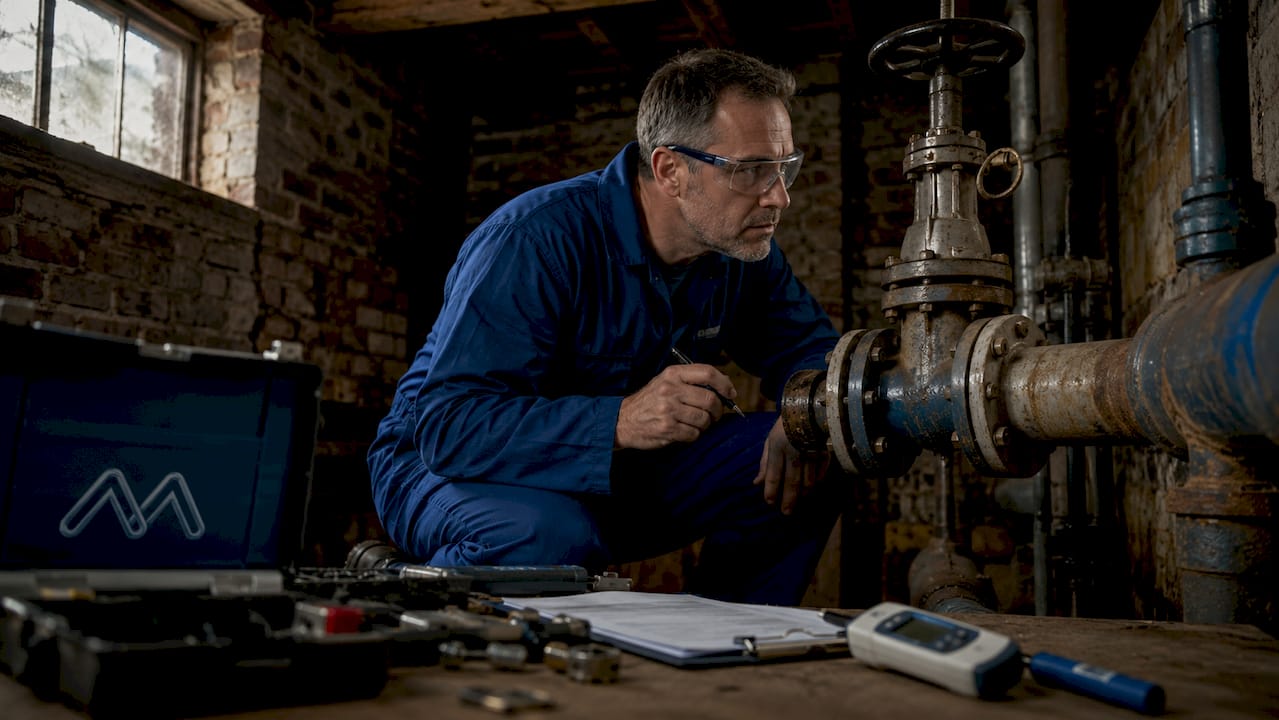
Communal water system assessment is the systematic evaluation of water infrastructure, management processes, and safety controls to confirm that shared water supplies deliver safe, hygienic water to every occupant. Facility managers and compliance officers who skip this process expose residents to waterborne pathogens, including Legionella pneumophila, the bacterium responsible for Legionnaires’ disease. The Health and Safety Executive’s Approved Code of Practice L8 sets the legal framework for this duty in the UK. Understanding why communal water systems need assessment is the first step toward meeting that duty with confidence rather than guesswork.
Why communal water systems need assessment: the core case
Communal water system assessment is not simply a compliance exercise. It is the mechanism that confirms whether your water safety controls are actually working. Technical factors account for 72.1% of system performance, but managerial factors contribute 26.7% and social factors 15.1%. That means nearly 42% of what determines whether a system is safe sits outside the pipework itself, in how the system is managed and how occupants use it.
Assessment brings all three dimensions into view at once. A temperature log that looks complete on paper may conceal a flushing regime that nobody actually follows. A schematic that shows a clean, linear distribution system may not reflect the dead legs added during a refurbishment three years ago. Only a structured evaluation catches these gaps before they become health incidents.

The HSE’s L8 Approved Code of Practice requires that water systems be managed as cohesive public health systems, with pressure management, corrosion control, and monitoring all working together. Assessment is the process that verifies this cohesion exists in practice, not just on paper.
What are the core components of a communal water system assessment?
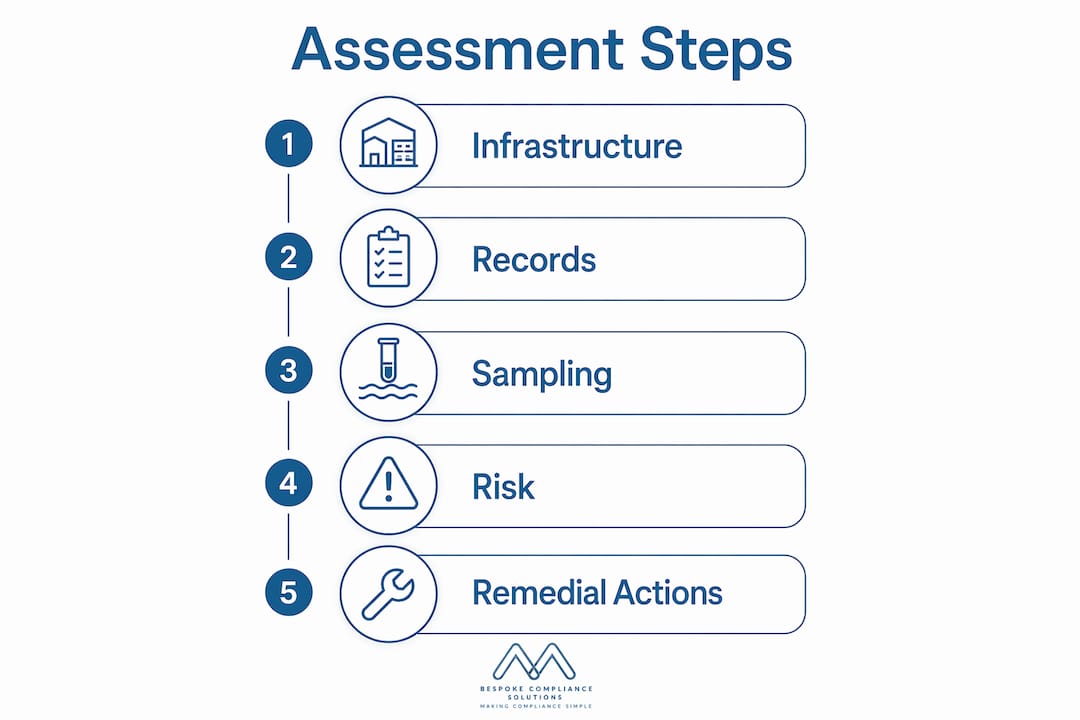
A thorough communal water system assessment covers three broad areas: physical infrastructure, management records, and compliance verification. Each area reveals a different category of risk.
Physical infrastructure checks
The physical inspection examines pipework, cold water storage tanks, calorifiers, thermostatic mixing valves (TMVs), and distribution outlets. Assessors look for dead legs, redundant pipework, and insulation defects because these are the most common contamination points in communal systems. A dead leg is a section of pipe with no flow, where water stagnates and temperatures drift into the Legionella growth range of 20–45°C.
Management and record review
Records tell the story of how a system has been managed between inspections. Assessors review temperature monitoring logs, TMV service histories, flushing schedules for low-use outlets, and water sampling results. Centralising all monitoring records into a single logbook system is the standard that makes this review possible without chasing contractors for scattered paperwork.
Compliance and sampling verification
Water safety audits should cover records from the past 3–12 months, including representative samples of communal hot water, cold water storage, and TMVs. Risk-led sampling prioritises high-risk blocks and vulnerable residents such as the elderly or immunocompromised. This targeted approach ensures that the most consequential parts of the system receive the closest scrutiny.
Pipework and tank condition, including insulation and access hatches
TMV functionality and service records
Cold and hot water temperature compliance at sentinel and representative outlets
Flushing logs for low-use and seasonal outlets
Written control scheme and current risk assessment validity
Contractor records and competency evidence
Pro Tip: Always cross-reference the physical system against the schematic during the inspection. If the drawing does not match what is on the wall, the risk assessment based on that drawing is invalid.
How do assessments contribute to managing risks and ensuring water safety?
Assessment identifies system weaknesses before they cause harm. It also validates whether the controls already in place are functioning as intended. These are two distinct functions, and both matter.
Identifying failure points
A system may have a written control scheme that specifies weekly flushing of low-use outlets. Assessment reveals whether that flushing is actually happening, whether the person doing it is competent, and whether the results are being recorded in a format that proves compliance. Without assessment, a facility manager has no reliable way to know whether the control scheme is being followed or simply filed.
Closing the loop on remedial actions
Assessment generates findings. Those findings require action. The most common failure in communal water management is not the absence of a risk assessment. It is the absence of a system for tracking whether the actions arising from that assessment were completed.
Effective water safety management requires a closed loop: identify the risk, assign the action, set a deadline, collect evidence of completion, and verify at the next assessment. Any break in that loop creates a compliance gap and a potential health risk.
The following sequence reflects best practice for using assessment findings effectively:
Log every finding with a severity rating and a named responsible person.
Set a realistic completion deadline based on risk level.
Collect photographic or documentary evidence of remedial work.
Verify completion at the next scheduled monitoring visit.
Update the risk assessment to reflect the current system status.
Assessment must be dynamic and continuous, reflecting real-time changes in system usage, occupancy, and contractor activity. A one-off assessment conducted at handover and never revisited is not a safety system. It is a document.
What are the main challenges in assessing communal water systems effectively?
Communal systems present specific challenges that single-building assessments do not. The scale, the number of stakeholders, and the pace of change all create conditions where gaps are easy to miss.
The most common practical difficulties include:
Scattered records: Monitoring data held by multiple contractors in different formats, with no central repository and no clear ownership.
Outdated schematics: System drawings that predate refurbishments, extensions, or changes in use, making physical hazards invisible on paper.
Changing occupancy: Blocks with variable occupancy create unpredictable low-use outlet patterns, increasing stagnation risk in ways that a static flushing schedule cannot address.
Accountability gaps: Water safety compliance improves significantly when a named individual holds responsibility rather than a generic team or department. Anonymous accountability produces inconsistent outcomes.
Invisible hazards: Dead legs, capped-off outlets, and disused plant rooms are rarely on anyone’s maintenance schedule precisely because they are out of sight.
Pro Tip: Before any assessment, request the current schematic and walk the system yourself. Discrepancies between the drawing and the physical installation are the single most reliable indicator of unmanaged risk.
Assessments are invalid if based on outdated system maps. Verifying the current pipework configuration before drawing conclusions is not optional. It is the foundation on which every other finding rests.
The role of the compliance manager is central here. Without a named person who owns the process, accountability dissolves across contractors, managing agents, and maintenance teams, and nothing gets done consistently.
How should facility managers implement and maintain effective assessments?
Integrating water system assessment into routine management requires structure, not just intention. The following steps reflect what works in practice across multi-site communal portfolios.
Assign named ownership. Appoint a specific individual as the Responsible Person for water safety at each site. This person owns the risk assessment, the control scheme, and the audit schedule.
Consolidate records into a central logbook. All temperature logs, TMV service records, flushing schedules, and sampling results belong in one place, accessible to both internal managers and external auditors.
Schedule assessment windows of 3–12 months. The appropriate frequency depends on system complexity and occupancy risk. Higher-risk sites with vulnerable residents warrant more frequent review.
Apply risk-led sampling. Prioritise sentinel outlets, high-risk blocks, and outlets serving vulnerable groups. Do not treat all outlets as equal when the risk profile is clearly not equal.
Use automated temperature monitoring where possible. Continuous data collection removes the human error and gaps that manual logging introduces, and it produces an audit trail that is difficult to dispute.
Review and update the risk assessment after every significant change. System modifications, changes in occupancy, contractor changes, and remedial works all require a reassessment of the written control scheme.
Assessment element | Recommended frequency |
Temperature monitoring at sentinel outlets | Monthly minimum |
TMV servicing and verification | Annually or per manufacturer guidance |
Low-use outlet flushing | Weekly |
Water sampling (Legionella) | Risk-led, typically annually or more often |
Full system audit and schematic review | Every 12 months, or after significant change |
The water hygiene audit checklist published by Bespokecompliancesolutions provides a practical framework for structuring these reviews across commercial and communal sites.
What measurable benefits result from regular water system assessments?
Regular communal water system assessment delivers benefits that extend well beyond avoiding enforcement action. Assessment ensures that all protective layers are cohesive and maintained, which translates directly into outcomes that matter to residents, managers, and boards.
Reduced health risk: Systematic monitoring and early intervention prevent Legionella colonisation before it reaches levels that cause illness.
Regulatory compliance: Documented assessments and control records demonstrate due diligence under HSE L8 and the Health and Safety at Work Act 1974.
Operational efficiency: Early fault detection, such as identifying a failing TMV or a stagnant dead leg, prevents costly emergency remediation.
Resident confidence: Visible, documented safety management builds trust with occupants and housing associations.
Cost savings: Proactive maintenance identified through assessment costs significantly less than reactive repair following a contamination event or enforcement notice.
Regular assessments lead to reduced health risks, regulatory compliance, and early fault detection. The organisations that treat assessment as an investment rather than an obligation consistently outperform those that treat it as a box-ticking exercise.
Key takeaways
Regular communal water system assessment is the only reliable method for confirming that safety controls are working, records are complete, and risks are identified before they cause harm.
Point | Details |
Assessment covers three dimensions | Technical infrastructure, management quality, and social factors all influence system safety and must be evaluated together. |
Records must be centralised | Scattered contractor logs create audit gaps; a single logbook system is the standard for compliance readiness. |
Named ownership is non-negotiable | A specific Responsible Person, not a generic team, must own the risk assessment and control scheme at each site. |
Audit windows of 3–12 months apply | Higher-risk sites with vulnerable occupants require more frequent review than the annual minimum. |
Assessment must be continuous | A one-off evaluation is not a safety system; findings must be actioned, evidenced, and verified at the next review. |
The golden thread that most managers are missing
The phrase “golden thread” gets used a lot in building safety discussions, but I have seen what happens when it is absent in water safety management, and it is not abstract. It is a folder of temperature logs from three different contractors in three different formats, none of which cross-reference each other, and an auditor who cannot tell whether the system has been monitored consistently for the past year or not at all.
The most common failure I encounter is not a lack of effort. Managers are often doing the work. The problem is that the evidence of that work is invisible because it was never consolidated. A flushing record that lives in a site operative’s notebook is not a compliance record. It is a liability.
What separates a genuinely safe communal water system from one that merely looks compliant on paper is the quality of the documentation trail. Common audit failures arise when evidence is scattered and inaccessible. The golden thread is not a luxury for large organisations with dedicated compliance teams. It is the minimum standard for any manager who wants to demonstrate due diligence when it matters.
Proactive management also means updating water risk assessments whenever the system changes, not just at the annual review. A refurbishment that adds a new branch, a block that sits empty for three months, a contractor change that disrupts the flushing schedule. Each of these events changes the risk profile. Each one requires a documented response.
— Sammi
How Bespokecompliancesolutions supports communal water system compliance
Bespokecompliancesolutions works with facility managers and compliance officers across the UK to make communal water system assessment practical and audit-ready. The team delivers bespoke Legionella risk assessments tailored to the specific configuration of each site, covering physical inspection, record review, and written control scheme validation. Where systems require remedial work, water tank cleaning and disinfection services restore hygiene standards and produce the documented evidence trail that auditors require. Bespokecompliancesolutions also supports the consolidation of monitoring records into a centralised logbook system, giving managers a single, accessible source of compliance evidence across all sites.
FAQ
What is a communal water system assessment?
A communal water system assessment is a structured evaluation of the physical infrastructure, management records, and safety controls of a shared water supply. It confirms whether the system meets HSE L8 requirements and identifies risks before they cause harm.
How often should a communal water system be assessed?
Water safety audits should cover records from the past 3–12 months, with higher-risk sites serving vulnerable residents reviewed more frequently. A full system audit and schematic review is recommended at least annually.
What are the main risks of not assessing a communal water system?
Unassessed systems risk Legionella colonisation, regulatory enforcement under HSE L8, and costly emergency remediation. Decentralised systems without adequate assessment frequently fail to meet potable water standards, with serious consequences for occupant health.
Who is responsible for communal water system assessment?
A named Responsible Person must own the water risk assessment and control scheme at each site. Named individuals significantly improve accountability and outcomes compared with generic team assignments.
What records should a communal water system assessment include?
Assessments should include temperature monitoring logs, TMV service records, flushing schedules, water sampling results, and contractor competency evidence, all consolidated into a central logbook covering the previous 3–12 months.
Recommended
Comments