
Essential guide to water risk assessment for Legionella

Legionella outbreaks are not a relic of poorly maintained 1970s tower blocks. They are still occurring in modern UK facilities, including hospitals, hotels, and commercial office buildings, right now. UKHSA surveillance data confirms that healthcare settings alone accounted for 4.5% of 2024 UK legionellosis cases, a figure that underscores how real and present this risk remains. If you manage a facility, a water risk assessment is not optional, not aspirational, and certainly not a once-and-done formality. This guide gives you a clear, practical roadmap to understanding what effective Legionella control actually requires.
Table of Contents
Key Takeaways
Point | Details |
Legal requirement | Every UK facility must complete regular water risk assessments to comply with HSE guidance. |
Stepwise process matters | A systemised approach greatly enhances Legionella control versus ad-hoc checks. |
Specialist support advised | Complex buildings and healthcare sites benefit from using qualified external assessors. |
Continuous monitoring | Frequent temperature checks and system reviews are essential parts of risk management. |
Not just compliance | Effective water risk assessment prevents outbreaks and protects public health, not just legal duties. |
Why water risk assessment matters for Legionella control
Legionella pneumophila, the bacterium responsible for Legionnaires’ disease, thrives in water systems where temperatures sit between 20°C and 45°C, where stagnation occurs, and where biofilm provides nutrients. Modern building infrastructure, with its complex pipework, large water storage tanks, and thermostatic mixing valves (TMVs), creates numerous opportunities for the bacteria to establish itself if not properly managed.
“The duty to manage Legionella risk is not discretionary. Under ACOP L8, dutyholders have a clear legal obligation to identify, assess, and control the risk from Legionella bacteria in any workplace water system.”
Water risk assessment is legally required under HSE ACOP L8 for dutyholders including facility managers and compliance officers to identify, assess, and control Legionella risks in water systems. The ACOP, which stands for Approved Code of Practice, carries special legal weight. If you are prosecuted and you have not followed ACOP L8, the burden of proof shifts to you to demonstrate you achieved an equivalent or better standard. That is a significant legal exposure most organisations would prefer to avoid.
The settings where risk is most acute include:
Hospitals and care homes, where vulnerable, immunocompromised patients face the greatest danger from aerosol inhalation
Hotels and leisure centres, where large water storage volumes and variable occupancy create ideal conditions for bacterial growth
Commercial offices, particularly those with infrequently used showers or water features
Retail and industrial premises, where complex hot and cold water systems may lack regular review
Understanding water risk assessment in healthcare is particularly critical given the vulnerability of patients and the complexity of water systems in those environments. But the principles apply with equal rigour across all commercial and public sector premises.
Critically, Legionella control is not a one-off exercise. Water systems change. Building use evolves. New pipework is added, outlets are decommissioned, or occupancy patterns shift dramatically. Each of these changes can introduce new risk, which is why ongoing risk management, rather than a single assessment, is the legal and practical standard.
Core elements of a compliant water risk assessment
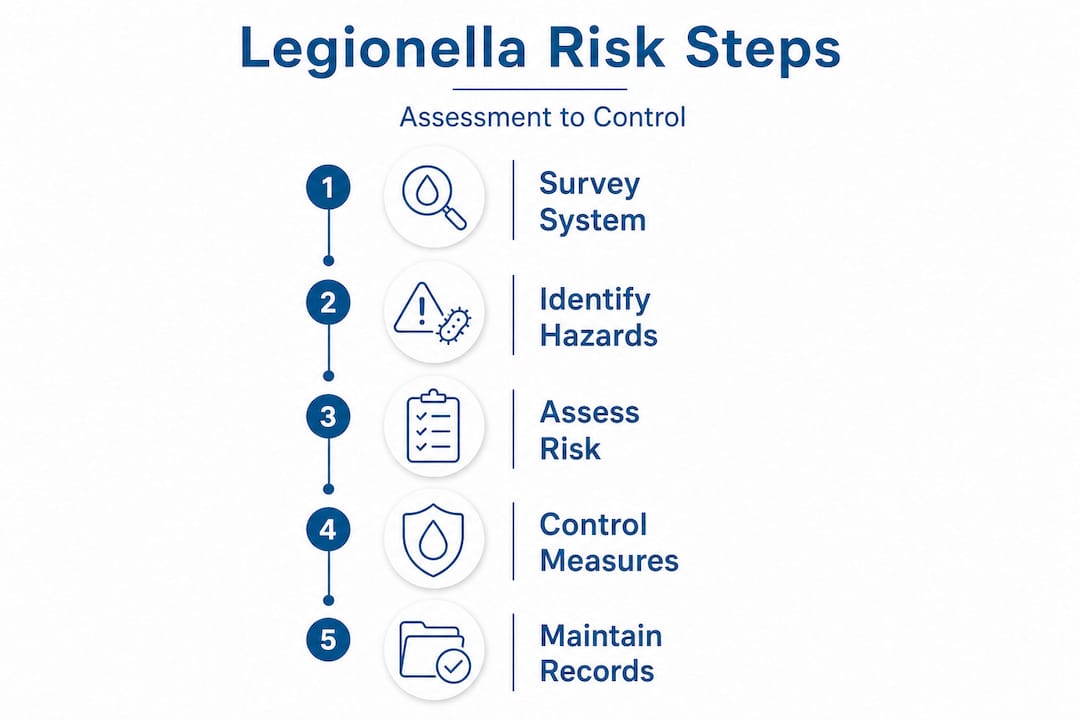
Understanding its significance, we now explore what a water risk assessment looks like in practical terms. A compliant assessment is not a checklist ticked off during a single site visit. It is a structured, documented process that generates a written scheme of control and assigns clear responsibilities.
The six-step methodology defined by HSE and ACOP L8 is as follows:
System inventory and mapping — Identify every component of the water system, from storage tanks and calorifiers to terminal outlets and cooling towers, and produce accurate as-built schematics.
Assessing growth conditions — Evaluate temperatures, stagnation points, biofilm potential, aerosol risks, and design flaws that could support Legionella growth.
Risk evaluation — Prioritise risk based on population susceptibility, likelihood of exposure, and system condition.
Written scheme of control — Produce a documented control programme detailing monitoring frequencies, remedial actions, and responsible parties.
Appoint a competent responsible person — Identify an individual with the knowledge and authority to implement and oversee the control scheme.
Monitoring, records, and periodic review — Establish ongoing monitoring routines, maintain contemporaneous records, and review the assessment at least every two years or following significant changes.
Pro Tip: Do not wait for your two-year review cycle if there are significant changes to building use, occupancy, or pipework. Trigger an early review. A reactive review after an incident is significantly more costly than a proactive one prompted by change.
Best practice versus minimum compliance
Element | Minimum compliance | Best practice |
Assessment frequency | Every 2 years | Annually or upon any system change |
Assessor competence | Basic knowledge for simple systems | Accredited specialist for complex premises |
Record keeping | Written scheme on file | Bespoke logbook system with real-time entries |
Monitoring frequency | Monthly sentinel outlets | Weekly or fortnightly with trend analysis |
Remedial action timescales | Defined but reactive | Defined, proactive, and escalation-ready |
Choosing between an in-house assessment and engaging a specialist is a critical decision. Reviewing a Legionella risk assessment in detail allows you to judge whether your existing documentation meets current standards or requires a full reassessment. For complex premises with cooling towers, thermal stores, or large healthcare infrastructure, specialist competence is not just advisable, it is the standard ACOP L8 expects. For a simple two-outlet office, a knowledgeable in-house person may suffice, provided they can demonstrate their competence and document it thoroughly.
Record keeping is frequently underestimated. Clear, contemporaneous records are your primary defence in the event of an investigation or legal challenge. Every monitoring visit, every temperature check, every remedial action must be logged with dates, outcomes, and the identity of the person responsible.
Key focus areas for Legionella control
Once the assessment framework is understood, it is vital to focus on the control points for Legionella prevention. Knowing where to look and what to look for transforms a paper exercise into genuine protection.
Temperature control: the primary weapon
Temperature controls are non-negotiable: hot water storage must be maintained above 60°C, distribution above 50°C, and cold water below 20°C. These thresholds inhibit bacterial proliferation and are the cornerstone of any control scheme.
Water type | Storage temperature | Distribution temperature |
Hot water | Above 60°C | Above 50°C |
Cold water | Below 20°C (target) | Below 20°C at point of use |
Sentinel outlets, meaning the first and last outlets on a circuit, should be checked monthly at a minimum to confirm temperatures are within acceptable ranges. Temperature monitoring checks must be systematic and recorded, not ad hoc. Automated water temperature monitoring is increasingly being adopted by forward-thinking facility managers to remove human error from this process and provide continuous assurance.
Managing infrequently used outlets and dead legs
Several edge cases demand particular attention in any control scheme:
Infrequently used outlets such as showers in rarely occupied guest rooms or staff changing facilities must be flushed regularly, typically weekly, to prevent stagnation and biofilm development
Dead legs, sections of pipework exceeding 12 metres that terminate in blind ends, are prime colonisation sites and should be removed or redesigned wherever possible
TMVs (thermostatic mixing valves) must be regularly cleaned and descaled, as scale deposits create habitat for biofilm
Cooling towers must be registered with the local authority and are subject to additional notification and maintenance requirements under the Health and Safety at Work Act
Healthcare environments face additional guidance through HTM 04-01 (Health Technical Memorandum), which layers specific requirements on top of ACOP L8 obligations
Pro Tip: Map every infrequently used outlet on your site schematic and assign a named individual responsibility for flushing. If it is nobody’s specific job, it does not get done consistently, and gaps in flushing records are precisely what investigations and enforcement notices are built on.
Practical challenges and common pitfalls in UK facilities
Even with good intentions, missteps happen. Here is what to watch out for in your water management programme.
“Compliance is not about filling in forms. It is about demonstrating that you genuinely understand your water system and that you have taken proportionate, documented action to control the risk.”
ACOP L8 is explicit that competence must match system complexity. Simple systems can be self-assessed by a knowledgeable responsible person, but complex or healthcare premises need specialists. This is not about hierarchy; it is about ensuring the person conducting or overseeing the assessment can actually identify risk, not just describe it in generic terms.
The most common pitfalls we encounter across UK facilities include:
Outdated risk assessments that do not reflect current building layout, occupancy, or system configuration. A two-year-old assessment for a premises that has undergone a refurbishment is, in effect, worthless.
Insufficient assessor competence, where an assessment has been conducted by someone with generic health and safety qualifications but no specific water hygiene expertise.
Incomplete or inconsistent monitoring records, where temperature checks are conducted but not recorded contemporaneously, or where records have gaps spanning weeks or months.
Failure to act on remedial findings, where an assessment identifies issues such as dead legs or poorly performing TMVs, but no corrective action is documented or completed.
Assuming a new building is safe, when in fact new construction creates its own risks through initial system stagnation, commissioning failures, and unflushed pipework.
Lessons from NHS GP surgery Legionella incidents demonstrate how even relatively straightforward premises can harbour serious risk when monitoring lapses or responsibilities are not clearly assigned. A Legionella case study from a business premises illustrates precisely this: good intentions without structured process create compliance gaps that regulators will not overlook.
The documentation culture within your organisation matters enormously. Facilities where compliance is embedded into day-to-day operations, where monitoring is habitual and records are reviewed regularly, perform consistently better in both regulatory inspections and real-world risk outcomes.
What most water risk assessment guides overlook
The industry guidance on Legionella is reasonably clear. ACOP L8 is detailed. HSE resources are accessible. So why do incidents continue to occur? Because most guidance treats water risk assessment as a document-generation exercise rather than a dynamic, living process.
We see this regularly in practice. A facility commissions an assessment, receives a report, files it, and considers the matter resolved. Two years later, a different consultant returns, finds the system largely unchanged in documentation terms, and produces a broadly similar report. The cycle repeats. Meanwhile, occupancy has shifted, a wing has been closed, three outlets have been infrequently used for eighteen months, and a TMV has not been serviced since installation.
The assessment itself is not the goal. It is the starting point. What matters is whether the written scheme of control generated by that assessment is actually implemented, monitored, and adjusted as conditions change. Re-evaluating risk assessments should be a deliberate, scheduled management activity, not a response to regulatory pressure.
There is also a persistent tendency to apply generic templates to bespoke buildings. Every facility has its own combination of water system age, design, usage patterns, and susceptible population. A control scheme for a 200-bed acute hospital will look entirely different from one for a boutique hotel or a multi-tenanted office block. The term “bespoke” is not marketing language in water hygiene. It is the standard.
Perhaps most critically, organisational culture determines whether compliance is genuine or performative. Facilities where senior management understands and values Legionella control as a patient or occupant safety issue, rather than an administrative burden, consistently demonstrate better outcomes. When monitoring is seen as meaningful rather than bureaucratic, records are accurate, anomalies are reported promptly, and remedial actions are completed rather than deferred.
Expert support for robust Legionella control
If your facility’s water risk assessment is overdue, incomplete, or has not been reviewed following recent changes, you are carrying a risk that is both legal and reputational.
At Bespoke Compliance Solutions, we work with facility managers and compliance officers across commercial, healthcare, retail, housing, and hospitality sectors to make Legionella compliance straightforward and genuinely effective. Whether you need a Legionella risk assessment for offices and commercial premises, specialist support for complex or high-risk environments, or sector-specific Legionella control tailored to your organisation, our team delivers solutions built around your site rather than a standard template. We also provide automated monitoring solutions for facilities seeking continuous assurance beyond manual checks. Contact us to discuss your requirements and take the next practical step towards confident, defensible compliance.
Frequently asked questions
Who is legally responsible for water risk assessment in UK commercial premises?
Dutyholders including facility managers, compliance officers, and building owners must ensure a water risk assessment is completed and kept up to date under HSE ACOP L8.
How often should a water risk assessment be reviewed?
At a minimum every two years, or whenever there are significant changes to the water system, building use, or occupancy patterns.
What temperature should hot and cold water be kept at to minimise Legionella risk?
Hot water must be stored above 60°C and distributed above 50°C; cold water should be maintained below 20°C at the point of use.
Can a facility manager perform their own water risk assessment?
Simple systems can be self-assessed if the facility manager is genuinely competent in water hygiene; complex or healthcare settings require a specialist with demonstrable expertise in Legionella risk management.
Recommended
Comments