
Healthcare water risk assessments explained for UK facilities
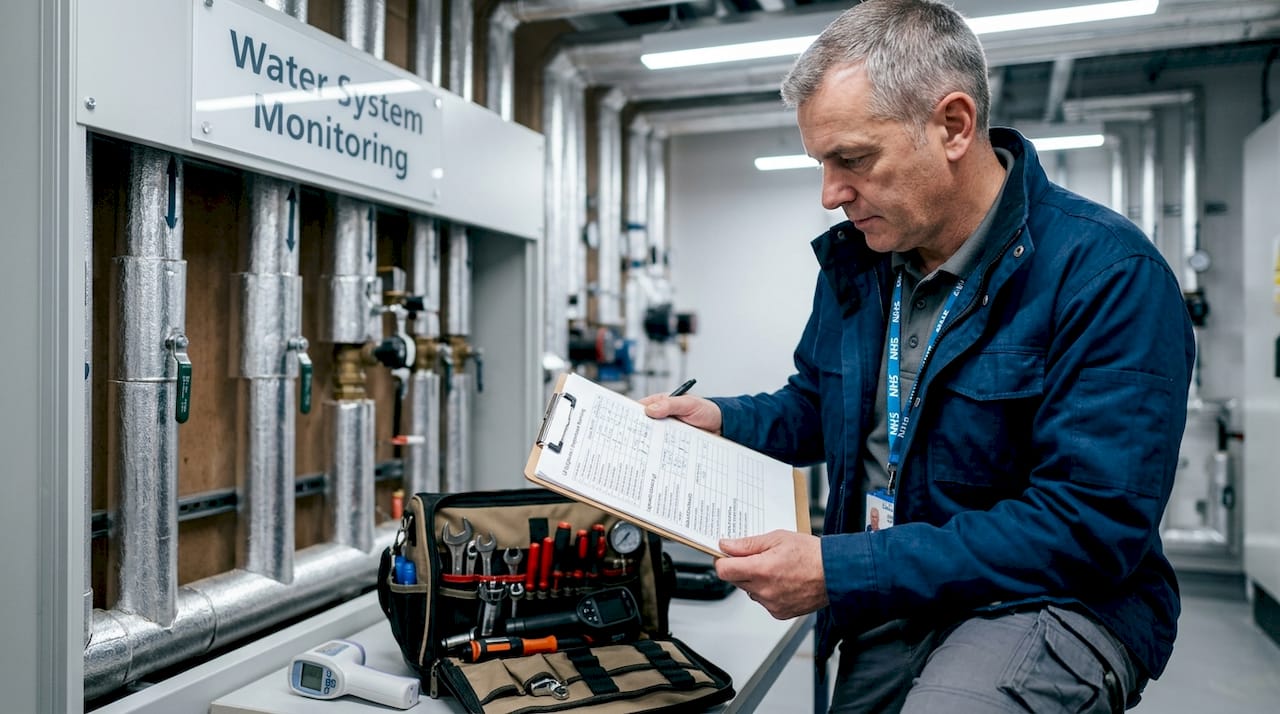
In UK healthcare, the assumption that modern water systems are inherently safe is a dangerous one. 2024 data shows that 4.5% of confirmed Legionella cases were directly linked to healthcare settings, representing 21 of 463 reported cases in England and Wales. For facilities managers and compliance officers, that figure is a reminder that waterborne pathogens do not discriminate between old buildings and new ones. A structured water risk assessment is the cornerstone of breaking the chain of infection, and this guide explains precisely what that process involves, who carries responsibility, and what genuine compliance looks like in a UK healthcare context.
Table of Contents
Key Takeaways
Point | Details |
Legionella is a real risk | A significant share of UK healthcare-acquired Legionella cases traces back to inadequate water risk controls. |
Assessments are systematic | A healthcare water risk assessment is a structured evaluation of all water systems to identify risks from Legionella and other pathogens. |
Follow UK-specific frameworks | HTM 04-01 and ACOP L8 set out standards for compliance and protection of vulnerable patients. |
Monitoring and documentation are critical | Monthly checks, temperature control, and complete records are essential for audit defence and outbreak prevention. |
Ongoing vigilance is needed | Risk assessment is only the foundation—continuous management and review are vital for true water safety. |
What is a healthcare water risk assessment?
Understanding the scale and stakes of the problem lets us explore what a water risk assessment actually involves.
A healthcare water risk assessment is a systematic evaluation of water systems in healthcare facilities to identify, evaluate, and control risks from Legionella bacteria and other waterborne pathogens such as Pseudomonas aeruginosa, aimed at preventing Legionnaires’ disease and healthcare-associated infections. It is not a one-page checklist. It is a documented, evidence-based process that maps every component of a water system, from cold water storage tanks and calorifiers through to individual outlets, showers, and thermostatic mixing valves (TMVs).
The pathogens of primary concern in healthcare are:
Legionella pneumophila — the bacterium responsible for Legionnaires’ disease, a potentially fatal form of pneumonia spread through inhalation of contaminated water droplets
Pseudomonas aeruginosa — an opportunistic pathogen particularly dangerous to immunocompromised patients, premature neonates, and those in intensive care
Non-tuberculous Mycobacteria (NTM) — increasingly recognised as a risk in healthcare water systems, especially in augmented care units
The preventative aim is clear: stop these organisms from proliferating and reaching vulnerable patients. Healthcare environments present unique challenges because the user population includes people with severely compromised immune systems, open wounds, or invasive devices. A concentration of Legionella that might cause no harm to a healthy adult can be life-threatening to a patient on an oncology ward.
“A water risk assessment is not a compliance formality. It is a clinical safety tool. The findings directly inform infection control decisions and patient safety outcomes across the facility.”
Legally, healthcare organisations in the UK are obligated to manage water safety under the Health and Safety at Work etc. Act 1974, the Control of Substances Hazardous to Health Regulations 2002 (COSHH), and the specific guidance of HTM 04-01. When reviewing a Legionella risk assessment, it is important to recognise that the assessment must reflect the current state of the system, not the state it was in when it was last surveyed.
Key standards and compliance frameworks
With the objectives set, it is vital to understand which frameworks determine your risk assessment obligations.
Three documents form the backbone of water safety compliance in UK healthcare. Understanding how they relate to one another is essential for any facilities manager or compliance officer.
Document | Applies to | Key focus |
ACOP L8 | All workplaces | Legionella prevention, risk assessment, control measures |
HSG274 | All workplaces | Technical guidance on implementing L8 requirements |
HTM 04-01 | NHS and healthcare premises | Adds Pseudomonas, NTM, point-of-use (POU) filtration, stricter tap water wholesomeness standards |
For most commercial settings, ACOP L8 and HSG274 compliance is sufficient. However, in healthcare, HTM 04-01 raises the bar considerably. It introduces requirements for point-of-use filtration in augmented care areas, more stringent water quality testing at the tap, and a formal Water Safety Plan (WSP) that integrates risk assessment findings with infection control policy. The focus on Pseudomonas and NTM reflects the reality that healthcare patients face threats beyond Legionella alone.

The question of whether to self-assess or engage external support depends on system complexity. Simple, well-maintained systems with a competent in-house team may be managed internally. Complex healthcare estates, those with multiple buildings, extensive pipework, cooling towers, or augmented care facilities, require LCA (Legionella Control Association) accredited support. This is not a suggestion; it is an expectation that CQC and HSE inspectors will probe during audits.
Non-compliance carries serious consequences. Regulatory action and outbreak risk are the two most immediate threats, but the reputational damage to a healthcare organisation following a Legionella outbreak can be lasting and severe. CQC inspection frameworks increasingly scrutinise water safety as part of the safe domain, and a poorly maintained water safety programme will generate enforcement notices or, in the worst cases, prosecution.
Pro Tip: Treat HTM 04-01 as your primary reference document rather than a supplement to L8. In healthcare, it sets the standard that regulators and inspectors will measure you against, and building your compliance programme around it from the outset prevents costly retrospective work.
Our work supporting Legionella compliance in Caludon and similar healthcare settings demonstrates that facilities which adopt HTM 04-01 as their baseline consistently perform better during CQC inspections than those treating it as optional guidance.
Step-by-step: The healthcare water risk assessment process
Now that compliance requirements are clear, see how an assessment is practically executed in UK healthcare environments.
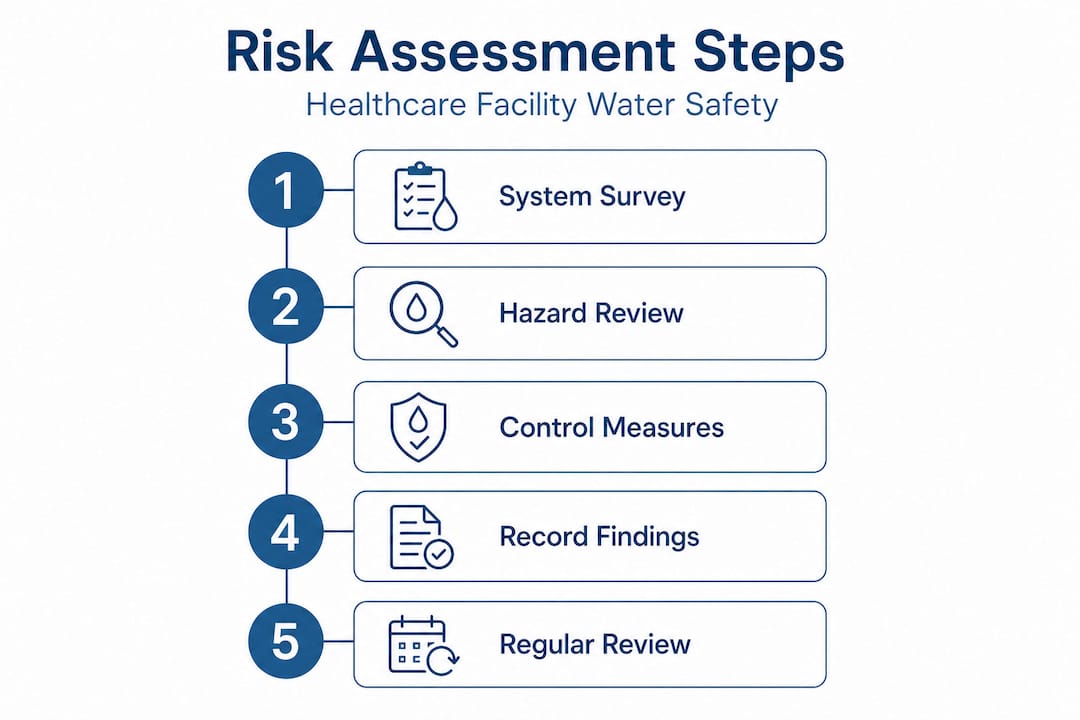
Conducting a water risk assessment in healthcare is a structured, multi-stage process. Here is how it unfolds in practice:
Appoint a Water Safety Group (WSG). Per HTM 04-01 requirements, facilities managers must establish a WSG that includes the responsible person, estates and facilities leads, the infection control team, and where appropriate, an external specialist. This group owns the Water Safety Plan and is accountable for its implementation.
Define roles and responsibilities. Every member of the WSG must have documented responsibilities. Ambiguity around who checks what, and when, is one of the most common causes of compliance failure during audits.
Conduct a full system survey. A qualified assessor physically inspects the entire water system, producing schematic drawings, identifying all water sources, storage vessels, distribution pipework, outlets, and any dead legs or infrequently used points.
Carry out water sampling and analysis. Samples are taken from sentinel outlets (the first and last outlets on each circuit) and tested for Legionella, Pseudomonas, and other relevant organisms. This baseline data informs the risk rating of each area.
Perform temperature checks. Temperature measurement is the primary monitoring tool for Legionella control.
The following benchmarks apply across UK healthcare settings:
Parameter | Required standard | Frequency |
Hot water storage (calorifier) | 60°C or above | Monthly minimum |
Hot water at outlets | 50°C within 1 minute | Monthly sentinel checks |
Cold water storage | Below 20°C | Monthly minimum |
Cold water at outlets | Below 20°C | Monthly sentinel checks |
Sentinel outlet monitoring | As above | Monthly |
Identify and rate risks. Each identified risk is assessed for likelihood and consequence, producing a risk matrix. High-risk areas such as augmented care units, oncology wards, and neonatal units receive the most rigorous controls.
Produce a written scheme of control. This document specifies every control measure, monitoring frequency, responsible person, and corrective action procedure.
Implement and monitor. Controls are put in place, monitoring begins, and all results are recorded in a logbook system.
If Legionella is detected, the response threshold in healthcare is lower than in general workplaces. HTM 04-01 requires investigation of any positive result, whilst HSE guidance triggers mandatory action at counts above 100 colony-forming units per litre (cfu/L). In augmented care, any detectable Pseudomonas at the tap requires immediate investigation and remediation.
Pro Tip: Use a real-world Legionella case study from your own sector when briefing your WSG. Abstract guidance becomes far more actionable when people understand what a real outbreak looks like and how it was traced back to a specific system failure.
The Coventry Legionella risk process we have supported illustrates how thorough documentation at each stage significantly reduces the time and disruption involved when an audit or incident occurs.
Common pitfalls and best practices for facility managers
Once you know the steps, it pays to be aware of pitfalls that can undermine even well-run assessments.
Even experienced facilities teams can fall into patterns that create compliance gaps. Recognising these pitfalls early is far less costly than discovering them during a CQC inspection or, worse, after an outbreak.
Temperature control failures are the most common and most consequential issue. Temperature remains the primary control measure for Legionella, and secondary chemical biocides such as chlorine dioxide or silver copper ionisation require robust validation evidence before they can be relied upon. Biocides are a supplement, not a substitute.
Over-reliance on chemical treatment without adequate evidence of efficacy is a pattern we see regularly. Facilities teams sometimes invest in chemical dosing systems and assume the problem is solved, without the sampling data to confirm it. This creates a false sense of security that auditors will quickly expose.
Common pitfalls to address in your water safety programme:
Dead legs and infrequently used outlets — water that sits stagnant in pipework provides ideal conditions for Legionella proliferation. Every outlet must be flushed regularly, and dead legs should be removed where possible
Inadequate record keeping — incomplete logbooks are a direct audit failure. Every temperature check, water sample, and corrective action must be recorded with dates, names, and outcomes
Failure to review assessments after system changes — any modification to the water system, including new pipework, refurbishments, or changes in building use, triggers a reassessment obligation
Insufficient staff training — estates staff who carry out monitoring tasks must understand why they are doing them, not just how. This understanding is what drives accurate reporting when something looks wrong
Delayed response to out-of-range results — there must be a clear, documented escalation procedure so that any temperature failure or positive sample triggers immediate, traceable action
“Documentation is your defence. In the event of an outbreak or an HSE investigation, the quality of your records will determine whether your organisation is seen as having exercised reasonable care or having been negligent.”
When an audit query or positive result arises, speed and transparency matter. Have your logbooks, risk assessment, and WSP accessible and up to date. Inspectors are not looking for perfection; they are looking for evidence of a functioning, responsive safety management system. Our experience supporting Legionella risk management in Binley and similar healthcare sites shows that well-maintained documentation consistently reduces the severity of audit findings.
Why a risk assessment is only the start: The overlooked realities
There is a pattern we encounter repeatedly across UK healthcare facilities. An organisation commissions a thorough, well-executed water risk assessment, files it carefully, and then treats it as a completed task. Twelve months later, the estate has changed, staff have turned over, and the assessment is already partially obsolete. The document on the shelf bears little resemblance to the system it was written to describe.
This is the uncomfortable truth about water safety management in healthcare: the assessment is not the destination. It is the starting point for an ongoing management process. Regulators and auditors are increasingly sophisticated in their expectations. They want to see dynamic, documented management actions, evidence that findings have been acted upon, that monitoring results have been reviewed, and that the WSG has met and responded to emerging issues. Paper compliance, where the right documents exist but nothing behind them is functioning, is being identified and challenged with growing frequency.
The culture within the estates and facilities team matters as much as the procedures. A team that understands why water safety is critical, rather than simply following a checklist, will notice when something is wrong and escalate it. That instinct cannot be written into a procedure; it comes from genuine competence and ongoing training.
We are firm advocates for reviewing Legionella assessments regularly, not just when something goes wrong. A review cycle that is tied to system changes, significant incidents, and at least every two years as a minimum, keeps your compliance programme genuinely reflective of current risk. Embedding the WSG into wider infection control governance, rather than treating it as a separate estates function, is one of the most effective structural changes a healthcare organisation can make. Water safety is infection control. The sooner that connection is made at a cultural level, the stronger both programmes become.
Expert Legionella compliance support for UK healthcare
Moving from compliance theory to confident practice requires more than good intentions and guidance documents. It requires specialist knowledge, local experience, and a partner who understands the specific demands of healthcare water systems.
At Bespoke Compliance Solutions, we provide bespoke Legionella risk assessments tailored to the complexity of your healthcare estate, whether you manage a single clinic or a multi-site NHS trust. Our services extend well beyond the initial assessment. We support the implementation of Water Safety Plans, logbook systems, and control programmes designed specifically for your site. Our Legionella awareness training builds genuine competence in your estates team, and our water testing and analysis services provide the sampling data you need to demonstrate ongoing control. Contact us today for a tailored consultation and find out how we can make compliance straightforward for your organisation.
Frequently asked questions
Who is responsible for water risk assessments in healthcare facilities?
The duty sits with the nominated responsible person or facilities manager, but they must appoint a competent Water Safety Group as specified in HTM 04-01, which integrates with the infection control team and, for complex sites, draws on LCA-accredited expertise.
What pathogens must be covered in a healthcare water risk assessment?
Assessments must address Legionella and other waterborne pathogens including Pseudomonas aeruginosa and non-tuberculous Mycobacteria, reflecting the heightened vulnerability of healthcare patients compared to general workplace populations.
How often should water temperatures and sentinel points be checked?
Monthly monitoring of sentinel outlets is the standard requirement, with immediate corrective action required whenever temperatures fall outside the established benchmarks.
What are the key temperature benchmarks for Legionella control?
Hot water must be stored at 60°C or above, delivered to outlets at 50°C within one minute, and cold water must be maintained below 20°C throughout the distribution system.
What are the consequences of not complying with water risk assessment duties?
Non-compliance risks regulatory action, substantial fines, CQC enforcement notices, and critically, the potential for serious outbreaks that directly threaten patient safety and organisational reputation.
Recommended
Comments