
Legionella outbreak examples in commercial premises
- May 19
- 9 min read
Identifying the source of a Legionella outbreak in a commercial building is rarely straightforward. The bacteria can thrive in systems you inspect regularly and remain undetected until someone is hospitalised. For facility managers and compliance officers, the examples legionella outbreaks commercial premises investigators have documented over recent years offer something textbooks cannot: a clear picture of how contamination actually develops, where standard protocols fall short, and what the consequences look like in practice. This article walks through real outbreak case studies, compares their causes and impacts, and translates those lessons into prevention strategies you can act on today.
Table of Contents
Key takeaways
Point | Details |
Cooling towers remain the primary risk | Multiple recent outbreaks confirm cooling towers as the leading commercial source, particularly in urban, high-occupancy environments. |
Unconventional sources are under-assessed | Devices like water flossers and misters have now been confirmed as outbreak sources and must be included in risk assessments. |
Construction activity amplifies risk | Nearby construction dust can accelerate contamination in cooling towers, requiring more frequent maintenance intervals. |
Legal consequences are increasing | UK legislation now carries fines up to £20,000 and potential imprisonment for Legionella management failures. |
Proactive water management prevents outbreaks | Documented control programmes with regular testing are consistently more effective than reactive responses to confirmed cases. |
Examples legionella outbreaks in commercial premises: risk factors first
Before examining specific cases, you need to understand the conditions that made those outbreaks possible. Commercial property legionella risks centre on a consistent set of factors, and recognising them in your own building is the starting point for effective management.
Legionella pneumophila grows between 20 and 45°C, making the tepid water in large commercial plumbing systems an ideal breeding ground. Stagnation makes things worse. Dead legs, infrequently used outlets, and oversized storage tanks all create conditions where water sits long enough for biofilm to form. Biofilm does not just support bacterial growth; it actively shields Legionella from disinfectant treatments, which is why a single flush or shock dose rarely resolves a systemic problem.
The built environment adds further complications. Commercial office towers, hotels, and healthcare facilities all feature the kind of complex, multi-floor plumbing that creates thermal variation and flow inconsistencies across the system. Cooling towers and HVAC components then aerosolise that contaminated water, dispersing bacteria over wide areas.
Operational factors matter too. Reduced building occupancy, such as during holiday periods or hybrid working arrangements, reduces water turnover and increases stagnation risk. Construction activity near the building introduces additional contamination pathways. Even routine maintenance lapses, a missed biocide dosing cycle or a temperature check recorded but not acted upon, can tip a borderline system into a genuine hazard.
The most vulnerable building types within commercial premises legionella risk profiles include:
Large office buildings with extensive cold and hot water distribution networks
Hotels with seasonal occupancy fluctuations and spa or pool facilities
Healthcare facilities where immunocompromised occupants face elevated clinical risk
Retail centres with decorative water features and misting systems
Buildings undergoing or adjacent to construction or refurbishment works
Pro Tip: If your building occupancy has dropped significantly due to remote working patterns, treat the water system as if it has been mothballed. Stagnation risk increases within days, not weeks.
1. Sydney CBD cooling tower outbreak (2023 to 2024)
The Sydney CBD outbreak between December 2023 and January 2024 recorded 16 confirmed cases of Legionnaires’ disease. Investigation traced the source to a cooling tower in the central business district, with genomic typing confirming the match between environmental and clinical samples.
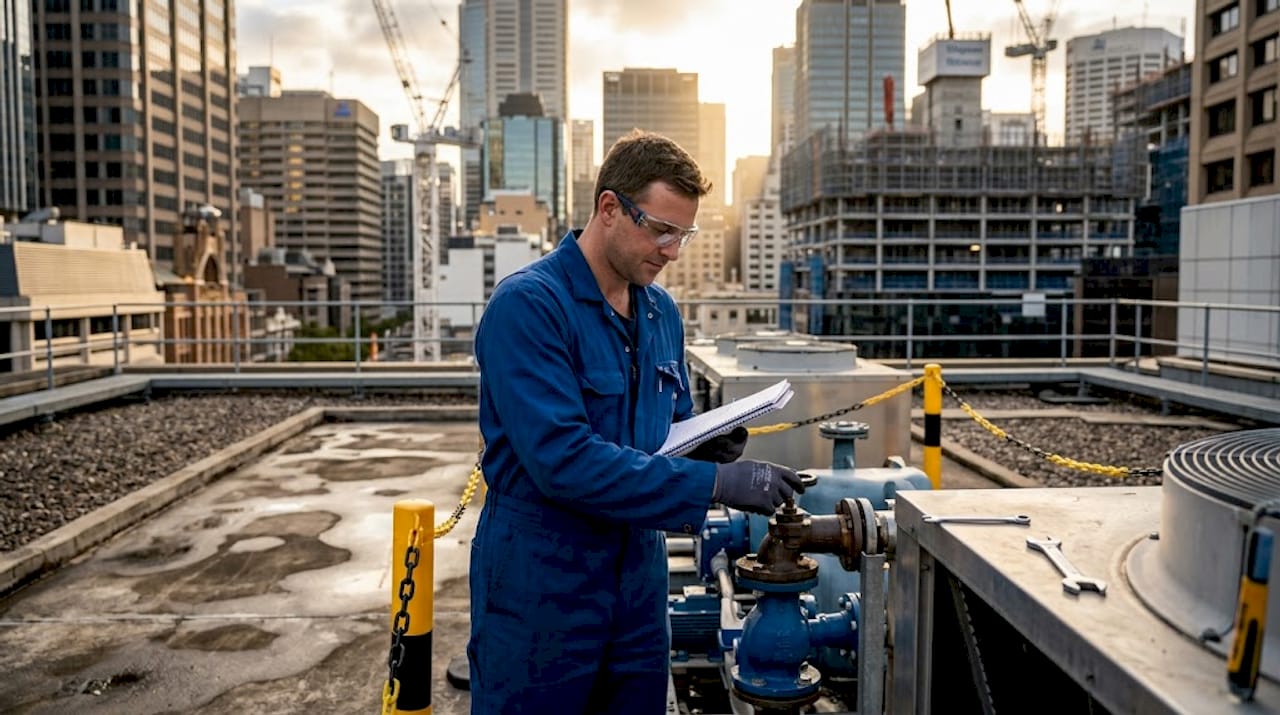
What made this outbreak particularly instructive was the role of construction activity. Ongoing nearby development introduced persistent dust contamination into the cooling tower, accelerating bacterial growth beyond what standard maintenance intervals could manage. The facility team was not negligent; their schedule simply had not been adjusted to account for a genuinely elevated environmental load.
The lesson for facility managers is that your risk assessment cannot be a static document. When construction begins near your building, that is a trigger event requiring an immediate review of your cooling tower maintenance frequency and biocide dosing regime.
2. Toronto outbreak (2026)
A 2026 outbreak in Toronto recorded 9 confirmed cases linked to urban plumbing systems in a commercial district. Investigators identified ageing infrastructure and water age as contributing factors, with temperature management within the distribution system found to be inconsistent across floors.
This case illustrates a challenge common to older commercial buildings: the original water system design may not meet current occupancy patterns or usage demands. Where systems were designed for continuous high-flow use, today’s hybrid working environment creates extended periods of low demand and stagnation in peripheral pipework.
3. California medical centre outbreak (2026)
The Kaiser Santa Clara outbreak recorded 18 confirmed cases linked to the hospital’s water distribution system. This case is one of the most significant recent examples of legionella outbreaks commercial premises in a healthcare context, given the elevated clinical vulnerability of the building’s occupants.
Healthcare water systems face a particular paradox. They are subject to stricter regulatory oversight than most commercial buildings, yet the complexity of their plumbing, multiple wards, specialised units, and high water demand creates numerous points of risk. This outbreak reinforced that even well-resourced facilities require continuous monitoring rather than periodic compliance checks.
4. Montana hotel investigation
A Montana hotel investigation returned results that should prompt every hospitality facility manager to review their own testing data. 65% of tested water sources within the property returned positive results for Legionella contamination. Twenty-six of forty sampled points were positive, confirming widespread systemic contamination rather than an isolated fault.
Hotels present a particularly complex risk profile. Guest rooms with irregular occupancy, spa facilities, cooling systems, and decorative features all represent potential sources. The Montana findings suggest that point-of-use testing alone is insufficient; you need system-wide sampling to understand the true contamination profile of a large hospitality property.
5. Water flosser outbreak in France
This is the case study that most facility managers have not yet encountered, and it carries significant implications for how you define the scope of your risk assessments. French investigators confirmed a case linked to a contaminated water flosser, with genomic identity matching between the device water and the patient’s clinical strain confirming Legionella pneumophila serogroup 1 as the causative agent.
Water flossers aerosolise water directly at close range to the user’s face. They sit in bathrooms connected to the building’s cold water supply. And in most commercial premises, they are entirely absent from the water safety risk assessment. The same logic applies to misters, humidifiers, and water features that create fine aerosols.
Unconventional aerosolising devices represent a genuinely emerging category of outbreak risk, and the France case is the clearest documented evidence yet that they warrant formal inclusion in your hazard analysis.
6. London investigations
London Legionella investigations into multiple outbreaks in commercial areas confirmed that outbreaks function as sentinel events, pointing to deeper failures in water system design or maintenance rather than isolated one-off incidents. The pattern across London cases showed that once contamination was identified, broader system reviews consistently uncovered historical maintenance gaps that had gone unaddressed.
This framing matters. An outbreak is not simply an unfortunate event. It is evidence that your water management programme had a gap serious enough for the bacteria to establish, multiply, and aerosolise to the point of clinical exposure.
Comparative analysis: sources, impacts, and lessons
Reviewing these cases alongside each other reveals patterns that individual incident reports can obscure. The table below summarises key comparators across the outbreak examples discussed.
Outbreak | Primary source | Cases confirmed | Distinctive factor |
Sydney CBD (2023 to 2024) | Cooling tower | 16 | Construction dust accelerated contamination |
Toronto (2026) | Urban plumbing | 9 | Water age and thermal inconsistency in ageing infrastructure |
California medical centre (2026) | Hospital water system | 18 | High-risk occupant vulnerability |
Montana hotel | Whole building system | Not specified | 65% of water sources tested positive |
France | Water flosser | 1 | Non-traditional aerosolising device confirmed as source |
The health impact of legionella in commercial settings ranges from single cases to clusters requiring hospital admission. What the data does not capture is the reputational and operational cost. Building closures, regulatory investigations, civil litigation, and loss of tenant confidence represent significant business impacts beyond the clinical figures.
Multidisciplinary water management is consistently identified in post-outbreak reviews as the practice that was absent. Not just a dedicated water safety officer, but a team that includes engineering, facilities operations, clinical or occupational health where relevant, and documented accountability at each level.
Pro Tip: After any confirmed outbreak, commission a full system-wide review rather than focusing remediation on the single identified source. The Montana hotel data shows that where one positive sample is found, many more typically exist.
Preventing legionella in buildings: practical recommendations
The outbreak examples above share a common thread: they were preventable. Each investigation identified specific control failures that, had they been addressed, would have broken the transmission chain before any clinical case occurred. The following steps reflect direct lessons from those cases.
Develop a written water management programme that maps every system, outlet, and device capable of aerosolising water, including non-traditional sources
Schedule Legionella risk assessments with review triggers for change events, not just annual calendar dates. Construction nearby, occupancy changes, and system modifications all qualify as triggers
Conduct water risk assessments that address temperature monitoring, flow verification, biofilm control, and disinfection at all identified risk points
Include humidifiers, water flossers, misters, spa equipment, and decorative features in your device inventory and hazard analysis
Align your water management programme with recognised standards and document your compliance position clearly
Communicate water safety obligations to building tenants and occupants, particularly in multi-tenanted commercial premises where shared systems cross operational boundaries
Train your facilities team through accredited Legionella awareness training to recognise signs of legionella contamination and respond appropriately to test results
The legal stakes have also shifted. UK legislation now carries fines up to £20,000 and imprisonment risk for management failures, making documented compliance not just a safety priority but a legal one.
My view on where Legionella management still gets it wrong
In my experience, the gap between a facility that has a Legionella compliance file and one that actually manages Legionella risk is wider than most compliance officers want to acknowledge. I have seen buildings with completed risk assessments, current test results, and signed-off logbooks that still experienced contamination events, because the programme was built to satisfy an audit rather than to control a biological hazard.
What I have found consistently is that the buildings with the best outcomes treat water safety as an operational discipline, not a compliance exercise. The people responsible for it understand the systems, know what a temperature exceedance actually means, and have the authority to act on it without waiting for a formal review cycle.
The France water flosser case represents something I think the industry has not fully absorbed yet. Non-traditional aerosolising devices are going to feature in more outbreak investigations as awareness grows and forensic techniques improve. If your current risk assessment does not include a category for unconventional aerosol sources, it has a blind spot.
My advice: stop treating your water management programme as a document to be updated and start treating it as a system to be operated. The two feel similar from the outside. They produce very different outcomes.
— Sammi
How Bespokecompliancesolutions can help protect your premises
If the outbreak cases covered in this article have highlighted gaps in your current water safety approach, Bespokecompliancesolutions offers the specialist support to address them directly.
Bespokecompliancesolutions provides Legionella risk assessments in Coventry and across the UK, tailored specifically to commercial premises with complex water systems. Whether you manage an office building, hotel, retail centre, or healthcare facility, the team develops bespoke control programmes built around your actual site conditions rather than generic templates. Services include water testing and analysis, disinfection, TMV servicing, logbook implementation, and staff training. For facilities in the Midlands, risk assessments in Binley and Caludon are also available. Contact Bespokecompliancesolutions to discuss a compliance plan built for your site.
FAQ
What are the most common sources of Legionella in commercial buildings?
Cooling towers, large hot and cold water distribution systems, decorative fountains, and HVAC components are the most frequently identified sources. Recent cases also confirm that unconventional devices such as water flossers and misters can harbour and transmit Legionella.
What are the signs of Legionella contamination in a water system?
There are no visible signs of Legionella contamination; the bacteria cannot be detected without laboratory testing. Temperature exceedances, biofilm presence, and poor water flow in distribution systems are operational indicators that increase contamination risk and warrant immediate testing.
How often should commercial premises conduct Legionella risk assessments?
Risk assessments should be reviewed at least every two years, but also whenever a significant change occurs, including building modifications, occupancy shifts, adjacent construction activity, or following any confirmed case.
What are the legal consequences of a Legionella management failure in the UK?
Under current UK legislation, management failures can result in fines up to £20,000 and potential imprisonment, in addition to civil liability and reputational consequences.
Does a positive Legionella test result always indicate an outbreak risk?
Not always, but any positive result requires immediate investigation and remediation. The Montana hotel case demonstrated that a single positive sample often signals wider systemic contamination, making system-wide testing the appropriate response rather than point-of-use remediation alone.
Recommended
Comments