
HTM 04-01 compliance: water safety guide for healthcare
- 2 hours ago
- 18 min read

Every NHS trust and independent healthcare provider in the UK has a legal and moral duty to protect patients from waterborne infection. The single most important deliverable under HTM 04-01 is a board-endorsed, site-specific Water Safety Plan (WSP), overseen by a multidisciplinary Water Safety Group (WSG) with clear lines of accountability up to the duty holder. Get that structure right and the rest of the compliance programme follows from it.
HTM 04-01 compliance in water safety for healthcare settings is not simply a maintenance schedule. It is a continuous risk management system covering design, operation, augmented care, and governance, all underpinned by documented evidence. HSE L8 sets the legal baseline for legionella control; HTM 04-01 builds on it specifically for healthcare premises where patient susceptibility makes the stakes considerably higher. NETB 2024/3 extends those obligations further for new builds and major refurbishments serving high-risk patients.
Your immediate compliance priorities:
Appoint a named Responsible Person and constitute a Water Safety Group with documented membership and terms of reference.
Commission a documented, site-specific risk assessment covering the whole system from supply to point of use.
Produce and publish a WSP that is reviewed at least annually or after any significant incident or change.
Establish a monitoring schedule with defined temperature targets, sampling frequencies and escalation thresholds.
Retain commissioning records, logbooks, training evidence and incident reports as an audit trail.
Pro Tip: Before your next WSG meeting, check whether your WSP has been formally signed off at board level. A WSP that exists only within the estates team has no governance weight and will not satisfy a CQC or HSE inspection.
Table of Contents
What HTM 04-01 covers: Parts A, B, C and D08
HTM 04-01 is structured in three main parts plus a performance supplement, each addressing a distinct phase of the water system lifecycle.
Part A: Design, installation and commissioning
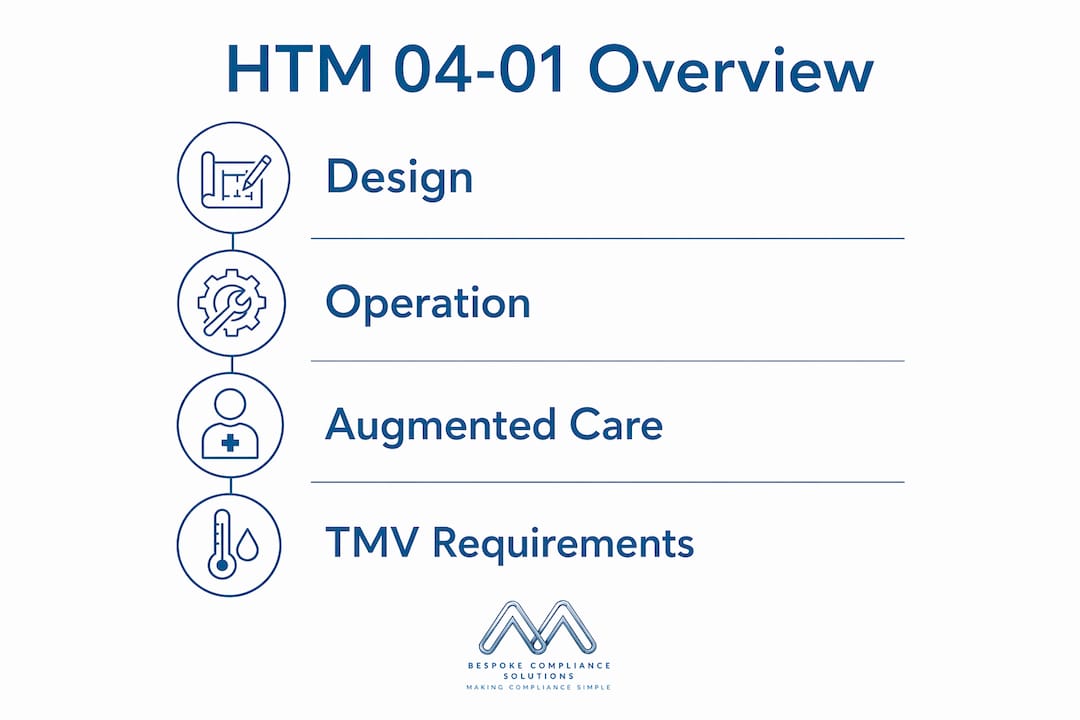
Part A sets out the engineering requirements that reduce long-term microbiological risk before a system ever goes live. It covers materials selection, pipework layout, storage sizing, dead-leg elimination and the commissioning protocols that must be followed before a system is handed over for clinical use.
Part B: Operational management
Part B is where most day-to-day compliance activity sits. It makes the WSP a living document, requiring ongoing monitoring, routine maintenance, temperature control, flushing regimes and record keeping to manage legionella, Pseudomonas aeruginosa and other waterborne pathogens.
Part C: Augmented care settings
Part C applies wherever patients are at heightened susceptibility, including intensive care units, haematology wards and neonatal units. It specifies additional engineering and operational controls, including decisions about whether water outlets should be present at all in certain clinical areas.
Supplement D08: Thermostatic mixing valves
D08 is the performance specification for thermostatic mixing valves (TMVs). It defines testing requirements, acceptable temperature performance and the servicing intervals that must be documented to demonstrate compliance.
Document | Scope | Key obligation |
HTM 04-01 Part A | Design, installation, commissioning | Commissioning records, materials, dead-leg elimination |
HTM 04-01 Part B | Operational management | WSP, monitoring, flushing, disinfection, logbooks |
HTM 04-01 Part C | Augmented care | Enhanced controls, outlet risk decisions, Pseudomonas |
Supplement D08 | TMV performance | Testing, servicing intervals, temperature compliance |
HSE L8 | Legionella legal baseline | Risk assessment, control programme, competent persons |
BS 8680 | Water risk management in buildings | Risk assessment methodology, WSP framework |
NETB 2024/3 | NTM and new builds | Project-specific WSG/WSP, commissioning controls |
NETB 2024/3 supplements HTM 04-01 specifically to address nontuberculous mycobacteria (NTM) risks, which legacy-compliant systems may not adequately control in specialist clinical units.
Pro Tip: Keep a master document register that maps each HTM 04-01 part, D08, HSE L8 and NETB 2024/3 to the specific sections of your WSP. Inspectors find it immediately; you save hours during an unannounced visit.
Who is accountable? Setting up your Water Safety Group
Governance is where most healthcare water safety programmes either hold together or quietly fall apart. HTM 04-01 is explicit: accountability lines must run clearly from the operational team up to the duty holder and board.
The duty holder and Responsible Person
The duty holder is typically the chief executive or equivalent. They carry ultimate legal responsibility and must receive assurance that the WSP is implemented and effective. The Responsible Person (RP) is the named individual, usually a senior estates or facilities manager, who has day-to-day accountability for the water safety programme. The RP must have sufficient authority, competence and resource to act.
Water Safety Group membership and function
The WSG is the multidisciplinary body that develops, reviews and oversees the WSP. Minimum membership should include:
The Responsible Person (chair or co-chair)
Infection Prevention and Control (IPC) representative
Estates and facilities manager
Clinical representative from high-risk areas
Authorised/Competent Person for water systems
Microbiologist or public health input (where available)
The WSG should meet at least quarterly, with minutes retained as governance evidence. Every meeting should review monitoring data, incident reports, outstanding remedial actions and any changes to the estate or patient population that affect risk.
Authorised and Competent Persons

Authorised Persons (APs) and Competent Persons (CPs) must hold demonstrable, documented competency for the specific tasks they carry out, whether that is legionella risk assessment, TMV servicing or disinfection works. When using third-party contractors, procurement checks must confirm relevant qualifications, insurance and evidence of continuing professional development. Staff competency and water hygiene awareness training are explicit requirements of operational management under HTM 04-01.
Pro Tip: Structure your WSG agenda in three fixed blocks: (1) monitoring data and trend review, (2) incident and near-miss debrief, (3) outstanding actions with owners and deadlines. That rhythm forces IPC and estates to reconcile their data at every meeting, which is where the most common compliance failures are caught early.
For multi-site organisations, water hygiene compliance across multiple sites requires a consistent governance framework that can be applied and audited at each location.
How to build a site-specific Water Safety Plan
The WSP is the operational heart of your compliance programme. It is not a static document filed in a drawer; Part B of HTM 04-01 makes clear it must function as a living risk management tool.
Step-by-step WSP development
Define scope. Map every water system on site: cold water storage, hot water calorifiers, distribution pipework, outlets, TMVs, cooling towers, and any supplementary systems such as ice machines or hydrotherapy pools.
Conduct the risk assessment. Identify hazards, assess likelihood and consequence, and prioritise by patient susceptibility. Small GP surgeries need a proportionate approach; a large acute trust requires a more detailed assessment. For smaller healthcare settings, water risk assessment guidance for GP surgeries illustrates how to calibrate scope appropriately.
Identify critical control points (CCPs). These are the points in the system where control is essential to prevent or eliminate a hazard, such as calorifier temperature, TMV outlet temperature and sentinel tap monitoring locations.
Assign controls and responsibilities. For each CCP, document the control measure, the monitoring method, the responsible person and corrective actions.
Set the monitoring schedule. Define frequencies for temperature checks, flushing, TMV servicing, sampling and disinfection. Align these with HTM 04-01 Part B recommendations and any enhanced requirements for augmented care areas.
Document commissioning evidence. Retain all records from system installation or major refurbishment, including pressure test results, disinfection certificates and sign-off by the WSG or Responsible Person.
Review and update. The WSP must be reviewed regularly, after significant incidents or changes to the estate or patient population, and whenever monitoring data indicates potential issues.
Mandatory WSP contents checklist
Governance structure: WSG membership, RP details, duty holder sign-off
Site schematics and asset inventory
Risk assessment with patient susceptibility ratings
CCP register with controls, limits and monitoring frequencies
Sampling plan: sites, frequency, laboratory, chain of custody
Training records and competency evidence for all named persons
Commissioning and disinfection records
Incident and near-miss log with corrective actions
Review history and version control
Water safety failure at the point of use, the so-called “last metre,” is a frequent cause of patient harm and legal exposure. The WSP must address outlet-level controls, not just bulk system parameters.
Pro Tip: Integrate clinical risk directly into your WSP by asking your IPC lead to annotate the patient susceptibility rating for each ward or department. A haematology bay and a staff changing room carry entirely different risk profiles, and your monitoring frequency should reflect that.
Part A essentials: design and commissioning controls
Design decisions made before a system is ever filled have a disproportionate effect on long-term microbiological risk. Getting them right at the outset is far cheaper than remediating a colonised system later.
Design principles to reduce colonisation risk
Minimise dead legs: any section of pipework that does not circulate regularly is a colonisation risk. Design pipework runs so that every outlet is served by a short, active branch.
Size storage correctly: HTM 04-01 is clear that reserve storage must be balanced against adequate turnover. Oversized cisterns or calorifiers in low-occupancy areas create stagnation hotspots that are difficult to manage operationally.
Select compatible materials: avoid materials that support biofilm formation or leach nutrients. Copper, stainless steel and approved plastic systems each have specific application guidance in Part A.
Plan for service access: every component that requires routine inspection or servicing must be physically accessible. Designing out access is a recurring problem in refurbishment projects.
Separate hot and cold: cold water pipework must be kept away from heat sources; hot water must be maintained at temperatures that prevent legionella proliferation throughout the distribution system.
Commissioning checklist
Pressure test all pipework before filling.
Fill with disinfected water and follow the sequence specified in the project-specific WSP (PWSP) where one is required.
Flush all outlets systematically before any clinical use.
Verify calorifier and return line temperatures against HTM 04-01 targets before sign-off.
Obtain TMV commissioning certificates confirming outlet temperature compliance.
Retain all disinfection certificates, test results and sign-off records permanently.
Obtain formal sign-off from the WSG or Responsible Person before clinical occupation.
NETB 2024/3 advises that commissioning should occur as late as practically possible before handover to minimise the period during which a filled but inactive system can become colonised. For new builds and major refurbishments in specialist units, a project-specific Water Safety Group (PWSG) and project-specific WSP (PWSP) are required.
System element | Temperature target | Monitoring point |
Calorifier store | 60°C or above | Stored water temperature |
Hot water flow | 55°C or above at sentinel outlets | Flow temperature at sentinel |
Hot water return | above target temperature | Return line temperature |
Cold water storage | Below 20°C | Stored water temperature |
Cold water at outlet | Below 20°C | Outlet temperature |
TMV blended outlet | target temperature range (clinical) | Outlet temperature post-TMV |
Pro Tip: Engage the WSG at RIBA Stage 2 or equivalent for any new build or major refurbishment. Waiting until Stage 4 or later means design decisions that create long-term risk have already been locked in.
Part B operational controls: what your estates team must do daily
Operational management is where compliance is won or lost week to week. Part B of HTM 04-01 sets out the controls, and the logbook is the evidence that they are being applied.
Core operational controls
Temperature control: calorifiers must store at 60°C or above; hot water must reach 55°C at sentinel outlets within one minute of running. Cold water must be kept below 20°C at the point of use.
Flushing: infrequently used outlets must be flushed weekly as a minimum. Document each flush with location, date, time and the name of the person who carried it out.
TMV servicing: TMVs must be serviced, cleaned, descaled and verified for temperature performance at intervals specified in D08. Records must include the pre- and post-service outlet temperature.
Disinfection: planned disinfection of tanks, calorifiers and distribution systems must be carried out at defined intervals and following any remedial works or positive sample results.
Point-of-use management: showerheads, hoses and flexible connections must be cleaned and descaled regularly. These components are among the highest-risk items in the “last metre.”
Essential logbook fields
Every monitoring record must capture: sample or check ID, location (asset reference), date and time, measured temperature or result, action taken (including “no action required”), the name of the responsible person, and any supporting evidence such as a photograph or laboratory report reference.
Automated water temperature monitoring creates a continuous, tamper-evident audit trail and removes the risk of missed manual checks, particularly in large or complex estates.
Interpreting monitoring data and escalating
When temperature results fall outside target ranges, the response must be immediate and documented. A single out-of-range result at a non-sentinel outlet may warrant investigation and a repeat check. Persistent positives at sentinel outlets, or any confirmed legionella detection, require immediate escalation to the WSG and, depending on severity, to the board and relevant regulatory bodies.
Identify the affected zone and isolate if clinically safe to do so.
Carry out confirmatory sampling with chain-of-custody documentation.
Notify the WSG, IPC lead and Responsible Person within the timeframe defined in your WSP incident protocol.
Commission remedial works (disinfection, TMV replacement, pipework modification) with a competent contractor.
Retest before returning the system to clinical use.
Record all actions, decisions and outcomes in the logbook and incident register.
Pro Tip: Set up a simple traffic-light dashboard from your logbook data: green for within target, amber for approaching limit, red for out of range. Presenting this at every WSG meeting takes five minutes and makes trends visible before they become incidents.
Part C: protecting patients in augmented care areas
Augmented care settings demand a materially different level of control. The patient population, typically immunocompromised or critically ill, cannot tolerate the residual risks that are acceptable in general ward environments.
When a project-specific WSG and WSP are required
Any new build, major refurbishment or change of use affecting an augmented care area must be supported by a project-specific WSG (PWSG) and a project-specific WSP (PWSP). NETB 2024/3 extends this requirement to address NTM risks, which standard HTM 04-01 controls may not fully mitigate in specialist units. Legacy systems that meet conventional legionella compliance thresholds may still pose hazards for these patient groups.
Outlet decisions in high-risk areas
The evidence base for removing water outlets in critical care is substantial. Research referenced in NETB 2024/3 (Hopman et al, 2017) demonstrated that removing tap water reduced Gram-negative infections in critical care settings. The decision to remove or retain outlets must be documented with a formal risk assessment justification, not simply assumed.
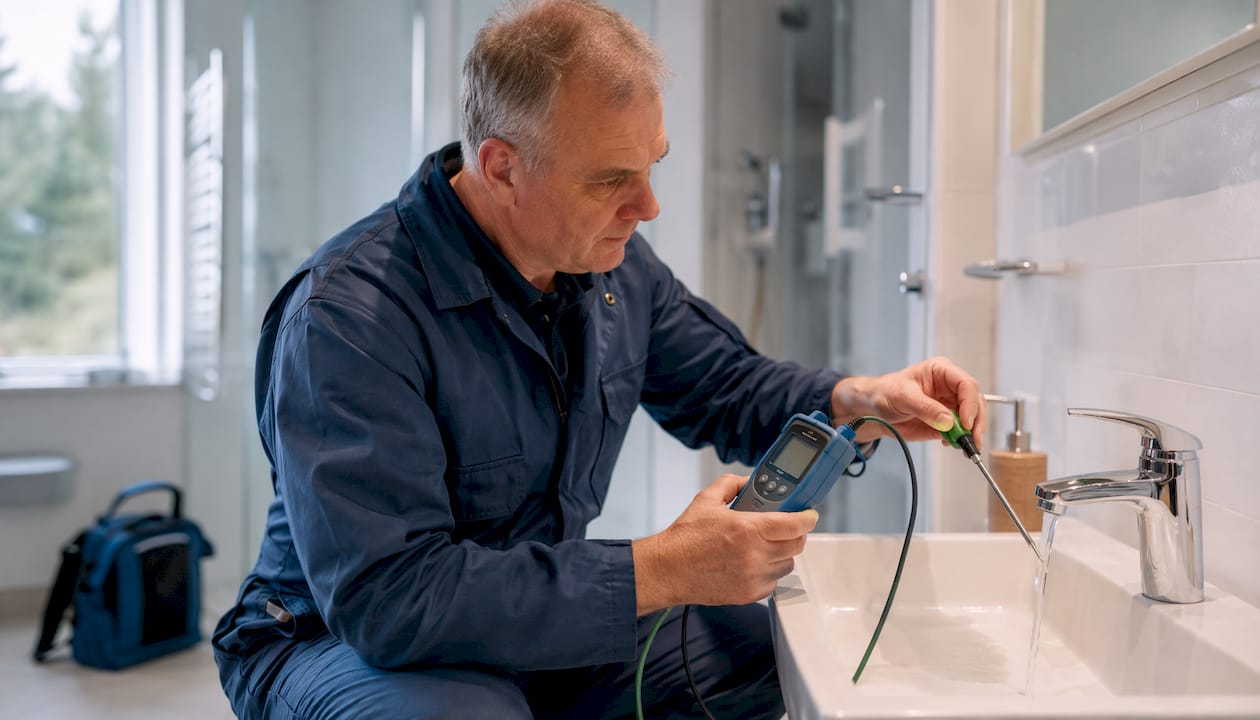
For healthcare water risk assessments in augmented care, the assessment must explicitly address NTM and Pseudomonas aeruginosa alongside legionella.
Escalation decision framework for augmented care
Trigger | Immediate action | Engineering control |
Pseudomonas detected at outlet | Remove from use, notify IPC | Point-of-use filter or outlet removal |
NTM detected in system | WSG emergency review | Enhanced disinfection, PWSP review |
Temperature failure in ICU/HDU | Immediate investigation | Remedial works before clinical use resumes |
New build/refurb in augmented area | Constitute PWSG | PWSP with NTM-specific commissioning controls |
Staff working in augmented care areas must receive specific training on the additional water safety controls that apply, including correct use of point-of-use filters, outlet hygiene and reporting obligations.
Point-of-use filters must be changed at the manufacturer’s specified interval and the change documented with date, location and the name of the person who carried it out.
Any decision to use point-of-use filters as a long-term control rather than a temporary measure must be formally risk-assessed and approved by the WSG.
Pro Tip: When planning a refurbishment in or adjacent to an augmented care area, map the water system impact on the PWSP before any work begins. Vibration, pressure changes and temporary connections during construction are all colonisation risks that must be controlled and documented.
Sampling, testing and interpreting results
A sampling programme is only as good as its design. Random or infrequent testing gives you a snapshot; a properly structured plan gives you a trend.
Sampling plan essentials
Select representative sites: sentinel outlets (first and last on a circuit), high-risk clinical areas, infrequently used outlets and any outlets that have previously returned positive results.
Define frequency: routine monitoring frequencies should be set in the WSP and adjusted upward following any positive result, system change or incident.
Use an accredited laboratory: samples must be handled with documented chain of custody, and the laboratory must hold UKAS accreditation for the relevant test methods.
Collect samples correctly: follow HTM 04-01 sampling protocols for pre-flush and post-flush samples as appropriate to the purpose of the test.
Action thresholds and immediate response
Any detection of legionella in a healthcare water system is a significant finding that requires immediate WSG notification, confirmatory sampling and a documented remedial response. The threshold for action is detection, not a count above a particular level.
For Pseudomonas aeruginosa, any detection at an outlet serving an augmented care area requires that outlet to be taken out of use immediately pending investigation. For indicator organisms, results above action levels defined in the WSP must trigger the escalation pathway within the timeframe specified in that plan.
Receive result from laboratory.
Compare against WSP action levels and classify: satisfactory, advisory, or immediate action.
Notify WSG, IPC and Responsible Person per the incident protocol.
Implement immediate containment (outlet closure, signage, alternative provision).
Commission confirmatory sampling and, where indicated, disinfection.
Document all steps, decisions and outcomes.
Report to board and, where required, to CQC or HSE.
When specialist contractors are required for disinfection or remedial works, their competence must be documented before they begin work. Retain their method statements, risk assessments, insurance certificates and post-works test results as part of the audit trail.
Pro Tip: Ask your laboratory to provide trend data, not just individual results. A series of results that are individually within limits but consistently rising is a warning sign that a standard pass/fail report will not flag.
Typical timelines and cost drivers for HTM 04-01 compliance
Compliance is not a one-off project. It is a programme with an initial set-up phase and ongoing operational costs. Understanding both helps you build a credible business case for board approval.
Typical timeline for key compliance milestones
Activity | Typical timeframe |
WSG constitution and terms of reference | 2–4 weeks |
Site-specific risk assessment | 4–8 weeks (depending on estate size) |
WSP development and board sign-off | 6 weeks from risk assessment |
Baseline sampling programme | 4–6 weeks |
TMV audit and initial servicing | 4–8 weeks (depending on TMV count) |
Staff training (initial cohort) | 1–2 days per cohort |
Commissioning records review and gap-fill | 2–6 weeks |
Remedial works (dead legs, pipework) | Variable: weeks to months |
Major cost drivers
Remedial pipework works: eliminating dead legs and reconfiguring oversized storage are the most significant capital costs, particularly in older estate.
TMV servicing and replacement: a large acute trust may have hundreds of TMVs; the initial audit and service cycle is a material cost.
Automated monitoring: the capital cost of automated temperature monitoring is offset by reduced manual labour and a more reliable audit trail.
Specialist sampling and laboratory analysis: routine sampling costs accumulate; factor in enhanced sampling following any positive result.
Disinfection works: planned disinfection is budgetable; reactive disinfection following a positive result is not, and is always more expensive.
Training: initial and refresher training for all relevant staff must be budgeted annually.
Prioritising spend under budget pressure
Patient-risk areas first: augmented care, ICU, haematology, neonatal.
Clinical areas second: general wards, outpatient areas with vulnerable patients.
Ancillary services third: staff facilities, plant rooms, non-patient areas.
Pro Tip: When presenting the compliance budget to the board, frame remedial costs against the cost of a legionella outbreak: patient harm, regulatory enforcement, reputational damage and potential litigation. The comparison makes the investment straightforward to justify.
How to implement HTM 04-01 in practice
Turning the memorandum’s requirements into a delivered programme requires a structured implementation plan with named owners and defined milestones.
Implementation checklist
Assign governance. Appoint the Responsible Person, constitute the WSG and obtain board endorsement of the governance structure.
Assess the estate. Commission a documented risk assessment covering all water systems, assets and patient susceptibility ratings.
Produce the WSP. Develop the site-specific WSP, including CCPs, monitoring schedule, sampling plan and incident protocols. Obtain board sign-off.
Audit commissioning records. Review existing records for completeness; commission gap-fill surveys where records are missing or out of date.
Deliver baseline sampling. Carry out a baseline sampling programme across representative sites to establish the current microbiological status of the system.
Service TMVs. Audit all TMVs against D08 requirements; service, clean and verify temperature performance; replace where necessary.
Train staff. Deliver HTM 04-01 awareness training to all relevant estates, facilities and clinical staff; retain attendance records.
Implement operational controls. Establish flushing regimes, temperature monitoring schedules and logbook systems; assign responsibility for each task.
Verify and report. Review monitoring data at each WSG meeting; report compliance status to the board at least annually.
Continuously improve. Use audit findings, incident data and monitoring trends to update the WSP and improve controls.
What a compliant programme must deliver
A documented, board-endorsed WSP reviewed at least annually
A functioning WSG with minutes and action logs
Baseline and routine sampling results with laboratory certificates
TMV service records compliant with D08
Staff training records with competency evidence
Commissioning and disinfection certificates
An incident register with documented corrective actions
Bespokecompliancesolutions supports healthcare organisations through every stage of this programme, from initial risk assessment and WSP development through to routine sampling, TMV servicing, automated monitoring and staff training. The Legionella compliance for healthcare premises service page sets out the full scope of what a BCS engagement delivers.
Pro Tip: Build your evidence pack in real time, not retrospectively. A shared folder structure that mirrors your WSP sections, updated after every monitoring event, means you are always audit-ready rather than scrambling before an inspection.
Key takeaways
HTM 04-01 compliance requires a board-endorsed Water Safety Plan, a functioning Water Safety Group, documented operational controls, and competent staff, all supported by a continuous audit trail from design through to point-of-use monitoring.
Point | Details |
WSP is the foundation | Every healthcare site must have a board-endorsed, site-specific Water Safety Plan reviewed at least annually. |
Governance must reach the board | The WSG reports to the duty holder; accountability lines must be documented and demonstrable at inspection. |
Augmented care needs more | Part C and NETB 2024/3 require enhanced controls, outlet risk decisions and project-specific WSPs for high-risk areas. |
Sampling needs a plan, not a schedule | Representative sites, accredited laboratories and trend analysis are required; any detection triggers the escalation pathway. |
Bespokecompliancesolutions delivers end-to-end | BCS provides risk assessments, WSP development, sampling, TMV servicing, automated monitoring and training across UK healthcare sites. |
Pro Tip: Copy the five rows above into your next board assurance paper as a compliance status summary. Mark each row RAG-rated against your current position. It takes ten minutes and gives the board exactly the oversight HTM 04-01 requires.
Water safety compliance: what the guidance gets wrong about priorities
The conventional framing of HTM 04-01 compliance treats it as a documentation exercise: produce the WSP, tick the boxes, file the logbooks. That framing is understandable, because the memorandum is a long and detailed document, and the temptation is to treat completion of the paperwork as the goal.
The problem is that the paperwork is evidence of a functioning system, not the system itself. A WSP that accurately describes controls that nobody is actually carrying out is worse than no WSP at all, because it creates a false sense of assurance at board level while the real risk goes unmanaged.
The guidance that most organisations underweight is the governance piece. Specifically, the requirement for IPC and estates to be in the same room, reviewing the same data, at regular intervals. The most common compliance failure is not a missing logbook entry; it is a clinical team that has changed a ward’s patient population without telling estates, or an estates team that has carried out pipework modifications without notifying IPC. Those communication failures are what turn a manageable microbiological finding into a patient safety incident.
The other thing that gets underestimated is the “last metre.” Organisations invest heavily in calorifier temperature management and TMV servicing, which is right. But showerheads, flexible hoses and point-of-use fittings in clinical areas are where Pseudomonas and NTM exposure actually happens. A system that is textbook-compliant at the bulk level can still harm a patient through a contaminated showerhead that was last cleaned six months ago.
The practical lesson is to spend as much governance energy on the interface between IPC and estates as on the technical controls themselves. A WSG that genuinely integrates clinical and engineering perspectives, and that reviews real monitoring data rather than summary reports, will catch problems that no amount of paperwork can prevent.
How Bespokecompliancesolutions supports your HTM 04-01 programme
Achieving and maintaining HTM 04-01 compliance across a healthcare estate is a sustained commitment, not a one-time project. Bespokecompliancesolutions works with healthcare organisations across the UK to make that commitment manageable, documented and defensible.
BCS delivers the full scope of what a compliant programme requires: bespoke legionella risk assessments, WSP development, water sampling and analysis, TMV servicing to D08, automated temperature monitoring, disinfection works and HTM 04-01 awareness training. Every engagement is scoped to your specific estate, patient population and existing compliance position, so you are not paying for a generic programme that does not fit your site.
Clients receive a documented governance handover at the end of each engagement: a completed WSP, sampling records, TMV service certificates, training attendance logs and a commissioning evidence pack structured for CQC or HSE inspection. The goal is to leave your team with a programme they can run and a board they can brief with confidence.
To start with a site-specific legionella risk assessment or a gap analysis against your current WSP, contact Bespokecompliancesolutions directly. The first step is understanding where you are; everything else follows from that.
Authoritative sources and further reading
The documents below are the primary references for HTM 04-01 compliance in UK healthcare. Keep them accessible for your WSG and include them in your audit evidence pack.
Primary guidance documents
HTM 04-01: Safe water in healthcare premises (NHS England) — the principal technical memorandum; Parts A, B and C plus Supplement D08.
HTM 04-01 Part B: Operational management (NHS England) — the operational management section in full.
NETB 2024/3: NHS Estates Technical Bulletin — supplement addressing NTM risks and project-specific WSP requirements.
HSE L8: Legionella bacteria — the control of legionella bacteria in water systems (HSE) — the legal baseline for legionella control; available from the HSE website.
BS 8680: Water quality — water safety plans — code of practice (BSI) — the British Standard for WSP methodology and risk management in buildings.
BS 8580-1 and BS 8580-2: Risk assessments for legionella control (BSI) — methodology for legionella risk assessment and review.
Role of HSE L8 and the Water Supply (Water Fittings) Regulations
HSE L8 is the Approved Code of Practice that gives legal force to legionella control obligations under the Health and Safety at Work etc. Act 1974 and the Control of Substances Hazardous to Health Regulations 2002. HTM 04-01 builds on L8 for the specific context of healthcare premises. The Water Supply (Water Fittings) Regulations 1999 govern the design and installation of water fittings to prevent contamination of the supply; compliance with these regulations is a prerequisite for any new installation or modification.
What to include in your audit pack
Document | Purpose in audit pack |
Current WSP with board sign-off | Demonstrates governance and living-document status |
WSG minutes (last year) | Evidence of active oversight and IPC/estates integration |
Monitoring logbooks | Demonstrates operational controls are being applied |
Sampling results with lab certificates | Microbiological compliance evidence |
TMV service records (D08) | Demonstrates D08 compliance and outlet temperature control |
Training records | Competency evidence for all named persons |
Commissioning and disinfection certificates | Design and installation compliance evidence |
Incident register with corrective actions | Demonstrates responsive management |
Annotate each document in your audit pack with the specific HTM 04-01 section or regulatory requirement it satisfies. An inspector who can cross-reference your evidence to the standard in under a minute will spend less time on your site and leave with a more favourable impression.
For guidance on how inspectors assess water safety evidence, regulatory inspection expectations provides a practical overview of what CQC and HSE inspectors look for and how to structure your evidence accordingly.
This article provides general information about HTM 04-01 compliance in UK healthcare settings. It is not a substitute for professional advice tailored to your specific site, patient population or regulatory position. Confirm current requirements with NHS England, HSE or a qualified water safety specialist before making compliance decisions.
Recommended
Comments