
WaterHygieneCentre.com alternatives for UK compliance in 2026
- 13 hours ago
- 5 min read

What are the best alternatives to WaterHygieneCentre.com for UK water hygiene compliance?
If you are evaluating water hygiene compliance providers beyond WaterHygieneCentre.com, the strongest alternatives combine risk-based management with UK-wide service coverage, verified technician qualifications, and transparent pricing. Bespokecompliancesolutions stands out as a specialist provider offering fully bespoke services across healthcare and commercial sectors throughout the UK.
The table below compares key dimensions across provider categories, including Bespokecompliancesolutions.
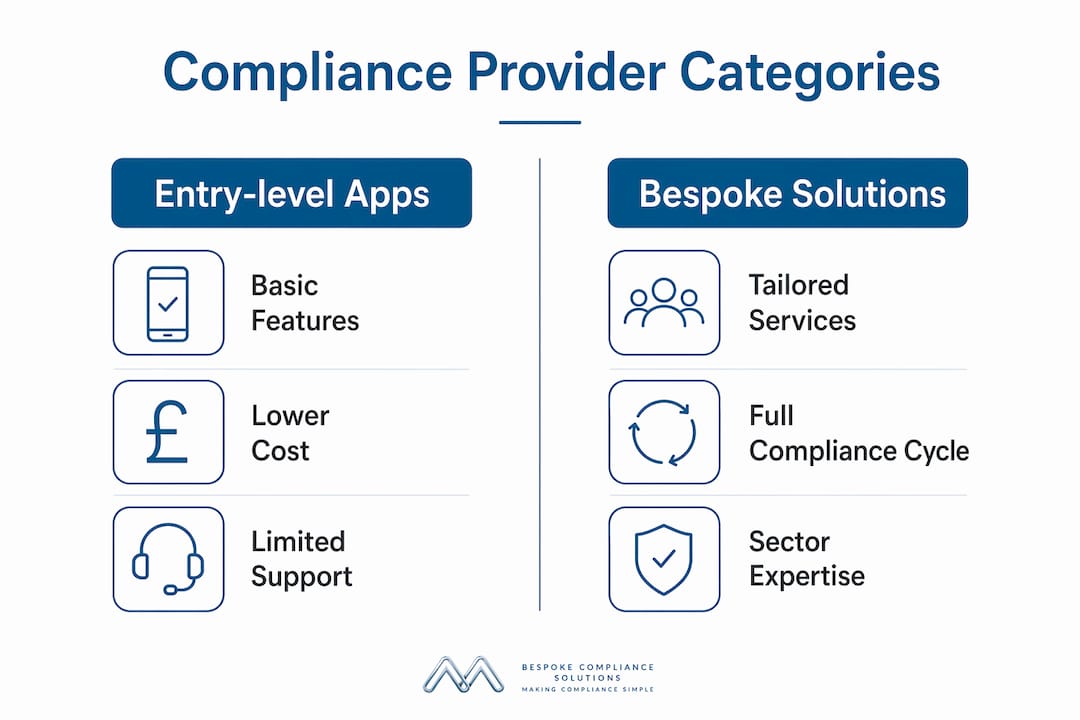
Criteria | Entry-level field apps | Generalist compliance firms | Bespokecompliancesolutions |
Service coverage | Limited, often single-discipline | Broad but standardised | Full portfolio: risk assessments, sampling, disinfections, TMV servicing, logbooks |
Risk-based management | Reactive testing only | Partial risk frameworks | Continuous risk assessment aligned with WHO guidance |
Compliance expertise | Basic | Moderate | Specialist Legionella and water hygiene focus |
UK-wide availability | Regional only | Variable | Confirmed UK-wide |
Customer support | Self-service | Account management | Dedicated consultancy and ongoing support |
Bespokecompliancesolutions works across commercial, healthcare, housing association, retail, and facilities management sectors. Its bespoke logbook system and automated monitoring tools go beyond what most generalist firms offer as standard.

Table of Contents
How do you choose the right water hygiene compliance provider?
What do WHO guidelines say about best practice in water hygiene?
How do customer reviews reveal the quality of compliance providers?
What contract terms and SLAs should you scrutinise before committing?
Bespokecompliancesolutions: a specialist alternative built around your sites
How do you choose the right water hygiene compliance provider?
Selecting a provider is not simply a matter of price. The criteria below reflect what facilities managers and compliance officers consistently find separates reliable partners from those who fall short when an audit arrives.
Technician qualifications: Confirm that all operatives hold a current National Water Hygiene EUSR registration (the “Blue Card”). UK water companies require this for anyone entering clean water sites or working on Restricted Operations, including subcontractors.
Risk-based approach: Providers should implement continuous risk assessment cycles, not just periodic spot-check sampling. Reactive testing alone fails to control ongoing hazards.
Compliance expertise: Look for demonstrated experience with Legionella control, HSE L8 guidance, and water safety plan implementation.
Pricing transparency: Request itemised quotes and ask whether pricing covers all call-outs or charges separately for reactive visits.
Service level agreements: Scrutinise response times, escalation procedures, and what constitutes a breach of the SLA.
Customer reputation: Ask for case studies or references from organisations in your sector, particularly healthcare or commercial premises.
UK-wide coverage: If you manage multiple sites, confirm the provider can service all locations under a single contract.
Pro Tip: Before signing any contract, request a sample audit report. A provider confident in their work will share one readily. If they hesitate, that tells you something about the quality of their documentation.
What do WHO guidelines say about best practice in water hygiene?
WHO guidance is unambiguous: effective water hygiene management depends on a continuous cycle of risk assessment, prioritisation, targeted action, and audit. Spot-check testing alone cannot control ongoing waterborne hazards, and providers who rely on it are leaving your organisation exposed between visits.
Water safety plans are the WHO-recommended framework for this. They require continuous monitoring, documented improvement cycles, and clear accountability at every stage. For UK facilities, this maps directly onto HSE L8 and the associated Approved Code of Practice, which mandates written schemes of control and regular review.
Evidence from WHO’s WASH programme links improved water hygiene management to dramatic reductions in diarrhoeal disease deaths, with progress on safely managed water services playing a key role during the Millennium Development Goal period.
Practical compliance under these standards involves several disciplines working together:
Regular Legionella risk assessments and written schemes of control
Water temperature monitoring (hot water above 50°C at outlets, cold below 20°C)
Routine water sampling and microbiological analysis
Disinfection of water systems following any remedial works
TMV (thermostatic mixing valve) servicing to prevent scalding and control Legionella risk
Legionella awareness training for responsible persons and site staff
Technician qualifications matter here too. EUSR-approved training covers both face-to-face and e-learning formats, delivered by trainers with verified water industry experience. Checking that your provider’s operatives hold current registrations is one of the fastest ways to assess overall compliance quality.
How do customer reviews reveal the quality of compliance providers?
Reputation in the water hygiene sector is built slowly and lost quickly. A single missed Legionella test or an undocumented remedial action can trigger an HSE investigation, so facilities managers rightly treat provider track records as a primary filter.
When reviewing alternatives, look beyond star ratings. Ask specifically whether the provider has experience in your sector. A firm with strong reviews from commercial landlords may have no meaningful experience in NHS settings, where infection control standards and documentation requirements are considerably more demanding. Case studies, named references, and verifiable audit outcomes carry more weight than anonymous testimonials.
Pay attention to how providers respond to negative feedback. A compliance firm that dismisses complaints or offers vague reassurances is unlikely to handle a regulatory challenge any differently. Responsiveness and transparency in public-facing reviews often mirror the quality of internal reporting.
What contract terms and SLAs should you scrutinise before committing?
Contract terms in water hygiene compliance are where many organisations get caught out. The headline price rarely reflects the true cost once reactive call-outs, additional sampling, and emergency disinfections are factored in.
Focus on these specific clauses before signing:
Response times: SLAs should specify maximum response times for both routine visits and emergency situations. For healthcare premises, a 24-hour emergency response is a reasonable minimum expectation.
Scope of works: Confirm exactly which systems are covered. Cooling towers, hot and cold water services, spa pools, and eye-wash stations each carry distinct regulatory obligations. A contract that covers “water hygiene” without specifying systems leaves gaps.
Documentation and reporting: Your provider should supply written reports after every visit, including any remedial actions identified and timescales for resolution. Vague verbal updates are not defensible in an audit.
Exit terms: Check notice periods and what happens to your compliance records if you switch provider. Your logbooks and risk assessment history belong to your organisation, not the contractor.
Bespokecompliancesolutions: a specialist alternative built around your sites
Facilities managers and compliance officers who need more than a standardised service contract will find Bespokecompliancesolutions a genuinely different option. Rather than applying a one-size template, BCS builds its service around your specific sites, systems, and risk profile.
The service portfolio covers the full compliance cycle: Legionella risk assessments in Coventry and across the UK, water sampling and testing, disinfections, TMV servicing, bespoke logbook implementation, and ongoing consultancy. Training is available for responsible persons and site staff, aligned with HSE L8 and WHO best practice. Every solution is tailored to your organisation rather than pulled from a standard catalogue.
BCS operates across commercial, healthcare, housing association, retail, and hotel sectors throughout the UK. If you want a provider that treats your compliance programme as a continuous partnership rather than a series of scheduled visits, contact Bespokecompliancesolutions to discuss your requirements.
Key takeaways
Choosing the right water hygiene compliance provider requires verified technician qualifications, a risk-based management approach, transparent pricing, and clear SLAs rather than simply the lowest quote.
Point | Details |
Risk-based management | WHO recommends continuous assessment and audit cycles, not reactive spot-check testing alone. |
EUSR Blue Card verification | Confirm all provider technicians hold current National Water Hygiene EUSR registration before appointment. |
Contract scrutiny | Check SLA response times, scope of works, documentation obligations, and exit terms before signing. |
Reputation due diligence | Seek sector-specific case studies and references rather than relying on generic star ratings. |
Bespokecompliancesolutions | Offers a full-portfolio, UK-wide, bespoke service covering risk assessments, sampling, training, and ongoing consultancy. |
Recommended
Comments