
Legionella outbreak response plan: business guide
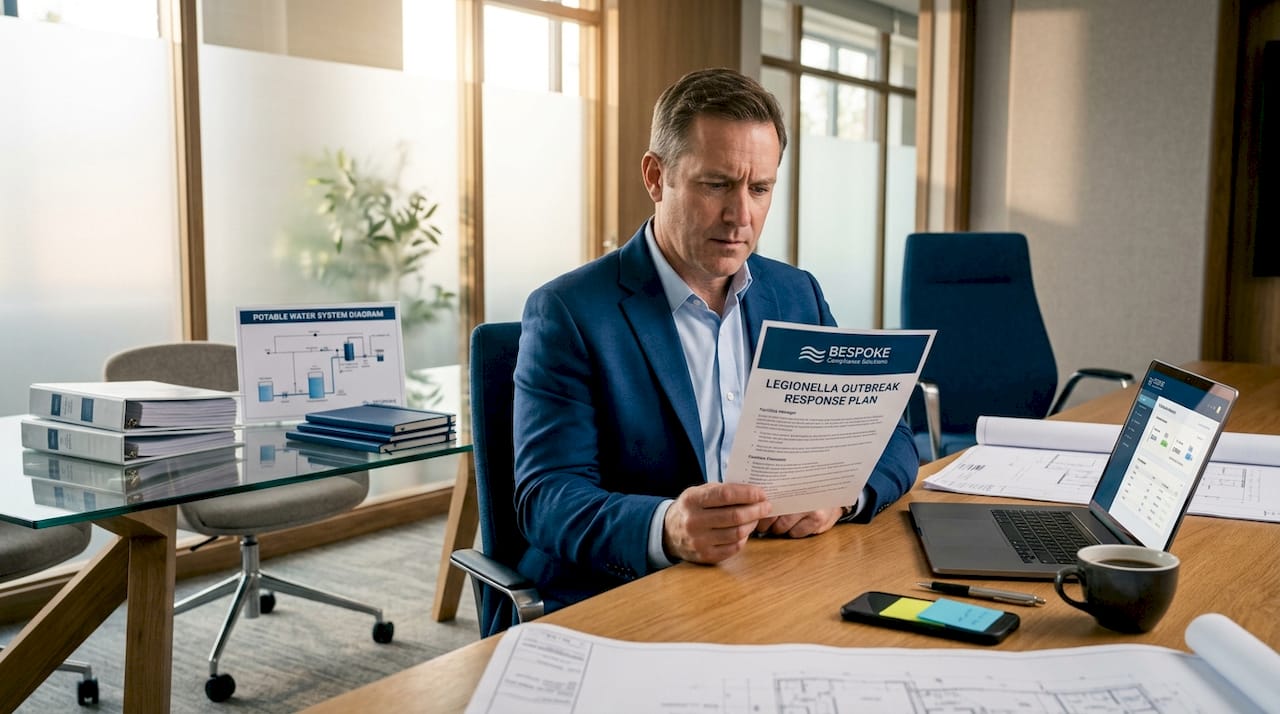
A legionella outbreak response plan is a documented, procedural framework that directs facility managers and compliance officers through the immediate and post-incident actions required to control Legionella pneumophila in building water systems. Known formally as part of a Water Management Programme (WMP), this plan sits at the intersection of public health protection and regulatory compliance under frameworks including ACOP L8 in the UK and ASHRAE 188 in the United States. For commercial and healthcare premises, the absence of a tested, written plan is not simply an administrative gap. It is a legal liability and a direct risk to occupant health.
What does a legionella outbreak response plan require for businesses?
Water Management Programmes are foundational to both Legionella prevention and outbreak response in commercial and healthcare facilities. Before writing a single line of your response plan, the underlying WMP must be in place, documented, and current. Without it, your response plan has no baseline to reference and no monitoring data to support an investigation.
Regulatory expectations in the UK are set by ACOP L8, which defines the legal duty of care for dutyholders managing water systems in non-domestic premises. ASHRAE 188 provides a parallel standard widely referenced in healthcare settings, particularly for facilities with international accreditation requirements. Both frameworks demand that written schemes include corrective action procedures, notification timelines, and defined responsibilities.
The monitoring infrastructure your plan depends on includes:
Temperature logs for hot and cold water distribution, recorded at defined sentinel points
Biocide dosing records where chemical treatment is part of the control scheme
Culture testing results from routine and reactive water sampling
System schematics showing all water storage, distribution, and outlet points
Appointing a competent person with the authority and expertise to execute the plan is a non-negotiable prerequisite under ACOP L8. This individual oversees monitoring, initiates corrective actions, and maintains records. Without a named, trained individual in this role, your plan cannot function under pressure.
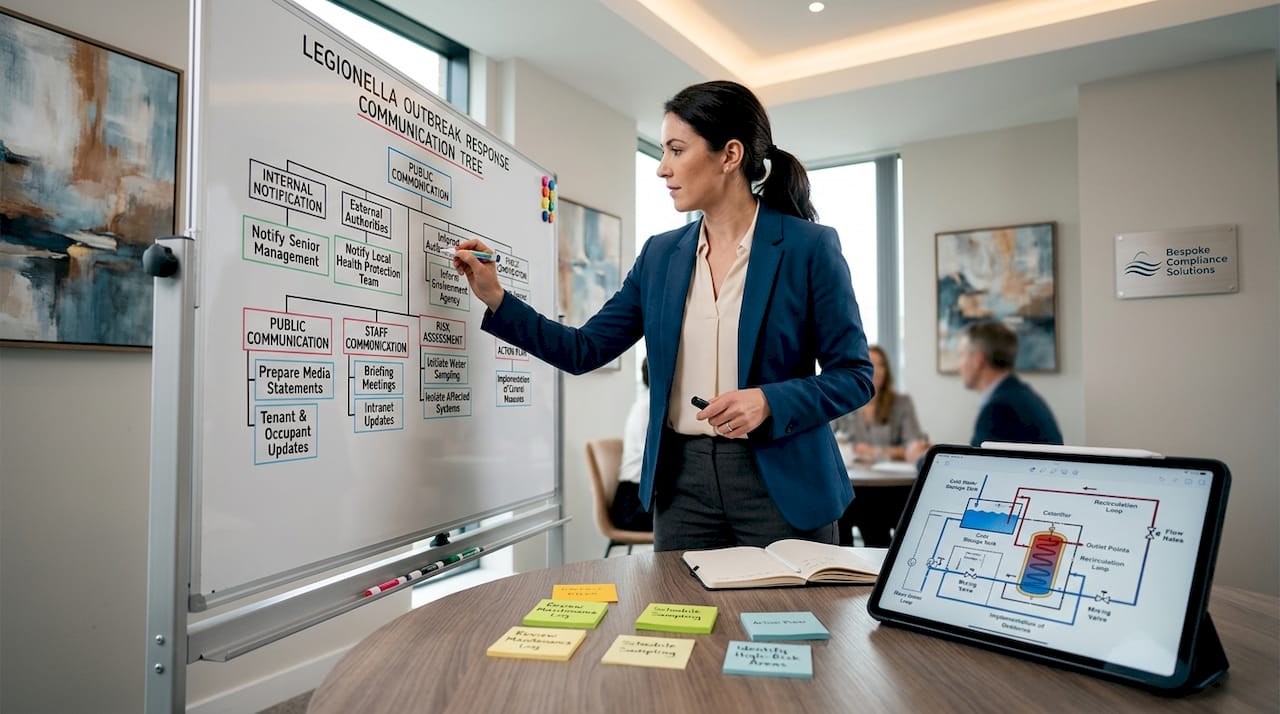
Pro Tip: Establish a clear communication tree before an incident occurs. Name deputies for the competent person role so that absence or unavailability does not stall your response.
Prerequisite | Why it matters |
Current Water Management Programme | Provides the baseline monitoring data investigators will request |
Named competent person | Ensures accountability and continuity during an incident |
Temperature and sampling records | Demonstrates ongoing control and supports root cause analysis |
System schematics | Enables rapid isolation of affected zones during an incident |
Regulatory framework alignment | ACOP L8 and ASHRAE 188 define minimum documentation standards |
How do you develop a step-by-step legionella response plan?
Building a compliant, workable plan follows a defined sequence. Skipping steps or treating this as a template exercise produces a document that fails under real conditions.
Identify and map all risk sources. Conduct or review your legionella risk assessment to catalogue every water system component with the potential to harbour or amplify Legionella. This includes cooling towers, hot and cold water storage tanks, showers, thermostatic mixing valves (TMVs), and any deadleg pipework.
Define control parameters and monitoring frequency. For each risk source, set the acceptable operating range. Cold water must be stored and distributed below 20°C. Hot water must be stored at 60°C and reach outlets at 50°C within one minute. Cold water above 20°C is defined as a loss of primary physical control and must trigger an immediate investigation and remedial response.
Write corrective action procedures for out-of-range events. For every control parameter, specify what happens when a reading falls outside the acceptable range. Who is notified? Within what timeframe? What investigation steps follow? What remedial action is taken, and who authorises it? Vague language at this stage creates confusion during an actual incident.
Specify notification and escalation procedures. Your plan must name the internal and external contacts who are informed at each stage. Internally, this typically includes the facilities director, health and safety lead, and senior management. Externally, it includes the local health protection team and, in healthcare settings, the infection prevention and control team. Define the trigger points that move an event from a monitoring exceedance to a declared incident.
Document the plan within your digital compliance system. Digital compliance software simplifies monitoring task scheduling, evidence capture, and report generation to provide audit-ready documentation quickly. Health departments assess the ability to locate records and trace response actions during investigations. A paper-based system introduces delay and risk at the worst possible moment.
Test the plan. Run a tabletop exercise with your competent person and key stakeholders at least annually. Identify gaps in communication, record access, or technical knowledge before an incident exposes them.
Pro Tip: Your plan should specify response timelines in hours, not days. For a positive Legionella culture result, most competent persons should be initiating remediation within 24 hours of receiving the laboratory report.
How do you execute emergency legionella response procedures effectively?
When a positive culture result or a confirmed case of Legionnaires’ disease is linked to your premises, the response sequence must be immediate and methodical. Speed matters, but so does documentation. Health departments review water management documentation, conduct water source testing, and request monitoring records during investigations. Every action you take from the moment of notification must be recorded with a timestamp.
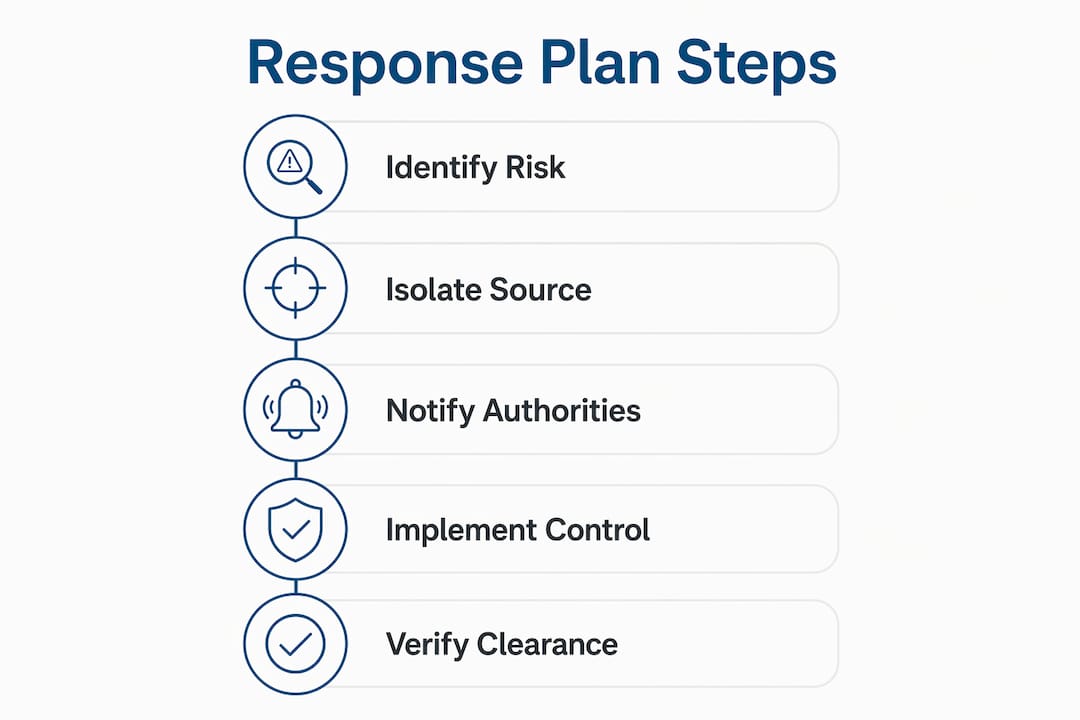
The immediate response steps are:
Isolate the affected system or zone where the positive result or suspected source has been identified. Do not wait for confirmation of a second sample before acting.
Notify the competent person and initiate the escalation chain as defined in your plan. In healthcare settings, the infection prevention and control team must be contacted without delay.
Preserve all recent monitoring records and make them accessible. A defensible response requires an investigation-ready record package with recent logs, corrective histories, and system inventories produced instantly to facilitate health department collaboration.
Commission remediation. Thermal disinfection involves raising water temperature to at least 70°C for five minutes at each outlet. Chemical remediation uses sodium hypochlorite at 50 ppm free chlorine for at least one hour, followed by flushing and confirmation testing. Both methods require documented evidence of completion.
Remediation without verification is not remediation. A single clear sample after treatment does not confirm sustained eradication. Plan for repeat sampling at two and six weeks post-remediation to confirm Legionella clearance before returning systems to full service.
Post-remediation, repeat sampling at two and six weeks is recommended to confirm sustained Legionella clearance rather than relying on a single test. This interval-based approach protects you legally and operationally.
Response stage | Key action | Documentation required |
Positive result received | Isolate affected zone, notify competent person | Timestamped notification log |
Remediation | Thermal or chemical disinfection to specified parameters | Method statement, temperature or dosing records |
Post-remediation sampling | Samples at two and six weeks | Laboratory reports with chain of custody |
Return to service | Confirmation of clear results at both intervals | Written authorisation from competent person |
One common pitfall is sampling too broadly at the outset. Routine sampling of toilets and urinals is not recommended in Legionella investigations unless all other sources have been ruled out. Focus sampling on likely amplification and transmission sources first to avoid wasting time and resources.
How do you maintain your plan to stay compliant and prepared?
A response plan that is written once and filed away is not a compliance asset. It is a liability. Plans must be reviewed and updated in response to specific triggers, not just on an annual calendar basis.
The events that must prompt a plan review include:
System modifications, such as new pipework, additional outlets, or changes to water treatment
Extended shutdowns or low occupancy periods, which increase stagnation risk and require flushing and disinfectant maintenance before return to full use
Positive culture results, even where no clinical case is confirmed
Staff changes affecting the competent person role or the escalation chain
Post-incident reviews that identify gaps in the previous plan’s performance
ACOP L8 mandates that dutyholders retain records of risk assessments, monitoring results, and control schemes for a minimum of five years. Written schemes must include corrective actions and records of out-of-range monitoring results. This five-year retention requirement means your digital or physical record system must be structured to retrieve historical data by date, location, and parameter type.
Training is the other maintenance pillar that facilities teams underestimate. The competent person must receive formal Legionella awareness training, but so must the wider team who conduct routine monitoring checks. Knowing how to complete temperature monitoring checks correctly and record results accurately is the foundation on which your entire response plan rests. A poorly recorded temperature log is as damaging as no log at all during an investigation.
Key takeaways
A legionella outbreak response plan works only when it is integrated within a live Water Management Programme, supported by named competent persons, and backed by audit-ready records that can be produced instantly during a health department investigation.
Point | Details |
Integration with WMP | Your response plan must sit within a current, documented Water Management Programme to be defensible. |
Competent person appointment | ACOP L8 requires a named, trained individual with authority to initiate and oversee all response actions. |
Remediation verification | Repeat sampling at two and six weeks post-treatment confirms sustained Legionella clearance. |
Record retention | ACOP L8 requires a minimum of five years’ retention for monitoring results and corrective action records. |
Plan review triggers | System changes, positive cultures, and post-incident reviews must each prompt a formal plan update. |
Why most outbreak plans fail before the incident starts
The plans I see most often in commercial and healthcare facilities share a common flaw. They are written to satisfy an audit, not to function under pressure. The escalation chain names a facilities manager who left the organisation two years ago. The remediation section references a contractor without a current service agreement. The temperature logs exist, but they are stored in a spreadsheet on someone’s desktop rather than a system that can be accessed and exported within minutes.
What I have found, working across commercial and healthcare premises, is that the gap between a compliant plan and an effective plan comes down to two things: speed of documentation and clarity of escalation. When a health protection team calls, you have hours to produce records, not days. The facilities teams that handle investigations well are the ones who have practised retrieving their records, not just creating them.
The other insight that rarely appears in standard guidance is that outbreak plans should be stress-tested against your worst-case scenario, not your average one. What happens if the incident occurs during a bank holiday weekend? What if your competent person is on annual leave? What if the affected system serves a critical care ward? Build those scenarios into your tabletop exercises and your plan will be genuinely fit for purpose.
Treat your response plan as a living document, reviewed after every significant event and updated whenever your water system changes. The businesses that manage Legionella incidents without reputational or legal damage are the ones that prepared before the phone rang.
— Sammi
How Bespokecompliancesolutions supports your outbreak planning
Bespokecompliancesolutions works with facility managers and compliance officers across commercial and healthcare premises to build outbreak response plans that are genuinely fit for purpose, not just audit-ready on paper. From bespoke legionella risk assessments tailored to your specific water systems, to full system disinfection and flushing services when remediation is required, the team provides end-to-end support across every stage of your compliance programme. Bespokecompliancesolutions also implements bespoke logbook systems and compliance method of works documentation to give you the audit-ready records that investigations demand. If your current plan needs reviewing or you are building one from scratch, contact Bespokecompliancesolutions to discuss a solution built around your sites.
FAQ
What is a legionella outbreak response plan?
A legionella outbreak response plan is a documented procedure within a Water Management Programme that defines the immediate actions, remediation steps, notification timelines, and record-keeping requirements a business must follow when Legionella is detected or a case of Legionnaires’ disease is linked to its premises.
How long must legionella records be kept under ACOP L8?
ACOP L8 requires dutyholders to retain records of risk assessments, monitoring results, and corrective actions for a minimum of five years. This includes all out-of-range readings and the remedial actions taken in response.
What temperature triggers a legionella response in cold water systems?
Cold water stored or distributed above 20°C is defined as a loss of primary physical control under ACOP L8 guidance. This exceedance must trigger an immediate investigation and documented remedial response.
Should you sample toilets and urinals during a legionella investigation?
Routine sampling of toilets and urinals is not recommended during Legionella investigations unless all other likely sources have been ruled out. Investigations should focus first on water systems known to generate aerosols, such as showers, cooling towers, and hot water outlets.
How many post-remediation samples are needed to confirm clearance?
A single clear sample is not sufficient to confirm sustained Legionella eradication. Repeat sampling at two and six weeks after remediation is recommended to verify that the treatment has been effective before returning the system to full service.
Recommended
Comments