
Legionella risk assessment cost in England: 2026 guide
A professional legionella risk assessment for a standard domestic rental in England typically costs an amount within a moderate price range. Small commercial sites cost more, and complex properties such as care homes, hotels, or sites with cooling towers generally have higher assessment costs, with enterprise or multi-site contracts priced individually.
If your water system is straightforward (a single cold-water tank, no cooling tower, no thermostatic mixing valves), you may be able to carry out the assessment yourself provided you are genuinely competent. If you have any doubt about system complexity, book a professional site visit. Either way, the legal duty sits with you as the dutyholder under the Control of Substances Hazardous to Health Regulations, and ACOP L8 sets the standard your assessment must meet.
At a glance:
Studio or 1–2 bed rental: typical lower-range cost
3–4 bed rental or small HMO: moderate cost reflecting some complexity
Larger HMO (5+ rooms): higher range due to more outlets
Small commercial (office, retail, GP surgery): increased cost related to commercial risk
Medium commercial (hotel, school, care home): higher costs due to system complexity and vulnerable occupants
Complex/enterprise (cooling towers, large estates): highest costs generally associated with complex systems and multiple sites
Key takeaways
A legionella risk assessment for a standard domestic rental in England costs £75–£200; complex commercial sites range from £400 to £2,000+, with system complexity the primary pricing variable.
Point | Details |
Domestic cost range | Expect £75–£200 for a standard rental; HMOs typically cost £300 depending on outlet count. |
Commercial cost range | Small commercial sites run £400; care homes and hotels typically reach £400–£1,200 or more. |
Competence rule | Landlords may self-assess simple systems, but complex systems, healthcare settings, and cooling towers require an external competent person under ACOP L8. |
What to check in a quote | Confirm a physical site visit, written control scheme, schematic drawing, and UKAS-accredited sampling are included before accepting any price. |
Bespokecompliancesolutions | Provides fixed-price assessments, UKAS-accredited sampling, TMV servicing, and training across England, with multi-site programmes available. |
Table of Contents
How much does a legionella risk assessment cost by property type?
What does a professional legionella risk assessment actually include?
Who can carry out the assessment, and when must you hire a specialist?
How often do you need a review, and what are the ongoing costs?
Bespokecompliancesolutions: fixed-price assessments across England
How much does a legionella risk assessment cost by property type?
Pricing depends largely on system complexity rather than simply building size, though property type remains a useful way to consider budgeting.
Property type | Typical pricing considerations | Key cost driver |
Studio / 1–2 bed rental | a lower typical range | Simple cold-water system, no tanks |
3–4 bed rental | a moderate range | One cold-water storage tank, basic outlets |
5+ bed / small HMO | higher price range | Multiple outlets, shared facilities |
Small office or retail unit | moderate price range | Low outlet count, single tank |
GP surgery / dental practice | higher range | Clinical risk, TMVs, sentinel outlets |
Hotel (small, up to 30 rooms) | elevated price range | High outlet count, calorifiers, records |
Care home | higher-end pricing | Vulnerable occupants, TMVs, full written scheme |
Site with cooling tower | highest typical costs | Cooling tower risk assessment, Legionella sampling |
Multi-site / enterprise | bespoke pricing | Travel, mobilisation, volume discount |
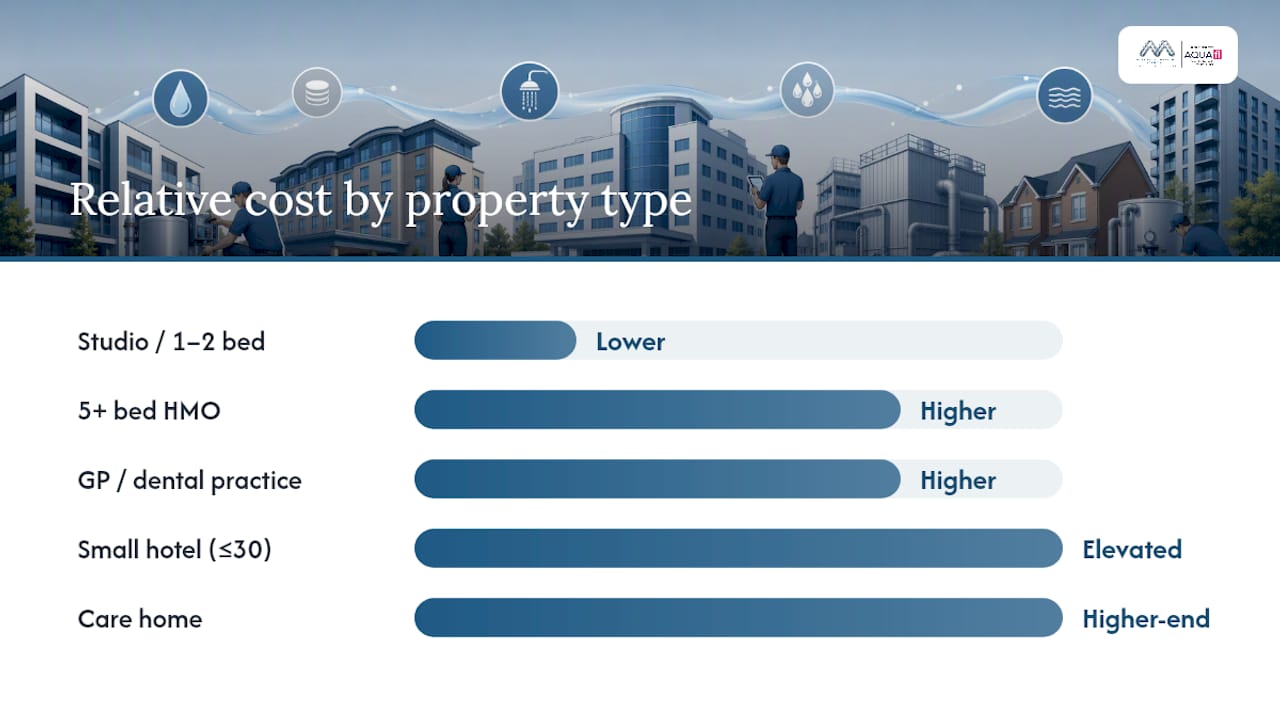
A few points worth noting. HMOs attract a price uplift over standard single-lets because shared facilities multiply the outlet count and management responsibilities. Clinical settings such as GP surgeries and dental practices sit at the higher end of the small-commercial band because HSG274 recommends closer monitoring of sentinel outlets and TMVs. Care homes and hotels carry the highest domestic-to-medium-commercial price tags because vulnerable occupants, calorifiers, and the volume of records required all add time.
For legionella compliance in offices and commercial premises, the written control scheme and monitoring schedule are typically more detailed than for residential settings, which pushes the fee toward the upper end of the commercial band.
What drives the price up or down on any quote?
The single biggest variable is system complexity, specifically the number of outlets, tanks, calorifiers, cooling towers, and thermostatic mixing valves (TMVs) the assessor must inspect and record. A flat with a combi boiler and no storage tank takes a fraction of the time a Victorian building with a cold-water storage tank, a calorifier, and twelve TMVs requires.
Primary cost drivers:
Outlet count: every tap, shower, and sentinel point adds inspection time
Cold-water storage tanks and calorifiers: each requires visual inspection, temperature checks, and records
Cooling towers: trigger a separate risk assessment and mandatory Legionella water testing under the Notification of Cooling Towers and Evaporative Condensers Regulations
TMVs: require individual inspection and servicing records
Travel and access: remote sites or properties requiring specialist access equipment add mobilisation costs
Sampling and laboratory analysis: UKAS-accredited sampling adds £50–£200+ per sample depending on test type
Urgency: same-day or next-day turnaround typically carries a premium of 20–50% over standard lead times
Accreditation and insurance: assessors carrying relevant professional indemnity and public liability insurance price slightly higher, but that cost is justified
What you can reduce or avoid:
Bundle multiple properties into a single visit to amortise travel costs across the portfolio
Avoid agency markups by contracting directly with the assessor
Provide accurate system information upfront (outlet count, tank locations, existing records) to cut survey time
Pro Tip: A slightly higher fee is often worth paying when it includes UKAS-accredited sampling, schematic drawings, and a fully populated action log. These deliverables are what stand up to HSE scrutiny; a cheap paper-only report often does not.
What does a professional legionella risk assessment actually include?
A compliant assessment is not a form-filling exercise. HSE guidance on identifying and assessing sources of risk sets out the practical elements a dutyholder must cover, and a professional assessor should deliver all of them.
Site survey tasks:
Physical inspection of all water outlets, storage tanks, calorifiers, and pipework
Temperature checks at sentinel hot and cold outlets
Visual inspection for dead legs, infrequently used outlets, and biofilm risk
Review of existing management arrangements and maintenance records
Identification of at-risk occupants (elderly, immunocompromised, young children)
Written deliverables:
Written risk assessment report with findings and risk ratings
Written control scheme (required under ACOP L8 for higher-risk systems)
Monitoring schedule specifying frequencies for temperature checks, flushing, and inspections
Schematic drawing of the water system
Action log with prioritised remedial recommendations
Records template or logbook for ongoing compliance
Sampling and laboratory analysis is not automatically included in every assessment. For low-risk domestic systems it is often optional. For clinical settings, care homes, hotels, and any site with a cooling tower, sampling is strongly recommended and in some cases required. When sampling is included, check that the laboratory holds UKAS accreditation.
Use this checklist when reviewing a provider’s deliverable list:
[ ] Physical site survey (not a desktop or template-only assessment)
[ ] Written risk assessment report
[ ] Written control scheme (for higher-risk systems)
[ ] Monitoring schedule
[ ] Schematic drawing
[ ] Action log with remedial priorities
[ ] Records template or logbook
[ ] UKAS-accredited sampling (where applicable)
You can also use Bespokecompliancesolutions’s guide on reviewing a legionella risk assessment to check whether an existing report meets ACOP L8 requirements.
Who can carry out the assessment, and when must you hire a specialist?
HSE guidance on landlords’ responsibilities is clear: dutyholders must carry out a suitable and sufficient assessment, and for simple domestic systems a landlord may be competent to do this themselves. The operative word is competent.
In practice, competence for a basic domestic system means understanding how the water system works, knowing which outlets are at risk, being able to identify dead legs and infrequently used outlets, and keeping adequate records. A landlord with a single flat served by a combi boiler and mains-fed cold water can reasonably self-assess using the HSE dutyholder guide INDG458 as a reference.
Situations that typically require an external competent person:
Any system with a cold-water storage tank, calorifier, or cooling tower
Healthcare settings, care homes, or any site with immunocompromised occupants
HMOs with shared facilities and high occupant turnover
Sites where the dutyholder cannot demonstrate relevant training or experience
Properties where a previous assessment identified significant risks requiring a written control scheme
Competence checklist when choosing an external assessor:
[ ] Relevant training certificate (City & Guilds, BOHS P901, or equivalent)
[ ] Membership of a recognised scheme (check SNIPEF certification schemes or equivalent)
[ ] Adequate professional indemnity and public liability insurance
[ ] Experience with your property type (residential, clinical, hospitality)
[ ] UKAS-accredited sampling capability (for higher-risk sites)
Pro Tip: Ask for the assessor’s CV or training certificates before booking. A credible assessor will provide these without hesitation; one who cannot is a red flag regardless of price.
How often do you need a review, and what are the ongoing costs?
The assessment is not a one-off purchase. ACOP L8 requires dutyholders to review the assessment whenever there is reason to believe it may no longer be valid, and at regular intervals regardless.
Typical review frequencies:
Low-risk domestic (combi boiler, no tank): review when the system changes or occupancy pattern changes significantly; no fixed interval but good practice suggests every 2 years
Standard residential with cold-water tank: annual review recommended; full reassessment every 2 years
Commercial and higher-risk settings: annual reassessment as a minimum; some sectors (healthcare, hospitality) require more frequent reviews
Ongoing budget items to plan for:
Routine temperature monitoring (monthly for hot and cold sentinel outlets): staff time or contractor cost
Periodic water sampling: £50–£200+ per sample, UKAS lab fees additional
TMV servicing: typically £30–£80 per valve per service visit
Logbook maintenance and record-keeping: staff time
Legionella awareness training for responsible persons: one-off or periodic refresher
For a portfolio landlord with ten properties, scheduling assessments in batches cuts the per-property cost. An assessor who can visit several properties in the same area on the same day will price the travel element once rather than ten times.
How to get a comparable quote: checklist and template
Getting three quotes that are genuinely comparable requires giving each assessor the same information. Vague requests produce vague prices.
What to include in your quote request:
Property address and type (residential, commercial, clinical)
Number of water outlets (taps, showers, sentinel points)
Number and type of storage vessels (cold-water tanks, calorifiers, expansion vessels)
Number of TMVs
Presence of any cooling towers or evaporative condensers
Access notes (locked plant rooms, height restrictions, occupied or vacant)
Existing records available (previous assessment, logbook, schematic)
Required turnaround time
Questions to ask each assessor:
What qualifications and training do you hold?
Are you covered by professional indemnity and public liability insurance?
Is sampling included, and is your laboratory UKAS-accredited?
What written deliverables will I receive, and in what format?
What is your standard turnaround from site visit to report?
Is the price fixed, or are there conditions that would change it?
Sample quote request (copy and adapt):
Red flags in a quote:
No mention of a physical site visit
No written control scheme in the deliverables
No evidence of relevant training or accreditation
A price so low it cannot cover travel, survey time, and report writing
Sample scenarios: what you might actually pay
These figures are illustrative ranges based on typical market rates in England. Actual prices depend on system complexity, location, and provider.
A studio flat with a combi boiler sits at the low end because there is no storage tank and the outlet count is minimal. The 6-room HMO costs roughly twice as much as a single-let not because it is twice the size, but because shared bathrooms, a cold-water tank, and the management records required under HMO licensing all add scope. The care home figure reflects the specific risks to immunocompromised occupants and the fuller written scheme that ACOP L8 requires for higher-risk settings.
Prices are illustrative only. Request an itemised fixed quote for your specific property.
Why prices vary across England: a market perspective
Demand for legionella assessments in England is not uniform. Areas with high concentrations of HMOs, care homes, and NHS facilities generate more assessor workload, which can tighten supply and push rates upward. Local authority enforcement focus also matters: councils actively pursuing HMO licensing compliance or care home inspections create a surge in demand that independent assessors price accordingly.
UKAS accreditation for sampling laboratories adds a genuine cost premium, but it is one that holds up under HSE scrutiny in a way that non-accredited sampling does not. Assessors who invest in accreditation, professional indemnity insurance, and ongoing training carry higher overheads, and their quotes reflect that.
Turnaround times vary too. A straightforward residential assessment can typically be completed within 5–10 working days from site visit to report. Complex commercial sites, particularly those requiring UKAS sampling with laboratory analysis, may take 2–4 weeks. If you need a rapid response, providers covering areas such as London can often offer same-day or next-day site visits for urgent compliance needs.
The real cost of getting this wrong
The cheapest quote is rarely the best value, and the gap between a compliant assessment and a paper-only exercise is wider than most landlords and facilities managers realise.
A desktop or template-based assessment that skips the physical site survey, omits schematic drawings, and uses a non-accredited laboratory for sampling leaves you holding a document that looks like compliance but would not survive an HSE inspection or, worse, a coroner’s inquest. Legionnaires’ disease is a serious, potentially fatal respiratory illness. The legal duty to assess and control the risk is not a box-ticking exercise; it is a genuine health protection obligation underpinned by COSHH regulations.
That said, spending more does not automatically mean better compliance. A well-structured assessment for a simple single-let at £120 from a competent, insured assessor is worth more than a £400 report from a firm that cannot explain what a written control scheme is.
The practical test is this: can the assessor show you their qualifications, name their sampling laboratory and its accreditation, and hand you a deliverable list that matches what ACOP L8 requires? If yes, the price is secondary. If not, move on regardless of how low the quote is.
Bespokecompliancesolutions: fixed-price assessments across England
Legionella compliance does not need to be complicated or expensive, but it does need to be done properly.
[
Bespokecompliancesolutions delivers legionella risk assessments for residential landlords, HMO operators, commercial property managers, healthcare providers, and housing associations across England, including Bedford, Bedfordshire, Berkshire, Buckinghamshire, and the City of London. Every assessment includes a physical site survey, written risk assessment report, written control scheme, monitoring schedule, schematic drawing, and action log. UKAS-accredited water sampling and analysis, TMV servicing, logbook implementation, and legionella awareness training are available as part of a complete compliance package.
For a fixed-price quote, supply your property address, outlet count, number of storage tanks, TMV count, and any existing records. Multi-site portfolios qualify for scheduled assessment programmes that reduce the per-property cost. Contact Bespokecompliancesolutions directly to request an itemised quote or discuss a rolling compliance plan for your portfolio.
Sources
Official guidance and legislation you should consult or cite when making or defending compliance decisions:
This article is general information, not a substitute for advice from a qualified doctor. Consult a qualified healthcare professional about your own circumstances before acting on anything here.
FAQ
Can a plumber do a legionella risk assessment?
A plumber can carry one out only if they are genuinely competent, meaning they hold relevant training (such as BOHS P901 or City & Guilds), understand legionella control principles, and can produce a written risk assessment and control scheme that meets ACOP L8. Being a qualified plumber alone does not satisfy the competence requirement.
Can I do my own legionella risk assessment?
Yes, for a simple domestic system such as a flat served by a combi boiler with no cold-water storage tank. HSE guidance confirms that a landlord may self-assess provided they are competent to identify risks and control measures. For any system with a storage tank, TMVs, or higher-risk occupants, an external competent person is strongly advisable.
Do I need a legionella risk assessment in the UK?
Yes. The duty applies to all employers and those with control of premises under COSHH regulations and the Health and Safety at Work etc. Act 1974. Residential landlords are included. Even where risk is judged low, INDG458 confirms that records of the assessment and any review must still be kept.
How much do legionella risk assessors get paid?
Legionella assessors’ salaries and freelance day rates vary depending on experience, sector, and qualifications. Senior consultants in healthcare or industrial settings command higher rates, which contributes to the higher cost of professional assessments compared to basic template reports.
How often should a legionella risk assessment be reviewed?
ACOP L8 requires a review whenever the assessment may no longer be valid, for example after a change to the water system, a change in use, or a significant change in occupancy. For commercial and higher-risk settings, an annual review is standard practice; for low-risk domestic systems with no storage tank, a review every two years is generally considered reasonable good practice.
Recommended
Comments