
Prepare legionella compliance evidence for inspectors

Legionella compliance evidence is the documented proof that your water safety risk controls are properly assessed, implemented, and recorded. When an inspector arrives, whether from the Health and Safety Executive, a local authority, or a sector-specific regulator, they are not looking for a certificate on the wall. They are looking for written records demonstrating that your risk assessment, written scheme, monitoring logs, and remedial action records reflect genuine, ongoing control. Knowing how to prepare legionella compliance evidence for inspectors means assembling a coherent, verifiable pack that tells the story of your water safety management from assessment through to corrective action.
What documents and records inspectors expect to see
The foundation of any inspection-ready evidence file is the written risk assessment. Under the Approved Code of Practice ACOP L8, this document must identify all water systems, assess the risk of Legionella proliferation, and be carried out or reviewed by a competent person. A risk assessment that is more than two years old, or one that has not been updated following significant changes to the building or its systems, will not satisfy an inspector. It is not a one-time exercise. It is a living document.
Beyond the risk assessment, inspectors expect a written scheme of control. This document specifies the control measures in place, the monitoring tasks required, the frequencies at which they must be carried out, and the named responsible persons accountable for each task. Without a written scheme, there is no baseline against which your monitoring logs can be judged.
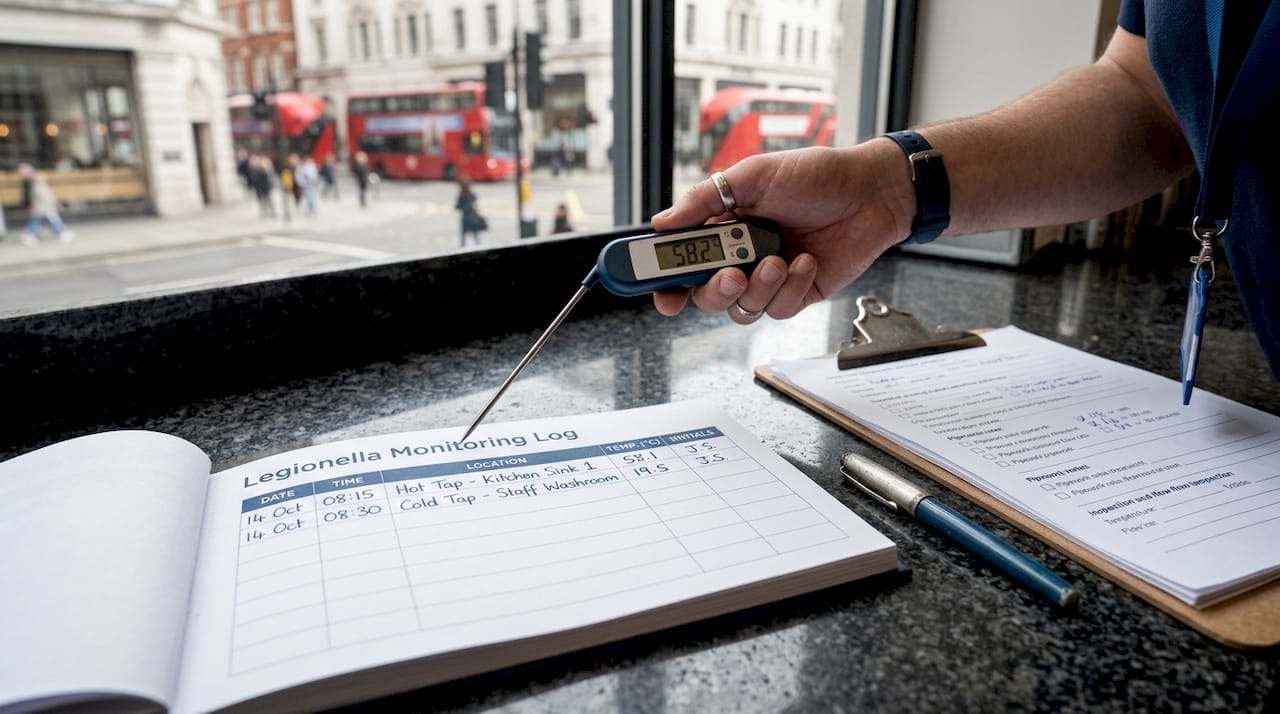
The monitoring logbook is where compliance becomes visible. Logbooks must contain temperature readings, flushing records for infrequently used outlets, cleaning and descaling records, water sample results, and remedial action records. ACOP L8 guidance requires these records to be retained for a minimum of five years. In healthcare settings, Health Technical Memorandum HTM 04-01 goes further, requiring water safety records to be retained for the lifetime of the asset, which in practice means decades rather than years.
The table below summarises the core document types inspectors review and what each must demonstrate:
Document | What it must demonstrate |
Written risk assessment | Competent assessment of all water systems, dated and reviewed |
Written scheme of control | Specific tasks, frequencies, responsible persons, and control targets |
Monitoring logbook | Complete, accurate, and chronologically filed operational records |
Remedial action records | Documented response to every adverse finding, with closure confirmation |
Competence and training records | Qualifications, authorisation letters, and training certificates for responsible staff |
Training and competence records are frequently overlooked. Authorisation records and training certificates for the Responsible Person and any Competent Person involved in monitoring must be kept and readily available. An inspector who cannot verify that the person taking temperature readings is trained to do so will treat every reading in that logbook with scepticism.
Pro Tip: Create a document register as a single-page index at the front of your evidence pack, listing each document, its version date, and its location. This alone can reduce inspection review time significantly and signals to the inspector that your organisation takes compliance seriously.
How to organise your evidence pack for inspection readiness
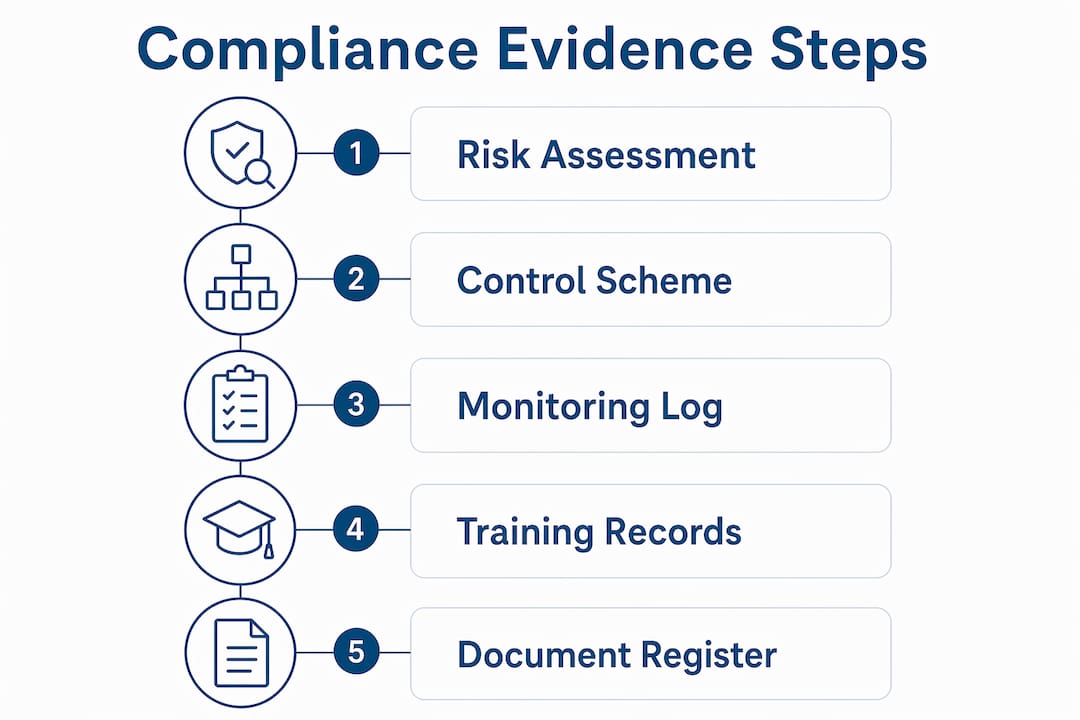
A well-organised evidence pack mirrors the sequence in which an inspector works through a site. A logical evidence index covering risk assessment and scheme, monitoring logs, sample results, and remedial action records allows an inspector to verify compliance efficiently and demonstrates that you understand the control loop, not just the paperwork.
Follow this sequence when assembling your pack:
Place the current written risk assessment and written scheme of control at the front, with version dates clearly visible.
File monitoring logs chronologically, with the most recent records on top and any gaps clearly annotated with an explanation.
Cross-reference laboratory certificates for water samples against the specific sampling points listed in your scheme, so the inspector can trace each result back to a defined location.
Include a remedial action register that links every adverse finding to a corrective action, a responsible person, a completion date, and a close-out confirmation.
Attach competence records for all staff involved in monitoring or control tasks, including any contractor documentation.
Add a review log showing when the risk assessment and scheme were last reviewed and by whom.
The comparison below illustrates the practical difference between paper-based and digital record-keeping approaches:
Approach | Strengths | Limitations |
Paper logbooks | Familiar, no technology dependency, legally accepted | Prone to gaps, difficult to search, risk of loss or damage |
Digital compliance systems | Automated audit trails, timestamped entries, rapid report generation | Requires validation, supporting policies, and staff training to be credible |
Digital systems can accelerate evidence compilation, but they do not substitute for proper procedures. An automated temperature monitoring system that generates reports without a validated calibration record or a supporting policy document will not satisfy an inspector. The technology supports the evidence. It does not replace it.
Pro Tip: Set calendar-triggered reviews for your risk assessment and written scheme. A review prompt every twelve months, or immediately following any significant system change, prevents the single most common compliance gap: an out-of-date assessment.
How to maintain compliance evidence across multiple sites
Managing evidence quality across a portfolio of sites, whether a housing association with dozens of properties or a facilities management contract covering commercial and educational buildings, requires a structured approach to roles and responsibilities. Documenting responsible persons with clear authority at each site is as important as the monitoring data itself. An inspector reviewing a multi-site portfolio will check that each site has a named, trained, and authorised individual accountable for water safety.
Key practices for maintaining compliance evidence across sites include:
Maintaining a central competence register that maps each site to its Responsible Person, their training dates, and their authorisation letter.
Using a standardised logbook format across all sites while allowing for site-specific risk entries, so records are consistent and comparable.
Scheduling internal audits on a rolling basis, reviewing two or three sites per month rather than attempting a portfolio-wide review once a year.
Retaining contractor documentation alongside in-house records. When external specialists carry out tasks such as tank cleaning or TMV servicing, their method statements, risk assessments, and completion certificates must be filed within the relevant site’s evidence pack.
For healthcare premises compliance, applying HTM 04-01 retention requirements across the board rather than only to NHS-managed buildings, since many private healthcare and care home operators face the same regulatory scrutiny.
Legionella compliance in schools and educational buildings presents a specific challenge: seasonal shutdowns create extended periods of low or no water use, which must be managed and documented through flushing regimes and re-commissioning records before the building reopens. These records are frequently missing from school evidence packs and are a common trigger for enforcement notices.
Pro Tip: Before any planned inspection, run a pre-inspection readiness check using your written scheme as the checklist. Every task listed in the scheme should have a corresponding, complete record in the logbook. Any gap you find before the inspector does is a gap you can address.
What to do when gaps appear during your compliance audit
Gaps in compliance evidence are not automatically a sign of failure. They become a problem when they are undocumented, unexplained, or accompanied by implausible or backfilled records. Inspectors treat missing temperature readings, absent remedial action records, and physically impossible readings as evidence that the control scheme is not being followed, not just that paperwork has been mislaid.
When you identify gaps during your internal audit preparation, follow these steps:
Document every gap honestly in a corrective action log, noting the nature of the gap, the period it covers, and the likely cause.
Investigate whether the gap reflects a genuine lapse in monitoring or a record-keeping failure, since the remediation approach differs for each.
Develop a time-bound remediation plan with named responsible persons and realistic completion dates.
Where a gap reflects a genuine period of unmonitored risk, carry out a retrospective risk review and document your conclusions.
Use the gap as a trigger for targeted staff training on record keeping, since most record-keeping failures trace back to unclear expectations rather than deliberate neglect.
Inspectors prioritise evidence that risk control schemes are not only written but actively followed. Honest, evolving logs with documented corrections carry more weight than a perfect-looking template with no evidence of real operational activity.
Evidence must be retrievable and timestamped, illustrating that schemes are followed in practice. If you discover a significant gap close to an inspection date, contact the inspector proactively and present your corrective action plan. Regulators consistently respond more favourably to organisations that demonstrate awareness and active remediation than to those who appear to have noticed nothing.
Key takeaways
Effective legionella compliance evidence preparation requires a complete, indexed, and verifiable documentation pack that demonstrates real-time implementation of risk controls, not just written policies.
Point | Details |
Core documents required | Risk assessment, written scheme, monitoring logbook, remedial records, and competence evidence form the minimum evidence set. |
Retention periods vary | Standard ACOP L8 retention is five years; healthcare settings under HTM 04-01 require lifetime asset retention. |
Organisation matters as much as content | An indexed pack mirroring inspector review order reduces verification time and signals operational competence. |
Gaps must be documented honestly | Undocumented gaps are treated as scheme failure; a corrective action log with timelines demonstrates active control. |
Multi-site management needs structure | A central competence register and rolling internal audits are the backbone of portfolio-wide evidence quality. |
What I have learned about inspectors and evidence packs
After working with compliance officers across commercial, healthcare, and housing portfolios, the pattern I see most often is this: organisations that struggle with inspections rarely have a monitoring problem. They have an organisation problem. The temperature readings exist. The sample results are filed somewhere. The remedial actions were taken. But none of it is connected, indexed, or retrievable in a way that tells a coherent story.
Inspectors are not trying to catch you out. They are trying to answer one question: does this organisation understand its water safety risks and is it actually managing them? A logbook with an honest annotation explaining why a reading was missed, followed by a documented corrective action, answers that question far more convincingly than a logbook with no gaps and no annotations at all. Perfect records with no evidence of real operational life raise suspicion, not confidence.
The organisations I have seen handle inspections best are those where staff at every level understand why the records matter, not just that they need to be completed. When a maintenance technician understands that their temperature log is the evidence that a vulnerable person in a care home or a student in a university hall was not exposed to Legionella risk, the quality of that record changes. Training is not a compliance box to tick. It is the mechanism by which your evidence pack becomes credible.
Technology helps, but only when it is embedded in a clear process. Automated monitoring systems that feed into a validated digital record are genuinely powerful tools for inspection readiness. The organisations that use them well are those that also have a policy document explaining how the system works, how it is calibrated, and what happens when an alert is triggered.
— Sammi
How Bespokecompliancesolutions supports your inspection preparation
Bespokecompliancesolutions works with compliance officers and facility managers across healthcare, housing, commercial, and educational sectors to build and maintain inspection-ready evidence packs. The team provides bespoke Legionella risk assessments, implementation of written control schemes, and bespoke logbook systems tailored to your specific sites and risk profiles. For organisations managing water system cleanliness as part of their evidence programme, professional tank cleaning and disinfection services generate the completion certificates and method statements your evidence pack requires. Where continuous monitoring is needed, automated temperature monitoring solutions provide timestamped, validated records that satisfy inspector scrutiny. Contact Bespokecompliancesolutions to discuss a compliance programme built around your organisation’s sites and inspection requirements.
FAQ
What documents do inspectors look for in a Legionella compliance inspection?
Inspectors expect a written risk assessment, a written scheme of control, monitoring logbooks with temperature and flushing records, remedial action records, and competence evidence for responsible staff. Compliance is demonstrated through these written records, not through certificates alone.
How long must Legionella compliance records be kept?
ACOP L8 requires a minimum retention period of five years for logbook records. Healthcare facilities operating under HTM 04-01 must retain water safety records for the lifetime of the asset, which routinely extends to several decades.
What happens if there are gaps in my Legionella monitoring records?
Gaps, implausible readings, and absent remedial records are treated by inspectors as evidence of scheme failure. Document every gap honestly in a corrective action log, investigate the cause, and present a time-bound remediation plan.
Is a digital compliance system sufficient for inspection purposes?
Digital systems can accelerate evidence compilation and provide timestamped audit trails, but they require validation records and supporting policies to be credible. A digital system without a calibration record or a documented alert-response procedure will not satisfy an inspector on its own.
How do I manage Legionella compliance evidence across multiple sites?
Maintain a central competence register mapping each site to its named Responsible Person, use a standardised logbook format across all sites, and conduct rolling internal audits rather than annual portfolio reviews. Contractor documentation must be filed within each site’s evidence pack alongside in-house records.
Recommended
Comments