
Water compliance gap analysis: a practical guide for facilities

A compliance gap analysis for water systems is a structured evaluation that compares your facility’s current water management practices against applicable regulations to identify exactly where you fall short of legal and safety requirements. For facility managers, compliance officers, and healthcare administrators, this process is the foundation of effective Legionella prevention and water hygiene management. The industry standard term is a water safety gap assessment, though “compliance gap analysis” is the phrase most commonly used in operational settings. Understanding both terms matters because regulators, auditors, and consultants use them interchangeably when reviewing your documentation.
What is a compliance gap analysis for water systems?
A water compliance gap analysis is a systematic comparison between what your water safety documentation, monitoring records, and operational practices currently show versus what HSE L8, HTM 04-01, and other applicable standards actually require. The output is a prioritised list of discrepancies, each with a risk rating and a recommended corrective action. This is not a one-time audit. It is a repeatable process that gives you a defensible, up-to-date picture of your compliance position at any given time.
The gap analysis examines three distinct layers of your water system. The first is documentation: are your written schemes, risk assessments, and logbooks current, complete, and site-specific? The second is operational practice: do your maintenance teams actually follow the procedures described in those documents? The third is monitoring data: are temperature checks, water sampling results, and disinfection records within the parameters set by your control programme? Gaps in any one of these layers create audit exposure, even if the other two are in good order.

For healthcare premises, the stakes are higher than in commercial settings. Healthcare water risk assessments must account for immunocompromised patients, complex water distribution networks, and the requirements of HTM 04-01 Part A and Part B. A gap analysis conducted without reference to these specific obligations will miss critical control points.
Which regulations does a water gap analysis benchmark against?
Any credible water regulatory compliance review must benchmark against a defined set of standards. In the UK, the primary frameworks are:
HSE L8 (Legionnaires’ Disease: The Control of Legionella Bacteria in Water Systems): The core approved code of practice for all duty holders managing water systems in non-domestic premises.
HTM 04-01 (Safe Water in Healthcare Premises): The NHS England technical memorandum that sets specific requirements for hospitals, care homes, and clinical environments, covering everything from water storage temperatures to Pseudomonas aeruginosa control.
BS 8580-1:2019: The British Standard for water quality risk assessments for Legionella control, which defines the methodology a risk assessment must follow to be considered valid.
The Water Supply (Water Quality) Regulations 2016: The statutory instrument governing drinking water quality in England, enforced by the Drinking Water Inspectorate.
Local authority and HSE enforcement guidance: Including improvement notices and prohibition notices that can be issued where systemic non-compliance is identified.
Beyond the UK framework, the principles of the multi-barrier risk protection approach are increasingly referenced by auditors and insurers. This framework holds that no single control measure is sufficient. Compliance depends on layered protections: physical controls, chemical treatment, monitoring, and documentation working together. A gap analysis that only checks whether temperatures are being recorded, without verifying that out-of-range results trigger corrective actions, misses the point entirely.
Documentation obligations are particularly demanding. Your gap analysis must confirm that maintenance records include timestamps, that water sampling follows a documented chain-of-custody process, and that calibration logs for monitoring equipment are current. Audit failures arise most frequently from deficits in these process records, not from treatment failures.
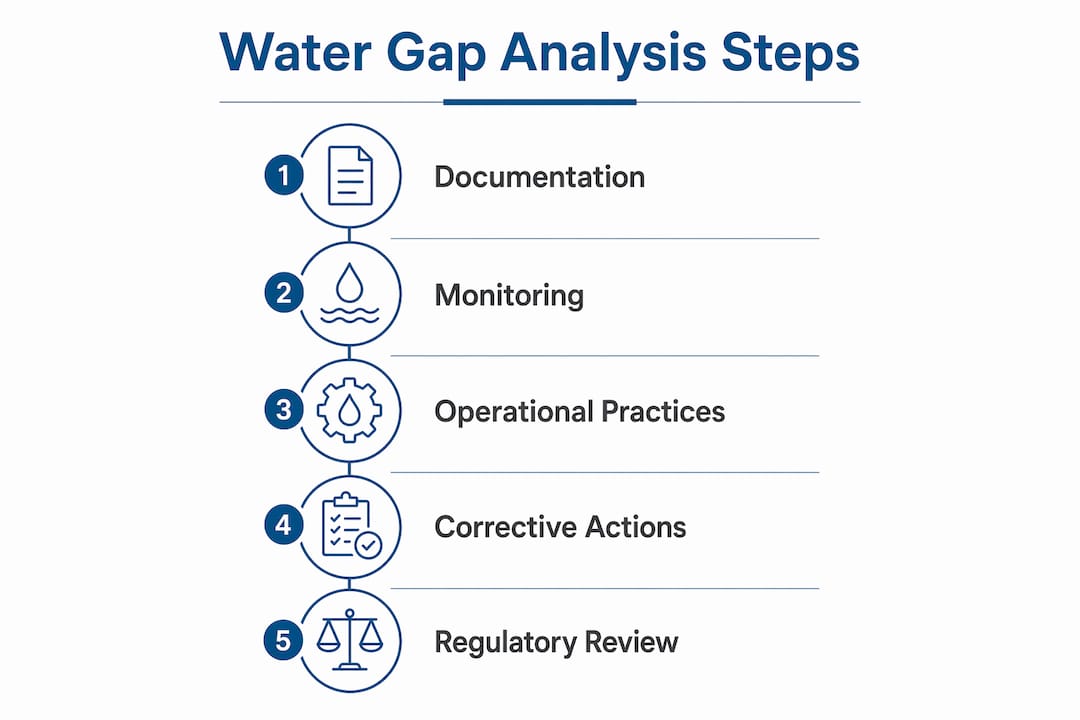
How to conduct a compliance gap analysis for water safety
The most effective methodology follows a four-step workflow that moves from data collection through to a reportable output. Cutting audit preparation time from three to six weeks down to a near-continuous process is achievable when this workflow is supported by automation.
Data retrieval. Gather all existing documentation: the written scheme of control, the most recent Legionella risk assessment, temperature monitoring logs, water sampling results, TMV service records, and any previous audit reports or enforcement correspondence. If your records are held across disconnected spreadsheets, paper logbooks, and email threads, this step alone will reveal significant gaps.
Exploratory data analysis. Review the collected data for completeness, consistency, and currency. Are all sentinel outlets being monitored at the correct frequency? Are there unexplained gaps in temperature records? Have any water sampling results exceeded action levels, and if so, was the response documented? This step identifies both missing data and data that exists but has not been acted upon.
Compliance checks. Compare your findings against the specific requirements of L8, HTM 04-01, and any other applicable standards. Each gap is recorded with a severity rating: critical (immediate risk to health or enforcement action), major (systemic failure requiring urgent attention), or minor (administrative shortfall with low immediate risk).
Audit report generation. Produce a structured report that maps each gap to the specific regulatory clause it breaches, assigns a responsible person, and sets a target completion date. This report becomes the basis for your corrective action plan and your evidence of due diligence if an enforcement authority makes enquiries.
Pro Tip: Integrate your SCADA alarms or automated temperature monitoring alerts directly into your corrective action records. When an out-of-range temperature triggers an alarm and that alarm automatically generates a timestamped corrective action entry, you produce audit-grade evidence without any manual intervention. This is the single most effective way to close the gap between what your system detects and what your documentation proves.
What are the most common compliance gaps found in water systems?
The most consistent finding across water quality compliance assessments is that documentation gaps are the greatest source of audit exposure, not treatment failures. Facilities that maintain good physical controls frequently fail audits because their records do not prove it.
The most frequently identified gaps include:
Outdated or generic risk assessments: Risk assessments that have not been reviewed following significant changes to the water system, or that describe a generic building rather than the specific site, do not satisfy L8 or HTM 04-01.
Incomplete monitoring records: Missing temperature checks for sentinel outlets, gaps in flushing records for infrequently used outlets, and absent TMV service records are among the most common findings.
No documented corrective actions: Monitoring data that shows out-of-range results with no corresponding corrective action record is a critical gap. It suggests the problem was either ignored or addressed informally without documentation.
Staffing and knowledge transfer failures: When the person responsible for water safety leaves and their knowledge is not captured in documented procedures, compliance deteriorates rapidly. This is a capacity gap that no amount of good equipment can compensate for.
Reactive rather than proactive workflows: Operators who rely on memory or disconnected paper logs to manage compliance are vulnerable to reactive drift, where problems are only identified after they become serious.
“The gap between text and practice is the most dangerous space in water safety management. A written scheme that describes perfect compliance, operated by a team that has never read it, offers no protection whatsoever.”
The financial consequences of these gaps are significant. Penalties for serious violations can reach $25,000 per day, and the reputational damage from a Legionella outbreak in a healthcare setting is incalculable. 27% of US public water systems violated at least one drinking water standard in 2022. That figure reflects a systemic problem with compliance culture, not just technical failures.
Practical strategies for closing water compliance gaps
Closing identified gaps requires both process changes and, in most cases, technological support. The table below compares a manual compliance approach with a digitally supported one across the dimensions that matter most to facility managers.
Compliance dimension | Manual approach | Digital approach |
Temperature monitoring | Paper logs, weekly rounds | Automated monitoring with real-time alerts |
Corrective action records | Handwritten notes, often incomplete | Timestamped digital entries linked to alarm triggers |
Audit preparation | Three to six weeks of manual compilation | Near-continuous, report generated on demand |
Risk assessment currency | Reviewed when someone remembers | Scheduled review reminders with version control |
Staff knowledge retention | Held by individuals, lost on departure | Embedded in documented procedures and digital logbooks |
A water compliance management system that integrates permit calendars, automated reporting, and corrective action workflows removes the dependency on individual memory and manual log compilation. The shift from static compliance to risk-informed automated decision support is the direction the industry is moving, and facilities that make this transition now will be significantly better positioned when regulations tighten further.
Pro Tip: When commissioning a gap analysis, ask your consultant to map every finding to a specific regulatory clause. A gap report that says “temperature monitoring is inadequate” is far less useful than one that says “sentinel outlet monitoring frequency does not meet L8 paragraph 2.97 requirements.” Specificity is what turns a gap report into a defensible corrective action plan.
How does regular gap analysis build long-term organisational resilience?
A gap analysis conducted once and filed away provides limited value. The organisations that manage water safety most effectively treat gap analysis as a recurring process embedded in their annual compliance calendar, not a one-off exercise triggered by an audit notice.
The gap between documented requirements and actual practice widens over time without active management. Staff change, systems are modified, and regulations are updated. A written scheme that was accurate three years ago may now describe a water system that no longer exists. Regular gap analysis catches these divergences before they become enforcement issues.
Emerging challenges are also reshaping what a thorough gap analysis must cover. Water Safety Plans, as advocated by the WHO and increasingly referenced in UK guidance, require a watershed-level view of water risk that goes beyond the building boundary. ESG reporting frameworks are beginning to incorporate water stress metrics, meaning that compliance officers in larger organisations now need to consider supply-side risks alongside on-site management. A gap analysis framework built only around current regulations will not prepare you for the requirements that are two years away.
The most resilient approach treats compliance not as a checklist to be completed but as a management system to be maintained. Risk-based Water Safety Plans are demonstrably superior to static checklist compliance for identifying and managing emerging risks, precisely because they require you to think about the entire system rather than individual parameters.
Key takeaways
A water compliance gap analysis is only as useful as the corrective actions it generates and the regularity with which it is repeated.
Point | Details |
Definition and scope | A gap analysis compares current water management practices against L8, HTM 04-01, and other applicable standards to identify specific shortfalls. |
Documentation is the primary risk | Most audit failures stem from incomplete records, not treatment failures. Timestamps, chain-of-custody logs, and corrective action records are critical. |
Automation reduces exposure | Integrating automated monitoring with corrective action workflows produces audit-grade evidence continuously, removing reliance on manual log compilation. |
Regular repetition is required | A gap analysis conducted once provides a snapshot. Embedding it as an annual process catches regulatory changes and operational drift before they become enforcement issues. |
Healthcare requires specialist standards | Facilities subject to HTM 04-01 must benchmark against its specific requirements, not just L8, to achieve genuine compliance. |
Why I think most facilities are solving the wrong problem
By Sammi
After working across healthcare, commercial, and housing association sites, the pattern I see most often is this: a facility invests in better treatment technology, installs new pipework, and then fails its next audit because the paperwork does not reflect any of it. The written scheme still describes the old system. The risk assessment has not been updated. The corrective action records are blank.
The instinct to fix the physical system first is understandable, but it is backwards. Regulators do not inspect your pipework on arrival. They ask for your documentation. If your records cannot prove that your controls are working, the physical reality is irrelevant from an enforcement perspective.
The facilities I have seen manage this best share one characteristic: they treat their compliance documentation as a live system, not an archive. They update their written scheme when anything changes. They log every corrective action at the time it happens. They review their gap analysis findings quarterly rather than annually. This is not bureaucracy for its own sake. It is the only way to demonstrate, at any moment, that you are managing risk rather than hoping nothing goes wrong.
The technology to do this well now exists and is accessible to organisations of all sizes. The barrier is rarely budget. It is the cultural shift from reactive to proactive compliance. That shift starts with understanding exactly where your gaps are.
— Sammi
How Bespokecompliancesolutions can close your compliance gaps
Bespokecompliancesolutions works with facility managers and compliance officers across the UK to identify and close water safety gaps before they become enforcement issues.
From bespoke Legionella risk assessments and water sampling through to the implementation of digital logbook systems and automated temperature monitoring, every service is tailored to your specific sites and regulatory obligations. Whether you manage a single commercial premises or a portfolio of healthcare facilities, Bespokecompliancesolutions provides the specialist advice, ongoing consultancy, and practical support to make compliance straightforward. Contact Bespokecompliancesolutions to arrange a gap analysis review and find out exactly where your water safety programme stands.
FAQ
What does a water compliance gap analysis actually involve?
A water compliance gap analysis compares your facility’s current documentation, monitoring records, and operational practices against the requirements of HSE L8, HTM 04-01, and other applicable standards to produce a prioritised list of shortfalls and corrective actions.
How often should a gap analysis be carried out?
A gap analysis should be conducted at least annually and following any significant change to your water system, staffing, or applicable regulations. Treating it as a recurring process rather than a one-off exercise is what maintains continuous compliance.
What are the most common gaps found in water compliance reviews?
Documentation failures are the most common finding, including outdated risk assessments, incomplete monitoring records, and absent corrective action logs. Treatment failures are identified far less frequently than record-keeping failures.
Is a gap analysis the same as a Legionella risk assessment?
No. A Legionella risk assessment, conducted under BS 8580-1:2019, evaluates the physical risk posed by your water system. A compliance gap analysis is broader and examines whether your entire water safety management programme, including the risk assessment itself, meets all applicable regulatory requirements.
Do healthcare facilities need a different type of gap analysis?
Yes. Healthcare premises must benchmark against HTM 04-01 in addition to L8, which introduces specific requirements for water storage temperatures, Pseudomonas aeruginosa control, and point-of-use filtration that do not apply to standard commercial buildings.
Recommended
Comments