
Benefits of outsourcing Legionella compliance: 9 key advantages

Outsourcing Legionella compliance is defined as the formal delegation of water safety management tasks to a specialist third-party provider, while the duty holder retains legal accountability under HSE’s ACoP L8 and HSG274. For facility managers and compliance officers in commercial and healthcare settings, this arrangement delivers expert risk management, reduced operational burden, and audit-ready documentation that in-house teams rarely achieve alone. The benefits of outsourcing Legionella compliance extend well beyond convenience. They directly affect your legal standing, financial exposure, and the safety of everyone who uses your building’s water systems.
1. What are the main operational benefits of outsourcing Legionella compliance?
Outsourcing water safety management gives your organisation access to specialists who apply HSG274 technical guidance systematically across your water systems. Generic monitoring regimes leave compliance gaps. Expert application of HSG274 schedules, tailored to your specific water systems, improves compliance defensibility in ways that a generalist in-house approach cannot match.
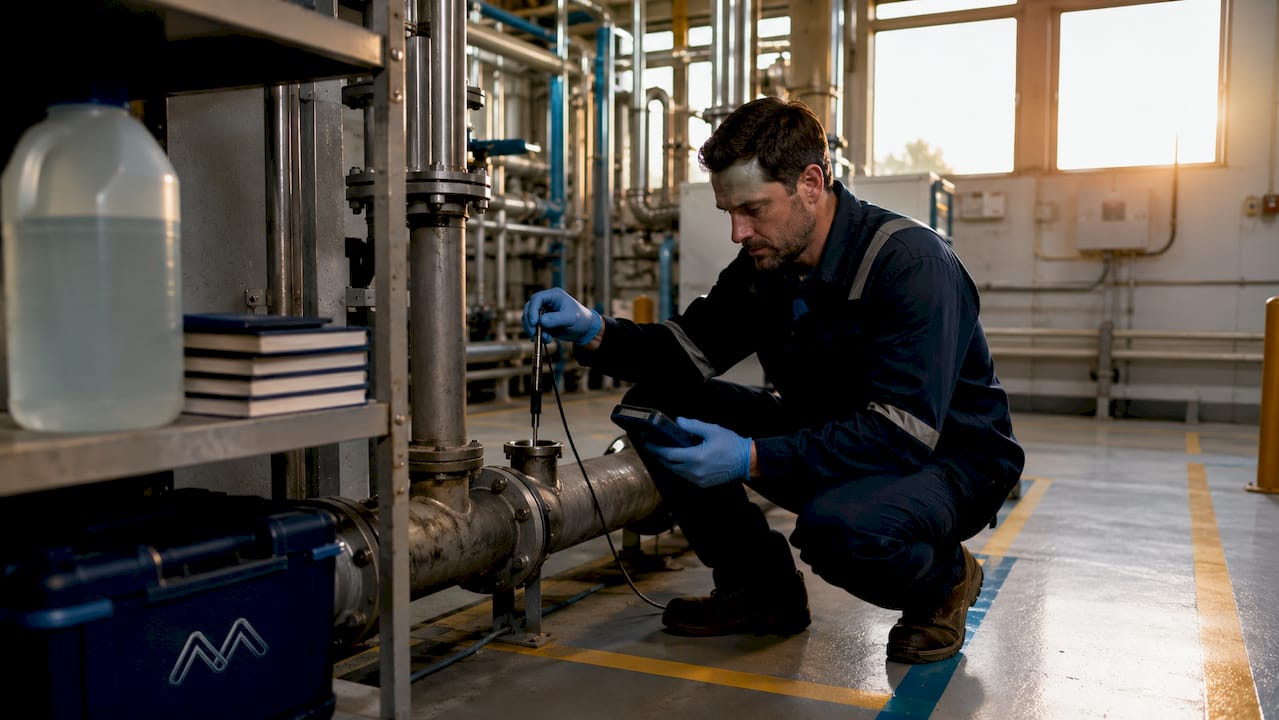
Outsourced providers build site-specific written control schemes that reflect the actual complexity of your pipework, storage tanks, and outlets. They implement continuous monitoring programmes, carry out prompt remedial actions when readings fall outside acceptable ranges, and update your written scheme accordingly. The operational win of outsourcing is a closed-loop compliance system where abnormal monitoring triggers documented corrective actions and updated risk assessments. Regulators focus on the actions taken in response to monitoring data, not just the raw readings themselves.
Remote temperature monitoring technology reduces the need for manual checks and cuts operating costs on larger or multi-site estates. Outsourcing also removes the risk of human error that comes with relying on staff who hold Legionella awareness as a secondary responsibility.
Site-specific written control schemes aligned to HSG274
Continuous monitoring with documented action triggers
Remote temperature monitoring reducing manual site visits
Multi-site compliance managed centrally by one provider
Reduced human error compared to in-house management
Pro Tip: When selecting a provider, ask specifically whether they operate a closed-loop monitoring system with documented action triggers. If they cannot describe that process clearly, their compliance model carries gaps.
2. How does outsourcing help manage legal and regulatory responsibilities?
Outsourcing technical tasks does not remove the legal responsibilities of the duty holder under ACoP L8. You must still identify risks, manage precautions, appoint a competent person, and keep records. This is the single most important legal point for any facility manager to understand before engaging a contractor.
What outsourcing does is give you a competent, documented partner who supports those obligations. Specialist providers produce inspection-ready records, carry out risk assessments to a defensible standard, and maintain the written scheme on your behalf. Outsourced providers in healthcare help implement continuous control regimes that are inspection-ready, while the organisation manages records and oversight. That division of responsibility, when clearly documented, satisfies HSE’s expectations for a monitored written scheme.
The risks of improper delegation are real. Handing tasks to a contractor without maintaining oversight leaves the duty holder exposed if an incident occurs. Organisations need an auditable record handover schedule from contractors, with immediate incident reporting, to meet ACoP L8 audit readiness. Without that structure, outsourcing creates a false sense of security rather than genuine compliance.
Duty holder retains legal accountability at all times
Contractors must demonstrate competence to satisfy HSE expectations
Outsourced providers produce audit-ready documentation and inspection records
Oversight duties of the appointed responsible person remain non-negotiable
Clear documented scopes of contractor roles protect the duty holder
Pro Tip: Establish a written scope of works with your provider that defines exactly which tasks they own and which remain with your team. Ambiguity in contractor roles is the most common cause of compliance failures during HSE inspections.
3. What financial advantages does outsourcing Legionella compliance deliver?
The financial case for outsourcing water safety management is stronger than most organisations realise until they calculate the true cost of managing it internally. Specialist in-house staff require ongoing training, accreditation, and time that diverts them from other duties. Outsourcing replaces that overhead with a fixed, predictable service cost.
Avoiding regulatory fines is the most direct financial benefit. HSE enforcement action for Legionella failures carries significant penalties, and the reputational damage from a confirmed outbreak far exceeds any compliance spend. Specialist outsourced support with actively maintained water safety documentation reduces compliance gaps and operational costs in complex systems. That reduction in gaps directly lowers the probability of enforcement action.
Emergency remediation following a Legionella incident is expensive. Decontamination, system shutdown, legal costs, and potential compensation claims represent a financial exposure that dwarfs the annual cost of a managed compliance programme. Documented compliance also supports insurance negotiations. Insurers view structured, third-party managed water safety programmes as evidence of risk control, which can influence premium assessments.
Efficiency gains come from eliminating unnecessary flushing routines and redundant site visits. A well-structured outsourced programme identifies which tasks are genuinely required and removes those that add cost without improving safety.
4. Outsourcing versus in-house Legionella compliance: which suits your organisation?
The right model depends on your organisation’s size, system complexity, and internal resource. Neither approach is universally superior. The comparison below sets out the key factors.
Factor | In-house management | Outsourced management |
Technical expertise | Dependent on staff training and retention | Specialist knowledge applied consistently |
Cost structure | Variable; includes training, time, and equipment | Fixed service cost; predictable budgeting |
Risk management | Higher exposure if staff change or knowledge gaps emerge | Reduced exposure through specialist oversight |
Flexibility | Limited by internal capacity and workload | Scalable across sites and system types |
Record-keeping | Relies on internal systems and discipline | Structured documentation provided by provider |
Regulatory defensibility | Dependent on staff competence and audit preparation | Audit-ready records produced as standard |
Healthcare environments carry the highest risk profile due to vulnerable occupants and complex water systems. Legionella compliance for healthcare premises demands continuous control regimes, frequent monitoring, and immediate response to any deviation. In-house teams in NHS trusts or private hospitals rarely hold the depth of specialist knowledge required to manage this without external support.
Commercial premises with straightforward water systems and a competent, trained responsible person can manage basic compliance internally. However, as soon as a building has cooling towers, complex hot and cold water distribution, or multiple outlets, the case for outsourcing becomes compelling. A real-world business premises case study illustrates how specialist third-party compliance services deliver measurable improvements in commercial buildings.
The hybrid model is also worth considering. Some organisations retain an internal responsible person who manages oversight and record-keeping, while outsourcing technical tasks such as risk assessments, water sampling, and system disinfection to a specialist provider.
5. Expert risk assessments tailored to your water systems
A Legionella risk assessment is not a one-size-fits-all document. It must reflect the specific design, condition, and usage patterns of your water systems. Outsourced specialists conduct bespoke risk assessments that identify site-specific hazards, prioritise remedial actions, and produce a written scheme that is both defensible and practical.
In-house assessments carried out by staff without specialist training frequently miss less obvious risk factors, such as infrequently used outlets, dead legs in pipework, or inadequate temperature control at sentinel points. These gaps do not show up until an inspection or, worse, an incident. Outsourced providers bring systematic methodology and current regulatory knowledge to every assessment. They also review and update assessments when systems change, which ACoP L8 requires but in-house teams often defer.
Reviewing a third-party risk assessment is itself a skill. Guidance on reviewing a Legionella risk assessment helps compliance officers understand what a quality assessment should contain and how to verify that a contractor has met the required standard.
6. Compliance record-keeping and logbook management
Monitoring records must be kept for at least 5 years and written risk assessments for at least 2 years after they cease to be current. That retention requirement sits with the duty holder, regardless of who carries out the monitoring. This is a practical challenge for organisations that rely on contractors to maintain their own databases without providing structured handover to the client.
Outsourced providers who operate structured logbook systems give compliance officers immediate access to all records required during an HSE inspection. A Legionella logbook that captures monitoring results, remedial actions, and scheme updates in one place removes the scramble that typically precedes an audit. Record-keeping is not an administrative afterthought. It is the primary evidence that your compliance programme is functioning as required.
7. Scalability across multi-site estates
Managing Legionella compliance across multiple sites with an in-house team creates coordination problems that grow with every additional building. Different systems, different risk profiles, and different monitoring schedules require a level of organisation that internal resource rarely sustains consistently.
Outsourcing water quality management to a single specialist provider creates a unified compliance framework across your entire estate. One provider holds the written schemes, monitoring records, and risk assessments for all sites. Reporting is consistent, gaps are visible, and remedial actions are tracked centrally. For property management companies, housing associations, and multi-site retailers, this centralised model is the most practical way to maintain consistent compliance standards.
8. Access to emerging monitoring technology
Automated water temperature monitoring represents one of the most significant advances in Legionella risk management outsourcing in recent years. Sensors installed at key points in your water system transmit readings continuously, flagging deviations before they become compliance failures. This technology reduces the frequency of manual checks and provides a continuous data record that supports both operational management and regulatory defence.
Outsourced providers with access to automated temperature monitoring deploy these systems as part of a managed service, meaning you benefit from the technology without the capital cost of purchasing and maintaining it yourself. The data feeds directly into your compliance records, creating the closed-loop documentation trail that regulators expect to see.
9. Reduced liability through documented competence
Demonstrating contractor competence is an HSE requirement, not a best practice suggestion. Outsourced providers affiliated with recognised bodies such as the Legionella Control Association (LCA) or holding UKAS-accredited laboratory services provide documented evidence of competence that protects the duty holder during inspections. Outsourcing must be viewed as delegating operational tasks, not delegating accountability. The biggest benefit is realised only when the duty holder maintains active oversight of the outsourced provider’s outputs.
Selecting a provider with clear accreditation, structured reporting, and a defined escalation process gives you the documented competence trail that satisfies HSE and reduces your personal liability as a responsible person.
Key takeaways
Outsourcing Legionella compliance delivers expert risk management and audit-ready documentation, but only when the duty holder maintains active oversight and clear contractual accountability.
Point | Details |
Legal accountability stays with you | ACoP L8 requires duty holders to retain oversight even when all technical tasks are outsourced. |
Closed-loop systems are the standard | Choose providers who document corrective actions triggered by monitoring data, not just raw readings. |
Record retention is your responsibility | Monitoring records must be kept for at least 5 years; ensure your provider delivers structured handover. |
Financial savings are real but indirect | Avoiding fines, emergency remediation, and insurance exposure outweighs the cost of a managed programme. |
Healthcare demands specialist outsourcing | Complex systems and vulnerable occupants make third-party compliance management the practical standard in healthcare. |
Why I think most organisations misunderstand what outsourcing actually buys them
The most common mistake I see facility managers make is treating outsourcing as a way to stop thinking about Legionella. They sign a contract, hand over the keys, and assume the problem is solved. It is not. What you have bought is operational expertise and structured documentation. What you have not bought is freedom from accountability.
The organisations that get the most value from outsourcing are the ones that stay engaged. They review their provider’s reports, ask questions when readings look unusual, and treat the written scheme as a living document rather than a filing exercise. That level of engagement takes perhaps two hours a month for most sites. It is not a burden. It is the difference between genuine compliance and a paper exercise that collapses under scrutiny.
I have also seen the opposite failure: organisations that try to manage everything in-house with staff who have completed a one-day awareness course and nothing more. That approach works until the system changes, a member of staff leaves, or an HSE inspector asks to see five years of monitoring records. The gap between what they think they have and what they actually have is usually significant.
The providers worth working with are those affiliated with the Legionella Control Association, who operate transparent reporting and give you immediate access to your own records. Remote monitoring technology is changing what outsourcing looks like in practice. Continuous data feeds mean your provider can flag a temperature deviation at 2am without anyone visiting the site. That is a genuine operational improvement, not a marketing claim.
Outsourcing works best when it is a partnership. You bring knowledge of your building and your occupants. Your provider brings technical depth and regulatory currency. Neither works as well without the other.
— Sammi
How Bespokecompliancesolutions supports your Legionella compliance
Bespokecompliancesolutions delivers specialist Legionella compliance solutions for commercial and healthcare organisations across the UK. Their services cover the full compliance cycle, from bespoke risk assessments and water testing and analysis through to logbook implementation, TMV servicing, and ongoing consultancy. For commercial premises, their Legionella compliance for offices service provides a structured, audit-ready programme that removes the guesswork from regulatory adherence. Every solution is tailored to your specific sites, systems, and risk profile, so you get compliance support that reflects your actual operation rather than a generic template.
FAQ
What does outsourcing Legionella compliance actually mean?
Outsourcing Legionella compliance means engaging a specialist third-party provider to carry out technical water safety tasks such as risk assessments, monitoring, and system disinfection. The duty holder retains legal accountability under ACoP L8 throughout.
Does outsourcing remove my legal responsibilities as a duty holder?
No. Under ACoP L8, duty holders must still identify risks, appoint a competent person, and keep records, regardless of which tasks are outsourced to a contractor.
How long must Legionella compliance records be kept?
Monitoring records must be retained for at least 5 years and written risk assessments for at least 2 years after they cease to be current, with records accessible to the duty holder at all times.
Is outsourcing Legionella compliance cost-effective for smaller organisations?
For organisations with complex water systems or limited internal expertise, outsourcing is typically more cost-effective than building in-house capability. It removes training costs, reduces the risk of fines, and provides predictable service expenditure.
What should I look for when choosing a Legionella compliance provider?
Select providers affiliated with the Legionella Control Association, who operate closed-loop monitoring systems, provide structured record handover, and can demonstrate competence through accreditation and documented methodology.
Recommended
Comments