Water compliance action tracker: a manager's guide
- Jun 16
- 8 min read

A compliance action tracker for water hygiene is a purpose-built digital platform that links monitoring results, risk assessment data, and corrective workflows into a single auditable system. Where general task management tools leave gaps, a water-specific action tracker for compliance closes the loop between an out-of-specification result and its verified resolution. Platforms such as ServiceTracker, SAMS, and OxMaint have set the standard for what this looks like in practice. For facilities and compliance managers operating under HSE L8 and ACOP L8 obligations in 2026, understanding what is a compliance action tracker water system means understanding the difference between reactive record-keeping and proactive risk control.
What is a compliance action tracker for water hygiene?
A compliance action tracker for water hygiene is not simply a digital logbook. It is a workflow engine that enforces closed-loop remediation, meaning any out-of-specification result triggers an automatic corrective action assignment and that action remains open until verified evidence of resolution is logged. This is the defining characteristic that separates purpose-built water compliance management tools from general project or task software.
These systems integrate three core functions. First, they hold and track risk assessment data, including Legionella risk assessments, asset registers, and control scheme documentation. Second, they manage monitoring schedules, sending automatic reminders for temperature checks, water sampling, and TMV servicing. Third, they record and escalate corrective actions, linking each remediation task directly to the monitoring result that triggered it.
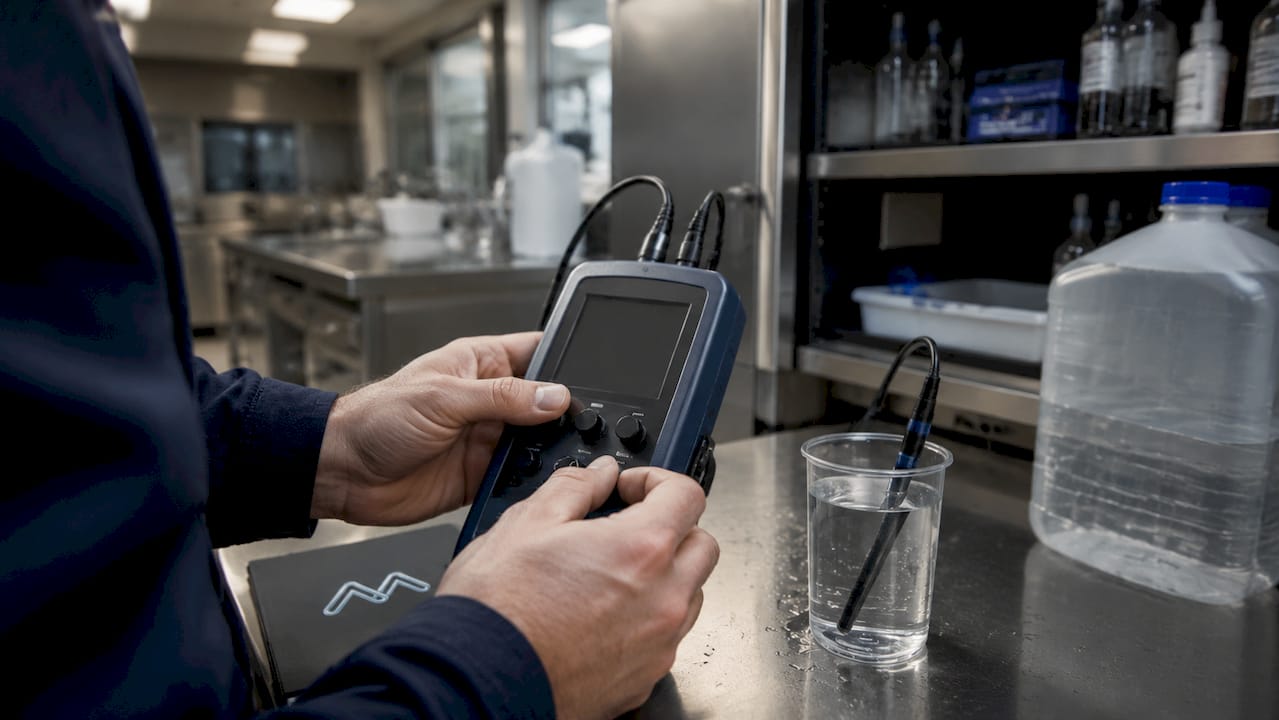
The practical result is a single, traceable record for every site, every asset, and every compliance event. Facilities managers working across multiple sites, whether in healthcare, housing associations, or commercial property, can view compliance status in real time rather than waiting for a paper-based monthly report. This is the operational shift that makes water compliance management genuinely manageable at scale.
What core features set water compliance trackers apart?
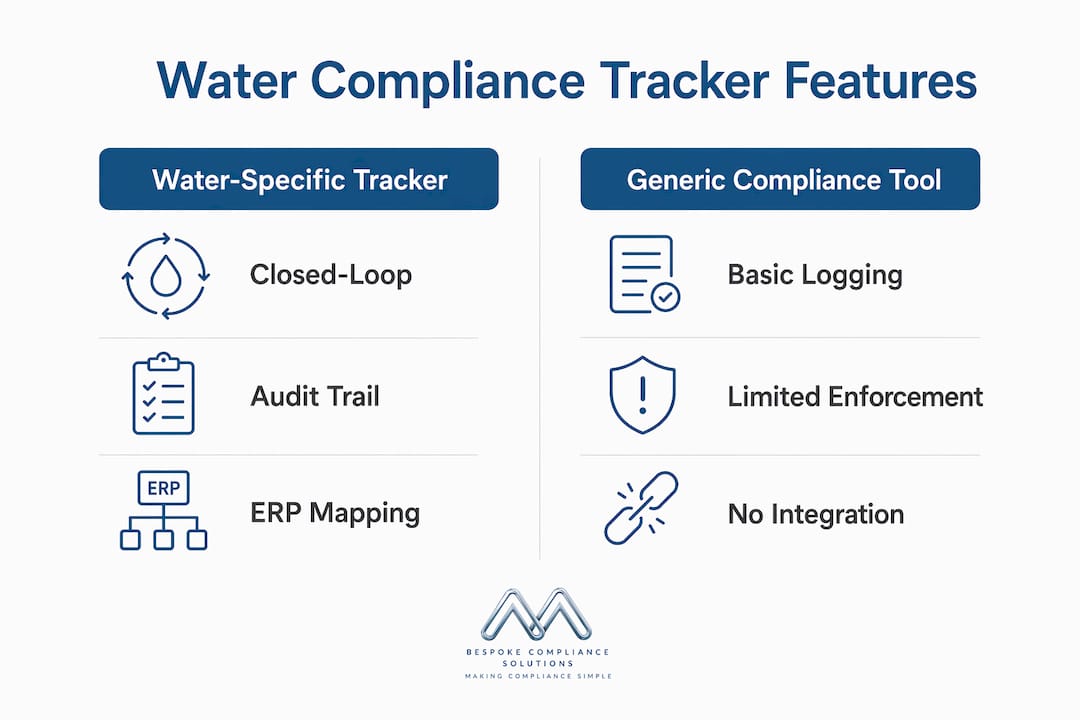
The table below shows how purpose-built water compliance platforms differ from generic compliance or CMMS tools.
Feature | Water-Specific Tracker | Generic Compliance Tool |
Closed-loop corrective actions | Automatic assignment, stays open until resolved | Manual task creation, no enforcement |
Regulatory ERP mapping | Built-in Enforcement Response Plan alignment | Not included |
Immutable audit trails | Timestamped, with technician ID and photo evidence | Basic activity logs |
Automated scheduling | Sampling reminders, temperature check alerts | Calendar reminders only |
Out-of-specification detection | Automatic flagging and escalation | Manual review required |
Mobile and field data capture | Real-time logging in the field | Limited or desktop-only |
The most critical distinction is the immutable audit trail. Regulators do not simply want to see that an action was completed. They want to trace the original test result, the technician who recorded it, the corrective action raised, and the photographic evidence of resolution. Generic tools cannot produce this chain of evidence reliably.
Enforcement Response Plan (ERP) mapping is equally important. Your software must reflect your specific regulatory obligations and internal control scheme. Without that alignment, gap analysis and audit evidence generation become impossible, regardless of how much data the system holds.
Pro Tip: When evaluating any water action compliance software, ask the vendor to demonstrate how the system handles a failed temperature result from trigger to verified close-out. If they cannot show you a complete, unbroken evidence chain in under three minutes, the tool is not fit for purpose.
How does compliance tracking reduce operational risk?
The financial and operational case for specialised compliance monitoring for water is well evidenced. Non-compliance penalties can exceed £60,000 per violation per day, and automated tracking tools reduce reporting times by up to 80%. That is not a marginal efficiency gain. It is the difference between a compliance function that runs on time and one that is perpetually behind.
Specialised platforms such as SAMS report that users save over 70 hours monthly on administration alone. That time is recovered from manual data entry, chasing paper records, and compiling reports for audits. The same platforms report a 95% reduction in compliance violations. Both figures point to the same underlying mechanism: when monitoring, escalation, and remediation are automated and connected, problems are caught and resolved before they become reportable incidents.
The operational benefits break down into four areas:
Proactive incident prevention. Automated alerts flag out-of-specification results immediately, allowing remediation before a Legionella risk escalates.
Audit readiness. Documentation pulled in minutes, not hours, means regulatory inspections do not disrupt operations.
Reduced administrative burden. Automated report generation removes the manual compilation that consumes compliance team time.
Multi-site visibility. Real-time dashboards give facilities managers a live view of compliance status across every site in their portfolio.
Pro Tip: Set up automated weekly compliance summary reports within your tracking system and share them with senior management. This creates a culture of visibility and means you are never caught unprepared ahead of an inspection.
What pitfalls should facilities managers avoid?
The most common mistake in water regulation action tracker selection is choosing a tool that was not designed for water hygiene compliance. Generic task management platforms, spreadsheets, and even some CMMS systems fail to meet the specific requirements of Legionella control and HSE L8 compliance. The consequences are not just administrative. Fragmented compliance records that fail to link permits, violations, enforcement actions, and corrective actions into a single traceable workflow are a direct liability in a regulatory inspection.
The four most damaging pitfalls are:
Using disconnected tools. Spreadsheets for monitoring, email for corrective actions, and a separate system for risk assessments create gaps that regulators will find.
Failing to map ERP workflows. If your software does not reflect your specific regulatory and internal enforcement response requirements, it cannot generate a valid audit trail.
Accepting reactive record-keeping. Most facilities managers do not distinguish between logging that something happened and enforcing that it was resolved. Effective trackers keep corrective actions open until verified close-out.
Ignoring mobile integration. Field staff who cannot log compliance data in real time revert to paper, which then requires double handling and introduces transcription errors.
A fifth pitfall is underestimating the importance of user adoption. The most capable platform delivers no value if site-level staff do not use it consistently. Choose a system with a mobile-first interface that field technicians can operate without training beyond a single session.
Pro Tip: During any software demo, ask specifically how the system handles your internal Enforcement Response Plan. If the vendor cannot map your ERP into the workflow during the demonstration, assume it cannot be done post-purchase either.
How to implement a water compliance action tracker effectively
Practical implementation follows a clear sequence. Rushing any stage creates the same fragmented records that the tracker is designed to prevent.
Assess your regulatory baseline. Map every monitoring obligation under HSE L8, your local authority requirements, and any sector-specific guidance. This list becomes the foundation of your system configuration. A water compliance management guide can help you structure this assessment.
Select a platform with integrated risk assessment and scheduling. Your tracker must hold your Legionella risk assessment data and use it to drive monitoring schedules automatically. Platforms that require manual schedule entry defeat the purpose.
Configure your ERP workflows before go-live. Map your enforcement response requirements into the system so that corrective action escalation is automatic from day one.
Train field staff on real-time data capture. Mobile-first tools that allow field staff to log results, upload photographs, and close out actions on a mobile device remove the paper handling that undermines data integrity.
Set up automated notifications and audit reports. Configure alerts for overdue actions, out-of-specification results, and upcoming monitoring deadlines. Schedule automated monthly compliance reports for management review.
Build in a quarterly gap analysis review. Use the system’s reporting function to identify recurring failures, overdue corrective actions, and monitoring gaps. This turns your tracker from a record-keeping tool into a genuine risk management instrument.
For sites with automated temperature monitoring, integration with your action tracker means temperature exceedances trigger corrective actions automatically, without manual intervention. This is the operational model that 2026 compliance expectations are moving towards across healthcare, commercial, and housing sectors.
Key takeaways
A compliance action tracker for water hygiene is the single most effective tool for converting regulatory obligations into verified, auditable outcomes across a facilities portfolio.
Point | Details |
Closed-loop workflows are non-negotiable | Corrective actions must stay open until verified resolution is logged, not simply assigned. |
ERP mapping determines audit validity | Software that does not reflect your regulatory enforcement response plan cannot produce a valid audit trail. |
Specialised tools outperform generic ones | Purpose-built platforms save over 70 hours monthly and reduce violations by up to 95%. |
Mobile integration protects data integrity | Field staff logging in real time removes paper handling and transcription errors from the compliance chain. |
Quarterly gap analysis drives improvement | Regular system reviews convert your tracker from a record into an active risk management tool. |
Why i think most facilities teams are still getting this wrong
From working closely with facilities and compliance managers across healthcare, housing, and commercial sectors, the pattern I see most often is not negligence. It is misplaced confidence. Teams believe their existing systems are adequate because they have not yet faced a serious regulatory inspection or a Legionella incident. The problem with that logic is obvious in retrospect.
The shift I have seen make the biggest difference is not the software itself. It is the moment a team stops treating compliance tracking as an administrative function and starts treating it as a risk control mechanism. When a corrective action tracker for water hygiene is configured correctly and used consistently, it changes the conversation in an inspection from “we think we are compliant” to “here is the evidence, timestamped and complete.”
The mobile-first argument is one I make consistently to sceptical managers. Field technicians will not carry a laptop to a plant room. If your compliance system requires desktop entry, your data is always at least one step removed from reality. The water hazard identification process begins in the field, and your tracker needs to begin there too.
The emerging trend worth watching is AI-driven predictive alerts, where systems flag assets at elevated risk based on historical monitoring patterns before an exceedance occurs. This is not speculative. It is already appearing in the more advanced platforms. Facilities teams that build good data habits now, through consistent real-time logging and closed-loop corrective actions, will be positioned to benefit from these capabilities as they become standard.
Proactive compliance is not a higher standard. It is the only standard that actually protects your organisation.
— Sammi
Take the next step towards water compliance confidence
Bespokecompliancesolutions works with facilities and compliance managers across commercial, healthcare, housing, and retail sectors to make water hygiene compliance straightforward and fully auditable. The foundation of any effective compliance action tracking system is an accurate, up-to-date Legionella risk assessment. Without it, your monitoring schedules, corrective action workflows, and audit records are built on incomplete data.
Bespokecompliancesolutions provides Legionella risk assessments tailored to your specific sites, feeding directly into a bespoke compliance management framework. From water testing and analysis to logbook implementation and ongoing consultancy, every service is designed to give you a complete, defensible compliance record. Contact Bespokecompliancesolutions to discuss a solution built around your organisation’s needs.
FAQ
What is a compliance action tracker for water hygiene?
A compliance action tracker for water hygiene is a digital platform that integrates risk assessment data, monitoring schedules, and corrective workflows into a single auditable system. It enforces closed-loop remediation, keeping corrective actions open until verified resolution is recorded.
How does a water compliance tracker differ from a spreadsheet or CMMS?
Spreadsheets and generic CMMS platforms cannot enforce closed-loop corrective actions, map regulatory enforcement response plans, or generate immutable timestamped audit trails. Purpose-built water compliance platforms provide all three as standard.
What regulations require compliance action tracking for water?
In the UK, HSE Approved Code of Practice L8 and the associated Technical Guidance HSG274 require documented monitoring, corrective action records, and audit-ready evidence for Legionella control in all premises where water systems present a risk.
How quickly can a compliance action tracker improve audit readiness?
Specialised platforms allow compliance documentation to be produced in minutes rather than hours, supporting regulatory inspections without disrupting operations. The SAMS platform reports a 95% reduction in violations following implementation.
Can a compliance tracker integrate with automated temperature monitoring?
Yes. Modern water compliance platforms integrate with automated temperature monitoring systems so that exceedances trigger corrective actions automatically, removing the need for manual intervention and reducing the risk of missed escalations.
Recommended
Comments