
Monthly checks, annual calibration: Thermometer protocols for UK sites
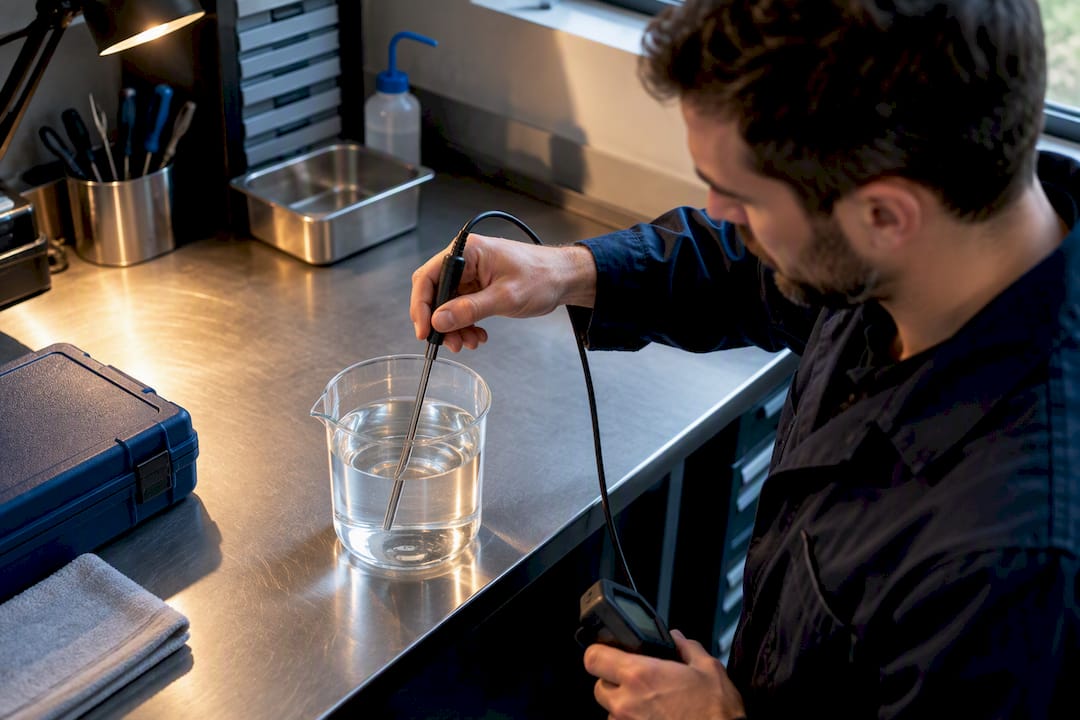
Use an immersible digital probe thermometer, not an infrared gun, for every outlet and tank check, and verify it with a two-point test (ice-point plus a warm reference or boiling-point) before you trust a single reading for Legionella compliance. Record that verification, book a formal calibration at least annually, and keep sentinel outlets on a monthly check as your baseline routine. Everything else in your monitoring programme depends on that instrument being right.
TL;DR:
Proper calibration and verification against ice-point and boiling-point are essential to ensure digital probe thermometers give accurate water temperature readings for Legionella compliance.
Immersible digital probe thermometers are the preferred choice for outlet and tank checks, requiring a stainless steel sheath, high accuracy, and quick stabilization times for reliable data.
Monthly checks of sentinel outlets for temperature targets and annual calibration of thermometers are mandatory, with records kept for audit purposes over time.
Using infrared thermometers or non-immersible devices on outlets leads to inaccurate surface readings that cannot verify compliance, especially if used for Legionella monitoring.
Regularly checking and replacing calibration instruments and maintaining detailed logs helps prevent measurement errors and ensures ongoing compliance with water safety standards.
Table of Contents
Which thermometer types work for water hygiene monitoring?
Get the device wrong and every reading after it is noise, not data. Facilities teams often reach for whatever thermometer is nearest to hand, but compliance monitoring has narrower requirements than most people assume.
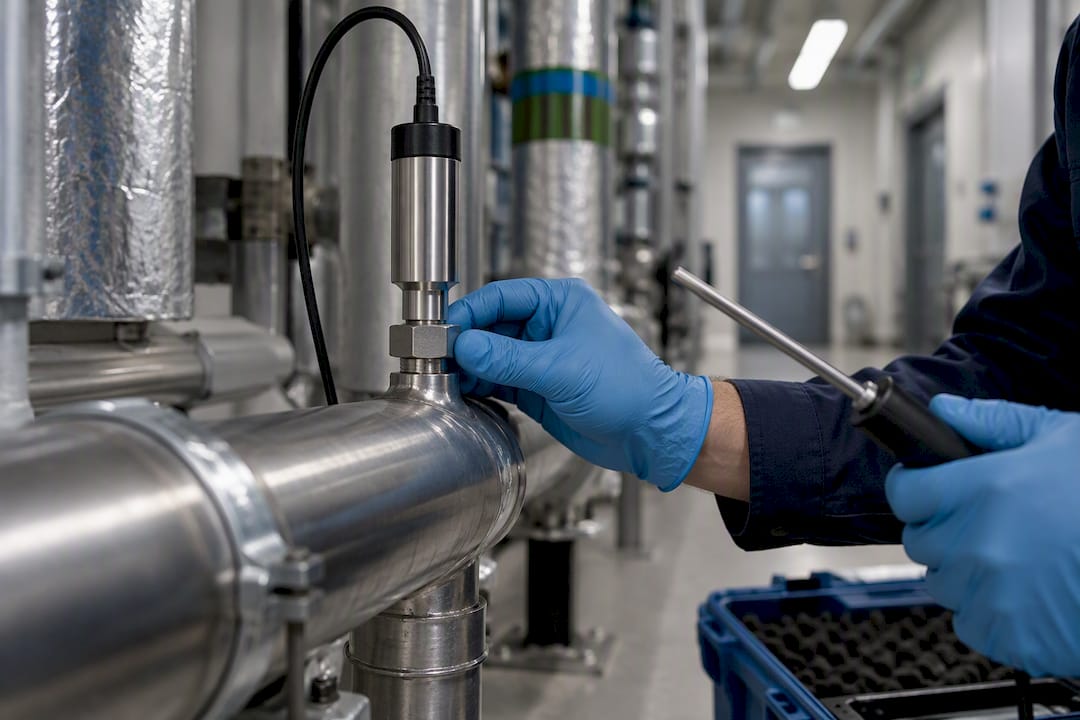
Immersible digital probe thermometers are the standard tool for outlet and tank checks. Look for a probe of sufficient length to reach flowing water at the outlet or beneath the surface of a stored tank, a stainless steel sheath that resists corrosion, and a precise display. Accuracy should be high enough for compliance over the relevant temperature range. Response time matters too: a probe that takes 30 seconds to stabilise will tempt staff to record a reading before it’s settled.
Pocket dial or stem thermometers suit quick, low-stakes checks, such as a rough tank or calorifier reading where a digital probe isn’t to hand. They’re slower to respond and harder to read precisely, so they’re not the right choice for sentinel outlet checks that feed into your compliance record.
Infrared thermometers measure surface temperature only. Point one at a tap and you’re reading the metal, not the water inside it, which makes infrared devices unsuitable for compliance monitoring. They have a legitimate use for rapid surface screening, spotting a cold radiator or checking pipe lagging, but never for a reading that goes into your Legionella log.
Immersible digital probe: preferred for outlet and tank checks, ±1°C accuracy, 0.1°C resolution
Pocket dial/stem: acceptable for informal spot checks only
Infrared: surface temperature only, not valid for compliance records
How do you calibrate and verify a water thermometer?
Calibration verifies your thermometer against a known reference, while field checks catch drift between calibrations. Both are important for accuracy.
Prepare an ice-point bath. Fill an insulated container with crushed ice and a small amount of cold water, enough to submerge the probe tip without it touching the sides or base.
Immerse the probe to the depth marked on the device (or at least 25mm) and stir gently.
Wait for stabilisation, usually 60 to 90 seconds, until the reading holds steady.
Record the reading. A correctly calibrated probe should show 0°C, within its stated tolerance (typically ±0.5°C). Repeat the check at boiling point if practical, considering altitude effects on boiling temperature; use suitable protective equipment for safety. Compare both reference points. If readings are accurate at one point but not the other, the device has a fault and should be withdrawn from use. Use specialized test caps or dry-block calibrators for routine field verification between formal calibrations to provide reliable reference temperatures.
Send for professional calibration annually, or sooner if the thermometer has been dropped, exposed to a chemical spill, or shows any drift on a field check.
Log every result, including the date, method used, observed value, and the certificate expiry date for the next formal calibration.
Pro Tip: Keep a spare, freshly calibrated probe in a drawer. When a field check flags drift on your primary thermometer, you can swap it out immediately rather than running your compliance checks on a device you no longer trust.
Two-point calibration is vital because a single reference point may miss linear faults that cause inaccurate readings at important temperatures.
What are the HSE and HTM temperature targets and check frequencies?
HSE guidance under HSG274 Part 2 and ACOP L8 sets the numeric targets that your calibrated thermometer exists to verify. Hot water should be stored at 60°C, distributed so outlets reach at least 50°C (55°C in healthcare settings under HTM 04-01) within one minute of running, and cold water should stay below 20°C, reached within two minutes.
Check | Target | Frequency |
Sentinel outlets (hot) | ≥50°C within 1 minute (≥55°C healthcare) | Monthly |
Sentinel outlets (cold) | <20°C within 2 minutes | Monthly |
Calorifier flow and return | 60°C stored | Monthly |
Other outlets | Within target range | Rotating annual basis |
Cold water storage tanks | <20°C | Roughly six-monthly |
Formal instrument calibration should be conducted regularly, approximately yearly or more often if frequent use or drift is observed. Every reading and every calibration need a place in your written scheme or Water Safety Plan, not scribbled on a clipboard that gets binned at year end.
Sentinel outlets and calorifiers: check monthly
Remaining outlets: rotate through the estate annually
Storage tanks: check about twice yearly
Thermometers: formal calibration regularly, with more frequent field verification
An auditor doesn’t just want to see this month’s readings. They want to see a pattern stretching back, with calibration certificates that line up against every reading in the log.
What mistakes throw off water temperature readings?
Most out-of-range readings turn out to be a measurement problem, not a system failure, but you won’t know which until you’ve ruled out the obvious errors.
Using the wrong device. An infrared gun on a tap gives you the tap’s surface temperature, not the water inside it.
Sampling blended water. Checking downstream of a thermostatic mixing valve gives you the blended output, not the hot supply temperature the standard actually requires.
Not running the outlet long enough. Standing water in the pipe cools or warms before it reaches target; run the outlet until the reading stabilises before recording it.
Checking the wrong outlet entirely. Sentinel outlets are specific, furthest-from-tank taps for a reason; a nearby convenience tap won’t tell you what you need to know.
Pro Tip: If a reading looks wrong, take it again with a second, known-good thermometer before you escalate. Ruling out the instrument in two minutes saves a wasted call-out for what turns out to be a faulty probe.
If a repeat reading with a different device confirms the failure, that’s a genuine system issue, likely circulation, calorifier output, or dead legs, and it needs escalating for remedial work rather than another round of checks.
— Sammi
What should you check when buying a calibration kit?
Kit choices range from simple field-calibrated probe sets to dry-block calibrators offering multiple fixed reference points, and multi-unit service contracts for organisations managing several sites. Whatever you buy, the calibration certificate that comes with it is where the real value sits.
A proper certificate states the calibration date, the method used, the measured values against tolerances, traceability to a national standard (look for UKAS accreditation where available), and the date the next recalibration is due. Without those details, you have a piece of paper, not evidence.
Check whether the supplier offers a return-calibration service so instruments don’t sit idle while away for testing
Ask about bulk or multi-unit calibration pricing if you manage several sites
Confirm whether on-site verification is available between formal calibrations
Check the warranty and repair terms before committing to a particular probe model
How automated monitoring reduces the calibration burden
Continuous monitoring sensors catch slow drift and trend changes between your monthly spot checks, flagging a failing calorifier days before a manual round would. But sensors aren’t exempt from the rules that govern any other thermometer: they still need periodic verification against a calibrated reference. Automated water temperature monitoring from Bespokecompliancesolutions pairs continuous alarms with scheduled sensor recalibration, and structured logbook systems turn raw readings into records an auditor can actually follow.
A practitioner’s weekly checklist
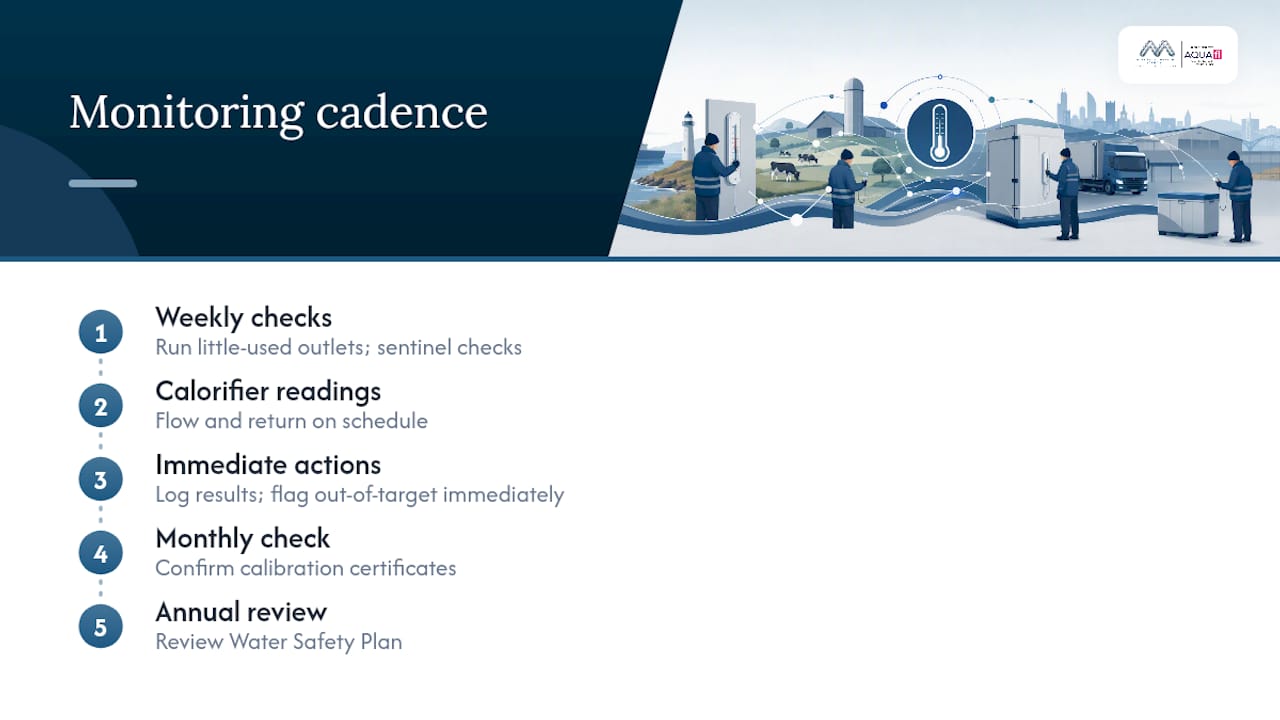
Run little-used outlets weekly so they don’t sit stagnant between formal checks. Measure sentinel outlets and calorifier flow and return on schedule, log every result the moment you take it, and flag anything outside target immediately rather than at month end. Once a month, confirm your calibration certificates are still valid; once a year, review the whole Water Safety Plan against what actually happened on site.
How Bespoke Compliance Solutions supports your monitoring programme
Manual spot checks and calibrated thermometers only get you so far when you’re managing multiple sites and rotating staff. Bespokecompliancesolutions gives facilities and health and safety managers a bespoke alternative: fully tailored compliance support rather than a generic package, with rapid turnaround on quotes and reports so gaps don’t sit open for weeks.
[
The service list runs from automated water temperature monitoring, for sites that need continuous alarms alongside their manual checks, through to Legionella water testing and analysis starting from £55 per sample, and Legionella risk assessments from £185. On-site and online Legionella awareness training is available for teams who need staff competent in the checks themselves, and bespoke logbook systems keep every reading and every calibration certificate in one audit-ready place.
If your calibration records have gaps, or you’re not confident your current monitoring routine would survive scrutiny, request a site survey through the Bespokecompliancesolutions team and get a quote tailored to your sites.
Sources
For the numeric detail behind every target in this guide, go to the primary sources. HSE’s guidance on Legionella and water systems covers HSG274 Part 2 and ACOP L8 in full. Healthcare sites should also check HTM 04-01 Part B for governance and delivery targets, and HSE’s testing and monitoring guidance for sampling requirements.
This article is general information, not a substitute for advice from a qualified doctor. Consult a qualified healthcare professional about your own circumstances before acting on anything here.
FAQ
How often does a thermometer need to be calibrated?
Formal calibration should happen at least once a year, with more frequent field verification if a thermometer is used heavily or shows signs of drift. Field guidance recommends checking against an ice bath or test cap between formal calibrations to catch problems early.
How should a thermometer be calibrated?
Immerse the probe in a crushed-ice bath and confirm it reads 0°C once stabilised, then repeat at a second reference point, boiling water or a certified test cap, to check for linearity errors across the range. Any device that fails either point should be sent for professional recalibration before it’s used again.
Where can I find a Legionella temperature testing kit?
Field-calibrated probe kits and dry-block calibrators are available from specialist test equipment suppliers, and you should always check for a UKAS-traceable certificate before buying. Bespokecompliancesolutions can also advise on calibrated kit options and automated monitoring alternatives for sites managing several outlets.
What are the two main methods of thermometer calibration?
The two standard reference points are the ice-point (0°C) and boiling-point, adjusted for altitude, used together as a two-point check to confirm both accuracy and linearity. Manufacturer test caps or dry-block calibrators offer a quicker, repeatable alternative for routine field checks between formal calibrations.
What temperature should hot water reach at the outlet?
Hot water should reach at least 50°C at the outlet within one minute of running, or 55°C in healthcare premises under HTM 04-01. Stored hot water should be kept at 60°C, and cold water should stay below 20°C, reached within two minutes of running.
Recommended
Comments