
Temperature monitoring checklist for UK Legionella compliance
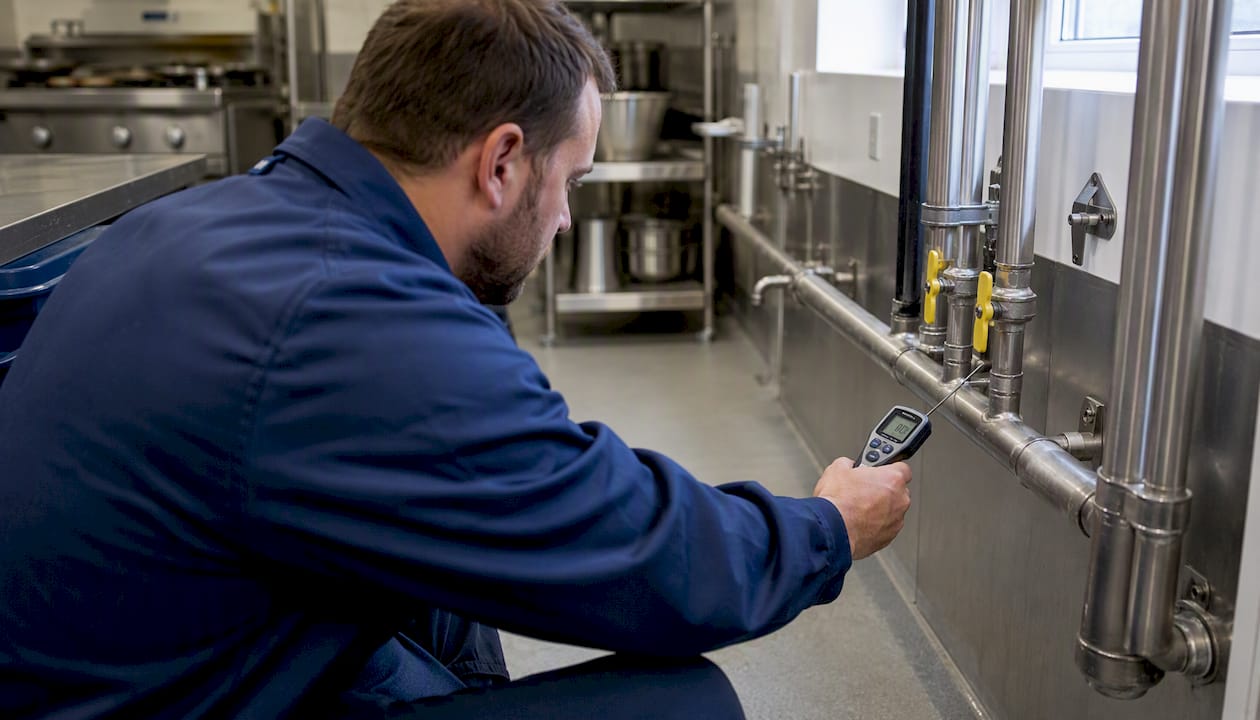
Your temperature monitoring checklist passes or fails on key temperature thresholds: hot water stored sufficiently hot to kill bacteria, delivered promptly to outlets at a safe temperature for legionella control, and cold water held at temperatures that prevent bacterial growth. These thresholds, set out in HSG274 Part 2, are the foundation of every compliant monitoring regime in the UK. If any reading falls outside them, you act before you move on.
Immediate pass/fail checks to run now:
Calorifier flow temperature: target at or above the temperature recommended by HSG274 Part 2
Calorifier return temperature: at or above the guidance threshold to ensure circulation
Sentinel hot outlets (nearest and furthest): reach the HSG274 recommended temperature within about one minute of running
Sentinel cold outlets (nearest and furthest): remain below the threshold temperature after running for about two minutes
If any check fails: isolate the outlet if there is a scalding or Legionella risk, post warning notices, provide alternative supply, and notify the responsible person promptly. Do not simply record the reading without further action.
Key takeaways
Consistent temperature monitoring, correctly recorded and acted upon, is the primary evidence that a Legionella control regime is working under UK HSE guidance.
Point | Details |
Core temperature targets | Hot stored ≥60 °C; cold <20 °C. |
Sentinel checks monthly | Select sentinels by hydraulic position, not physical distance; check near and far outlets on each loop. |
Act on every fail | Protect users first, flush and recheck, notify the responsible person, and record every step. |
Written scheme is mandatory | ACOP L8 requires a documented scheme, named competent person, and records retained for at least five years. |
Bespokecompliancesolutions | Provides risk assessments, logbook systems, TMV servicing, and remedial works tailored to your site. |
Table of Contents
What does your temperature monitoring checklist need to record?
How to choose sentinel outlets and build a simple sampling plan
Thermometers, probes and automated monitoring: keeping instruments accurate
What to do immediately when a temperature reading is out of range
Managing TMVs and scalding risk alongside Legionella temperature targets
Bespokecompliancesolutions: site-specific compliance support for your monitoring regime
What does your temperature monitoring checklist need to record?
A compliant log captures enough detail for an auditor to reconstruct exactly what happened, who did it, and what followed. The table below sets out the minimum fields.
The HSE danger-zone summary puts this plainly: the 20–45 °C band is where Legionella bacteria proliferate. Every reading you record is proof that your system is staying clear of it.
Quick-action checkboxes for a failed reading:
[ ] Outlet flushed and remeasured
[ ] Reading still out of range: responsible person notified
[ ] Outlet isolated or warning posted
[ ] Competent contractor instructed
[ ] Follow-up date set and recorded
How to choose sentinel outlets and build a simple sampling plan
Sentinel selection is where many monitoring plans go wrong. Physical proximity to the calorifier is not the right criterion. What matters is hydraulic position: the outlet that receives flow first and the outlet that sits at the end of the longest loop are the ones that reveal whether the whole system is performing.
Stepwise approach to building your sentinel plan:
Obtain or draw a schematic showing all pipework loops, risers, and branches.
Identify each principal loop or riser serving a distinct zone or floor.
For each loop, select the hydraulically nearest outlet (first off the flow) and the hydraulically furthest outlet (last before the return).
In multi-storey buildings, treat each riser as a separate loop; choose one near and one far sentinel per riser.
Where a loop serves vulnerable users (elderly residents, children, clinical areas), add an intermediate sentinel and increase check frequency.
Document the rationale for each sentinel in the written scheme, including the outlet ID, floor, and loop reference.
For a typical six-storey hotel, that means at least 12 sentinel outlets: two per riser for three risers, covering near and far positions. A housing block with a single loop needs a minimum of two sentinels, though the risk assessment may require more.
Monitoring frequency defaults under HSE health-services guidance: sentinel outlets monthly, calorifier flow and return monthly, cold storage tanks at least every six months. The risk assessment drives any increase above those defaults.
Pro Tip: Map your sentinel plan on the same schematic as your written scheme. An auditor who can see the hydraulic rationale for each sentinel will spend far less time questioning your monitoring regime.
Where and how to measure temperatures accurately
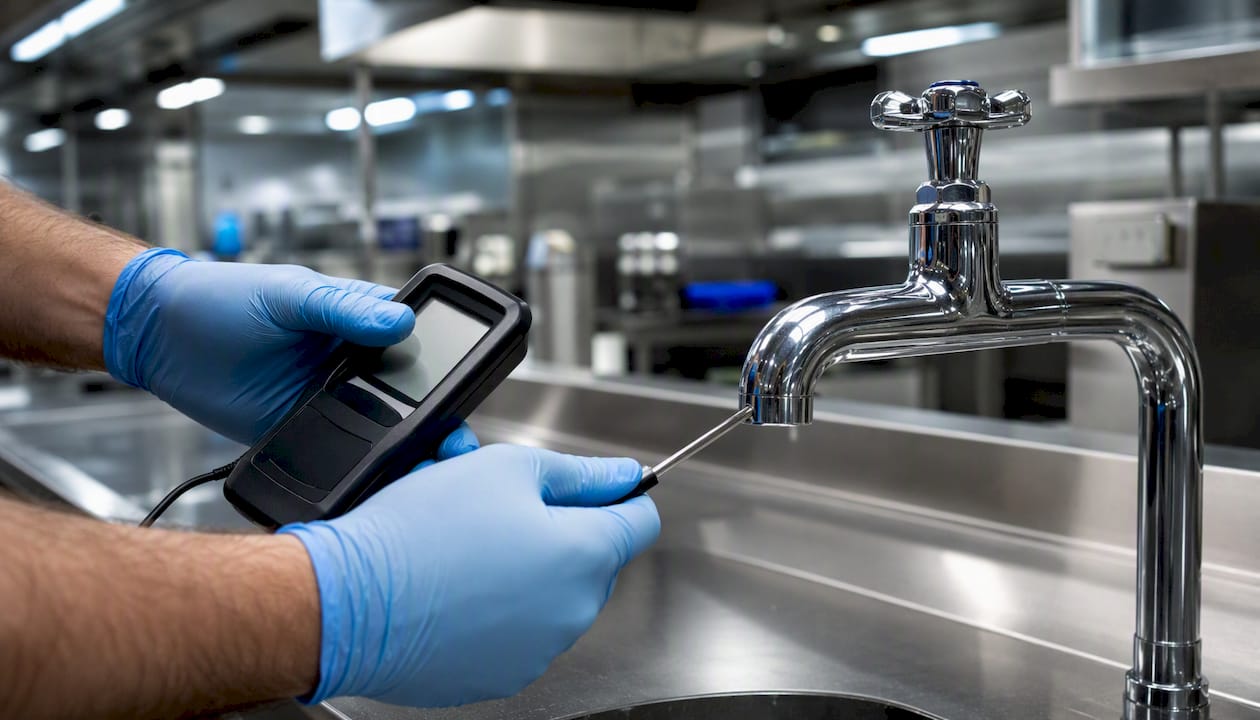
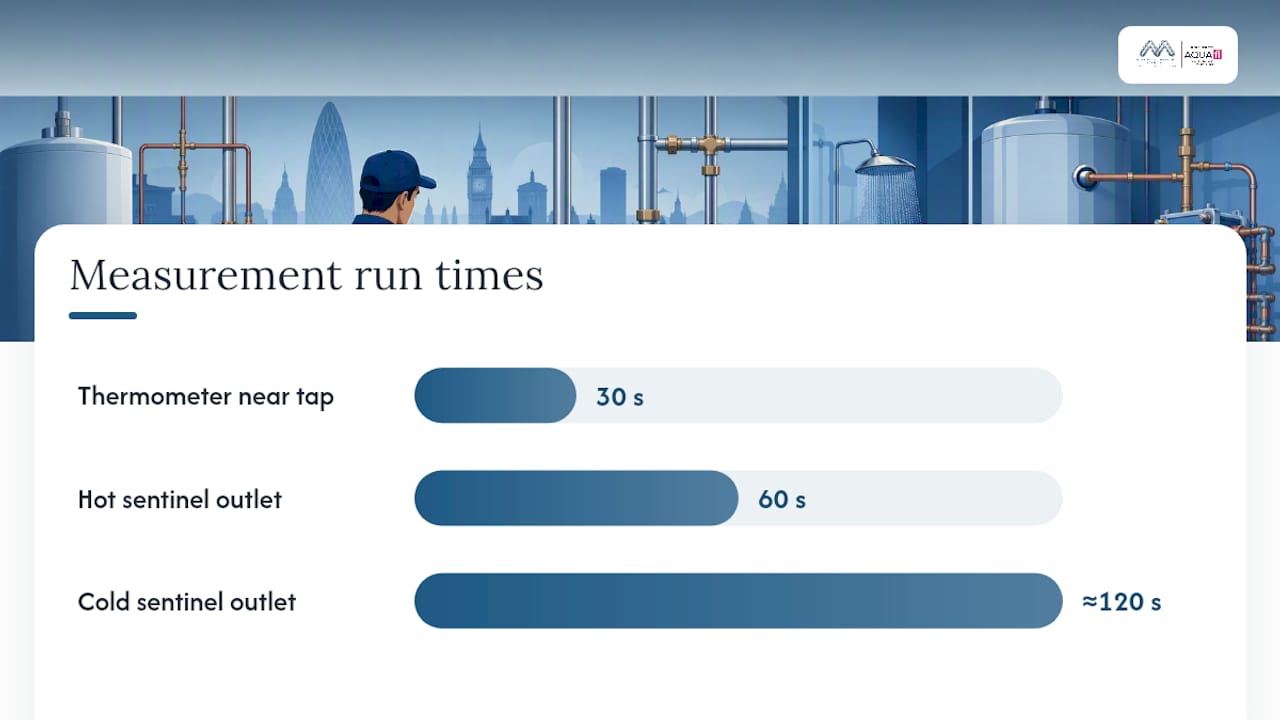
Measurement point and timing determine whether a reading is meaningful. A thermometer held near a tap for 30 seconds tells you very little; a calibrated probe in the correct pocket after the correct run time tells you whether the system is working.
Essential measurement points:
Calorifier flow: immersion pocket at the top of the vessel or on the flow pipework immediately downstream
Calorifier return: immersion pocket on the return pipework before it re-enters the vessel
Hot sentinel outlets: after running the hot tap for one minute, as specified in HSE practical measurement guidance
Cold sentinel outlets: after running the cold tap for approximately two minutes (or as set by the risk assessment for long-run branches)
Hot inlet to TMVs: upstream of the mixing valve, at the dedicated thermometer pocket or with a surface probe
Cold storage tank: at the ball-valve outlet or draw-off point
Timing rules in practice:
Start the stopwatch when the tap opens fully.
For hot outlets, record temperature at or before 60 seconds. If the target is not reached by 60 seconds, record the actual temperature and the elapsed time, and flag as a fail.
For cold outlets, record at approximately two minutes. In long-run branches, the risk assessment may extend this; document the agreed time in the written scheme.
Never record a reading taken from a static outlet without running the water first.
Surface probes are acceptable where no thermometer pocket exists, but they introduce measurement error of 1–2 °C. Where a pocket is present, always use an immersion probe.
Thermometers, probes and automated monitoring: keeping instruments accurate
A reading is only as reliable as the instrument taking it. Calibration is not optional; it is the difference between a defensible record and a liability.
Instrument types and appropriate use:
Immersion probe thermometers: first choice for calorifier pockets and any fixed thermometer socket; accuracy typically ±0.5 °C
Surface-contact probes: use where no pocket exists; note the ±1–2 °C tolerance in the log
Fixed pocket sensors linked to a BMS or automated monitoring system: suitable for continuous calorifier and circulation monitoring; require periodic verification against a calibrated handheld
Calibration schedule and instrument register fields:
Calibrate all handheld instruments at least annually against a UKAS-accredited reference or traceable standard.
Record in the instrument register: instrument ID, make and model, last calibration date, tolerance, next calibration due, and calibrating technician.
After any suspect reading, verify the instrument before initiating remedial work.
Automated BMS monitoring catches temperature drift between manual checks, which is its main advantage. The limitation is sensor drift: a sensor that reads 2 °C high will mask a failing calorifier. Run a calibrated handheld check at least quarterly, or immediately after any alarm event, before concluding the system has failed.
Pro Tip: Keep a spare calibrated probe on site. If a reading looks wrong, swap instruments and recheck before calling a contractor. Sensor drift causes more false alarms than actual system failures.
What to do immediately when a temperature reading is out of range
Consistent failure to reach targets points to a structural problem: stagnation, a balancing fault, pump failure, or insulation breakdown. A single low reading may be a transient issue; two consecutive low readings at the same outlet are an engineering problem.
Immediate user-protection steps (do these first):
If water is dangerously hot (scalding risk): isolate the outlet, post a warning notice, and provide an alternative supply before investigating.
If water is dangerously cold (Legionella risk): restrict use of the outlet, post a warning, and notify the responsible person within the same working day.
Investigative workflow:
Recheck with a verified instrument. If the reading is confirmed, proceed.
Flush the outlet for five minutes and remeasure. Record both readings.
Check pump operation and circulation: confirm the pump is running and the return temperature is within range.
Inspect balancing valves on the affected loop; a closed or partially closed valve is a common cause of low distribution temperatures.
Check for dead legs or recently decommissioned branches that may be introducing cold water into the loop.
Inspect pipework insulation on the affected run; uninsulated sections in cold voids drop distribution temperatures quickly.
If the fault is not resolved within 24 hours, instruct a competent contractor. Consider water sampling and thermal or chemical disinfection if the system has been out of range for an extended period.
Minimum incident records: date and time of failure, outlet ID, measured temperature, immediate actions taken, temporary controls in place, person notified, follow-up date, and outcome of reinspection.
What your written scheme and logbook must include
ACOP L8 requires dutyholders to prepare a written scheme, implement it, and keep records. An auditor or HSE inspector will look for these elements.
Written scheme essentials:
System schematic with all outlets, loops, risers, and sentinel positions marked
Named responsible person and evidence of their competence
Sentinel list with hydraulic rationale for each selection
Monitoring frequencies for each check type, referenced to the risk assessment
Remedial action thresholds and escalation contacts
Review date and version control
Logbook field | Minimum requirement |
Date and time | Every entry |
Location / outlet ID | Unique reference per schematic |
Temperature recorded | °C to one decimal place |
Operator | Named and signed |
Action taken | Specific, not “noted” |
Follow-up outcome | Recorded at reinspection |
Store records in a central site file or a secure digital system for a minimum of five years. Temperature logs feed directly into the risk assessment review: a pattern of borderline readings is grounds for increasing monitoring frequency or commissioning a full system review, as the HSE hot-and-cold guidance makes clear.
Managing TMVs and scalding risk alongside Legionella temperature targets
Thermostatic mixing valves are the point where Legionella control and scald prevention meet. Hot water must be stored and distributed at temperatures that kill Legionella, then blended down to safe delivery temperatures at the point of use for vulnerable users.
Key TMV management points:
Measure temperature at the hot inlet to the TMV, not at the blended outlet, for Legionella compliance purposes.
Blended outlet temperature for vulnerable users (elderly, disabled, children) should typically not exceed 44 °C; confirm the specific target with the risk assessment.
Service TMVs at frequencies set by the risk assessment; HSE health-services guidance indicates this is typically annually as a minimum for healthcare settings, with more frequent checks where the risk assessment requires it.
If a TMV fails to blend correctly (delivering water above the blended set-point), isolate it and provide an alternative supply before servicing.
Document every TMV service: date, engineer, inlet temperatures, blended outlet temperature, and any parts replaced.
Pro Tip: For hotels and housing associations, sector-specific guidance on TMV monitoring and shower maintenance is worth reviewing. The hospitality and leisure compliance page covers the practical approach for those settings.
A practical template you can copy into your logbook
The entries below show a pass, a fail, and a recorded remedial action. Copy the structure into your own log or digital system.
Common pitfalls to avoid:
Missing or duplicated outlet IDs: every outlet must have a unique reference that matches the schematic.
Vague action entries: “checked” or “noted” are not compliant records. Write what you did, what you found, and what happens next.
Recording temperature before the run time has elapsed: set a stopwatch, not a guess.
Leaving the “action” column blank on a pass: write “Pass” explicitly so there is no ambiguity.
Training, competence and when to call a specialist
The dutyholder’s obligation under ACOP L8 is to appoint a competent person, not simply a willing one. Competence for temperature monitoring means understanding why the checks matter, not just how to hold a thermometer.
What competence looks like in practice:
Correct probe selection and insertion technique for immersion pockets
Understanding of run-time requirements before recording
Ability to identify a fail and initiate the escalation procedure
Familiarity with the site schematic and sentinel locations
Basic understanding of the Legionella danger zone and why the thresholds exist
Training topics to cover: HSE temperature targets and their basis, sentinel selection rationale, measurement methods, logbook completion, and escalation procedures. A Legionella risk assessment review is a good prompt to check whether the person currently doing checks is still the right one.
When to bring in a specialist: instrument calibration, system balancing, TMV servicing, thermal disinfection, and any situation where two consecutive checks have failed at the same outlet. A specialist visit should include calibrated instruments, a written report, and clear remedial recommendations.
Pro Tip: Ask any contractor to show you their instrument calibration certificate before they take a single reading on your site. An uncalibrated instrument produces a record that is worse than no record at all.
What the monitoring records actually tell you
Most compliance managers treat temperature monitoring as a box-ticking exercise. That is the wrong frame. The log is a performance record for your water system, and patterns in it are diagnostic.
A calorifier return that creeps from 52 °C to 49 °C over three months is not a rounding error; it is a circulation problem developing in real time. A cold sentinel that reads 18 °C in January and 19.8 °C in July is telling you the cold feed is picking up heat from adjacent pipework, and that the summer months are your highest-risk period. Neither of these signals shows up if you only look at whether a reading passed or failed on the day.
The other thing practitioners underestimate is the value of a well-documented fail. A logbook that shows a failed reading, an immediate flush, a confirmed recheck, a contractor call, and a resolved outcome is stronger evidence of a functioning control regime than a logbook full of unbroken passes. Auditors and HSE inspectors know that no system runs perfectly; what they are looking for is whether you noticed, responded, and recorded.
Short-term fixes, such as increasing flush frequency or adjusting pump run-times, can buy time. They are not a substitute for engineering remediation when the root cause is a dead leg, a failed pump, or a fundamentally unbalanced loop.
Bespokecompliancesolutions: site-specific compliance support for your monitoring regime
Completing a temperature monitoring checklist is straightforward when the system is well-designed, the sentinels are correctly selected, and the instruments are calibrated. Getting to that point is where most sites need help.
Bespokecompliancesolutions provides the full range of services that sit behind a compliant monitoring regime: bespoke Legionella risk assessments, written scheme preparation, implementation of logbook systems (paper and digital), TMV servicing, instrument calibration, water sampling and analysis, and remedial works when checks reveal system faults. Every service is scoped to your specific site, not a generic template. If your sentinel plan needs rationalising, your calorifier return temperatures are borderline, or you simply need a competent person to take over the monthly checks, contact Bespokecompliancesolutions for a site review.
Sources
Keep these documents linked in your written scheme and refer to them when setting monitoring frequencies, sentinel rationale, or sector-specific targets.
HSG274 Part 2: Hot and cold water systems
Recommended
Comments