
Water hygiene monitoring: a guide for facilities managers
- 6 hours ago
- 10 min read
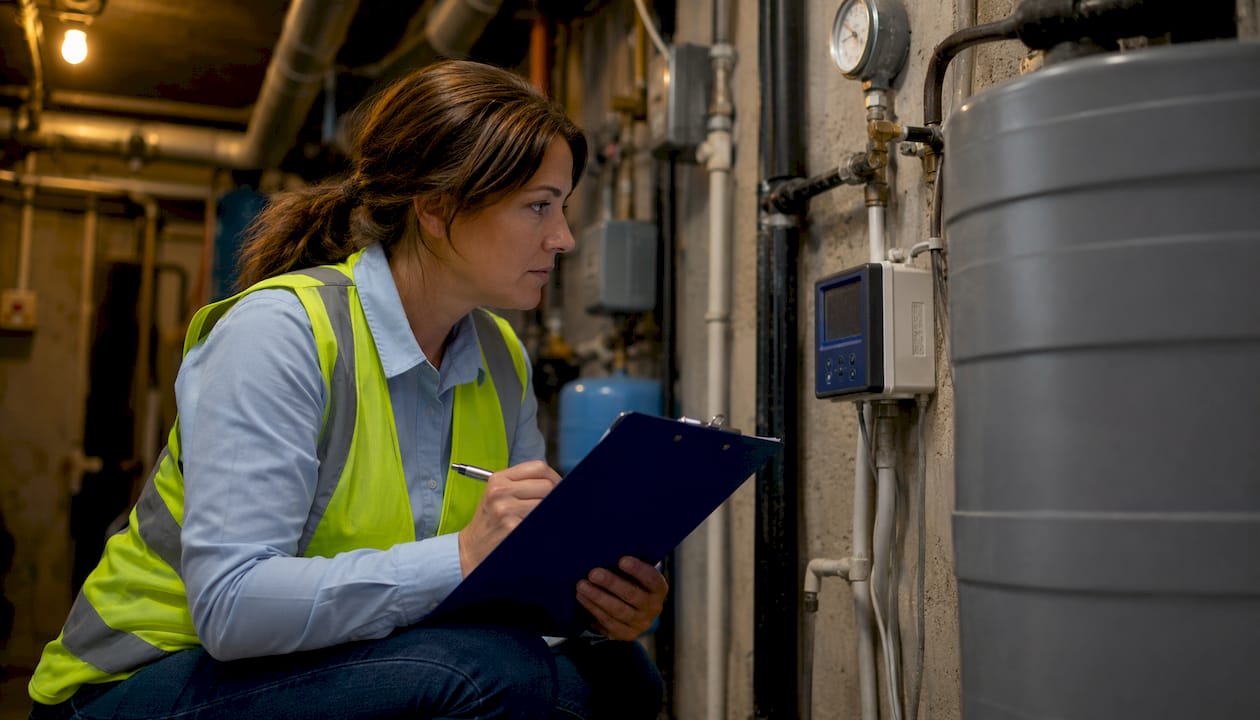
Water hygiene monitoring is the scheduled programme of checks and measurements that confirms your water system controls are working and that conditions favouring Legionella growth are being kept in check. Under UK health and safety law, duty holders have a legal obligation to manage water-borne risk, and monitoring is the mechanism that turns a written scheme of control into a defensible, auditable routine.
“Water hygiene monitoring confirms the effectiveness of control measures installed after a Legionella risk assessment and acts as an early-warning system to detect conditions favourable to bacterial growth.” — ESPO water hygiene guidance
Two temperature thresholds sit at the heart of the whole programme: cold water stored below a certain temperature to inhibit bacterial growth and hot water distributed above a certain level to prevent Legionella proliferation. Stray outside those bands and you have created the conditions Legionella thrives in. The HSE’s Approved Code of Practice, ACoP L8, sets out how monitoring supports those controls, and the WHO’s WASH framework underpins the broader public-health rationale. Failing to produce evidence of regular maintenance can also affect insurance cover under the Workplace (Health, Safety and Welfare) Regulations 1992.
Table of Contents
What does a water hygiene monitoring programme actually include?
How often should you monitor, and what triggers extra checks?
How do you interpret results and what do you do when something is wrong?
What records do you need to keep, and how should you structure a logbook?
How Bespokecompliancesolutions supports your monitoring compliance
What does a water hygiene monitoring programme actually include?
A water hygiene programme is not a single test. It is a layered set of tasks, each targeting a different failure mode in the system. Common tasks include flushing infrequently used outlets, routine sentinel outlet temperature checks, and periodic inspection and cleaning of tanks and calorifiers.
Here is a practical checklist you can map directly to your site scope of work:
Sentinel outlet temperature checks — measure hot and cold water at representative first- and last-draw points on each circuit. Hot outlets should reach above 50°C within one minute; cold outlets should run below 20°C.
Flushing of infrequently used outlets — showers, teapoints, and any outlet unused for seven days or more need a purge flush to prevent stagnation.
Storage tank and calorifier inspections — visual checks for sediment, biofilm, debris, and structural integrity of lids and insulation.
Thermostatic mixing valve (TMV) servicing — check for correct blended temperature, clean strainers, and verify fail-safe operation.
Microbiological sampling — when risk assessment or adverse temperature results indicate it, samples go to a UKAS-accredited laboratory for Legionella culture or ATP analysis.
Cleaning, disinfection and remedial works — chlorination or thermal disinfection triggered by sampling results or system changes.
Pipework and dead-leg checks — identify sections of low flow that create warm, stagnant water.
Pro Tip: After any period of low occupancy — a long weekend, a holiday shutdown, or a building mothballing — prioritise flushing all outlets before normal use resumes, starting with showers, which carry the highest aerosol risk. Do not wait for the next scheduled visit.
How often should you monitor, and what triggers extra checks?
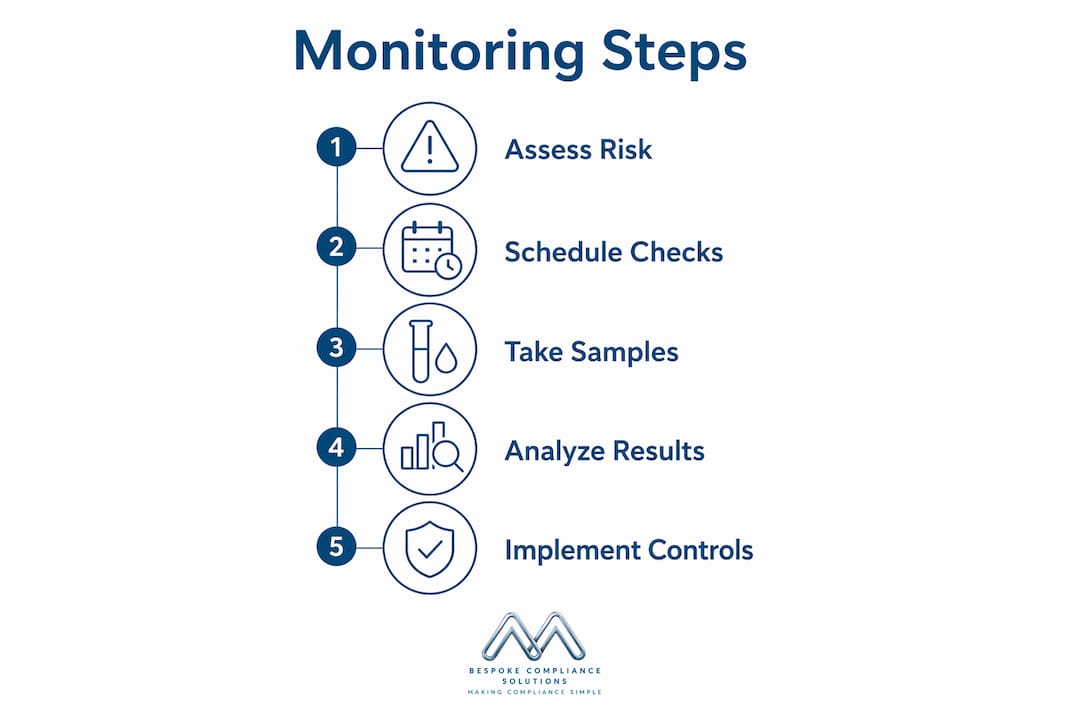
Frequency is not a fixed schedule you copy from a template. ACoP L8 is clear: monitoring frequency must be proportionate to the risk identified in the site-specific risk assessment. A low-risk office with a simple direct-feed system needs far less frequent intervention than a large healthcare facility with complex calorifier circuits.
That said, typical timelines give you a useful starting framework:
Weekly — flush low-use outlets (any outlet not used in the previous seven days).
Monthly — sentinel hot and cold temperature checks at representative outlets.
Quarterly — TMV checks, visual inspections of accessible pipework, and review of logbook trends.
Annually — full tank inspection, calorifier inspection, and risk assessment review.
Several triggers should prompt you to increase frequency outside that cycle. System changes or new pipework, recommissioning after a shutdown, suspected contamination, the arrival of vulnerable occupants (immunocompromised patients or elderly residents), and any confirmed Legionella detection all require immediate additional checks. You can find more on when to review a Legionella risk assessment as circumstances change.
Microbiological testing is an investigative tool, not a routine requirement for low-risk systems. Use it when temperature results are persistently out of tolerance, after a disinfection event, or when a risk assessment flags a high-risk population. When you do sample, use a UKAS-accredited laboratory and make sure the sampler understands sample handling and the limitations of results, including detection limits and repeatability, so interpretation is meaningful.

How do you interpret results and what do you do when something is wrong?
An out-of-tolerance result is not automatically a crisis, but it does demand a structured response. Work through these steps in order:
Check for recording error — confirm the thermometer was calibrated and the reading was taken correctly before drawing conclusions.
Re-test immediately — a single anomalous reading may reflect a transient condition. A second reading at the same outlet confirms or dismisses it.
Identify the cause — stagnation from low use, a failed calorifier thermostat, cross-connection, or insulation failure are the most common culprits.
Apply interim controls — if hot water at a sentinel outlet is below 50°C, restrict access to that outlet and increase flushing frequency while the cause is investigated.
Carry out remedial action — this may mean thermal disinfection, chlorination, equipment repair, or dead-leg removal, depending on the root cause.
Escalate to microbiological sampling — if temperature failures persist or if the system serves a vulnerable population, commission Legionella water testing from a UKAS-accredited laboratory.
Log everything — record the adverse result, the investigation, the remedial action taken, and the outcome. This log is your primary defence if a regulator or insurer asks questions.
Review the scheme of control — if the same outlet fails repeatedly, the monitoring frequency or control measure itself needs updating, not just the logbook entry.
The 24–48 hours after an adverse result are critical. Interim controls and a documented investigation plan should be in place within that window. Leaving a known failure unaddressed and unrecorded is the scenario that creates serious regulatory and legal exposure.
Who is responsible for water hygiene monitoring?
The duty holder carries ultimate legal responsibility. In most commercial buildings that is the employer or the person in control of the premises. ACoP L8 requires the duty holder to appoint a competent person to manage the written scheme of control, and that appointment must be documented.
Competence is not just a training certificate. A genuinely competent person understands the site’s water systems, knows how to use and calibrate monitoring instruments, can interpret results in context, and recognises when to escalate. For Legionella risk management in higher-risk settings such as healthcare or housing with vulnerable occupants, the competence bar is higher still.
Three models are common in practice:
Trained in-house staff — suitable for simpler, lower-risk systems where a nominated person can be trained to carry out and record routine checks.
Third-party competent contractor — a specialist provider carries out all or most monitoring tasks and supplies audit-ready records.
Hybrid model — in-house staff handle daily or weekly flushing logs, while a specialist contractor conducts monthly temperature surveys, quarterly inspections, and any microbiological sampling.
When appointing an external provider, check for relevant qualifications and industry membership, confirm that any laboratory work goes through a UKAS-accredited facility, verify that the contractor holds adequate professional indemnity and public liability insurance, and ask to see a sample logbook from a comparable site.
What records do you need to keep, and how should you structure a logbook?
Meticulous records are often the primary defence if an incident occurs. A logbook that is incomplete, inconsistent, or clearly templated from a generic form will not hold up under scrutiny from the HSE or an insurer. Every entry should capture:
Date and time of the visit or check
Location and outlet reference (use a consistent asset numbering system)
Reading or result (temperature in °C, visual inspection outcome, sample reference number)
Instrument used and its calibration status
Operator name and signature
Action taken — including “no action required” where that is the correct outcome
Sign-off by responsible person
That last point matters more than most logbooks reflect. A record signed off by the competent person, not just the operative who took the reading, demonstrates that results are being reviewed, not just collected.
Pro Tip: Set a monthly or quarterly logbook review in your calendar. Trend analysis across several months will reveal a calorifier that is slowly losing temperature, or a cold-water tank that creeps above 20°C each summer, long before either becomes a compliance failure. Catching a slow drift early is far cheaper than an emergency disinfection.
Records should be retained for at least the period your insurer and the HSE would expect to examine in the event of a claim or investigation. Five years is a widely cited minimum for water hygiene records, though specific circumstances may require longer retention.
How do you implement a monitoring programme from scratch?
A monitoring programme needs a foundation before it needs a schedule. Work through this implementation checklist in order:
Asset register — map every water outlet, storage vessel, calorifier, TMV, and section of pipework on site.
Risk assessment — a formal Legionella risk assessment identifies hazards, assigns risk levels, and drives the monitoring frequency for each asset.
Written scheme of control — the document that describes every control measure, who is responsible, and how compliance is demonstrated.
Schedule of tasks — assign each task a frequency, a responsible role, and a record format.
Competence assignment — confirm who carries out each task and that they are trained and equipped to do so.
Record system — paper logbooks work, but a digital system reduces human error and provides real-time alerts that let teams move from reactive fixes to predictive maintenance.
Review cadence — schedule formal programme reviews at least annually, or after any trigger event.
Sample monitoring schedule
Task | Typical frequency | Responsible role |
Flush low-use outlets | Weekly | In-house facilities staff |
Sentinel temperature checks | Monthly | Competent person / contractor |
TMV checks | Quarterly | Specialist contractor |
Tank and calorifier inspection | Annually | Specialist contractor |
Microbiological sampling | Risk-led / post-disinfection | UKAS-accredited laboratory |
Logbook trend review | Monthly / quarterly | Responsible person |
Risk assessment review | Annually or on trigger | Competent assessor |
A managed service removes much of the administrative burden from in-house teams. Proactive monitoring services turn ACoP L8 and drinking water duties into clear, defensible routines by mapping water flow, defining monitoring tasks, and keeping auditable records. Bespokecompliancesolutions provides risk assessments, water sampling, TMV servicing, logbook implementation, and automated temperature monitoring across sites throughout the UK.
Pro Tip: Automated temperature monitoring systems log readings continuously and flag exceedances in real time. That moves your programme from administrative logging to genuine predictive maintenance, and the audit trail is far more defensible than a monthly paper sheet. It is worth considering for any site with complex hot-water circuits or a vulnerable occupant population.
Healthcare settings in particular benefit from this approach. Preventive maintenance schedules in clinical environments follow a similar logic: continuous monitoring catches drift before it becomes a failure.
Key takeaways
Water hygiene monitoring is the scheduled, risk-proportionate programme of checks that proves your Legionella controls are working and gives you a defensible record if anything goes wrong.
Point | Details |
Core definition | Scheduled checks confirm control measures are working and detect conditions favourable to Legionella growth. |
Temperature thresholds | Cold water below 20°C, hot water above 50°C — these are the two non-negotiable control parameters. |
Risk-proportionate frequency | Monitoring frequency must match site risk; typical tasks range from weekly flushing to annual tank inspections. |
Record everything | A complete, signed logbook is your primary defence with the HSE and insurers after any incident. |
Appoint a competent person | ACoP L8 requires a documented appointment; competence covers training, instruments, and knowing when to escalate. |
Bespokecompliancesolutions | Provides end-to-end monitoring support across UK sites, from risk assessments and sampling to logbook systems and automated monitoring. |
Why routine monitoring wins compliance battles
The facilities managers I see struggling with water hygiene compliance almost always share one characteristic: they have a monitoring programme on paper that does not reflect what actually happens on site. Generic templates, copied from another building or downloaded from the internet, are the single most common pitfall. They list the right tasks but assign them to the wrong outlets, at the wrong frequency, for the wrong reasons. When the HSE or an insurer asks why a particular outlet was checked monthly rather than weekly, “because the template said so” is not an answer.
Over-monitoring is a real problem too, and it is underappreciated. Checking every outlet every month on a large site generates enormous volumes of data that nobody reviews. The result is a logbook that looks thorough but contains no useful signal. Effective monitoring is specific: it targets the outlets and assets your risk assessment identifies as higher risk, at a frequency justified by that risk, and the records are reviewed regularly enough to catch trends.
The defensive value of a well-kept logbook is hard to overstate. When records are complete, consistent, and signed off by a named competent person, they demonstrate that the duty holder took the obligation seriously and acted on what the monitoring found. That is what separates a defensible position from a damaging one. Make the scheme building-specific, review it at least annually, and treat the logbook as the legal document it effectively is.
How Bespokecompliancesolutions supports your monitoring compliance
Bespokecompliancesolutions gives facilities teams a practical, site-specific alternative to managing water hygiene compliance in-house with generic tools and overstretched staff. The difference is a programme built around your building’s actual water system, not a standard template.
Services directly relevant to monitoring compliance include:
Legionella risk assessments that drive your monitoring frequency and scope
Water sampling and analysis through UKAS-accredited laboratory partners
Implementation of bespoke logbook systems, paper or digital
TMV servicing and verification
Automated temperature monitoring installation and management
Disinfection and remedial works following adverse results
Ongoing consultancy and Legionella awareness training for in-house staff
Whether you need a first risk assessment, a managed ongoing programme, or support following an adverse result, Bespokecompliancesolutions works across commercial, healthcare, housing association, retail, and facilities management sites throughout the UK. Request a site survey or quote via the Legionella compliance for offices and commercial premises page.
This article provides general information about water hygiene monitoring in the UK. It is not a substitute for professional advice tailored to your specific site and circumstances. Confirm current regulatory requirements with the HSE or a qualified competent person.
Useful sources and further reading
HSE — Testing and monitoring your water system for Legionella: the primary UK regulatory reference for monitoring obligations under ACoP L8. hse.gov.uk/legionnaires
HSE — ACoP L8 (Legionnaires’ disease: The control of Legionella bacteria in water systems): the approved code of practice that sets the legal standard for duty holders in the UK.
UKAS (United Kingdom Accreditation Service): use ukas.com to verify that any laboratory carrying out Legionella microbiological testing holds current UKAS accreditation.
WHO — Water, Sanitation and Hygiene (WASH): who.int/health-topics/water-sanitation-and-hygiene-wash — the international public-health framework underpinning national water safety standards.
Bespokecompliancesolutions — Water analysis and Legionella testing: bespokecompliancesolutions.co.uk/water-analysis-and-legionella-testing
Bespokecompliancesolutions — Legionella compliance for offices and commercial premises: bespokecompliancesolutions.co.uk/legionella-compliance-in-offices-and-commercial-premises
Recommended
Comments