
Why integrated compliance systems matter for business
- 9 hours ago
- 7 min read

Integrated compliance systems are structured frameworks that unify multiple regulatory requirements, standards, and controls into a single, cohesive programme. For business leaders and compliance professionals in commercial and healthcare sectors, understanding why integrated compliance systems matter is the difference between reactive firefighting and genuine risk control. Implementing ISO 9001, ISO 14001, and ISO 45001 simultaneously within an integrated structure costs 30–40% less than sequential implementation. That figure alone reframes compliance from a cost centre into a financial decision.
Why integrated compliance systems matter for cost and audit efficiency
Fragmented compliance is expensive. When each regulatory requirement is managed separately, organisations duplicate effort, repeat audits, and consume leadership time on administration rather than strategy. The industry term for the alternative is an Integrated Management System (IMS), and the financial case for adopting one is clear.
Implementing multiple ISO standards simultaneously costs 30–40% less than sequential implementation. This saving comes from shared documentation, unified training programmes, and a single internal audit cycle that covers multiple standards at once. For a mid-sized healthcare trust or commercial property portfolio, that reduction in overhead is material.

The audit burden on senior staff is equally significant. A VP of Engineering can lose four weeks annually managing separate SOC, ISO, and PCI audits. A consolidated assurance approach, where controls are mapped once and tested across multiple frameworks simultaneously, recovers that time for strategic work. For healthcare compliance managers juggling HSE L8, CQC requirements, and internal governance, the parallel is direct.
The table below shows the practical difference between sequential and integrated compliance implementation:
Factor | Sequential Implementation | Integrated Implementation |
Implementation cost | Full cost per standard | 30–40% lower overall |
Audit cycles | Separate per framework | Single unified cycle |
Documentation | Duplicated across teams | Shared, centralised records |
Leadership time on audits | Up to four weeks per year | Significantly reduced |
Risk visibility | Fragmented by department | Real-time, connected view |
Pro Tip: Before selecting any compliance software or management platform, map every regulatory obligation your organisation currently holds. List them in a single register. This exercise alone reveals duplication and sets the foundation for a genuine IMS rather than a rebranded filing system.
How does integration reduce breach risk and financial exposure?
The financial consequences of poor compliance integration extend well beyond audit fees. Organisations with high compliance complexity face average data breach costs of $5.28 million, compared to $3.84 million for organisations with low complexity. That $1.44 million gap is a direct measure of what fragmented controls cost when something goes wrong.
Incident response is where integration pays its clearest dividend. Regular testing of incident response plans cuts breach costs by 58% and speeds recovery. This is only achievable when your compliance framework connects risk identification, control testing, and response procedures into a single workflow. Organisations running separate systems for health and safety, water hygiene, and data governance cannot test their response holistically because the systems do not talk to each other.
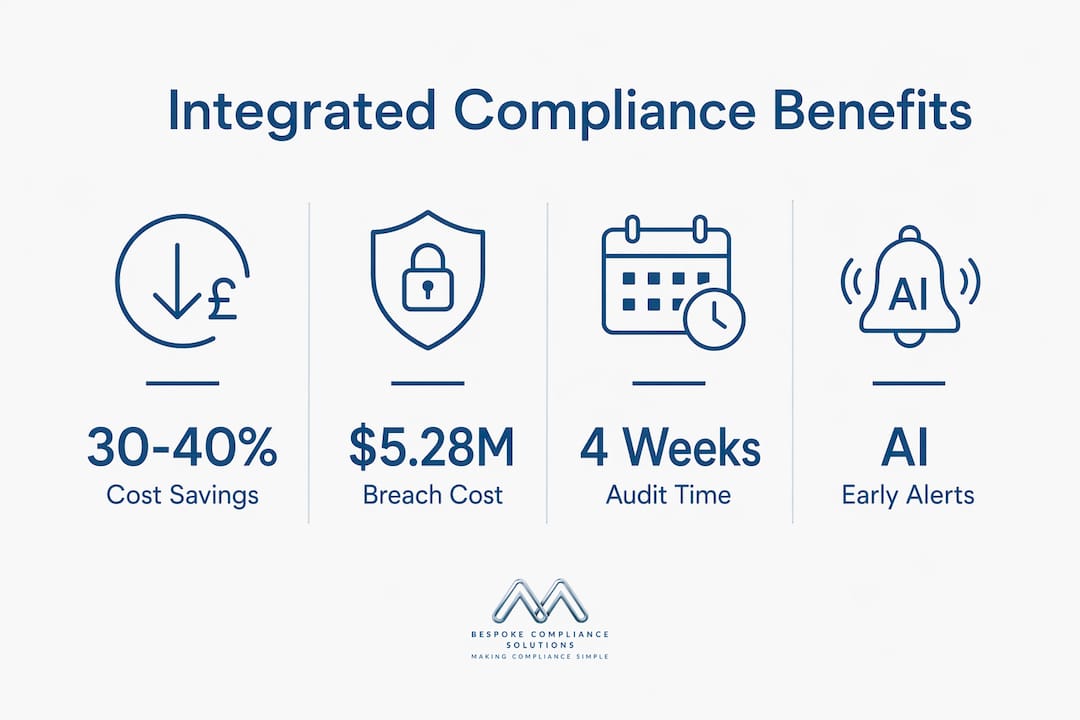
Unified compliance moves organisations from fragmented auditing to real-time, dynamic risk monitoring through connected data systems. Boards can interrogate current control status and obligations without waiting for quarterly reports or manual consolidation. For a healthcare premises manager responsible for Legionella risk management across multiple wards, real-time visibility is not a luxury. It is a patient safety requirement.
The risk management improvements enabled by integration include:
Earlier detection of control failures through connected monitoring rather than periodic manual checks
Faster incident response because procedures, evidence, and contacts are held in one place
Reduced regulatory penalties from demonstrable, documented control at the point of inspection
Lower insurance exposure as insurers increasingly price risk based on the maturity of compliance frameworks
Stronger audit trails that satisfy multiple regulators from a single evidence base
What organisational challenges must be overcome to implement integration?
Technical integration is the easier half of the problem. The harder challenge is organisational alignment. The biggest hurdle in integrated compliance is breaking down silos for shared definitions and governance models. Two departments can use the same word, “risk,” and mean entirely different things. Without a shared taxonomy, integration produces connected systems that still require manual reconciliation.
Without agreed shared data standards and governance, integration efforts force teams to manually reconcile controls and evidence. This is the most common failure mode. Organisations invest in a new platform, connect their existing data, and discover that the underlying records are inconsistent, incomplete, or owned by no one. The technology works. The governance does not.
Successful integration requires moving from departmental silos to assigned process owners responsible for end-to-end control documentation and improvement. This means naming individuals, not teams, as accountable for specific controls. A named process owner for water hygiene compliance, for example, is responsible for documentation, evidence, and continuous improvement across every site. Without that accountability, records satisfy local managers but fail external inspectors.
Executive sponsorship is the third ingredient. Integration that starts in a compliance team and never reaches the board will stall at the first departmental objection. The role of a compliance manager in a healthcare or commercial setting now requires the ability to present integration as a business case, not just a regulatory obligation.
Pro Tip: Run a governance alignment workshop before you touch any technology. Bring together the leads for health and safety, facilities, data protection, and quality. Agree on shared definitions for “risk,” “control,” and “evidence.” Document the outcome. This single session prevents months of rework after implementation.
How do integrated systems transform the compliance professional’s role?
The compliance professional’s role is changing. Connected compliance uses AI and shared data to surface patterns early, helping teams see risk sooner and respond with context rather than scrambling for information after an incident. This shift moves compliance from a reporting function to an advisory one.
Integrated compliance repositions compliance teams as strategic partners using AI-driven insight to influence business growth rather than just reactive reporting. In practice, this means a compliance manager in a commercial property firm can advise on acquisition risk before a deal closes, rather than discovering compliance gaps during due diligence. In healthcare, it means a water hygiene lead can present board-level risk data in real time rather than compiling a monthly report from spreadsheets.
The benefits of this transformation are concrete:
Proactive risk advice replaces reactive incident management as the primary output of the compliance function
M&A confidence improves because integrated compliance demonstrates a low-risk profile that reduces red flags during investor due diligence
Staff retention improves when compliance professionals spend time on analysis and strategy rather than chasing paperwork
Cross-functional credibility grows as compliance teams provide insight that operations, finance, and leadership actually use
Healthcare compliance managers working across NHS trusts, GP surgeries, and private facilities are already navigating this shift. The water compliance management system frameworks that once lived in ring binders are moving into connected digital platforms. The professionals who understand both the regulatory requirements and the governance architecture of integration will define the next generation of compliance leadership.
Key takeaways
Integrated compliance systems reduce costs, lower breach risk, and transform compliance from a reactive function into a strategic business asset.
Point | Details |
Cost savings are measurable | Integrated ISO implementation costs 30–40% less than managing standards separately. |
Breach risk falls with integration | High compliance complexity costs $1.44 million more per breach than low complexity organisations. |
Governance alignment comes first | Shared data standards and named process owners must be in place before technology is introduced. |
Incident response is the key lever | Regular testing of integrated response plans cuts breach costs by 58% and speeds recovery. |
Compliance teams become strategic | Connected systems enable proactive risk advice, M&A support, and real-time board reporting. |
The part most organisations get wrong
I have worked with commercial and healthcare organisations at every stage of compliance maturity, and the pattern is consistent. The organisations that struggle with integration are not the ones that chose the wrong software. They are the ones that started with the technology and skipped the governance conversation.
The instinct is understandable. A new platform feels like progress. Governance workshops feel like delay. But when you connect systems that hold inconsistent data, owned by different people with different definitions of the same terms, you do not get integration. You get a faster way to produce conflicting reports.
What actually works is starting with a single, honest question: who is accountable for this control, and what does “compliant” mean to them? In healthcare water hygiene, that question surfaces disagreements between estates teams, infection control leads, and facilities managers that have existed for years. Resolving them before implementation is not bureaucracy. It is the work.
The organisations I have seen get this right share one characteristic. They treat integration as a continuous improvement programme, not a project with an end date. They assign named owners, review governance quarterly, and measure compliance outcomes rather than compliance activity. That shift in mindset is what separates organisations that achieve genuine regulatory compliance from those that achieve well-documented checkbox satisfaction.
— Sammi
How Bespokecompliancesolutions supports your compliance programme
Bespokecompliancesolutions works with commercial and healthcare organisations across the UK to make compliance straightforward and genuinely effective. Whether you are building an integrated water hygiene programme from scratch or strengthening an existing framework, the team provides bespoke support tailored to your sites and obligations.

Services include Legionella risk assessments, water sampling and analysis, TMV servicing, bespoke logbook systems, and Legionella awareness training aligned with HSE L8 requirements. Each solution is designed to integrate with your existing governance structure, not sit alongside it as another separate obligation. Contact Bespokecompliancesolutions to discuss how a bespoke compliance programme can reduce your risk exposure and free your team to focus on what matters.
FAQ
What is an integrated compliance system?
An integrated compliance system is a unified framework that consolidates multiple regulatory standards, controls, and evidence into a single management programme. It replaces separate, siloed compliance processes with connected workflows and shared documentation.
How do integrated compliance systems reduce costs?
Implementing multiple ISO standards simultaneously within an integrated structure costs 30–40% less than sequential implementation, primarily through shared documentation, unified audits, and reduced duplication of effort.
Why is compliance integration critical for healthcare organisations?
Healthcare organisations manage overlapping obligations across HSE L8, CQC, and infection control requirements. Integration connects these into a single evidence base, enabling real-time risk monitoring and faster incident response across complex, multi-site environments.
What is the biggest risk of fragmented compliance systems?
Organisations with high compliance complexity face average breach costs of $5.28 million, compared to $3.84 million for low complexity organisations. Fragmentation also prevents holistic incident response testing, which is the single most effective way to reduce breach costs.
Where should an organisation start with compliance integration?
Start with governance alignment, not technology. Agree on shared definitions, assign named process owners for each control area, and document accountability before connecting any systems. This prevents the manual reconciliation that undermines most integration efforts.
Recommended
Comments