
Cooling tower Legionella control: your legal duties explained
- 2 days ago
- 8 min read
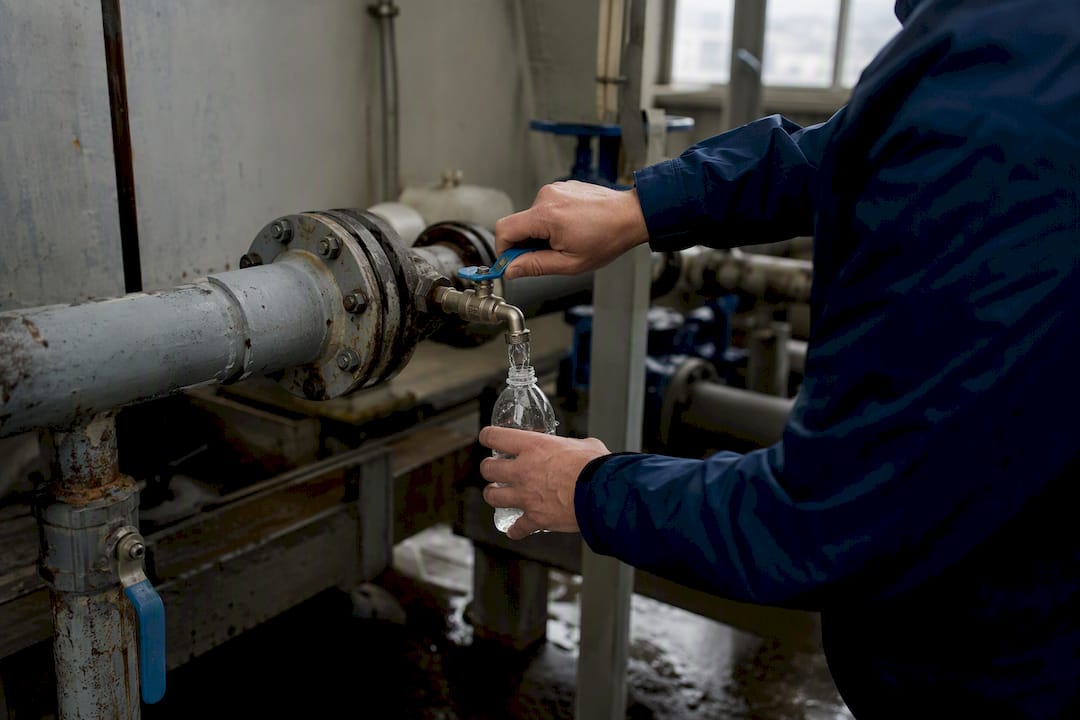
If you manage a cooling tower in England, you must comply with ACOP L8 and HSG274 Part 1. That means a written control scheme, an appointed competent person, and active monitoring running today, not next quarter.
The Health and Safety Executive treats cooling towers as a high-priority Legionella risk because they generate fine water droplets that can travel considerable distances on the wind. Five things that need to be in place right now:
A written control scheme covering your system, control limits, and remedial actions
A named, competent responsible person overseeing the programme
Active water treatment with a documented biocide regime
A working monitoring and sampling routine, including pH-corrected DPD No. 1 testing
Local authority notification, where your system falls under the 1992 Regulations
Pro Tip: If you cannot answer “who owns this scheme, and when was it last reviewed?” in under ten seconds, treat that as your first compliance gap. Firms such as Bespoke Compliance Solutions exist precisely to close gaps like this quickly, before an inspector or a health incident finds them first.
Key Takeaways
Effective cooling tower Legionella control depends on a live written scheme, a competent responsible person, and consistent pH-corrected monitoring, not testing alone.
Point | Details |
Follow ACOP L8 and HSG274 Part 1 | These set your legal duties and the technical detail on testing, dosing and system design. |
Notify your local authority | The 1992 Regulations require written notification of cooling towers and updates on any system changes. |
Correct for pH on every test | DPD No. 1 halogen readings must be pH-corrected, or dosing decisions can be badly wrong. |
Keep the written scheme live | Review it whenever the system changes, not just on a fixed annual date. |
Get specialist support where needed | Bespoke Compliance Solutions provides risk assessments, sampling, training and disinfection for sites across England. |
This article is general information, not a substitute for advice from a qualified doctor. Consult a qualified healthcare professional about your own circumstances before acting on anything here.
Table of Contents
What does UK law require for cooling tower Legionella control?
Three documents govern how you run a cooling tower in England, and they work together rather than in isolation.
ACOP L8 (the Approved Code of Practice) sets the legal backbone. It requires dutyholders to carry out a Legionella risk assessment, prepare a written scheme for controlling risk, implement precautions, monitor their effectiveness, keep records, and appoint someone competent to manage the whole process. HSG274 Part 1 is the technical guidance that tells you how to meet those duties for evaporative cooling systems specifically. Its second edition, updated in March 2024, sharpened its emphasis on DPD No. 1 testing methodology and pH correction, because a raw chlorine or bromine reading without a pH correction can badly misrepresent how well your biocide is actually working.
Separately, the Notification of Cooling Towers and Evaporative Condensers Regulations 1992 require anyone who owns or controls premises with a cooling tower or evaporative condenser to notify their local authority in writing. You must also tell them when a system is added, changed, or taken out of use, so the register stays accurate.
ACOP L8: risk assessment, written scheme, monitoring, competence, records
HSG274 Part 1: technical detail on testing, dosing and system design
1992 Regulations: notify the local authority and update it on system changes
RIDDOR: report to HSE where there’s reasonable evidence linking a diagnosed case of Legionnaires’ disease to occupational exposure
Missing any one of these isn’t a paperwork slip. It’s a legal exposure with your name on it as the responsible person.
Which practical controls actually prevent Legionella growth?
Legionella needs three things to establish itself: stagnant or slow-moving water, a temperature between roughly 20°C and 45°C, and a food source such as biofilm, scale, or organic debris. Cooling towers can tick all three boxes if they’re poorly maintained, which is why the controls below aren’t optional extras.
Consider design alternatives first. Where it’s reasonably practicable, dutyholders should weigh up replacing a wet cooling tower with a dry, air-cooled system to remove the aerosol risk entirely, particularly at new build or major refurbishment stage.
Fit and maintain drift eliminators. These reduce the volume of aerosol escaping the tower. Combine this with easy physical access for cleaning, because a tower nobody can reach properly rarely gets cleaned properly.
Run side-stream filtration. This strips out suspended solids and organic material before they settle as sediment or feed biofilm growth in low-flow areas.
Dose biocide consistently, not sporadically. A treatment regime that lapses over a bank holiday weekend or during a shutdown is a common route to a spike in bacterial counts.
Control corrosion and scale together. Both create surfaces and micro-environments where biofilm thrives, so your water treatment programme needs to manage all three risks (microbial, scale, corrosion) as one system, not three separate problems.
Test with DPD No. 1 and correct for pH. Free-halogen readings shift significantly depending on water pH, so an uncorrected reading can show an apparently healthy residual while the biocide is actually far less effective than it looks.
Cleaning and disinfection frequency should be tied to how quickly a system fouls, not a fixed calendar date picked out of convenience. A tower running near a construction site or with high organic loading needs a tighter schedule than a clean, enclosed rooftop unit.
Pro Tip: A common and entirely avoidable failure is logging halogen results without pH correction. Build the correction step into your dosing log template so it happens automatically, not as an afterthought someone forgets under pressure.
How often should you monitor and sample a cooling tower?
Monitoring is what turns a paper control scheme into a system you can actually trust. Visual checks, temperature readings, and free-halogen residuals (always pH-corrected) form your daily and weekly rhythm, alongside conductivity checks that flag when the system needs blowdown.
Samples should come from representative points, typically the sump, the make-up water line, and return lines, not just wherever is easiest to reach. HSG274 Part 1 guidance suggests total viable count (TVC) of aerobic bacteria should sit at or below around 1×10⁴ cfu/ml to demonstrate the treatment programme is working. A result climbing towards or past that qualitative threshold is an early warning sign, not something to note and revisit next month.
Daily/weekly: visual inspection, temperature, pH-corrected halogen residual, conductivity
Monthly (typical): TVC sampling from sump and return lines
Trigger response: rising TVC or fouling frequency calls for a chemical or engineering review, not just more frequent testing
Consistent operational controls, cleaning, filtration, correct dosing, do more to prevent Legionella growth than testing alone ever will, according to HSE’s own safety bulletins on cooling towers. Testing tells you whether the controls are working. It isn’t a substitute for them.
Who is responsible for keeping compliance records up to date?
Your written control scheme needs a clear owner, and that person needs to be genuinely competent, not just nominated on paper. If in-house expertise falls short, ACOP L8 expects you to bring in a qualified specialist rather than leave gaps unfilled.
The scheme itself should include a system schematic, defined control limits, a sampling plan, and documented remedial actions for when limits are breached. Alongside it, keep:
Inspection and cleaning logs
Dosing and biocide records
Sampling and laboratory reports
Records of corrective actions taken and when
Review the scheme whenever the system changes, at commissioning, decommissioning, or plant modification, not just on a fixed annual cycle. A scheme that hasn’t kept pace with a plant change is one of the most common gaps auditors find.
What should you do after a positive Legionella result?
A positive sample or suspected exposure needs a fast, structured response, not a wait-and-see approach.
Contain immediately: reduce or stop aerosol release where possible, restrict site access, and increase biocide dosing under specialist guidance.
Notify appropriately: inform your local authority, and report to HSE under RIDDOR if there’s reasonable evidence linking a diagnosed Legionnaires’ case to occupational exposure.
Investigate the root cause: additional targeted sampling, a full engineering inspection, and a review of recent operational history.
Bring in specialist support: a competent external provider can carry out emergency disinfection and rebuild confidence in the system with verified retesting.
Speed matters here far more than perfection. A fast, documented response protects both public health and your legal position.
Getting expert support for cooling tower compliance
Running all of this in-house, risk assessments, sampling, disinfection, training, records, stretches most facilities teams thin. Bespoke Compliance Solutions offers:
Bespoke Legionella risk assessments and written scheme development
Water sampling and laboratory analysis, including DPD No. 1 testing
Legionella awareness training, delivered on-site or online
Disinfection works and logbook system implementation
Automated temperature monitoring for ongoing compliance
The result is a programme built around your actual site, not a generic template.
Why proactive Legionella management pays off
Reactive compliance is expensive in every sense: fines, reputational damage, and in the worst cases, lives. Competent external support isn’t an admission that you can’t manage it yourself. It’s how experienced dutyholders keep pace with evolving guidance like HSG274 Part 1 without carrying every burden alone. Review your written scheme this month, not next.
Book a cooling tower assessment with Bespoke Compliance Solutions
Bespoke Compliance Solutions builds your control programme around your actual site conditions, water chemistry and usage pattern, not a generic template pulled off a shelf.
[
An initial assessment covers your existing written scheme (or builds one from scratch if none exists), reviews your monitoring history, and checks whether your current biocide regime and testing methodology actually meet HSG274 Part 1 standards. You get a site visit, a clear written report, and a practical monitoring programme you can hand straight to your team. For commercial premises across Bedfordshire, Buckinghamshire, Berkshire and beyond, Bespoke Compliance Solutions’ Legionella compliance service for offices and commercial premises covers everything from the initial risk assessment through to ongoing monitoring and disinfection works.
Recommendations stay specific to your system, your usage, and your existing records, with follow-up support so the scheme keeps working after the first visit. Get in touch to book a site assessment and find out exactly where your current programme stands.
Sources
FAQ
Can you get Legionella from a cooling tower?
Yes. Cooling towers generate fine water droplets that can carry Legionella bacteria on the wind, and outbreaks have been traced to poorly maintained towers releasing contaminated aerosol.
How can I control Legionella infections in cooling towers?
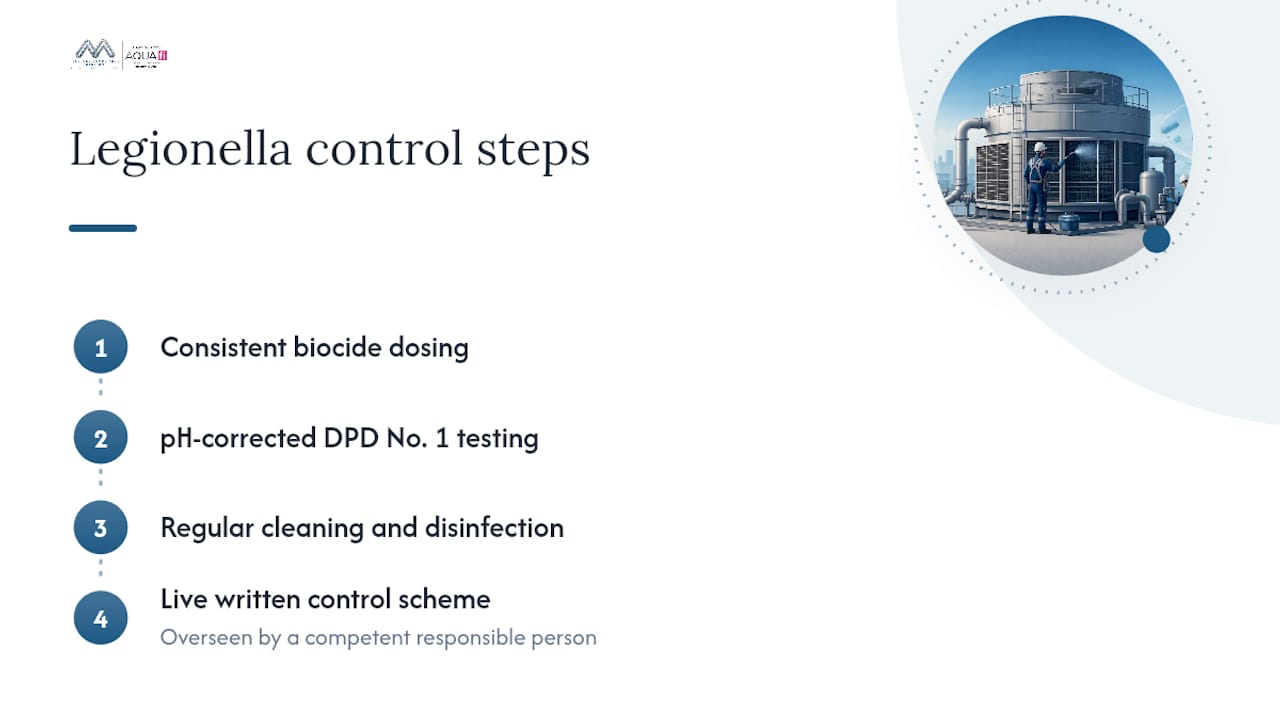
Effective control combines consistent biocide dosing, pH-corrected DPD No. 1 testing, regular cleaning and disinfection, and a live written control scheme overseen by a competent responsible person, as set out in ACOP L8 and HSG274 Part 1.
What are the acceptable levels of Legionella in cooling towers?
HSG274 Part 1 guidance suggests total viable count of aerobic bacteria should sit at or below around 1×10⁴ cfu/ml to demonstrate the treatment programme is under control; a rising trend towards or past that level signals the system needs attention.
What are the UK regulations on Legionella?
The core framework is HSE’s ACOP L8 and HSG274 Part 1 for technical guidance, plus the Notification of Cooling Towers and Evaporative Condensers Regulations 1992 requiring written notification to your local authority. RIDDOR reporting applies where there’s reasonable evidence of occupational exposure.
Do I need a specialist to manage Legionella compliance?
Not always, but ACOP L8 expects dutyholders without in-house competence to engage a qualified specialist. Providers such as Bespoke Compliance Solutions carry out risk assessments, sampling and disinfection for sites that need that expertise.
Recommended
Comments