
Legionella obligations for academies: 2026 guide
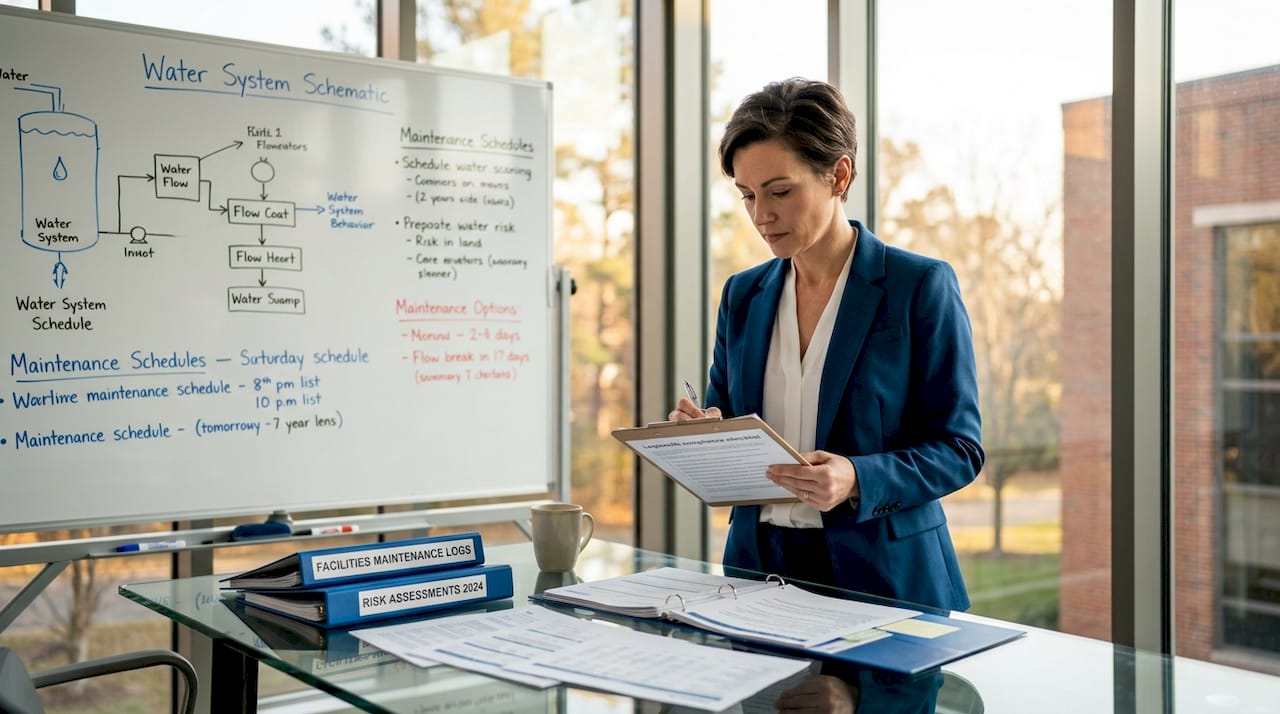
Legionella obligations for academies place the academy trust as the legal duty holder under the Health and Safety at Work Act 1974, responsible for managing all water safety risks on site. Unlike maintained schools, where the local authority retains certain responsibilities, academy trusts hold full control of their premises and water systems. This means compliance with ACOP L8 and HSG274 is non-negotiable and falls squarely on trust leadership. Appointing a competent responsible person, conducting a suitable risk assessment, and implementing a written control scheme are the three pillars every academy must have in place.
What are the legionella compliance requirements under ACOP L8 for academies?
ACOP L8 is the Approved Code of Practice that sets the legal framework for controlling Legionella bacteria in water systems across all premises, including academies. Failing to follow it is not a technicality. It is a breach of health and safety law that can result in prosecution, improvement notices, and reputational damage to the trust.
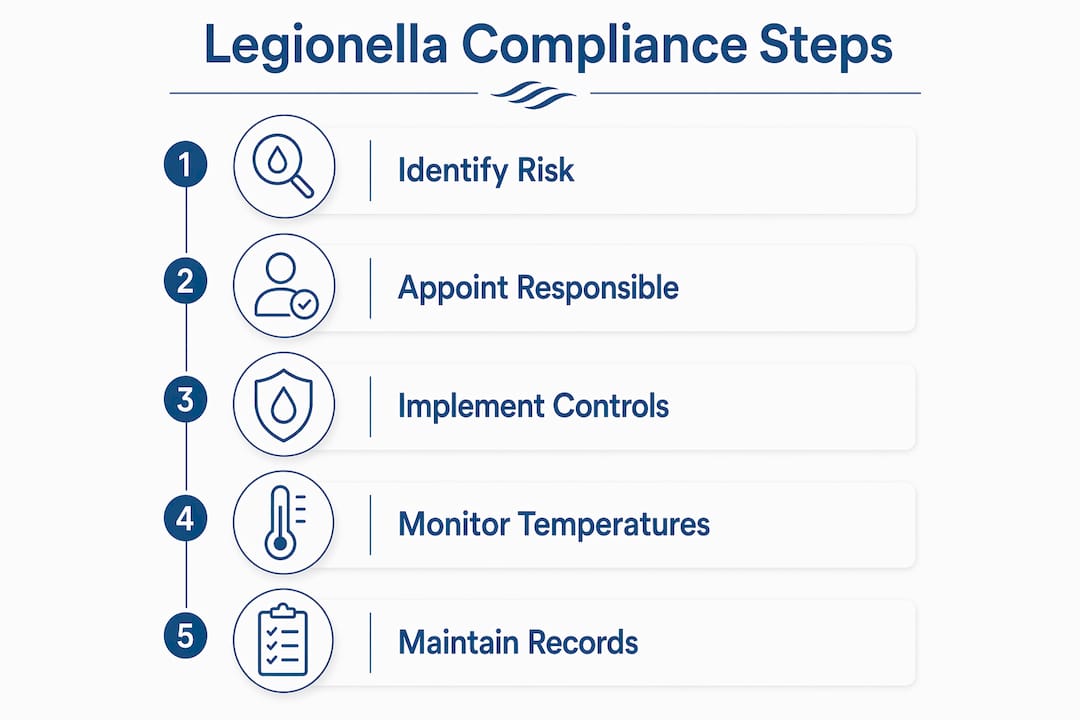
The specific duties under ACOP L8 for academies follow a clear sequence:
Conduct a suitable and sufficient Legionella risk assessment. This must reflect the actual water systems in use across every building on site, including any that are infrequently used or recently altered. A suitable risk assessment is not a generic document downloaded from the internet. It must be site-specific and reviewed whenever circumstances change.
Develop a written scheme of control. Once risks are identified, the trust must produce a written scheme detailing how each risk will be managed, by whom, and at what frequency. This document is the operational backbone of your compliance programme.
Appoint a competent responsible person. ACOP L8 requires the duty holder to appoint someone with the knowledge, skills, and authority to manage day-to-day Legionella control. This person must understand the water systems, the control measures, and when to escalate.
Implement and monitor the control scheme. Having a written scheme is not enough. The trust must demonstrate active implementation through regular monitoring, temperature checks, and flushing records.
Review the risk assessment regularly. There is no fixed legal interval, but annual reviews are standard practice in schools and academies. Any significant change to the building, water system, or occupancy pattern triggers an immediate review obligation.
Retain all records for a minimum of five years. Record retention is a legal requirement, not optional housekeeping. Every monitoring entry, corrective action, and review must be documented and accessible.
Pro Tip: When appointing a responsible person, document their competence formally. During an HSE inspection, you will need to demonstrate not just who holds the role, but why they are qualified to hold it.
How should academies control and monitor legionella risk in water systems?
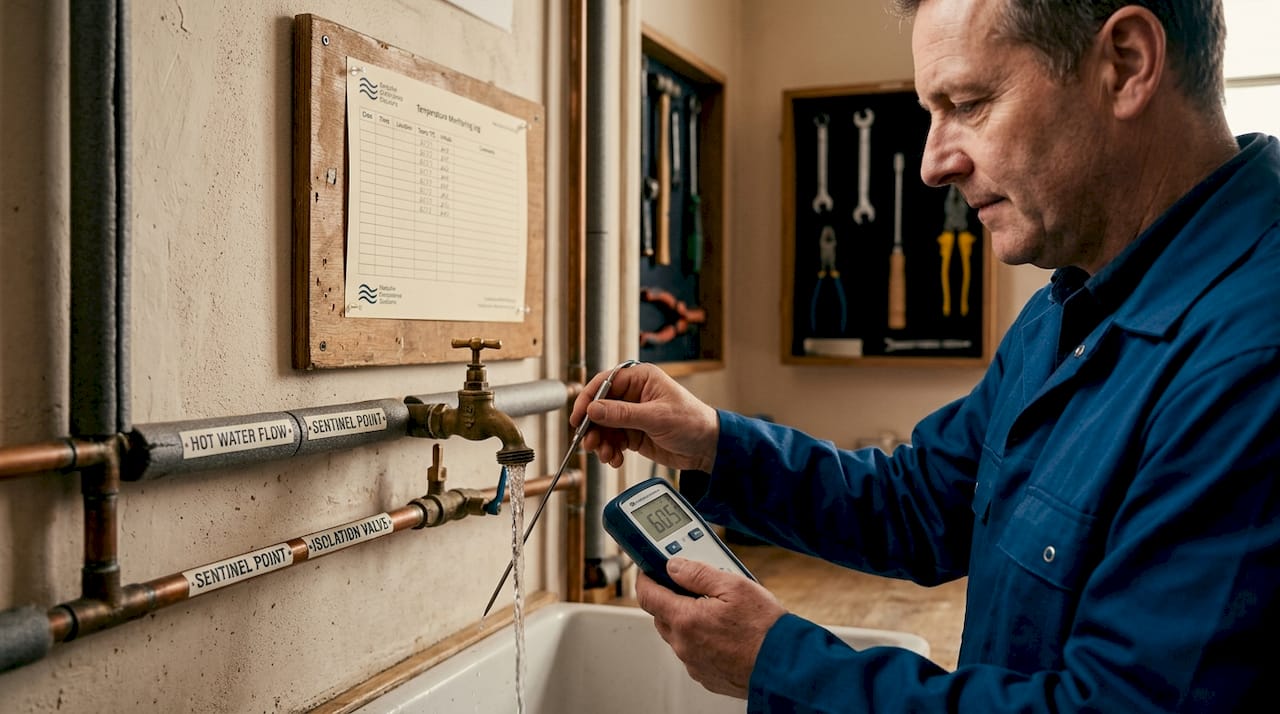
Technical control of Legionella risk in academies centres on temperature management and preventing water stagnation. HSG274 Part 2 provides the technical implementation guidance that sits alongside ACOP L8, and its temperature targets are the foundation of any effective control programme.
The core temperature parameters every academy must maintain are:
Cold water: stored and distributed below 20°C at all times
Hot water storage: maintained at or above 60°C
Hot water outlets: reaching 50°C or above within one minute of running
Sentinel point monitoring: conducted monthly at designated representative outlets
These targets are not arbitrary. Temperature monitoring at sentinel points is the primary early-warning system for identifying system failures before Legionella can proliferate to dangerous levels. A single out-of-range reading demands a documented corrective action, not just a note in the margin.
The table below summarises the key monitoring requirements for academy water systems:
Parameter | Target | Monitoring frequency |
Cold water storage | Below 20°C | Monthly |
Hot water storage | Above 60°C | Monthly |
Hot water outlets (sentinel) | 50°C within 60 seconds | Monthly |
Low-use outlet flushing | Full flush before use | Weekly or per scheme |
Flushing of low-use outlets deserves particular attention in academy settings. School holidays create extended periods of stagnation in taps, showers, and drinking fountains that see little or no use during term time. Stagnation prevention through flushing must be built into the written scheme and carried out before buildings reopen after any significant closure.
Pro Tip: Map your sentinel points before the summer closure and assign named individuals to carry out flushing during the holiday period. Verbal agreements are not sufficient. The scheme must name the person, the outlet, and the date.
Sentinel point selection is where many multi-building campuses fall short. Points should represent the extremes of hot water distribution and include taps used by vulnerable populations such as younger pupils or those with additional needs. Selecting only convenient or accessible outlets misses the purpose of sentinel monitoring entirely.
What record keeping practices make legionella compliance defensible?
A site-specific logbook is the single most important document in your compliance arsenal during an inspection or incident investigation. Enforcement bodies do not simply check whether monitoring was carried out. They examine whether out-of-range readings triggered documented corrective actions and whether those actions were verified.
Effective record keeping for academies requires the following:
Risk assessments and written schemes retained for at least five years, with version control showing when and why updates were made
Monitoring logs linked directly to the written scheme procedures, so any inspector can trace a temperature reading back to the control measure it relates to
Corrective action records that document what was done, by whom, and when, following any out-of-spec result
Review records showing that the risk assessment was formally reconsidered after building works, changes in occupancy, or system modifications
The audit trail connecting data to procedures is what enforcement scrutiny focuses on. A logbook full of temperature readings with no corrective action entries for out-of-range results is a liability, not an asset. It demonstrates that monitoring was carried out but not acted upon.
Pro Tip: Use a bespoke logbook system that links each monitoring entry to the relevant written procedure. Generic spreadsheets rarely survive an HSE audit intact.
Documentation must also reflect real operational use. If a building is mothballed during a major refurbishment, the written scheme must be updated to reflect reduced use and the flushing regime adjusted accordingly. A scheme that describes normal term-time operations during a six-month closure is not suitable and sufficient.
How do academy governance and leadership support legionella compliance?
Governance is where legionella management in schools either holds together or falls apart. The academy trust board carries ultimate legal accountability, and that accountability cannot be delegated away. What can be delegated is the day-to-day execution, provided it goes to a competent person with the resources to act.
Effective governance for Legionella compliance in academies follows this structure:
The trust board confirms the health and safety policy, allocates budget for risk assessments, monitoring, and maintenance, and receives regular compliance reports. Governors and senior leadership provide strategic direction and must be satisfied that competent oversight is in place.
The principal or business manager typically holds the responsible person role at site level, coordinating monitoring schedules, contractor relationships, and staff training.
Facilities staff carry out day-to-day monitoring, flushing, and temperature checks, recording results in the logbook and escalating anomalies immediately.
External specialists such as Bespokecompliancesolutions conduct independent risk assessments, water sampling, and compliance audits that the internal team cannot objectively carry out on themselves.
Training is a governance responsibility, not just an operational one. Legionella awareness training for responsible persons and facilities staff is the mechanism by which the trust demonstrates competence. Without it, the appointment of a responsible person is a title without substance. Weak operational oversight and reactive management are the primary causes of compliance failures in educational settings. Proactive systems with clear accountability and trained staff are the defence.
Independent audits add a layer of assurance that internal reviews cannot replicate. When an academy trust can show that an external specialist has reviewed and validated its control programme, that evidence carries significant weight during enforcement visits or following an incident.
Key takeaways
Legionella compliance for academies requires the trust to act as legal duty holder, implementing ACOP L8 controls through trained staff, site-specific documentation, and active monitoring rather than paperwork alone.
Point | Details |
Trust as duty holder | The academy trust holds full legal responsibility for Legionella compliance, not the local authority. |
ACOP L8 framework | Risk assessment, written scheme, responsible person appointment, and five-year record retention are all mandatory. |
Temperature control | Cold water below 20°C, hot water stored above 60°C, and monthly sentinel point monitoring are the operational baseline. |
Defensible records | Logbooks must link monitoring data to corrective actions; enforcement focuses on response to out-of-range readings. |
Governance accountability | Governors must allocate resources and verify competence; training and independent audits are not optional extras. |
What I have learned from working with academies on legionella compliance
Most compliance failures I encounter in academies are not caused by ignorance of the law. They are caused by the gap between what the written scheme says and what actually happens on site. A trust might have a beautifully formatted risk assessment and a logbook that looks complete on paper, yet the sentinel points were selected for convenience rather than system coverage, and nobody flushed the science block showers during the Easter closure.
Multi-building campuses are the hardest environments to manage well. Each building may have its own water distribution layout, its own usage patterns, and its own seasonal closure schedule. A single written scheme that treats the whole campus as one system will almost always miss something. The sentinel monitoring guidance in HSG274 is explicit about representing the extremes of distribution, but I regularly see assessments that cluster sentinel points around the main building and ignore outlying blocks entirely.
The other pattern I see repeatedly is the responsible person who has the title but not the time or training to carry it out properly. Governance bodies sometimes treat the appointment as an administrative act rather than a substantive one. If the person you have appointed cannot explain what a sentinel point is or what action to take when a hot water reading comes in below 50°C, the appointment is not compliant in any meaningful sense.
My honest recommendation is this: treat your risk assessment as a living document and your logbook as your legal defence. Both must reflect what is actually happening in your buildings, not what you intended to happen when the scheme was written.
— Sammi
How Bespokecompliancesolutions supports academy legionella compliance
Academies that work with Bespokecompliancesolutions get more than a risk assessment document. They get a compliance programme built around their actual sites, water systems, and operational patterns.
Bespokecompliancesolutions delivers bespoke Legionella risk assessments designed specifically for academy environments, covering every building and water system on campus. The team also provides water testing and analysis, ongoing monitoring support, and implementation of site-specific logbook systems that hold up under HSE scrutiny. For responsible persons and facilities staff, structured awareness training builds the competence that governance bodies need to demonstrate. Whether your trust needs an initial assessment or ongoing compliance support, Bespokecompliancesolutions works in partnership with you across all UK sites.
FAQ
Who is the duty holder for legionella in an academy?
The academy trust is the legal duty holder for Legionella compliance, not the local authority. This means the trust board holds ultimate accountability for managing water safety risks under the Health and Safety at Work Act 1974.
How often must legionella risk assessments be reviewed in schools?
Risk assessments must be reviewed whenever there is reason to believe they are no longer valid, such as after building works or changes in occupancy. Annual reviews are the standard practice adopted by most academies as a minimum baseline.
What temperature should hot water be stored at in an academy?
Hot water must be stored at or above 60°C and reach 50°C at outlets within one minute of running. These targets are set under HSG274 Part 2 and form the core of temperature-based Legionella control in educational buildings.
How long must legionella records be kept?
All Legionella risk control records, including monitoring logs, corrective actions, and written schemes, must be retained for a minimum of five years. These records form the audit trail that enforcement bodies examine during inspections.
What is a responsible person for legionella in an academy?
A responsible person is an individual appointed by the duty holder to manage day-to-day Legionella control, as required by ACOP L8. They must have the knowledge, skills, and authority to implement the written scheme and respond to out-of-range monitoring results.
Recommended
Comments