
Legionella training requirements: what England's law demands
- 3 hours ago
- 11 min read

Yes. Under HSE’s Approved Code of Practice L8, anyone appointed to assess Legionella risk, manage control measures, or carry out day-to-day tasks like temperature checks and flushing must be “competent” — and training is the foundation of that competence. There’s no separate “Legionella Training Act”. The requirement sits inside the Health and Safety at Work etc. Act 1974 and the Management of Health and Safety at Work Regulations, with ACOP L8 spelling out exactly what dutyholders must do to comply.
If you’re the responsible person, or you’ve just been handed that title, three things need to happen this week:
Confirm in writing who your appointed responsible person is, and check they’ve had formal training, not just a verbal briefing.
Pull your training records and check they include dates, content covered, and assessment outcomes, not just a list of names who turned up.
Identify which staff physically touch the water system (flushing showers, checking calorifiers, dosing) and confirm they have practical, task-specific instruction, not generic awareness slides.
HSE guidance is blunt about why this matters: inadequate training and poor communication are documented contributory factors in Legionnaires’ disease outbreaks. That’s not a compliance technicality. Bespokecompliancesolutions works with facilities and compliance teams across England precisely because getting training wrong tends to surface only when it’s too late, at inspection or after an incident.
Key Takeaways
Legionella training is a legal requirement under ACOP L8, but competence demands training plus documented, site-specific practical evidence, not a certificate alone.
Point | Details |
Training is mandatory, not optional | ACOP L8 requires anyone assessing risk or operating control measures to be trained and competent. |
Certificates alone don’t prove competence | HSE guidance states competence combines training, instruction, experience and knowledge. |
Records must be audit-ready | Keep training dates, syllabus content, assessment outcomes and refresher schedules in the site logbook. |
Refresher intervals are risk-based | Retrain every 12 to 24 months typically, sooner after a positive sample or system change. |
Choose a provider matched to your risk assessment | Bespokecompliancesolutions builds awareness and responsible person training around each site’s own findings and logbook system. |
Table of Contents
Legal basis in England: HSE duties, ACOP L8 and HSG274 explained
The starting point is the Health and Safety at Work etc. Act 1974, which places a general duty on employers to protect the health of employees and anyone else affected by their undertaking, including tenants, patients, and visitors exposed to water systems. The Management of Health and Safety at Work Regulations then require a suitable and sufficient risk assessment, and Legionella is treated as a workplace hazard falling within COSHH.
ACOP L8 translates that legal framework into specific expectations for water systems. It carries special legal status: while you can technically comply with the law by another route, following L8 is treated by courts and by HSE inspectors as the default evidence that you’ve met your duty. Deviating from it means you’d need to prove your alternative approach was equally effective, which is a harder argument to win after an incident.
HSG274 sits alongside L8 as technical guidance, unpacking the practical detail L8 doesn’t cover, things like specific temperature parameters, sampling protocols, and how to control risk in different system types (cooling towers, hot and cold water services, spa pools). It’s the document most training providers build their course syllabus around, because it lists training, monitoring, and maintenance as core control measures.
What does “competent” actually mean in HSE’s own words? This is where many organisations trip up, assuming a training certificate closes the matter.
Competence is a combination of training, instruction, experience and knowledge. A certificate of attendance alone does not automatically demonstrate that a person is competent to carry out their duties.
That distinction comes directly from HSE’s guidance on managing the risk, and it reframes training as one input among several, not a box-ticking exercise.
On records, HSE expects dutyholders to retain:
Evidence of who has been trained, when, and to what standard.
Risk assessment findings and the significant findings register.
Records of monitoring, maintenance, and any remedial action taken.
Retention periods aren’t arbitrary. HSG274 Part 2 recommends keeping records for as long as they remain current, plus a minimum of two years afterwards, with monitoring records often kept for five years given how they demonstrate a pattern of control over time.
Who needs which training: matching roles to responsibilities
Training requirements scale with responsibility, not job title. A facilities manager overseeing three sites needs different depth than a caretaker who flushes an unused shower once a fortnight. Getting this mapping wrong, either under-training operational staff or over-training people who never touch the system, wastes budget and leaves gaps.
The dutyholder is usually the employer, building owner, or landlord, the legal entity ultimately responsible under the Health and Safety at Work etc. Act. They don’t necessarily need hands-on Legionella training themselves, but they must ensure someone competent is appointed and adequately resourced.
The responsible person (sometimes called the deputy or day-to-day manager) needs formal training covering risk assessment interpretation, the site’s specific control scheme, and how to instruct others. This is the person HSE inspectors will question directly, and they need to explain the site’s control measures fluently, not read from a manual.
Operational and maintenance staff need task-specific practical instruction: how to flush correctly, how to read and log temperatures, and what to do if readings fall outside range. This is competence built through supervised repetition, not a single classroom session.
Contractors and external specialists brought in for sampling, disinfection, or TMV servicing must demonstrate their own competence, but the dutyholder retains oversight. Ask for CVs, sample reports, and references before signing off, and don’t assume a contractor’s certificate absolves your organisation of responsibility.
Multi-site employers face an added complication: handovers. When a responsible person changes site or leaves the organisation, training and system knowledge often leave with them unless it’s documented properly, which is exactly where tailored logbook systems earn their keep.
Training levels and what each course must actually teach
Most training in England falls into three recognised tiers, and confusing them is a common source of non-compliance.
Awareness training is the broadest tier, suitable for general staff who need to understand what Legionella is, why control measures exist, and how to report a fault. It’s typically a half-day and covers no hands-on assessment.
Responsible person training goes deeper: interpreting a site risk assessment, understanding the water system schematic, recognising deviations from normal control parameters, and knowing when to escalate.
Competent person or Level 3 technical training is aimed at those managing the programme across a portfolio or acting as the named competent person for complex systems. It covers legal duties, audit preparation, and often overlaps with CIBSE technical guidance on water treatment.
Regardless of tier, HSG274 sets the expectation that course content should include:
Temperature monitoring and the acceptable ranges for hot and cold water services.
Flushing procedures for infrequently used outlets.
Basic sampling technique, even if sampling itself is contracted out.
Disinfection principles, including what triggers a shock dose.
TMV (thermostatic mixing valve) awareness where scalding risk and Legionella control intersect.
Assessment format matters more than most buyers realise. A course ending in a multiple-choice quiz tells you someone can recognise the right answer on a screen. A course that includes observed practical tasks, or requires a written scenario response tied to the learner’s own site risk assessment, tells you they can apply it. Accreditation from bodies like City & Guilds, CIBSE, or IOSH gives a useful external benchmark, and CPD hours logged against a recognised scheme make refresher planning far easier to track.
Pro Tip: Ask your training provider to build at least one exercise around your own site’s most recent risk assessment findings. Generic case studies teach the theory; site-specific exercises teach the job.
How you prove competence, not just attendance
An attendance certificate proves someone sat through a session. It doesn’t prove they can identify a stagnant outlet, read a calorifier temperature correctly, or explain why a shower head needs descaling. HSE’s own guidance is explicit that certificates alone don’t demonstrate competence, and inspectors know the difference between a paper trail and a working system.
What auditable evidence actually looks like:
The course syllabus and who delivered it, with their own credentials on file.
A full attendee list matched against current staff, not a historic snapshot from three years ago.
Assessment outcomes for each attendee, including any resits or additional supervision required.
Dates of training and the scheduled refresher date, visible at a glance.
Signed observation checklists showing a supervisor watched a task being performed correctly on site.
Store this evidence somewhere an inspector can reach it in minutes, not somewhere it needs to be requested from a third party. Most organisations keep it inside the site water logbook alongside monitoring records, with a digital backup for continuity if the physical copy is damaged or misplaced. In inspections, regulators typically ask the responsible person to walk through the site’s specific control measures and produce recent monitoring data on the spot; the strongest evidence tends to be a supervisor’s recent, dated observation of a task performed correctly, not a training certificate from two years earlier.
Refresher training and CPD: how often is often enough
HSE requires regular refresher training but deliberately avoids setting one fixed interval for every role and every site, because risk profiles differ too much for a single number to make sense.
Responsible persons typically refresh periodically, though a change in system design, a positive sample result, or a near-miss should trigger earlier retraining regardless of timing.
Operational staff performing routine tasks often benefit from shorter, more frequent refreshers, brief annual sessions reinforcing flushing and temperature checks, since these are the tasks most likely to drift into bad habits.
Competent persons managing multiple sites should treat any regulatory update, HSG274 revision, or incident anywhere in their portfolio as a prompt to review whether their own knowledge, and their team’s, needs updating.
Recording CPD hours against a recognised scheme, rather than just noting “attended refresher”, gives you a defensible paper trail when an inspector asks how you know competence has been maintained over time.
Choosing a compliant training provider in England
Not every course badged “Legionella training” meets the ACOP L8 standard, and the gap often only becomes visible during an inspection. A short checklist before you commit budget:
Does the syllabus reference ACOP L8 and HSG274 explicitly, rather than generic “water hygiene awareness”?
Are practical or scenario-based assessments included, not just a quiz at the end?
Can the trainer show their own credentials and recent field experience?
Will the course be tailored to your system type (cooling towers, calorifiers, spa pools) rather than delivered as a one-size-fits-all deck?
Is the provider accredited or CPD-recognised by a body such as City & Guilds, CIBSE, or IOSH?
Worth asking directly: how do they assess understanding, can they share a sample syllabus, do they offer any post-course workplace check, and how many CPD hours does the course carry?
Pro Tip: If a provider can’t describe how they’d assess a delegate’s practical understanding, walk away. Attendance-only courses with no workplace follow-up are the single biggest reason organisations fail audits despite having “trained” staff.

Bespokecompliancesolutions builds Legionella awareness training around each client’s actual risk assessment findings rather than a generic template, which is the difference inspectors notice first.
Online, classroom or blended: which delivery format works
Online courses are convenient and cost-effective for awareness-level content, especially across multi-site organisations needing to train large numbers of staff quickly. Their limitation is obvious: nobody can observe whether a learner can actually flush an outlet or read a calorifier gauge through a screen.
Classroom training allows real-time questioning and hands-on demonstration, but it’s harder to schedule across dispersed sites and costs more per head.
Blended delivery tends to offer the strongest balance for organisations managing several buildings: theory delivered online, followed by an assessed practical session on site.
Whatever format you choose, practical assessment should cover at least: correct flushing technique, temperature logging accuracy, and recognising an out-of-range reading.
Document remote learning with a signed workplace assessment form completed by a supervisor within a reasonable period after the online module, not months later once the content has faded.
Common misconceptions that undermine compliance
Attendance isn’t competence. A signature on a register proves someone was in the room, nothing more.
Missing records fail audits faster than missing training. Inspectors can’t verify what isn’t documented, even if the training genuinely happened.
Generic courses ignore your risk assessment. Training divorced from your site’s actual findings is easy for an inspector to flag as inadequate.
One contractor, zero oversight, is a gap waiting to surface. Dutyholders remain accountable even when the practical work is outsourced.
What implementation actually looks like on the ground
Most organisations don’t fail because they skipped training entirely. They fail because training happened once, years ago, and nobody updated it when the system changed or when staff turned over. The pattern repeats across housing associations, retail sites, and healthcare premises alike: a strong start, then drift.
The fix isn’t more paperwork for its own sake. It’s tying refresher schedules to real triggers, a new calorifier, a positive sample, a staff change, rather than a vague annual reminder nobody actions. Bespoke Compliance Solutions works across commercial, healthcare, and housing sites in England, and the organisations that stay audit-ready are the ones that treat training as a living record, not a filing cabinet exercise completed once and forgotten.
— Sammi
How Bespokecompliancesolutions supports your training obligations
If you’re weighing up whether to build training in-house, buy a generic online course, or find a provider who actually understands your water system, that last option tends to close the most compliance gaps for the least ongoing effort. Bespokecompliancesolutions is the alternative to a one-size-fits-all training package for organisations across England — courses are built directly from your own risk assessment findings, not a generic template, and delivered alongside the logbook systems inspectors expect to see.
[

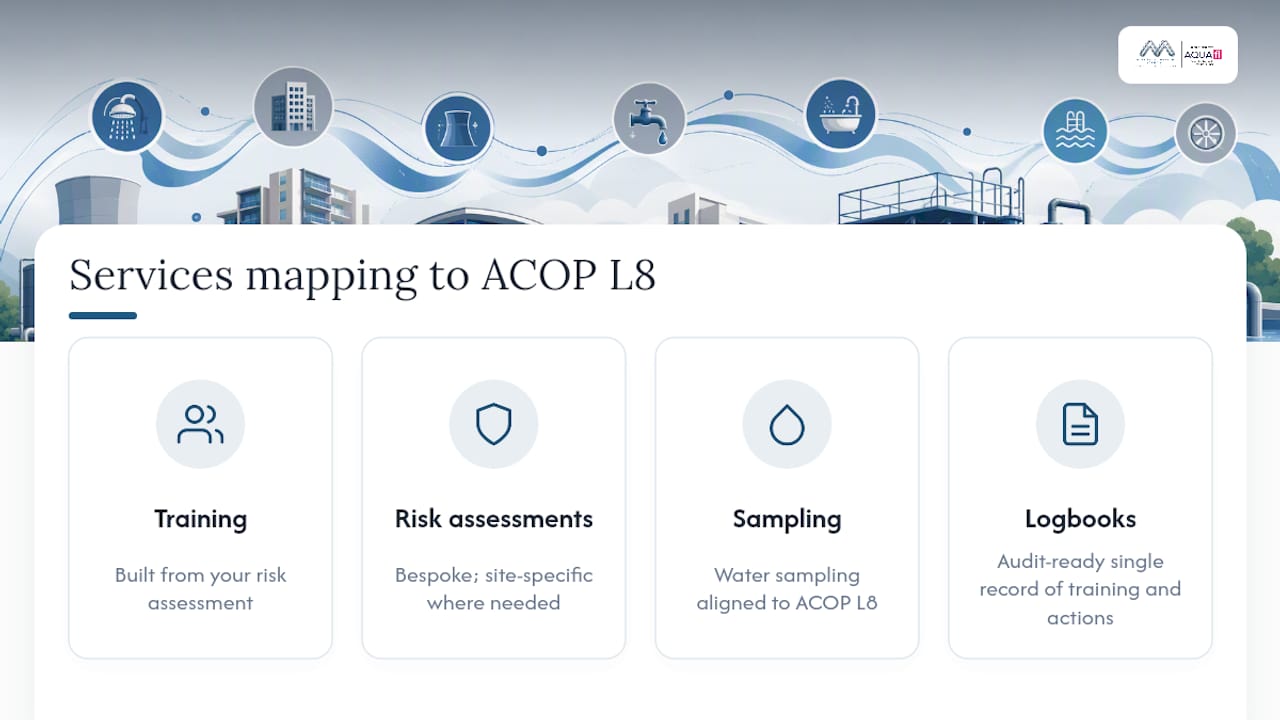
Services map directly onto what ACOP L8 requires: Legionella awareness and responsible person training, bespoke risk assessments, water sampling, and bespoke logbook implementation that gives you a single, audit-ready record of training, monitoring, and remedial action. For organisations near Coventry, the team also delivers site-specific risk assessments that pair naturally with a training refresh.
If your current training hasn’t been reviewed against your latest risk assessment, or your records wouldn’t survive ten minutes with an inspector, get in touch with Bespokecompliancesolutions to book a training session or request a quote for a combined assessment and training package.
Primary sources and further reading
The definitive references are HSE’s ACOP L8, HSG274 technical guidance, and INDG458 for dutyholders. For training services aligned to these standards, see Bespokecompliancesolutions’ awareness training page.
This article is general information, not a substitute for advice from a qualified doctor. Consult a qualified healthcare professional about your own circumstances before acting on anything here.
FAQ
Is Legionella training a legal requirement?
Yes. Under ACOP L8, anyone appointed to assess risk or carry out control measures must be trained and demonstrably competent, as part of employers’ duties under the Health and Safety at Work etc. Act.
How often do you need to do Legionella training?
There’s no single fixed interval; HSE requires regular refreshers, with most responsible persons retraining every 12 to 24 months, or sooner after a system change, positive sample, or incident.
What are the regulations in the UK regarding Legionella?
Legionella control in England sits under the Health and Safety at Work etc. Act, the Management of Health and Safety at Work Regulations, and ACOP L8, with HSG274 providing detailed technical guidance on control measures.
What qualifications do you need to do Legionella testing?
There’s no single mandatory qualification, but competent samplers typically hold training accredited or recognised by bodies such as City & Guilds, CIBSE, or IOSH, alongside demonstrable practical experience, and dutyholders must satisfy themselves of a contractor’s competence before relying on their results.
Does Bespokecompliancesolutions offer Legionella awareness training?
Yes, Bespokecompliancesolutions delivers Legionella awareness and responsible person training tailored to each client’s own site risk assessment, alongside logbook implementation for audit-ready records.
Recommended
Comments