
Outsource legionella management for estate properties

Outsourcing Legionella management, known formally as water hygiene compliance under ACoP L8 and COSHH regulations, is the most reliable way for estate property managers to achieve defensible, continuous water safety. When you outsource legionella management across estate properties, you replace fragmented, reactive tasks with a single integrated programme covering risk assessment, planned maintenance, and digital records. Platforms like Vision Pro Software and WiseBlock now make portfolio-wide compliance visible in real time. The 2026 regulatory environment expects more from duty holders, not less, and the right outsourced partner makes that expectation manageable.
Who holds legal responsibility when you outsource legionella management?
The duty holder retains full legal responsibility for Legionella management regardless of how many tasks are outsourced. UK ACoP L8 and COSHH regulations make no delegation of legal accountability to contractors. This is the most misunderstood aspect of property management legionella compliance.
Under UK law, the duty holder is typically the employer, landlord, or managing agent who controls the premises. You can delegate the operational work of testing, flushing, and temperature monitoring to a specialist contractor. You cannot delegate the legal duty to ensure that work is done correctly and documented.
“The primary error property managers make is believing outsourcing removes legal liability. Instead, it creates an extended duty requiring thorough contractor vetting.” — NestFM
The practical implication is significant. If your contractor fails to complete a scheduled flush and a Legionella outbreak occurs, enforcement action falls on you, not the contractor. This is why evaluating contractors on their ability to produce audit-ready compliance evidence matters far more than selecting the lowest price.
Key questions to ask before appointing any provider:
Can they produce a full audit trail for every site visit, temperature check, and remedial action?
Do they carry appropriate professional indemnity and public liability insurance?
Are their risk assessors qualified to a recognised standard such as City & Guilds or BOHS P901?
Do they operate under a formal written scheme of control aligned to HSE legionella regulations?
Can they demonstrate experience across multi-site estate portfolios?
Appointing a contractor without these assurances does not reduce your risk. It compounds it.
What does a comprehensive outsourced Legionella service include?
Best-practice outsourcing uses an integrated, closed-loop management model covering four core pillars. Each pillar connects to the next, so a finding in one area automatically triggers action in another. This is what separates genuine compliance from box-ticking.
The four pillars of effective outsourced water safety:
Legionella risk assessment. A qualified assessor surveys every water system across your estate, identifies risk factors, and produces a written report. This is the foundation of all subsequent work. Bespokecompliancesolutions produces bespoke risk assessments tailored to each site rather than applying a generic template. You can read more about what a thorough review looks like in this guide to reviewing a risk assessment.
Formal written scheme of control. The risk assessment findings feed directly into a site-specific control plan. This document defines every control measure, the frequency of each task, and who is responsible. Without it, your maintenance team has no clear reference point.
Planned preventive maintenance (PPM). HSE ACoP L8 guidelines require hot water storage above 60°C and cold water below 20°C as fundamental control measures. Regular flushing of little-used outlets and routine system cleaning are also required. PPM schedules translate these requirements into calendar-based tasks with assigned engineers.
Digital logbooks and compliance records. Digital platforms like Vision Pro Software enable portfolio-wide visibility and audit-ready record keeping. These tools reduce administrative burden while strengthening your L8 compliance programme. WiseBlock offers similar automated temperature monitoring capabilities for large estates.
Service component | Manual approach | Integrated outsourced approach |
Risk assessment | Periodic, standalone report | Feeds directly into control plan and PPM |
Temperature monitoring | Manual logs, paper-based | Automated alerts, digital records |
Remedial actions | Reactive, ad hoc | Triggered by assessment findings, tracked to completion |
Audit readiness | Compiled on request | Available in real time via digital platform |
Multi-site oversight | Site-by-site review | Portfolio dashboard with exception reporting |
Pro Tip: Ask your provider to demonstrate how a risk assessment finding triggers a PPM task in their system. If they cannot show you a live example, the integration exists only on paper.
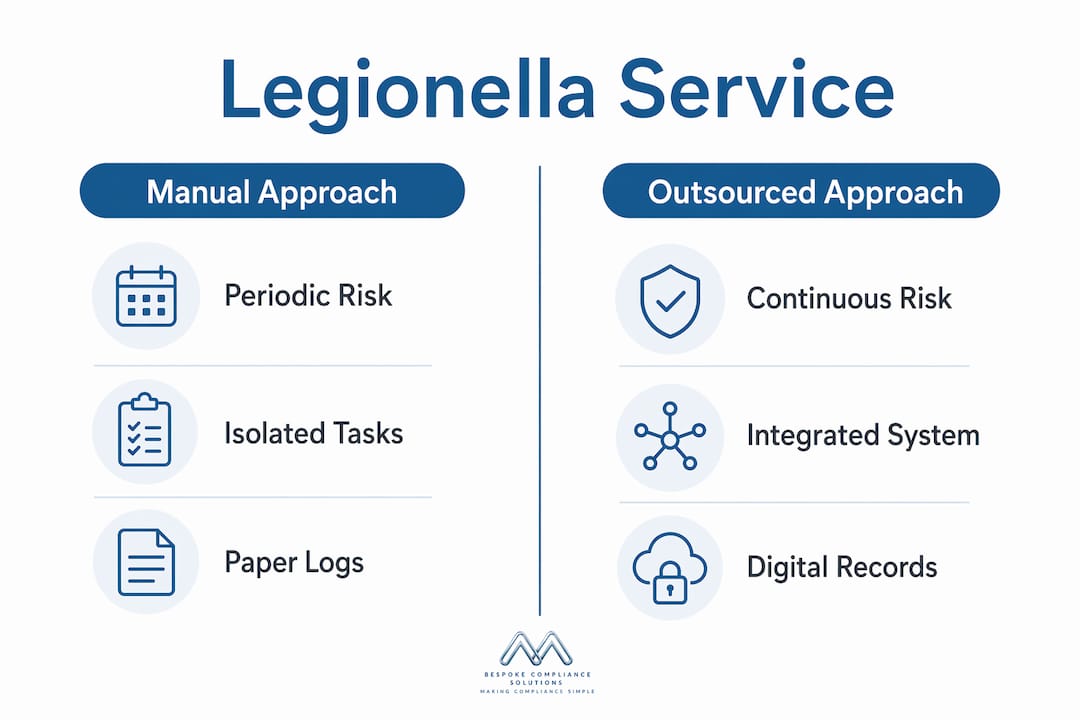
Legionella risk assessments should connect directly with remedial and maintenance actions via clear roles and escalation routes. Integration ensures that actions such as flushing or temperature corrections trigger decisions and follow-up, not just record keeping.
How to select and work with an outsourced Legionella provider
Selecting a provider for legionella compliance across estates requires more than checking accreditations. The working relationship determines whether compliance holds up under scrutiny.

Start with capability, not cost. Your provider must demonstrate multi-site scalability, software integration with your existing property management systems, and a governance framework that maps to your duty holder obligations. A provider managing a single commercial building operates very differently from one managing a mixed-use estate portfolio.
What to request before signing a contract:
A sample digital logbook showing how records are structured and accessed
A sample PPM schedule showing task frequency, engineer assignment, and sign-off process
Evidence of how overdue tasks are escalated and reported to the duty holder
References from property managers with comparable estate portfolios
Confirmation of how regulatory updates, such as HSG274 revisions, are incorporated into their service
Service level agreements should specify reporting frequency, escalation timelines, and what happens when a task is missed. Vague SLAs create the governance gaps that regulators find most concerning.
Pro Tip: Schedule a quarterly review meeting with your provider, not just an annual one. Water systems change, occupancy changes, and risk profiles shift. Quarterly reviews catch drift before it becomes a compliance failure.
Onboarding a new provider across a large estate takes time. Expect a mobilisation period of four to eight weeks for a full site survey, system mapping, and logbook setup. Build this into your contract timeline so compliance does not lapse during the transition.
Common pitfalls when outsourcing Legionella management
Fragmented compliance with separate providers for assessment, maintenance, and remediation creates blind spots and governance gaps. This is the most common structural failure in estate property legionella programmes.
“Fragmented management leads to governance blind spots. An accountable, integrated partner reduces risk and administrative complexity.” — RiskWarden
The specific pitfalls to avoid:
Using multiple unconnected vendors. When your risk assessor, maintenance contractor, and remediation team operate independently, no single party owns the compliance outcome. Findings get lost between handovers.
Over-relying on laboratory testing. Routine laboratory Legionella testing is not always mandatory and can generate unnecessary costs. A positive result also creates immediate legal and reputational exposure. Temperature control and system hygiene are the primary controls, not testing frequency.
Failing to review risk assessments regularly. A risk assessment is not a one-time document. Significant changes to a water system, building occupancy, or use require a reassessment. Many estate managers treat the initial assessment as permanent.
Ignoring remedial action deadlines. Identifying a risk and failing to act on it within the recommended timeframe is worse than not identifying it at all. It creates a documented record of inaction.
Weak communication protocols. If your contractor cannot reach the right person to authorise urgent remedial work, tasks stall. Define escalation contacts and response times in writing before work begins.
Practical legionella prevention examples from social housing portfolios show that the most effective programmes combine clear role assignment with automated monitoring, reducing both human error and response times.
Key takeaways
Outsourcing Legionella management for estate properties delivers defensible compliance only when the provider operates an integrated, closed-loop service that connects risk assessment findings directly to planned maintenance and digital records.
Point | Details |
Legal duty stays with you | ACoP L8 and COSHH mean the duty holder retains liability regardless of outsourcing. |
Integration prevents gaps | Closed-loop services linking assessment, PPM, and records eliminate governance blind spots. |
Temperature control is primary | Maintaining hot water above 60°C and cold below 20°C is more critical than laboratory testing frequency. |
Vetting beats price | Audit-ready evidence and qualified assessors matter more than the lowest contract price. |
Regular reviews sustain compliance | Quarterly provider reviews and updated risk assessments keep compliance current as estates change. |
Why integrated partnerships outperform the cheapest quote
I have worked with estate managers who appointed three separate contractors for assessment, maintenance, and remediation, believing it gave them competitive pricing at each stage. What it actually gave them was three sets of records that did not talk to each other, a remedial action that sat unresolved for six months because no single contractor owned it, and an HSE inspection that exposed every gap.
The shift I consistently advocate is treating your Legionella provider as a compliance partner, not a task vendor. The difference shows up when something goes wrong. An integrated partner knows your estate, holds your records, and can produce a complete audit trail within hours. A collection of separate contractors cannot.
Automated temperature monitoring is changing what is possible for large estates. Continuous data feeds replace monthly manual checks, and exception alerts mean engineers respond to real problems rather than completing routine visits that find nothing. The technology exists now, and providers who have not adopted it are already behind the standard the best estates expect.
The regulatory direction is also clear. HSE continues to tighten expectations around documentation and duty holder accountability. The estates that will manage this well are those that have already embedded integrated outsourced programmes, not those scrambling to compile records when an inspection arrives.
— Sammi
Legionella compliance support from Bespokecompliancesolutions
Bespokecompliancesolutions works with property managers and estate owners across the UK to deliver integrated Legionella compliance programmes built around your specific portfolio.
Every service begins with a bespoke risk assessment, feeds into a site-specific written scheme of control, and is supported by planned preventive maintenance and a digital logbook system. Whether you manage commercial premises, housing associations, or mixed-use estates, Bespokecompliancesolutions provides legionella compliance for commercial properties and specialist water tank disinfection as part of a fully managed programme. Contact Bespokecompliancesolutions to arrange an initial consultation and find out how a single integrated provider simplifies your compliance obligations.
FAQ
What does it mean to outsource Legionella management?
Outsourcing Legionella management means appointing a specialist contractor to carry out risk assessments, planned maintenance, temperature monitoring, and compliance record keeping on your behalf. The duty holder retains legal responsibility under ACoP L8 throughout.
Does outsourcing transfer my legal liability for Legionella?
No. UK ACoP L8 and COSHH regulations make no provision for transferring legal accountability to contractors. You remain the duty holder and are responsible for ensuring your contractor performs correctly.
How often should a Legionella risk assessment be reviewed?
A risk assessment should be reviewed whenever there is a significant change to the water system, building use, or occupancy, and at regular intervals as defined in your written scheme of control. Annual reviews are standard practice for most estate properties.
What temperature controls are required under ACoP L8?
HSE ACoP L8 requires hot water storage above 60°C and cold water storage below 20°C. Regular flushing of infrequently used outlets is also required to prevent stagnation and bacterial growth.
How do I know if my Legionella provider is audit-ready?
Ask your provider to produce a complete compliance record for a single site within 24 hours. If they cannot deliver a full audit trail covering risk assessments, PPM completion, temperature logs, and remedial actions, their records will not withstand regulatory scrutiny.
Recommended
Comments