
What is a water compliance audit? A guide for businesses

A water compliance audit is a systematic, third-party evaluation of an organisation’s water management system against regulatory standards, designed to identify gaps and confirm legal compliance. In the UK, this process sits within a framework of legal duties covering Legionella control, water hygiene, and safe water quality management. Businesses that fail these audits face serious consequences. Environmental fines have exceeded $1.8 billion globally, illustrating the financial weight of non-compliance. Understanding what a water compliance audit involves, and how to prepare for one, is one of the most practical things a business owner or facilities manager can do to protect their organisation.
What does the water compliance audit process involve?
A water compliance audit reviews your entire water management system, not just water quality test results. Auditors examine infrastructure, operational practices, and, critically, your documentation. The scope is broad by design. Regulators need to see that your organisation manages water safety as an ongoing, controlled process rather than a reactive one.
The audit typically covers the following areas:
Current risk assessments — Your Legionella risk assessment must be up to date and reflect the current state of your water systems. Auditors check the date, the assessor’s competence, and whether the findings align with your actual site.
Control schemes and written schemes — These documents describe how you manage each water system. They must be specific, accurate, and actively followed.
Monitoring logs — Temperature records, chemical dosing logs, and inspection records must be complete, consistent, and within required timeframes.
Maintenance and remedial records — Auditors look for evidence that corrective actions were completed promptly. Successful audits depend on traceable proof that actions were taken within regulated timescales.
Asset registers — A complete, current register of all water system assets is a baseline requirement.
Corrective action logs — Any identified issue must have a documented resolution, with dates and responsible parties named.
Auditors also assess whether the people responsible for water management understand their roles. Competence is scrutinised, not just paperwork. A current risk assessment aligned with the current system, combined with accurate monitoring and timely remedial proof, forms the backbone of a successful audit.
Pro Tip: Use a Computerised Maintenance Management System (CMMS) to link inspection findings directly to corrective actions. A CMMS creates a full chain of compliance evidence in one auditable record, which prevents common findings such as missing monitoring data.

Why is water compliance documentation so critical?
Documentation failures are the leading cause of water compliance audit failures. Over 60% of Safe Drinking Water Act violations stem from documentation, monitoring, or reporting errors rather than actual water quality failures. That figure reframes the entire audit challenge. Your water may be perfectly safe, but if you cannot prove it, you will fail.
Auditors operate on a clear principle:
“If you can’t prove it happened, it didn’t happen.” Auditors treat missing corrective action records as negligence, regardless of whether the work was actually carried out.
The most common documentation gaps businesses face include:
Missing or incomplete temperature monitoring logs
Late or absent corrective action records
Outdated risk assessments that no longer reflect the current system
Monitoring reports submitted outside required timeframes
No evidence of staff training or competency checks
The concept of the “execution gap” explains why this happens so often. A Water Management Plan may be perfect on paper but fragmented in practice, with records scattered across spreadsheets, email threads, and paper files. When an auditor arrives, pulling together a coherent evidence trail becomes a scramble. Fragmented record-keeping does not just slow you down. It creates genuine compliance risk.
Pro Tip: Treat every monitoring task as a documentation task. The moment a temperature check or inspection is completed, the record must be created. Delayed entries are a red flag for auditors.
A Legionella risk assessment review is a good starting point for identifying where your documentation currently has gaps.
Traditional vs modern approaches to water compliance management
The way you manage compliance records directly affects your audit readiness. Manual approaches and modern digital systems produce very different outcomes when an auditor walks through the door.
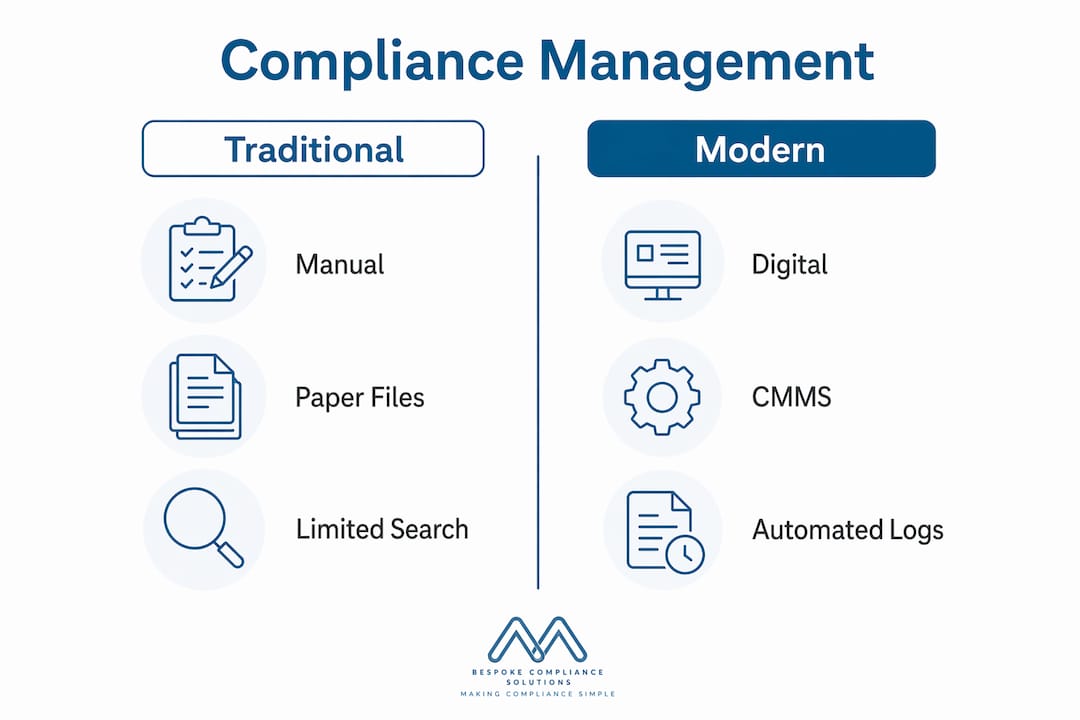
Feature | Traditional (manual) | Modern (digital/CMMS) |
Record storage | Spreadsheets, paper files, email | Centralised digital platform |
Audit trail | Fragmented, hard to retrieve | Searchable, timestamped, linked to assets |
Corrective actions | Tracked informally | Automated workflows with accountability |
Audit response time | Days to compile | Hours with automated systems |
Risk of gaps | High, reliant on individuals | Low, system prompts and flags missed tasks |
Competency evidence | Often undocumented | Logged against named personnel |
Manual systems are not inherently wrong, but they carry significant risk. They rely on individuals remembering to update records, file documents correctly, and flag overdue tasks. When staff change, that institutional knowledge disappears. Auditors call this “tribal knowledge,” and it is not a compliance strategy.
Modern platforms automate documentation capture and provide searchable audit trails that meet regulator expectations. The shift from manual to digital does not need to happen overnight. Start by digitising your monitoring logs and corrective action records. Those two areas account for the majority of audit findings.
Pro Tip: If your organisation is not ready for a full CMMS, begin with a structured digital logbook. Bespokecompliancesolutions offers a bespoke logbook system implementation that gives you a clear, auditable record without the complexity of enterprise software.
How can businesses prepare for and maintain successful water compliance audits?
Audit readiness is not a project you complete before an inspection. Compliance requires ongoing management and daily, proactive documentation. Businesses that treat audits as a one-time effort consistently find themselves scrambling when inspectors arrive.
The following practices build genuine, continuous compliance:
Assign clear roles using a RACI model. Every water management task needs a named Responsible person, an Accountable owner, someone to Consult, and someone to Inform. Ambiguity about who owns a task is how records go missing.
Set and maintain monitoring schedules. Weekly temperature checks, monthly inspections, and quarterly reviews must be scheduled, completed, and recorded. Missed tasks must be documented with a reason, not simply skipped.
Build corrective action workflows. When an issue is identified, the workflow must capture the finding, the action taken, the person responsible, the completion date, and a verification check. Partial records are treated as incomplete compliance.
Maintain a permanent, organised audit file. A permanent digital file with all risk assessments, control schemes, monitoring logs, and corrective action records enables audit readiness without last-minute scrambling.
Conduct internal audits. Review your own records quarterly. Identify gaps before an external auditor does. An internal audit against your water regulation checklist is far less costly than a compliance failure.
Use qualified external support. For complex sites, healthcare facilities, or multi-site organisations, specialist compliance support removes the risk of gaps that internal teams may not recognise. Bespokecompliancesolutions works with healthcare water risk assessments and commercial premises across the UK, providing the expertise that turns compliance from a burden into a managed process.
The key differentiator between passing and failing a water quality audit is the ability to rapidly retrieve comprehensive evidence, including timestamped corrective action trails linked to specific assets. Businesses that build this capability into their daily operations do not fear audits. They are ready for them.
Pro Tip: Schedule a mock audit six weeks before any anticipated inspection. Walk through your evidence file as an auditor would. Every gap you find is one less finding on the official report.
Key takeaways
A water compliance audit is won or lost on the quality and accessibility of your documentation, not the quality of your water alone.
Point | Details |
Definition of a water compliance audit | A systematic, third-party review of your water management system against regulatory standards to confirm legal compliance. |
Documentation is the primary risk | Over 60% of violations arise from documentation and reporting failures, not water quality issues. |
Auditor mindset | Auditors treat unproven actions as non-compliance; if there is no record, the task did not happen. |
Continuous compliance beats last-minute preparation | Daily monitoring, scheduled maintenance, and organised records remove audit stress entirely. |
Technology reduces audit risk | Digital systems and CMMS platforms cut audit response time from days to hours by centralising evidence. |
Why I think most businesses are solving the wrong problem
From working across commercial, healthcare, and housing association sites, the pattern I see most often is this: businesses invest heavily in the physical side of water management, new assets, better chemicals, upgraded systems, and then neglect the paperwork that proves it all happened. They are solving the wrong problem.
An auditor does not walk in with a water testing kit. They walk in with a checklist and a request to see your records. I have seen well-managed sites fail audits because a temperature log had three weeks of missing entries. I have also seen sites with older infrastructure pass comfortably because their documentation was meticulous and their corrective action trails were complete.
The cultural shift that matters most is moving from “we do this” to “we record that we do this.” Those are not the same thing in the eyes of a regulator. Small procedural changes, like making a monitoring log the last step of every maintenance visit rather than an optional follow-up, have saved clients from significant audit findings.
Technology helps, but it is not the whole answer. A digital system with poor discipline produces digital gaps instead of paper ones. The mindset has to change first. Audit readiness is a daily habit, not a filing exercise you do the week before an inspection arrives.
— Sammi
How Bespokecompliancesolutions supports your water compliance audit readiness
Bespokecompliancesolutions works with businesses across commercial, healthcare, retail, and housing sectors to make water compliance manageable and audit-ready every day of the year. From Legionella compliance for offices and commercial premises to bespoke logbook systems and water testing and analysis, every service is built around your specific site and sector. Bespokecompliancesolutions also provides automated water temperature monitoring, which removes one of the most common documentation gaps from your compliance picture entirely. Whether you need a full Legionella risk assessment, a compliance programme review, or ongoing consultancy support, the team is equipped to reduce your audit risk and keep your organisation on the right side of regulation.
FAQ
What is a water compliance audit in the UK?
A water compliance audit is a formal review of an organisation’s water management system against UK regulatory standards, including Legionella control requirements under the Health and Safety at Work Act 1974 and the Control of Substances Hazardous to Health Regulations. It assesses documentation, monitoring records, risk assessments, and corrective action evidence.
How often should a water compliance audit be conducted?
There is no single fixed frequency mandated across all sectors, but most regulatory guidance recommends annual reviews as a minimum, with continuous monitoring and internal checks throughout the year. High-risk environments such as healthcare facilities typically require more frequent formal reviews.
Why do businesses fail water compliance audits?
Over 60% of violations arise from documentation, monitoring, or reporting failures rather than water quality problems. Missing logs, incomplete corrective action records, and outdated risk assessments are the most common causes of audit failure.
What documents does an auditor typically request?
Auditors request current risk assessments, written control schemes, temperature monitoring logs, maintenance records, corrective action trails, asset registers, and evidence of staff competency. All records must be complete, dated, and retrievable quickly.
Can a business conduct its own internal water compliance audit?
Yes. Internal audits against a water regulation checklist are a recognised best practice for identifying gaps before an external inspection. For complex sites or regulated sectors, pairing internal reviews with specialist external support from a provider such as Bespokecompliancesolutions significantly reduces the risk of missing critical compliance requirements.
Recommended
Comments