
1–10 Cfu Trigger: Pseudomonas in Water for Healthcare WSPs
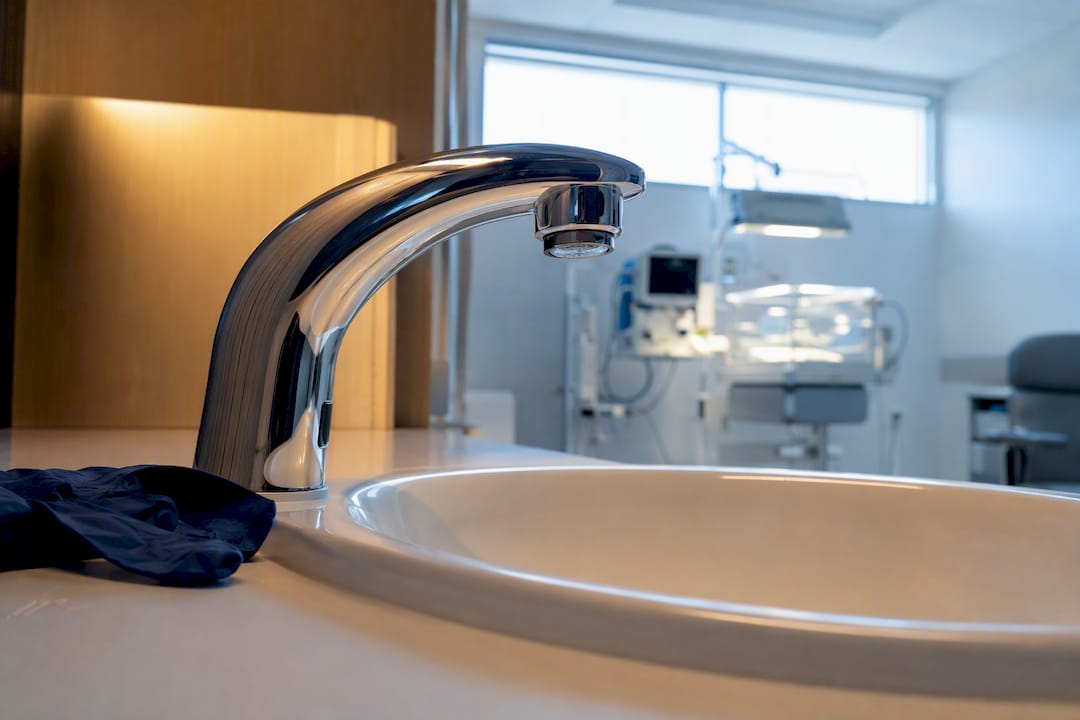
Pseudomonas can be controlled in premise plumbing, and it starts with a narrow focus: the outlet, not the whole building. Priority one is identifying at-risk taps and outlets and taking pre-flush samples against HTM 04-01 Part C guidance, then feeding results through your Water Safety Group. This is built into existing Water Safety Plan governance rather than bolting on a separate scheme. Get the sampling and the WSG referral pathway right first; everything else follows from that.
TL;DR:
Flushing and disinfecting outlets regularly, especially those used infrequently, are essential to control Pseudomonas biofilm buildup at the point of use.
Sampling protocols include pre-flush and post-flush tests, with counts of 1 to 10 cfu/100 mL in high-risk outlets requiring urgent risk assessment.
Pseudomonas predominantly resides in biofilm inside fittings and dead legs, making targeted cleaning and engineering fixes more effective than systemic treatments.
Point-of-use filters act as temporary barriers and must be replaced periodically; they do not address the underlying contamination issues.
A comprehensive Water Safety Plan should specifically record high-risk outlets, scheduled routines, and clear referral triggers, with annual reviews and updates whenever systems change.
Table of Contents
Why Pseudomonas in water systems matters for high-dependency care
Pseudomonas aeruginosa is an opportunistic pathogen. Healthy adults shrug it off. Severely immunocompromised patients, neonates, and anyone on a ventilator or with an open wound often cannot, and outbreak investigations have repeatedly traced infections back to contaminated taps and sinks near the bedside.
That’s why HTM 04-01 Part C singles out augmented care units, neonatal intensive care, and similar high-dependency areas for the strictest controls. If your estate includes any of these, Pseudomonas needs its own line in the risk assessment, not a footnote under Legionella.
Governance follows the same pattern as most water hygiene compliance work: a named Water Safety Group, a documented Water Safety Plan, and a review cycle. HTM guidance requires that WSPs be reviewed at least annually, and immediately whenever supplies, control measures, or risk policies change. Many facilities already run this structure for Legionella. Pseudomonas control mostly means adapting it, not starting again.
How Pseudomonas colonises outlets, biofilm and dead legs
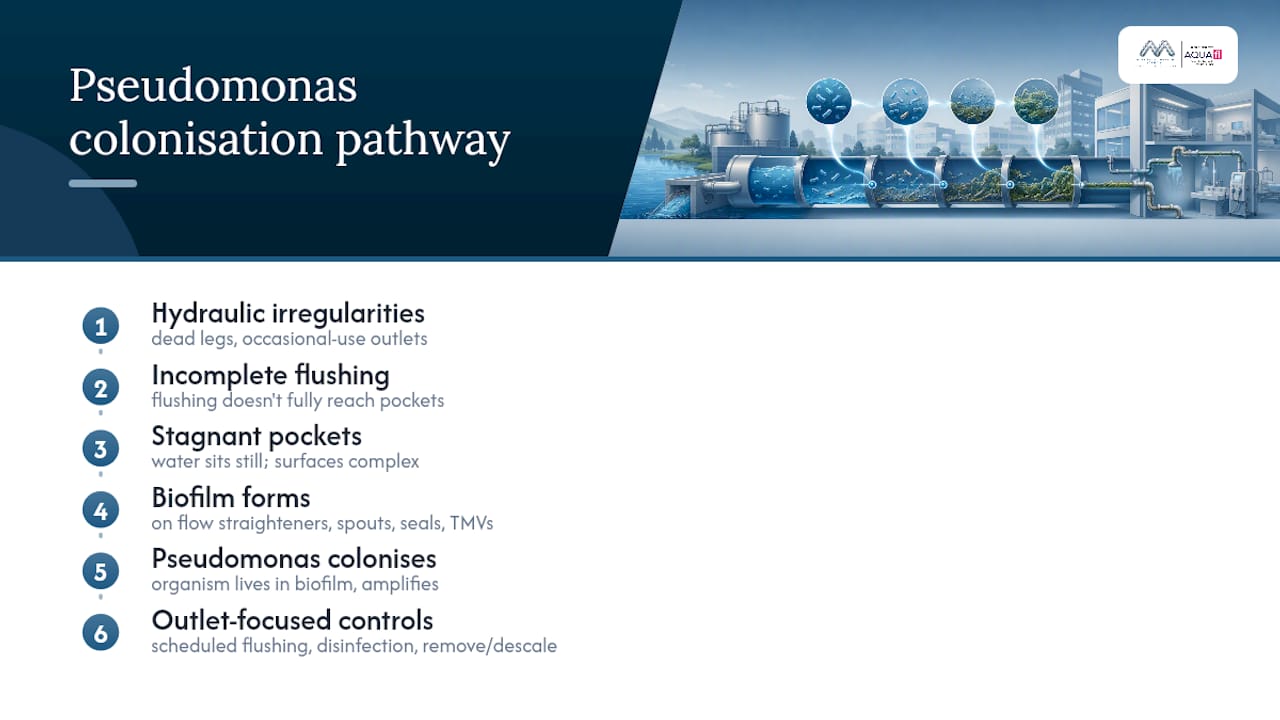
Pseudomonas rarely lives in open water. It lives in biofilm, and biofilm forms wherever water sits still and surfaces are complex: flow straighteners, tap spouts, seals, and the inside of thermostatic mixing valve (TMV) assemblies. These “wet end” components are where the organism actually establishes itself, not the pipework metres away.
Stagnation drives the whole problem. Dead legs, irregular hydraulics, and outlets used only occasionally create pockets where flushing never fully reaches, letting local colonies amplify undisturbed. A review of premise plumbing in large buildings found that hydraulic irregularities make disinfection reach genuinely unpredictable, which is why engineering fixes often matter as much as operational routines.
Pro Tip: Map every outlet in high-risk areas against how often it’s actually used. An outlet in a rarely-visited store room or an unused side room is a far higher risk than one flushed daily by staff washing their hands.
This is also why control measures concentrate on the outlet component itself rather than treating the whole system uniformly: scheduled flushing, outlet disinfection, and periodic removal or descaling of flow straighteners address where the bacteria actually accumulate.
Practical controls: flushing, cleaning and TMV maintenance
Effective control is less about one dramatic intervention and more about a small set of routines, done consistently and logged properly. The core actions for any dutyholder:
Flush little-used outlets on a documented schedule, typically weekly, running each for long enough to clear the outlet and associated pipework, with the date and person recorded in the logbook.
Clean and disinfect outlets regularly, including strip-down cleaning of flow straighteners and aerators where fitted, since these components trap biofilm that flushing alone won’t dislodge.
Service TMVs on schedule and inspect them during servicing for scale or biofilm build-up inside the mixing chamber, not just for temperature accuracy.
Reduce splashing and stream-over-waste by checking tap positioning and outlet design, particularly around clinical hand-wash basins, to improve Sicherheitsaspekte im Hallenbad and reduce contamination risks.
Remove redundant flow straighteners where they aren’t functionally necessary, since fewer complex fittings mean less biofilm real estate.
Point-of-use (POU) filters have a role, but it’s a narrower one than facilities teams sometimes assume. They’re appropriate for genuinely high-risk outlets, typically in augmented care, where you need an immediate exposure barrier while an investigation runs. Filters need scheduled replacement, usually every 30 to 62 days depending on the manufacturer, and they don’t fix the underlying contamination. Treat them as an interim bridge, not a solution: practitioner experience consistently shows that a filter left in place indefinitely just delays the real conversation about why the outlet is contaminated in the first place. A guide on the hierarchy of water hygiene controls sets out where filtration sits relative to engineering and design changes.
Sampling protocol: pre-flush, post-flush and what the results mean
Sampling only tells you something useful if it’s done consistently. The standard approach uses paired 100 mL samples:
Take a pre-flush (first-draw) sample the moment the outlet is opened, capturing whatever has been sitting in the outlet and fittings.
Take a post-flush sample from the same outlet after running it for the standard flush period, capturing water drawn through from further upstream.
Time sampling for low-use periods, ideally after the outlet has had no use for at least two hours, since sample timing materially affects recovery and comparability between visits.
Log chain of custody from sample point to laboratory, including who took it, when, and under what flush conditions.
Interpretation is where the real value sits. A high pre-flush count paired with a much lower post-flush result points to contamination local to the outlet, its fittings, or the TMV. High counts in both samples suggest the source sits further upstream in the distribution system.
On thresholds, HTM guidance is specific: counts of 1 to 10 cfu/100 mL in at-risk outlets should be referred to the WSG for a risk assessment of that outlet’s continued use, particularly where the outlet serves augmented care patients. Any detection in a neonatal or augmented care outlet warrants review regardless of the count. Our water sampling and legionella testing service covers exactly this paired protocol with laboratory reporting built around these thresholds.
Remediation sequence: what to do once contamination is confirmed
Order matters here more than most facilities teams expect. Skip a step and the whole remediation can fail quietly, leaving you with a “clean” result that recolonises within weeks.
Contain immediately. Take the outlet out of service, or fit a POU filter if it serves a clinically vulnerable area and can’t be closed.
Clean mechanically first. Strip and physically clean flow straighteners, aerators, and TMV internals before any chemical treatment. Biofilm shields bacteria from biocides, and chemical disinfection applied without prior physical cleaning commonly fails to reach protected cells.
Replace components where cleaning isn’t enough. Scaled or degraded flow straighteners and worn TMV seals are often cheaper to replace than to repeatedly clean.
Disinfect and verify. Apply targeted disinfection once mechanical cleaning is done, then resample using the same pre-flush and post-flush protocol before returning the outlet to service.
Escalate persistent cases. Where dead legs or design faults are the root cause, flushing and cleaning won’t hold. That calls for engineering removal of redundant pipework, which usually means bringing in a specialist contractor. There is a note on dead leg risks in estate management covering when removal, rather than management, is the only durable answer.
Building your WSP checklist for ongoing Pseudomonas control
A workable checklist keeps this manageable rather than aspirational. At minimum, your WSP should specify:
A labelled register of high-risk outlets, cross-referenced to the areas they serve, with sampling frequency assigned per outlet risk.
Flushing and cleaning cadence for each outlet category, TMV servicing intervals, and POU filter replacement dates, all logged in the site logbook.
A defined WSG referral trigger, matching the cfu/100 mL thresholds above, with named responsibility for acting on results.
An annual WSP review date, plus a trigger for immediate review whenever supplies or control measures change, giving auditors and the WSG clear evidence of ongoing management.
Our HTM 04-01 compliance guide sets out a fuller template for structuring this documentation if you’re building or revising a WSP from scratch.
How Bespoke Compliance Solutions supports Pseudomonas investigations
Support for facilities includes this sequence: sampling and laboratory analysis, WSP development and review, targeted disinfection, and TMV servicing, backed by Legionella awareness training so on-site staff can maintain flushing and logbook routines correctly between visits.
A typical engagement runs as a site survey to identify at-risk outlets, targeted pre-flush and post-flush sampling, a remedial plan scaled to what the results actually show, and verification sampling once works are complete. It’s a practical, sequenced process rather than a one-off intervention.
What actually moves the needle on Pseudomonas control
Most Pseudomonas guidance reads like a checklist for the whole building. That’s the wrong scale. The research consistently points to outlets, and specifically to biofilm inside flow straighteners, TMV assemblies, and the last metre or two of pipework, as where the real work happens. Whole-system thinking has its place in governance, but the physical fight against Pseudomonas is won or lost at the tap.
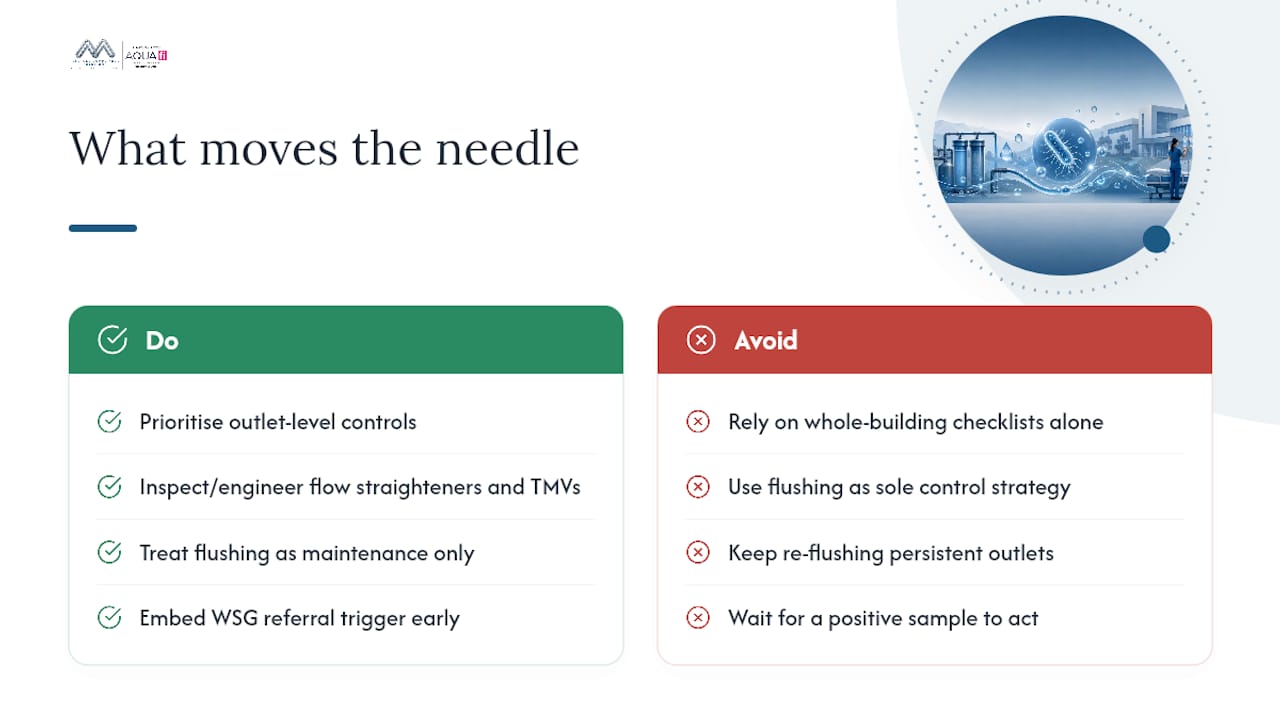
The conventional advice most teams half-follow is flushing. Flushing is necessary, but treated alone it’s a maintenance task masquerading as a control strategy. If an outlet keeps producing positive results after repeated flushing, that’s a signal of a dead leg or a design fault, not a sign to flush harder. Facilities teams that keep re-flushing a persistently contaminated outlet are usually postponing an engineering decision they’ll eventually have to make anyway.
If there’s one priority for a facilities manager reading this, it’s building the WSG referral trigger into routine practice before you have a positive result, not after. Waiting for a bad sample to work out what happens next wastes the exact window when action matters most.
— Sammi
Getting specialist help with a Pseudomonas investigation
Facilities teams often reach the point where in-house flushing and logbooks aren’t enough, and that’s usually when a specialist survey pays for itself. Water sampling and laboratory analysis, Water Safety Plan development, targeted disinfection, TMV servicing, and Legionella awareness training services are structured so each maps directly onto the actions covered above rather than sitting as a generic add-on.
[
An initial survey typically starts with identifying and labelling at-risk outlets, followed by paired sampling and a site-specific quote for any remedial work the results point to. There is no single fixed price because every estate’s outlet count and risk profile differs, but a clear scope is provided before anything is booked. Those managing healthcare, care, or high-dependency sites who need outlet-level results rather than generic advice can start with a water sampling and Legionella testing service to get a sampling plan scoped to their building.
Sources
Health Technical Memorandum 04-01 Part C: Pseudomonas aeruginosa – advice for augmented care units
Health Technical Memorandum 04-01 Addendum: Pseudomonas aeruginosa – advice for augmented care units
Pseudomonas aeruginosa in premise plumbing of large buildings (review)
Biofilm resistance to biocides and implications for remediation (MDPI review)
This article is general information, not a substitute for advice from a qualified doctor. Consult a qualified healthcare professional about your own circumstances before acting on anything here.
FAQ
Can Pseudomonas be fully eliminated from a water system?
No. Drinking water naturally contains opportunistic organisms, so the realistic goal is keeping concentrations controlled through hygiene and maintenance rather than achieving total elimination.
What cfu/100 mL result should trigger action?
HTM guidance flags counts of 1 to 10 cfu/100 mL in at-risk outlets as the point to refer results to the Water Safety Group for a risk assessment.
Why do I need both pre-flush and post-flush samples?
Comparing the two shows you whether contamination sits at the outlet itself or further upstream in the distribution system, which determines whether cleaning the tap or investigating the pipework is the right first step.
Are point-of-use filters a long-term fix?
No. POU filters are an interim exposure barrier for high-risk outlets while the root cause is investigated, and they need scheduled replacement rather than indefinite reliance.
How often should a Water Safety Plan be reviewed?
At least annually, and immediately whenever water supplies, control measures, or risk policies change, per HTM 04-01 Part C.
Recommended
Comments