
Board reporting for water safety: a governance guide

The board must receive one concise package: a risk-rating update, evidence that controls are working, a record of any incidents and their outcomes, and a clear statement of what resources management needs to address outstanding issues. That is the minimum. Without it, the board cannot demonstrate oversight, cannot defend resourcing decisions, and cannot satisfy a regulator or court that it took water safety seriously.
What to hand to the board at each meeting:
A one-page executive summary (BLUF format: action required, current risk rating, headline findings)
A RAG (Red/Amber/Green) dashboard showing control-point status, temperature compliance, and overdue actions
An incident notice for any positive Legionella result, illness report, or system failure since the last meeting
A resource request with costed options where remedial works or capital investment are needed
Recommended board decisions or resolutions (approve budget, note report, commission external review)
Appendices: risk assessment extract, recent laboratory results, logbook evidence, action tracker, Water Safety Group (WSG) minutes
What to prepare this week before the next board meeting:
Confirm the current risk assessment is in date and summarise its headline risk rating
Pull the last three months of temperature monitoring data and sampling results
List every overdue remedial action with its owner and revised deadline
Draft a one-page BLUF summary using the structure in Section 2 below
Check that the Responsible Person (RP) is named in the board paper and that the WSG Terms of Reference (TOR) are current
Table of Contents
What must a board water-safety report contain?
The board paper is not a technical document. Its job is to give non-specialist directors enough information to make decisions, allocate resources, and demonstrate that they have exercised oversight. Keep the main body to one page. Put the evidence in appendices.
The executive summary: answer first
Open with the action required, not the background. A strong opening looks like this:
“The board is asked to note the current water-safety risk rating, approve the remedial works programme, and confirm that the Responsible Person appointment remains current. No Legionella-positive samples were recorded in the quarter. Two temperature exceedances were identified; both were remediated within 24 hours and are recorded in the action tracker at Appendix C.”
That single paragraph tells the board what it needs to decide, what the risk level is, and what management has already done. Everything else is supporting evidence.
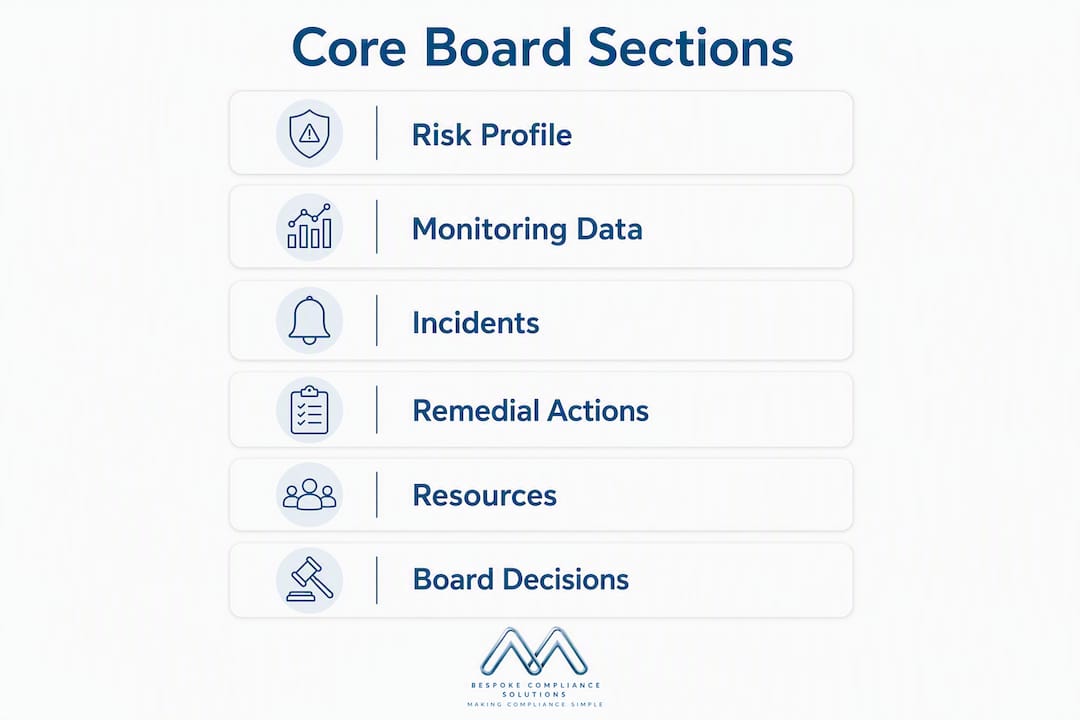
Core sections of the board paper
Risk profile summary. State the current risk rating from the most recent risk assessment, the date of that assessment, and whether any material changes to the water system have occurred since. Reference the water hygiene risk hierarchy to show the board which controls sit at the top of the priority stack.

Monitoring data summary. Summarise the quarter’s temperature monitoring results: summary of control points within target ranges, any exceedances, and time to corrective action. Include a one-line note on sampling frequency and whether the schedule was met.
Incidents and outcomes. List every notifiable event since the last report: positive samples, illness reports, system failures, and regulatory contacts. For each, state the date, the nature of the event, the immediate action taken, and the current status.
Remedial actions and deadlines. A short table: action, priority, owner, original deadline, revised deadline (if applicable), and status. The board does not need the full action tracker here; it needs to see whether critical items are on time.
Resource implications. State what management needs: budget approval, additional staff, contractor engagement, or capital investment. Give costed options where possible so the board can make a genuine decision rather than simply note the report.
Recommended board decisions. End the main body with numbered resolutions. “The board is asked to: (1) note this report; (2) approve the remedial works budget; (3) confirm the Responsible Person appointment.”
Appendix checklist
Pro Tip: Keep appendices labelled consistently (A, B, C…) and cross-referenced in the main body. An auditor or regulator should be able to trace every claim in the executive summary to a specific appendix within 60 seconds.
Appendix A: Risk assessment extract (executive summary page and risk-rating matrix)
Appendix B: Laboratory sampling results with certificates (last quarter minimum)
Appendix C: Action tracker (full list with owners, deadlines, and status)
Appendix D: Temperature monitoring logbook extract or automated sensor report
Appendix E: WSG minutes (last two meetings)
Appendix F: External audit or assurance report (when applicable)
Appendix G: Calibration records for monitoring equipment
The one-page summary belongs in the board pack. The appendices go in a separate tab or digital folder. Directors who want the detail can find it; those who need only the headline can read the summary and vote on the resolutions.
Who is accountable, and who escalates what?
Governance guidance for water-sector organisations is clear on one point: board and executive roles must stay distinct. The board sets direction, allocates resources, and holds management to account. Management delivers the controls, produces the evidence, and escalates material issues. Conflating the two creates oversight creep and, in a dispute, makes it harder to show that the board was genuinely independent.
Roles and responsibilities mapped
Role | Primary responsibility | Typical evidence produced | Escalation owner for |
Board / Duty Holder | Strategic oversight, resourcing decisions, regulatory accountability | Board minutes, approved budgets, resolutions | Regulatory intervention, deaths or serious illness, major capital decisions |
Responsible Person (RP) | Day-to-day compliance management, scheme of control | RP appointment letter, scheme of control document, logbook sign-off | Positive Legionella samples, system failures, overdue critical actions |
Water Safety Group / WMG | Operational governance, monitoring review, action tracking | WSG minutes, action log, monitoring summaries | Escalation to RP and board where thresholds are breached |
Estates / Facilities | Physical control delivery, temperature monitoring, maintenance | Logbooks, maintenance records, calibration certificates | Immediate system failures to RP |
External contractors | Specialist works (disinfection, TMV servicing, tank cleaning) | Job sheets, certificates of completion, lab reports | Findings outside scope to RP |
External laboratory | Sampling analysis | Laboratory certificates, accreditation records | Positive results directly to RP per agreed protocol |
The RP is the linchpin. The duty holder or employer is responsible for commissioning Legionella risk assessments and for ensuring the RP has the authority and resources to act on findings. That appointment must be documented, reviewed annually, and confirmed in the board paper.
Avoiding oversight creep
The board should not be approving individual maintenance tasks or signing off temperature logs. If board papers contain that level of operational detail, the governance structure has drifted. A clean TOR for the WSG, with explicit delegated authority for routine operational decisions, keeps the board focused on material risk and resourcing. Record the delegation explicitly in the TOR and reference it in the board paper.
What must reach the board immediately?
Routine periodic reporting covers the steady state. Some events require immediate notification to the board, outside the normal reporting cycle.
Escalation triggers requiring immediate board notification:
A confirmed Legionella-positive result in a potable or domestic hot and cold water system
Repeat positive results following remediation (indicating controls have not resolved the issue)
A death or serious illness with a plausible link to the water system
Multiple simultaneous system failures (e.g., loss of temperature control across several risers)
A major deviation in temperature control that cannot be corrected within the agreed response time
Regulatory contact, enforcement notice, or inspection by the HSE, CQC, or Drinking Water Inspectorate
Credible media enquiry or public complaint with potential reputational or legal implications
Failure of a critical control measure identified in the risk assessment
Incident report format
When an escalation trigger is met, the RP sends the board a short incident note within 24 hours. It follows this structure:
“On [date], [event description]. Immediate action taken: [action]. Current status: [contained/ongoing]. Estimated resolution: [date/timeframe]. Action owner: [name]. Full incident report and laboratory results at Appendix [X].”
That is the whole note. The board does not need a root-cause analysis at this stage; it needs to know what happened, what has been done, and who is responsible. A full post-incident report follows once the situation is resolved, and it goes into the next scheduled board paper with a completed action tracker entry.
Who notifies the board and how
The RP notifies the board secretary, who circulates the incident note to all directors. For a confirmed Legionella positive or a death, the board chair should convene an emergency call or meeting within 48 hours. For lower-severity triggers (single temperature exceedance, minor system fault), a written note with a commitment to report at the next scheduled meeting is usually sufficient. The WSG TOR should specify the threshold for each response type so there is no ambiguity.
How often should the board receive water-safety reports?
Quarterly board updates are the standard for most organisations, with monthly WSG reporting feeding into them. That cadence gives the board enough frequency to spot trends without drowning directors in operational data. For high-risk settings (acute healthcare, large housing estates, complex cooling systems), monthly board updates may be warranted until the risk profile is stable.
Sample KPIs for the board dashboard
KPI | Definition | Target | RAG threshold |
Positive sample rate | % of samples returning Legionella-positive results | — | Red: any positive |
Temperature compliance | % of control points within target range (cold, hot temperatures at point of use) | — | Amber: mid-range; Red: low |
Time to remedial action | Average days from exceedance identified to corrective action completed | ≤2 days | Amber: 3–5 days; Red: >5 days |
Overdue actions | % of actions past their agreed deadline | — | Amber: low single digits; Red: higher |
Sensor / monitoring uptime | % of automated monitoring points operational | ≥98% | Amber: high; Red: lower |
Risk assessment currency | Months since last full risk assessment | ≤24 months | Amber: above average months; Red: longer |
Pro Tip: A compliance dashboard for water hygiene should fit on a single A4 sheet or one screen. If the board needs to scroll to see all the KPIs, the dashboard is too detailed. Trend lines matter more than single data points: a temperature compliance rate that has fallen from 98% to 91% over three quarters is a board-level concern even if it is still technically Amber.
For organisations managing multiple sites, standardising KPIs and reporting formats across the estate is the only way to produce a board pack that is genuinely comparable from quarter to quarter.
Evidence checklist for assurance
The board pack appendices should contain, at minimum:
Current risk assessment (or extract showing risk rating and date)
Laboratory certificates from the most recent sampling round
Calibration records for temperature monitoring equipment
Action tracker (all open items with owners and deadlines)
WSG minutes from the period covered by the report
External audit or assurance report (when one has been commissioned)
Remediation completion certificates where works have been carried out
What should a Water Safety Group’s Terms of Reference include?
The WSG (sometimes called the Water Management Group or WMG) is the operational governance body that sits between the facilities team and the board. Its TOR is the document that gives it authority, defines its membership, and sets the reporting line to the board. Without a current, signed TOR, the WSG’s outputs carry no formal weight in a governance review.
TOR checklist
Purpose: state that the WSG exists to oversee the implementation of the water-safety scheme of control, review monitoring data, manage the action tracker, and report to the board on water-safety performance
Membership: RP (chair), estates or facilities lead, head of compliance, nominated clinician or technical lead (healthcare settings), contractor lead (where applicable), external laboratory or consultant (by invitation)
Meeting frequency: monthly as a minimum; extraordinary meetings within 48 hours of an escalation trigger
Reporting line: WSG reports to the board (or a named board committee) via the RP; the RP is responsible for preparing the board paper
Delegated authority: define what the WSG can decide without board approval (e.g., routine remedial works below a defined monetary threshold) and what requires board sign-off
Quorum: minimum three members including the RP
Conflict of interest: any member with a financial interest in a contractor or supplier must declare it and withdraw from related decisions
Review: TOR reviewed annually and after any significant change to the water system or organisational structure
Standing agenda items
A WSG meeting agenda should cover, in order: apologies and quorum; minutes of the last meeting and actions arising; monitoring data review (temperature, sampling, sensor uptime); incident and near-miss review; action tracker update; resource and budget items; any regulatory or external audit matters; items for escalation to the board; date of next meeting.
The action log entry format should record: action reference number, description, owner, date raised, agreed deadline, revised deadline (if applicable), status, and evidence of completion. That format maps directly to the board paper’s remedial actions section, so the RP can copy the relevant rows without reformatting.
Cascading WSG outputs to the board
The WSG minutes become Appendix E of the board pack. The action tracker becomes Appendix C. The RP’s job is to distil the WSG’s findings into the one-page executive summary, flagging anything that requires a board decision or resource approval. The board should never be seeing raw monitoring data for the first time; by the time it reaches the board paper, it has already been reviewed and interpreted by the WSG.
How do you evidence adequate resources to the board?
Assurance is not just about showing that controls are in place. It is about showing that the organisation has the people, the budget, and the competence to sustain those controls. That is what a regulator or court will ask about if something goes wrong.
The assurance map
Monitoring data flows from the estates team and contractors into the WSG. The WSG reviews it monthly, updates the action tracker, and flags material issues to the RP. The RP prepares the quarterly board paper, which goes to the board (or its audit/risk committee). External reviews, whether specialist audits, independent risk assessments, or regulatory inspections, are escalated directly to the board with a management response.
Evidencing resourcing
The board paper’s resource section should include:
A costed short-term option (immediate remedial works required now)
A costed medium-term option (planned maintenance and monitoring upgrades within 12 months)
A costed long-term option (capital investment, system replacement, or major refurbishment)
Competence records for the RP and key staff (training certificates, professional memberships)
Contract scopes and KPIs for external contractors and laboratories
Any outstanding capital investment proposals with risk consequences of deferral stated explicitly
The board cannot make a genuine resourcing decision if it only sees one option. Presenting three costed options, with the risk consequence of each, is what turns a “note this report” agenda item into a real governance decision.
When to commission external reviews
An independent specialist audit is warranted when: the risk assessment is more than two years old; the organisation has undergone significant structural or operational change; a positive Legionella result has occurred; a regulator has raised concerns; or the board has doubts about the adequacy of internal controls. The audit report goes to the board as a standalone appendix, with a management response that addresses each finding and assigns an owner and deadline to every remedial action.
Documents the board should see to be satisfied that resourcing is adequate:
Current RP appointment letter and competence evidence
Contractor appointment documents and scope of works
Training records for all staff with water-safety responsibilities
Most recent external audit or specialist review report and management response
Capital and revenue budget allocations for water-safety activities
Evidence that the WSG has reviewed and approved the monitoring schedule
Which UK regulations govern water-safety board reporting?
Board papers should reference the regulatory baseline explicitly. Directors who have not been briefed on the legal framework cannot be expected to understand the significance of a positive Legionella result or a temperature exceedance. A short regulatory context paragraph in the board paper, or a standing annex updated annually, closes that gap.
Core references to cite in board papers
HSE L8 (Legionnaires’ disease: the control of Legionella bacteria in water systems): the primary approved code of practice. Cite it when explaining the duty to assess and control Legionella risk and the requirement for a written scheme of control.
HSG274 (Technical guidance on Legionella): three-part technical supplement to L8. Cite Part 2 for domestic hot and cold water systems, Part 3 for cooling towers. Reference it when presenting temperature control targets and sampling protocols.
HTM 04-01 (Health Technical Memorandum: Safe water in healthcare premises): mandatory for NHS and healthcare settings. Practical guidance on applying HTM 04-01 is available for facilities teams working in clinical environments.
Health and Safety at Work etc. Act 1974 and the Management of Health and Safety at Work Regulations 1999: the overarching duty of care framework. Cite these when explaining the board’s legal accountability as duty holder.
CQC guidance (where applicable): for registered care providers, CQC’s fundamental standards include safe care and treatment. Water-safety failures can trigger CQC enforcement. Reference the relevant Key Lines of Enquiry in board papers for care settings.
Drinking Water Inspectorate (DWI) guidance: relevant where the organisation operates its own supply or where a local supply issue has been notified. Cite DWI guidance when reporting on water-quality compliance for drinking water.
Suggested citation wording for board papers
“This report has been prepared with reference to HSE L8 (Approved Code of Practice), HSG274 Parts 1–3, and [HTM 04-01 where applicable]. The organisation’s water-safety scheme of control is designed to meet the requirements of these standards. Any deviations from the scheme are recorded in the action tracker at Appendix C.”
That single sentence shows the board has considered the regulatory baseline. It also creates a contemporaneous record that the organisation was aware of its obligations at the time the report was prepared.
Noting regulator engagement in minutes
Any contact with the HSE, CQC, or DWI must be recorded in the board minutes by date, nature of contact, and outcome. If an enforcement notice or improvement notice has been issued, the board paper should include the notice as an appendix and a management response with a remediation timeline. Regulators look at board minutes when investigating incidents; a minute that shows the board was informed, asked questions, and approved a remediation plan is a material piece of evidence.
Why does documented board reporting matter legally and commercially?
Documented board reporting on water safety is a primary defence in oversight disputes and a key expectation of investors and regulators. That is not a theoretical point.
Governance commentary from Harvard Law School’s corporate governance forum makes clear that investor attention to director oversight has increased materially, and that failures to oversee material risks, including safety issues, are now treated as fiduciary failures during director elections. A board that cannot produce minutes showing it received water-safety reports, asked questions, and made resourcing decisions is exposed, not just to regulatory sanction, but to shareholder challenge.
The legal standard is equally demanding. Caremark-style oversight doctrine requires evidence that the board implemented a monitoring system and actively reviewed it. Lack of documented monitoring exposes directors to personal liability. In a water-safety context, that means the board must be able to show, through its minutes and papers, that it received reports, challenged management, and made decisions, not merely that a compliance programme existed somewhere in the organisation.
Best practice guidance on board risk management reinforces this: boards should require periodic reports on principal risks and, for mission-critical risks, use committee structures to maintain oversight. Water safety qualifies as a principal risk in any organisation with complex water systems, a vulnerable population, or a regulatory registration.
Documentation checklist for legal defence
Board minutes recording the specific water-safety reports received, the questions asked, and the decisions made
Named action owners and deadlines in every minute where a remedial action was approved
Evidence that the board received and considered external audit or specialist review reports
Records of resourcing decisions: budget approvals, capital investment sign-offs, contractor appointments
Confirmation in minutes that the RP appointment was reviewed and remains current
A continuous paper trail from WSG minutes through to board papers, showing the governance chain
The practical implication: minutes that say only “the board noted the water-safety report” are not enough. Minutes should record what the board was told, what it asked, and what it decided. That level of specificity is what turns a routine governance process into a credible legal defence.
Key takeaways
Effective board reporting on water safety requires a one-page BLUF summary, a RAG dashboard, clear escalation thresholds, and a documented evidence trail that satisfies both regulators and oversight scrutiny.
Point | Details |
Board paper structure | Lead with the action required, current risk rating, and recommended resolutions; put evidence in labelled appendices. |
Escalation thresholds | Define triggers in the WSG TOR so any positive Legionella result or system failure reaches the board within 24 hours. |
Quarterly cadence | Report to the board quarterly as a minimum; monthly WSG reporting feeds the board pack and keeps the action tracker current. |
Legal defence | Minutes must record what the board received, what it asked, and what it decided; “noted” alone is insufficient under Caremark-style oversight standards. |
Bespokecompliancesolutions | BCS provides Legionella risk assessments, water sampling, and board-ready compliance report packs to support governance teams across the UK. |
A practitioner’s view on keeping board reporting manageable
There is a temptation, particularly in organisations that have recently had a compliance scare, to send the board everything: every temperature log, every lab certificate, every contractor job sheet. The board then stops reading the water-safety section because it is 40 pages long and nothing in it is framed as a decision. That is a governance failure, not a compliance success.
The approach that actually works is simpler than most governance teams expect. Cut the board paper to one page. Attach a RAG dashboard and a single appendix of evidence. Delegate everything routine to the WSG, and make sure the WSG minutes are clean, dated, and signed. The board’s job is to decide and resource, not to audit.
The deliverables governance teams find most useful in practice are: a one-page report pack template they can complete in under an hour; a WSG minutes template with standing agenda items pre-populated; an action tracker that maps directly to the board paper’s remedial actions section; and sampled lab reports filed in a consistent folder structure so they can be retrieved instantly during an audit.
Three governance behaviours matter more than any template. Keep board papers decision-focused: if a paragraph does not lead to a resolution or a resource request, it probably belongs in the WSG minutes, not the board pack. Avoid operational minutiae: the board does not need to know which tap was flushed on which date. And record resourcing decisions explicitly in the minutes, with the amount approved, the works authorised, and the expected completion date. That last point is where most organisations fall short, and it is precisely what a regulator or court will look for first.
Bespokecompliancesolutions can build your board-ready evidence pack
Pulling together a credible board paper, a current risk assessment, and a complete evidence pack is straightforward when you have the right specialist behind you. Bespokecompliancesolutions delivers exactly that: Legionella risk assessments, water sampling and laboratory analysis, and board-ready compliance report packs that give your governance team the documentation it needs without months of internal effort.
BCS services map directly to the governance needs covered in this guide:
Legionella risk assessments: — current, site-specific, and written to feed directly into the board paper’s risk profile section
Water sampling and analysis: laboratory-certified results in a format ready for board pack appendices
Legionella awareness training: — for RPs, facilities staff, and governance teams who need to understand what they are signing off
To commission a risk assessment or request a board-ready compliance pack for your sites across the UK, contact Bespokecompliancesolutions directly and get a site-specific quote.
Useful UK sources and templates for board papers
When citing regulatory standards in board papers, link to or reference the primary source directly. The following are the authoritative references governance teams should keep to hand.
HSE L8: Legionnaires’ disease — the control of Legionella bacteria in water systems: the approved code of practice; cite in the regulatory context section of every board paper
HSG274 (Parts 1–3): HSE technical guidance supplementing L8; cite Part 2 for domestic systems and Part 3 for cooling towers when presenting temperature targets and sampling protocols
HTM 04-01: Safe water in healthcare premises: mandatory for NHS and registered healthcare providers; reference in board papers for any clinical or care setting
WHO Water Safety Plan Manual: international reference for risk-based water-safety planning; useful context for board papers in organisations with complex or non-standard supply arrangements
OECD Principles on Water Governance: governance framework principles (legitimacy, transparency, accountability) that underpin good water-safety oversight structures
DWI guidance: relevant for organisations with private supplies or where a local supply issue has been formally notified; available from the Drinking Water Inspectorate website
CQC fundamental standards: for registered care providers; reference the relevant Key Lines of Enquiry when reporting to boards in care settings
For internal templates, Bespokecompliancesolutions provides sample board-report packs, WSG TOR templates, action trackers, and compliance dashboards as part of its consultancy and ongoing support services. Contact BCS to obtain templates tailored to your organisation’s sites and risk profile.
Recommended
Comments