
Water safety during school closures: your practical guide
- a few seconds ago
- 8 min read
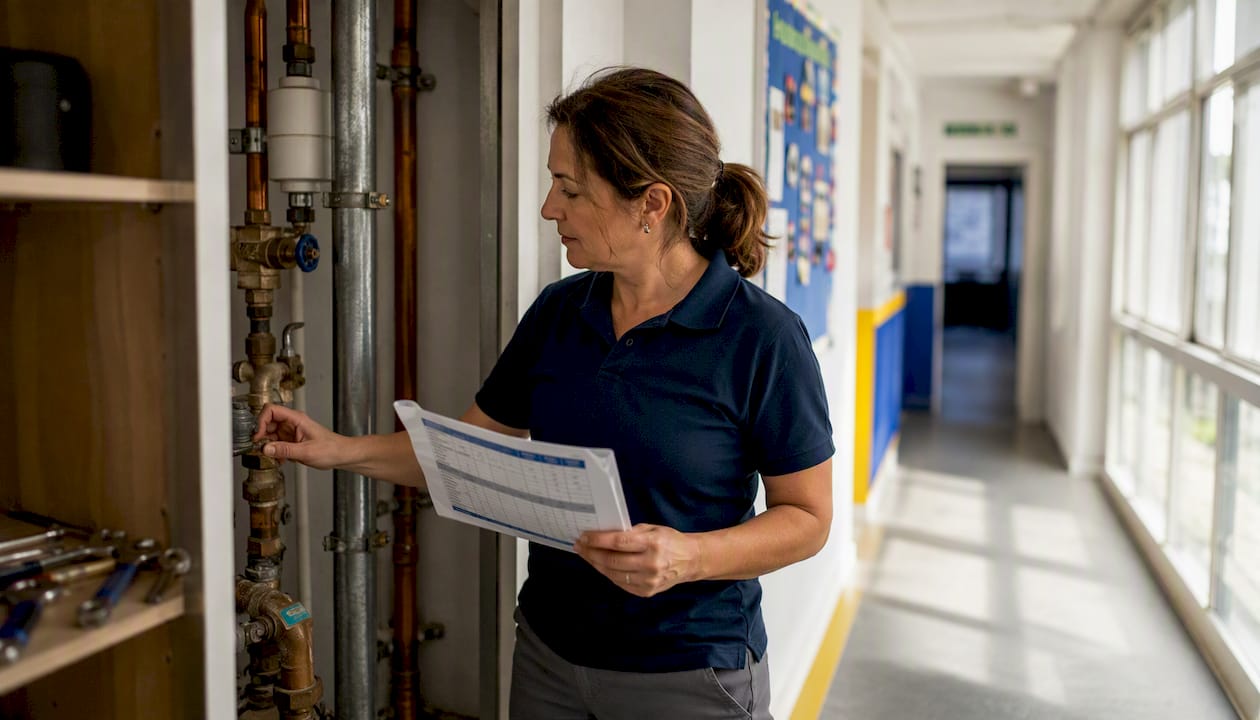
If you cannot confirm that water has been flowing regularly through your school’s system during a closure, do not use it for drinking. Supply bottled water immediately and begin documented flushing. That is the HSE-aligned starting position, and everything else in this guide builds from it.
Your first three actions, in order:
Isolate drinking outlets and post clear “do not drink” notices at every tap and fountain.
Supply bottled water for all staff and pupils until the system is proven safe.
Contact your competent person or facilities manager to begin a documented flushing programme.
Pro Tip: The single highest-impact, lowest-effort action in the first hour is removing showerheads before any flushing begins. This eliminates the most concentrated source of aerosol exposure during the riskiest first flush.
Table of Contents
Who is legally responsible for school water safety?
The duty-holder is typically the headteacher, school proprietor, or the facilities manager acting on their behalf. Under the Health and Safety at Work etc. Act 1974 and its associated regulations, they must ensure water systems do not pose a risk to health. ACOP L8 and HSG274 Part 2 set the technical standard; GOV.UK school-premises guidance and DWI Technical Bulletins provide the operational detail for educational settings.

The minimum documentary evidence inspectors expect includes: a current, site-specific Legionella risk assessment, signed competent-person declarations, bacteriological test certificates from an accredited laboratory, and a logbook showing temperature readings and flushing records. For academies, Legionella obligations carry the same legal weight as for maintained schools. Contact your competent person before reopening, not after a problem surfaces.
What should you check in the 72 hours before pupils return?
A tight sequence matters here. Doing things out of order, such as sampling before flushing, wastes time and money.
Within 24 hours: Isolate any outlets that show discolouration, odour, or visible sediment. Supply bottled water. Notify the responsible person and the maintenance management organisation (MMO).
Within 48 hours: Begin systematic flushing from the incoming supply to the furthest outlet. Check hot-water generation temperatures. Inspect showers, water fountains, and all infrequently used taps. Log every action with time, outlet location, and the name of the person carrying out the work.
Within 72 hours: Confirm hot-water temperatures have stabilised. If any outlet fails temperature checks or shows signs of contamination, escalate to a competent person for bacteriological sampling before allowing use.
Pro Tip: During the first flush, run taps slowly rather than at full pressure. High flow rates increase aerosol generation, which is where the real inhalation risk sits. Slow flow, PPE on, showerheads off.
How to flush correctly: temperatures, timing, and disinfection
Flushing is not simply running a tap for thirty seconds. The sequence starts at the incoming supply and works outward to the furthest outlet; reversing this order risks pushing stagnant water back into cleaner sections of the pipework.
Recovering water systems after stagnation means treating the first slug of water as the highest-risk material. Staff should wear gloves and a face covering, remove showerheads, and run outlets slowly for one to two minutes before increasing flow. Record temperatures at the start and end of each flush.
For temperature targets, ACOP L8 and HSG274 are clear: cold water should be maintained below 20 °C; hot water stored at a minimum of 60 °C and delivered at 50 °C within one minute at the outlet.
Outlet type | Minimum flush time | Special instructions |
Cold tap (infrequently used) | 2 minutes | Run slowly; record inlet and outlet temperature |
Hot tap (infrequently used) | Until hot water reaches outlet; minimum 2 min | Confirm 50 °C at outlet within 1 minute of full flow |
Shower | — | Remove showerhead; flush into bucket or use sleeve; wear PPE |
Water fountain / drinking point | 3 minutes | Flush to drain; do not collect for drinking until tested |
Storage tank / calorifier | Per competent person instruction | Do not drain; check temperature and visual condition |
When to call in a water-treatment specialist: closures exceeding one month, visible discolouration or sediment, failed bacteriological results, or any system that cannot be confirmed as having maintained regular throughput. Technical guidance recommends 24-hour chlorination residue for long closures.
Pro Tip: Wear a disposable FFP2 or FFP3 mask during the first flush of any shower or spray fitting. Legionella risk from aerosol inhalation is highest in that first minute, before the stagnant water clears.
Mothballing versus turning off the water: what is the difference?
Turning off the water is not mothballing. Mothballing is a formal, risk-based procedure defined against the school’s site-specific risk assessment; it balances microbial control, water use, and chemical effects. Simply isolating the supply leaves pipework filled with stagnant water at uncontrolled temperatures, which is precisely the condition that allows Legionella to proliferate.
Systems should normally be left filled rather than drained; draining can cause pipework degradation and does not eliminate microbial risk.
For partial occupancy, identify which outlets remain live, establish an interim weekly flushing regime for all others, and notify the responsible person and MMO in writing.
RAAC-affected buildings present additional complexity: structural uncertainty can delay reoccupation timelines, extending stagnation periods and increasing Legionella risk significantly. These sites need a specialist assessment before any reactivation plan is finalised.
Mothballing decisions must be documented and reviewed against the risk assessment, not made informally.
Pro Tip: Before any term break, confirm in writing who is responsible for weekly flushing and what happens if that person is absent. A single caretaker with no documented cover is one of the most common compliance failures seen in schools.
When do you need bacteriological sampling?
Flushing alone is not always sufficient. Sampling is needed when:
The school cannot confirm regular water throughput during the closure.
The closure has exceeded one month.
There is visible contamination, discolouration, taste, or odour.
A member of staff or pupil presents with symptoms consistent with Legionnaires’ disease.
Symptoms of Legionnaires’ disease can closely resemble other respiratory illnesses, including flu and COVID-19. That overlap means cases can be misdiagnosed, delaying treatment. A low threshold for specialist input is the right call.
Testing uses Legionella culture methods carried out by an accredited laboratory. Results typically take 10–14 days for a full culture; presumptive results may be available sooner. While awaiting results, bottled water remains the safe default. On a positive result: restrict all use of the affected system, consult your competent person for disinfection, and notify the enforcing authority if required.
Pro Tip: When briefing a lab or competent person, give them the closure dates, the last confirmed temperature readings, and any flushing records you hold. This lets them triage the risk level immediately and prioritise your sample.
What records do inspectors expect to see?
Good records are the difference between demonstrating compliance and hoping for the best. Every logbook entry should include:
Date and time of the check or flush.
Outlet location (use a consistent reference from the site plan).
Name of the person carrying out the work.
Duration of flushing and temperatures recorded (inlet and outlet).
Any faults noted and corrective actions taken.
Beyond the logbook, file bacteriological test certificates, disinfection method statements, and signed competent-person declarations. Retain records for a minimum of five years; hand them over formally during staff changes or governance reviews, with a written note of what is being transferred and to whom.
A maintained monitoring regime should include weekly operation or flushing of all outlets, with recorded checks. When an inspector arrives, they will typically ask to see the logbook, the current risk assessment, the most recent bacteriological certificates, and evidence of competent-person sign-off.
Document | Minimum retention | Who signs |
Flushing logbook | a minimum of five years | Person carrying out the flush |
Bacteriological test certificates | a minimum of five years | Accredited laboratory |
Disinfection method statement | a minimum of five years | Water-treatment specialist |
Legionella risk assessment | Until superseded | Competent person |
Competent-person declaration | a minimum of five years | Named competent person |
How long does reopening safely take, and what does it cost?
Timeline and cost depend heavily on how long the building has been closed and the condition of the system.
Stage | Typical duration | Notes |
Routine flushing programme | Half a day to 2 days | Internal staff; longer for large or complex sites |
Bacteriological sampling turnaround | 10–14 days (culture) | Presumptive results may be faster |
Full disinfection (chlorination) | 1–3 days on site | Specialist contractor required |
Remedial works (e.g. showerhead replacement, pipe repairs) | Days to weeks | Depends on scope identified in risk assessment |
Early flushing, carried out before contamination takes hold, is consistently cheaper than late-stage sterilisation. Common cost items include internal labour for flushing, specialist contractor attendance for disinfection, accredited laboratory fees for sampling, and replacement parts such as showerheads and inline filters. Getting a competent person involved before reopening, rather than after a failed test, almost always reduces the total spend.
Key takeaways
Schools that cannot confirm regular water throughput during a closure must supply bottled water and begin documented flushing before allowing any drinking from the system.
Point | Details |
Bottled water first | If throughput cannot be confirmed, supply bottled water immediately and post “do not drink” notices at all outlets. |
Flush in the right order | Start at the incoming supply and work to the furthest outlet; never reverse the sequence. |
Sampling triggers | Closures over one month, visible contamination, or suspected Legionnaires’ symptoms all require bacteriological sampling before reuse. |
Records are non-negotiable | Log every flush with date, outlet, person, duration, and temperatures; retain certificates for five years. |
Bespokecompliancesolutions | BCS provides site-specific Legionella risk assessments, accredited water sampling, and documented flushing programmes for schools across the UK. |
The part most schools get wrong
The most consistent gap in school water safety is not the flushing itself. It is the paperwork around who is responsible when the usual person is not there. A caretaker who flushes outlets every week during term time is doing the right thing. But if there is no documented cover arrangement for half-term, Easter, or the summer, that weekly regime simply stops, and six weeks of stagnation undoes months of good practice.
The second thing worth saying plainly: Legionnaires’ disease does not announce itself clearly. Its symptoms overlap with flu and, more recently, with COVID-19. A member of staff who feels unwell after the first week back may not connect it to the water system, and neither may their GP. Keeping the threshold for specialist input low, and making sure staff know to report respiratory illness in the first fortnight after reopening, is a straightforward precaution that costs nothing.
Compliance paperwork can feel like bureaucracy for its own sake. In water hygiene, it is the only way to prove that what should have happened actually did.
Bespokecompliancesolutions: fast, site-specific support for schools
When a school needs to reopen safely and the water system has not been managed through a closure, the priority is speed and documentation. Bespokecompliancesolutions provides Legionella compliance for schools across the UK, covering site-specific risk assessments, accredited water sampling, full disinfection services, bespoke logbook systems, and Legionella awareness training for site staff.
Every service is tailored to the site, not copied from a generic template. If you need a risk assessment completed before pupils return, or bacteriological sampling with accredited lab analysis, contact Bespokecompliancesolutions to book a visit or request a quote. The faster you act, the more options you have.
This article provides general guidance on water hygiene compliance in UK educational settings. It is not a substitute for professional advice specific to your site. Confirm current regulatory requirements with the HSE or a qualified competent person before making compliance decisions.
Useful sources and further reading
HSG274 Part 2: Legionnaires’ disease — Technical guidance — The HSE’s principal technical standard for hot and cold water systems, covering temperature targets, flushing, and risk assessment requirements. Essential reading for any duty-holder.
GOV.UK: Managing school premises during closures — Government guidance on maintaining water services, temperature monitoring, and logbook requirements during school closures.
DWI Technical Bulletin: Water hygiene during COVID-19 closures — Covers stagnation risks, chlorination thresholds, and the triggers for escalating to a water-treatment specialist.
Water UK briefing note: Recovering drinking-water supplies after inactivity — Practical flushing techniques, PPE guidance, and aerosol-reduction measures for site teams.
EM-ED Support: Legionella monitoring at schools (fact sheet) — School-specific fact sheet covering weekly flushing regimes, staffing cover, and symptom awareness.
Government Business: Legionella risk in RAAC-affected buildings — Explains the additional water-hygiene considerations for schools with RAAC-affected structures.
Bespokecompliancesolutions: Legionella compliance in schools — Structured protocols for school water systems, including routine flushing and monitoring guidance.
Recommended