
Why water hygiene audits reduce liability in the UK
- 2 days ago
- 13 min read

A properly scoped, independent water hygiene audit materially reduces legal and financial liability for duty holders — and the single most urgent action you can take is to commission one, or verify that your current Responsible Person genuinely holds the authority, budget, and escalation rights the role demands.
Documented evidence: Audit reports, Water Safety Plans (WSPs), and monitoring logs create the paper trail that regulators and prosecutors examine first. Without them, a duty holder cannot demonstrate due diligence under HSE ACoP L8.
Demonstrable controls: Audits verify that monitoring is happening, that out-of-tolerance readings trigger corrective action, and that remedial works are completed and verified — the chain that distinguishes “we do it” from “we can prove it.”
Competence and independence: An auditor who is independent of the remedial-works contractor provides an objective baseline. Bespoke Compliance Solutions conducts independent water hygiene audits across UK commercial, healthcare, and public sector sites, producing audit reports, non-conformance logs, and WSP amendments that stand up to enforcement scrutiny.
Table of Contents
What is a water hygiene audit, and how does it differ from a Legionella risk assessment?
How water hygiene audits reduce liability: the practical mechanisms
UK regulatory context: HSE ACoP L8, HTM 04-01, and what auditors document
Who should carry out the audit, and what does competence actually mean?
Common audit findings and the remedial actions that reduce liability
Why appointing a Responsible Person alone does not remove liability
How Bespokecompliancesolutions can help you reduce water hygiene liability
What is a water hygiene audit, and how does it differ from a Legionella risk assessment?
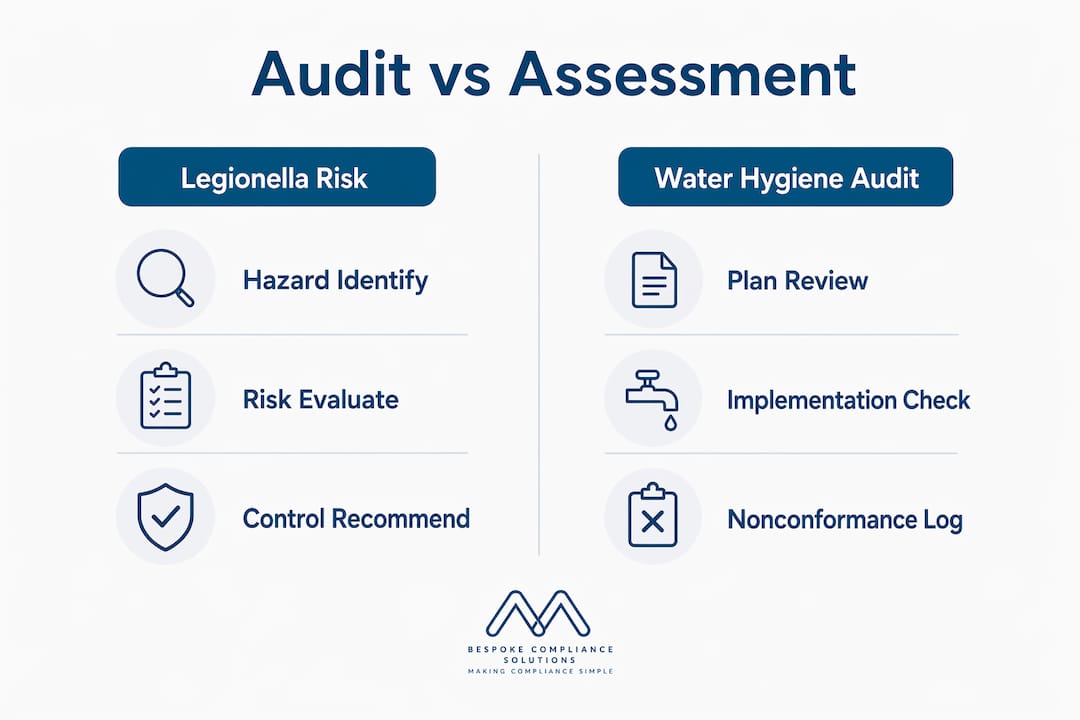
A water hygiene audit is an independent, systematic check of whether your Water Safety Plan is complete, implemented, and actually working. The WHO guidance on WSP auditing describes auditing as a core component of WSP verification — not a one-off exercise, but a formal mechanism for continuous improvement and regulatory compliance.
The confusion between an audit and a Legionella risk assessment is common and genuinely costly. They serve different purposes, happen at different times, and produce different outputs.
Dimension | Legionella risk assessment | Water hygiene audit |
Purpose | Identify hazards and evaluate risk across the water system | Verify that controls identified in the risk assessment are implemented and effective |
Timing | Typically every two years, or after significant system changes | Annually, or following an incident, system change, or enforcement action |
Output | Written risk assessment report, recommended control scheme | Audit report, non-conformance log, WSP amendments, evidence pack |
Sign-off | Competent assessor (e.g. RSPH/CIEH qualified) | Independent auditor, separate from the remedial-works provider |
Regulatory basis | HSE ACoP L8 (mandatory for duty holders) | HSE ACoP L8 and HTM 04-01 (healthcare); WHO WSP framework |
A typical audit delivers: an audit report with findings graded by severity, a non-conformance log with recommended remedials, proposed WSP amendments, and an evidence pack containing photographs, temperature readings, and laboratory reports. That evidence pack is what changes an enforcement conversation.
How water hygiene audits reduce liability: the practical mechanisms
Liability in water hygiene cases is almost always created by a gap between what an organisation claims to do and what it can prove. Audits close that gap through several concrete mechanisms.
Evidence of due diligence: An audit report, signed by a competent independent auditor, is the clearest demonstration that a duty holder took their obligations seriously. Courts and the HSE weigh this heavily.
Catching latent risks before an incident: Audits surface problems — stagnant zones, incorrect schematics, unclean tanks — before they cause a Legionnaires’ disease outbreak. Prevention is cheaper than prosecution.
Proving corrective action was taken: Regulators do not just ask whether monitoring occurred; they ask what happened when a reading was out of tolerance. An audit verifies the response column was completed and acted upon.
Enabling insurer defence: Insurers defending a liability claim need evidence that the organisation followed recognised standards. An independent audit report is precisely that evidence.
Supporting communication with public health and regulators: When an incident does occur, an organisation with a current audit report, a live WSP, and a complete monitoring log is in a fundamentally different position to one that cannot produce records.
Consider a scenario: a building occupant contracts Legionnaires’ disease and the HSE investigates. If the duty holder can produce a recent independent audit report showing the WSP was reviewed, monitoring was in place, and non-conformances were closed within agreed timescales, the evidential burden shifts. The organisation can demonstrate it met the standard of care ACoP L8 sets out. Without that audit trail, the HSE’s starting assumption is that controls were inadequate.
Pro Tip: The chain of evidence regulators and prosecutors look for runs in one direction: risk assessment → written control scheme (WSP) → monitoring records → corrective action → verification that the action worked. An audit that cannot follow that chain from start to finish is not providing the liability protection you think it is.
What does a water hygiene audit typically cover?
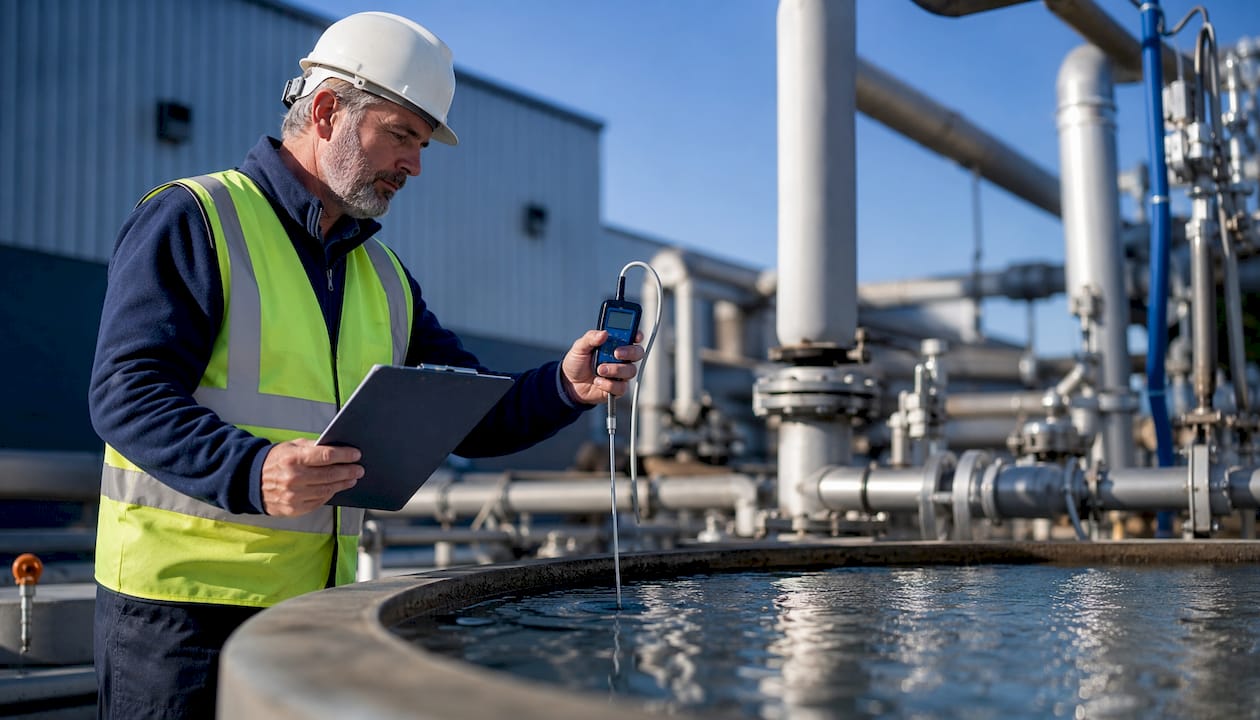
The scope of an audit should map directly to the controls in your WSP. A whole-building water assessment approach ensures nothing is missed. The table below shows the areas a thorough audit covers and the evidence it should produce for each.
Area checked | What the auditor examines | Evidence expected |
System schematics | Accuracy and currency of drawings | Updated, dated schematics signed off by a competent person |
Cold water storage tanks | Condition, covers, insulation, inlet/outlet | Inspection report, photographs, cleaning records |
Calorifiers and hot water cylinders | Temperature, condition, blending valves | Temperature logs, service records |
Thermostatic mixing valves (TMVs) | Calibration, service history, fail-safe function | TMV service log, calibration certificates |
Sentinel and representative outlets | Flushing records, physical condition | Flushing logs with dates and readings |
Distribution pipework | Dead legs, redundant pipework, insulation | Schematic annotation, photographic evidence |
Temperature monitoring | Frequency, method, out-of-tolerance responses | Monitoring log with action column completed |
Water sampling | Rationale, lab accreditation (UKAS), results | UKAS-accredited lab reports, sampling schedule |
Maintenance and contractor records | Contractor competence, scope of works | Contractor certificates, method statements |
Water Safety Plan | Completeness, currency, roles assigned | Signed, dated WSP with review history |
Sampling deserves particular attention. It is expensive and frequently misused as a comfort blanket. An auditor should interrogate the sampling rationale and confirm the laboratory holds UKAS accreditation, rather than simply accepting a set of passing results that may not be representative of the actual system.
Temperature monitoring and asset list verification are non-negotiable. An asset list that does not reflect the physical system means monitoring points are missing, and missing monitoring points are a direct liability exposure.
UK regulatory context: HSE ACoP L8, HTM 04-01, and what auditors document
HSE ACoP L8 is the primary UK standard for Legionella control in water systems. Its status as an Approved Code of Practice means that in a prosecution, a duty holder who did not follow it must demonstrate they met the standard by an equally effective means. In practice, that is very difficult without documented audit evidence. The water risk management role of senior managers is directly implicated when ACoP L8 compliance cannot be evidenced.
For healthcare settings, HTM 04-01 sets a higher bar. It requires a formal Water Safety Group, a written Water Safety Plan reviewed at least annually, and audit of the plan’s implementation. Healthcare estates teams should treat an HTM 04-01 audit as a distinct exercise from a standard commercial audit, with specific attention to immunocompromised patient risk and the healthcare risk assessment framework.
Key regulatory points for compliance managers:
Record retention: ACoP L8 guidance and enforcement practice point to a minimum of five years as the practical expectation for water hygiene records. Prosecutors examine whether action was taken when monitoring was out of tolerance — records that show a breach but no response are more damaging than no records at all.
UKAS-accredited laboratory testing: Results from non-accredited laboratories carry significantly less weight in enforcement proceedings and insurer investigations. Always specify UKAS accreditation when commissioning water sampling.
Evidential burden: Where ACoP L8 applies and a duty holder cannot show compliance, the burden effectively shifts to them to prove an equivalent standard was met. Audit records are the primary mechanism for meeting that burden.
Regulatory inspections: Understanding how regulatory inspections assess water safety is useful preparation — inspectors follow a structured evidence trail that mirrors the audit chain.
Who should carry out the audit, and what does competence actually mean?
Competence in water hygiene auditing is not self-certified. When appointing an auditor, ask for evidence against these markers:
Relevant formal training and qualifications (RSPH Level 2 Award in Legionella Awareness as a minimum; higher-level qualifications for complex sites)
Demonstrable practical experience across similar building types and water system configurations
Sector-specific knowledge (healthcare, housing, commercial) relevant to your estate
Professional membership or certification where applicable (CIEH, BOHS)
Independence from the remedial-works contractor — this is the most frequently overlooked requirement
Using the same contractor for both the risk assessment and the remedial works creates an inherent conflict of interest. An independent auditor provides an objective baseline and significantly strengthens a duty holder’s defence if enforcement action follows. Bespokecompliancesolutions operates as an independent auditor, separate from any remedial contractor relationship.
Checklist to verify your Responsible Person is genuinely empowered:
Written authority statement naming the individual and their scope
Budget allocation for water hygiene works, documented and accessible
Escalation rights: can they halt operations or commission emergency works without approval delay?
Competence evidence: training records, qualifications, CPD
Operational involvement: evidence of site visits, monitoring sign-off, contractor oversight
Pro Tip: If your Responsible Person cannot point to a budget line, an escalation log, and physical evidence of their involvement in monitoring, they are a paperwork appointment — and that is exactly what an HSE investigator will conclude. Document the authority, not just the name.
How to prepare for a water hygiene audit
Preparation reduces audit time, cuts cost, and produces a more useful report. Gather these documents before the auditor arrives:
Current Legionella risk assessment (dated, signed, with assessor credentials)
Water Safety Plan (WSP) with review history
System schematics (as-built, current)
Monitoring records for the preceding 12 months minimum
Remedial works log with completion dates and verification sign-off
Contractor records: method statements, competence certificates, insurance
Laboratory reports with UKAS accreditation confirmation
Training records for the Responsible Person and relevant staff
A typical audit timeline runs from initial engagement to final report in two to four weeks, depending on site complexity. The site visit itself usually takes one to two days for a medium-sized commercial building; larger or multi-site estates take longer. Sampling turnaround from a UKAS-accredited laboratory is typically five to ten working days, which is often the critical path item.
Cost drivers include building size, system complexity, the number of sampling points, and whether remedial works are identified during the audit. Sites with poor documentation or outdated schematics take longer to audit — which is itself a finding. Co-ordinate with your estates team in advance to arrange access to plant rooms, roof tanks, and basement services. Shutdowns for tank inspection should be planned to avoid operational disruption.
A commercial water hygiene audit checklist can help you confirm you have everything in order before the auditor arrives.
Common audit findings and the remedial actions that reduce liability
Most audit findings fall into two categories: safety-critical (requiring immediate action) and lower-priority (planned remedial works). Knowing which is which matters, because the speed of your response is itself evidence of competence.
Safety-critical findings:
Incorrect or outdated schematics: The system cannot be safely managed if the drawings do not reflect reality. Remedial action: commission an as-built survey and update schematics within 30 days. Accurate schematics shorten any future investigation and demonstrate system knowledge.
Missing or incomplete monitoring records: Gaps in the monitoring log suggest controls are not operating. Remedial action: reinstate monitoring immediately, investigate the cause of the gap, and document the investigation. Unexplained gaps are a prosecution risk.
Stagnant zones and dead legs: Unused pipework creates conditions for Legionella growth. Remedial action: remove dead legs or implement a flushing regime with documented evidence. Physical removal is always preferable.
Unclean or uncovered cold water storage tanks: Tank condition directly affects water quality across the system. Remedial action: clean, disinfect, and inspect tanks; repair or replace covers. Retain photographic evidence before and after.
Non-evidenced corrective action: Monitoring shows an out-of-tolerance reading, but there is no record of what was done. This is the single most damaging finding in enforcement terms. Remedial action: complete the response column for every historical out-of-tolerance reading and implement a process to prevent recurrence.
Lower-priority findings (planned remedial works):
Undocumented sample results or results from non-UKAS laboratories
TMVs overdue for service
Incomplete WSP (missing roles, escalation routes, or monitoring point descriptions)
Training records not current for the Responsible Person
Escalation thresholds matter. If an audit finds evidence of active Legionella contamination, or a tank in a condition that poses an immediate risk, the duty holder should commission emergency disinfection before the audit report is even finalised. Planned remedial works for lower-priority findings should be scheduled within a documented timeframe and tracked to completion.
Maintaining a defendable position after the audit
An audit is a point-in-time check. What converts it into continuous legal defensibility is the governance that follows.
Maintenance checklist:
Retain all audit reports, WSPs, monitoring records, and remedial works logs for a minimum of five years
Set monitoring frequencies in the WSP and stick to them; any deviation must be documented and justified
For every non-conformance identified in the audit, record the action taken, the person responsible, and the verification that the action was effective
Oversee contractors: retain their method statements, competence certificates, and completion sign-offs
Keep training records current for the Responsible Person and any staff involved in monitoring
Your Water Safety Plan should contain: named roles with written authority, escalation routes and contact details, a complete list of monitoring points with frequencies and acceptable ranges, corrective action procedures for each parameter, and a review schedule. The audit informs WSP updates — every finding that reveals a gap in the plan should trigger an amendment, dated and signed.
Automated temperature monitoring systems can significantly reduce the burden of manual monitoring and produce a continuous, timestamped record that is far more defensible than a weekly manual log. Legionella awareness training for the Responsible Person and relevant staff should be refreshed at least every two years and documented.
A water hygiene policy review following each audit cycle helps confirm that policy documents reflect current practice rather than aspirational intent.
Why appointing a Responsible Person alone does not remove liability
The paperwork-only failure mode is the most common pattern in enforcement investigations. An organisation names a Responsible Person, files the appointment letter, and considers the matter closed. Auditors — and HSE investigators — test for operational evidence, not just documentation.
Physical signs tell the real story. Auditors look for discrepancies between recorded flushing schedules and the actual condition of outlets: stagnation, debris, corrosion, or scale that suggests flushing has not occurred as logged. A flushing log that shows weekly activity but outlets that show months of stagnation is not a compliance record — it is evidence of falsification, which is a far worse position than simply having no record.
The evidence a Responsible Person appointment must be supported by:
A written authority statement, signed by senior management, specifying scope and limits of authority
A documented budget allocation for water hygiene works, with evidence it has been used
An escalation log showing the Responsible Person has raised issues and received responses
Competence evidence: qualifications, training records, CPD log
Physical evidence of involvement: site visit records, monitoring sign-offs, contractor briefing notes
Template language for an authority statement: “[Name] is appointed as Responsible Person for water hygiene at [site/organisation] with authority to commission monitoring, remedial works, and emergency disinfection up to [£X] without further approval, and to escalate to [named senior manager] for works exceeding that threshold. This appointment is reviewed annually.”
The role of the compliance manager in water hygiene extends to verifying that the Responsible Person appointment is substantive, not nominal. Senior management accountability is explored further in the senior management water compliance guide.
Key takeaways
Independent water hygiene audits reduce liability by creating a documented, verifiable chain of evidence that demonstrates due diligence under HSE ACoP L8 and, where applicable, HTM 04-01.
Point | Details |
Commission an independent audit | Appoint an auditor independent of your remedial-works contractor to produce an objective, defensible report. |
Verify Responsible Person authority | Confirm the named individual holds written authority, a budget allocation, and documented escalation rights. |
Close high-risk findings promptly | Safety-critical non-conformances (stagnant zones, missing monitoring, unclean tanks) require documented remedial action within 30 days. |
Retain records for five years | Keep audit reports, WSPs, monitoring logs, and remedial works records for a minimum of five years to support any enforcement defence. |
Bespokecompliancesolutions | Provides independent water hygiene audits, Legionella risk assessments, UKAS-aligned testing, and ongoing compliance support across UK sites. |
The audit gap most organisations overlook
Most facilities teams understand they need a Legionella risk assessment. Fewer understand that the risk assessment alone is not a defence — it is a starting point. What regulators and insurers actually examine is whether the controls the risk assessment recommended were implemented, monitored, and verified. That is the audit’s job, and it is a job that a risk assessment simply cannot do for itself.
The cases that result in prosecution or significant civil liability almost always share one feature: the organisation had paperwork, but the paperwork did not reflect reality. Schematics that showed a system that no longer existed. Monitoring logs that recorded readings nobody had actually taken. A Responsible Person who could not describe the water system they were supposedly managing. An independent audit, conducted by someone with no commercial interest in the remedial outcome, is the only reliable way to find those gaps before a regulator does.
The organisations that fare best in enforcement investigations are not necessarily those with the most sophisticated systems. They are the ones who can produce a coherent, consistent, evidenced account of what they did, when they did it, and what happened when something went wrong. An annual independent audit, followed by documented remedial action and a live WSP, is the most straightforward way to build that account.
How Bespokecompliancesolutions can help you reduce water hygiene liability
If your last audit is more than twelve months old, or you cannot immediately locate your current WSP, monitoring logs, and Responsible Person authority statement, your liability exposure is higher than it needs to be.
Bespokecompliancesolutions provides independent water hygiene audits, Legionella risk assessments, UKAS-aligned water testing and sampling, remedial works oversight, automated temperature monitoring, and Legionella awareness training for commercial, healthcare, housing, and public sector organisations across the UK. Every engagement is scoped to your site, not a generic template, and every audit report is produced independently of any remedial contractor relationship.
To arrange an audit or risk assessment, contact Bespokecompliancesolutions with your site address, building type, and the date of your last risk assessment. For commercial premises, the Legionella compliance service page sets out the full scope of what an engagement covers. This article is general information; confirm the current requirements for your specific site and sector with a qualified water hygiene professional.
Useful sources and further reading
HSE ACoP L8: The primary UK standard for Legionella control. Sets out duty holder obligations and the evidential expectations that make audit records valuable in prosecution.
HTM 04-01 (NHS England): The healthcare-specific standard for safe water in NHS and healthcare premises. Requires a formal Water Safety Group and annual WSP audit — essential reading for healthcare estates managers.
WHO WSP Auditing Guidance: The international framework for auditing Water Safety Plans. Useful for understanding audit methodology and the role of auditing in continuous improvement.
NHS: Legionnaires’ disease: Plain-language clinical overview of Legionnaires’ disease — useful for communicating risk to senior management and building occupants.
How cleaning audits create a healthier, safer workplace: Cross-discipline context on audit methodology in estate management; useful where water hygiene audits sit alongside broader estate audit programmes.
Recommended
Comments