
What is a water system condition survey?
- 4 days ago
- 10 min read

A water system condition survey is a physical, site-specific inspection of a building’s water infrastructure that documents every asset, records its condition, and identifies the physical factors that could allow Legionella bacteria to grow or spread. It is the foundation document that ACOP L8 requires dutyholders to produce before writing a Scheme of Control, and enforcement officers treat a desktop-only assessment as inadequate.
The survey’s immediate outputs are what matter most to you as a facilities or compliance manager:
A complete asset register covering every water-system component on site
An accurate schematic diagram showing the layout and connections of the whole system
Prioritised remedial actions ranked by urgency
Defined monitoring points and sentinel outlets for ongoing temperature checks
Pro Tip: A desktop review of existing drawings is not a substitute for a physical survey. HSE guidance makes clear that site-specific surveys are required, and assessments based on generic templates without a site walk are unlikely to satisfy enforcement expectations.
Table of Contents
What does a water system condition survey inspect?
The survey covers every component where Legionella risk could originate or escalate. Missing a single asset can leave a gap in the Scheme of Control.
Incoming supply and cold water storage tanks: tank condition, float valves, lids, insulation, and water temperature. Heat gain from adjacent plant is a common and serious finding.
Calorifiers and hot water circulation: flow and return temperatures, thermostat settings, circulation pumps, and any dead-end branches on the circuit.
Thermostatic mixing valves (TMVs): correct setting, condition, and whether they are on a servicing schedule.
Showers and spray outlets: condition of heads, hoses, and frequency of use. Infrequently used showers are a stagnation risk even when the rest of the system is well managed.
Cooling towers and evaporative condensers: drift eliminators, bleed-off controls, biocide dosing records, and aerosol dispersal direction.
Pipework, insulation, and deadlegs: pipe runs that serve redundant outlets or have been capped off create stagnation zones where water sits in the 20–45 °C growth range.
Overflow and drainage interfaces: cross-contamination risks where drainage connects close to potable supply.
Scale, corrosion, and biofilm indicators: visible sediment in tanks or on valve seats signals conditions that support Legionella growth.
Where visual and temperature evidence is sufficient, sampling is not automatically required. Sampling is justified for cooling towers, where doubt exists about control, or where a UKAS-accredited laboratory result is needed to validate a remedial action.
How does a condition survey relate to a Legionella risk assessment?
The two are distinct but inseparable. The condition survey is the physical inspection phase; the Legionella Risk Assessment (LRA) is the risk judgement that follows from it.
Document | What it does |
Condition survey | Records what assets exist, where they are, and what condition they are in |
Legionella Risk Assessment | Judges the risk each finding presents and sets control priorities |
Scheme of Control | Defines the tasks, frequencies, and responsibilities to manage those risks |
BS 8580-1 is the recognised standard for Legionella risk assessment methodology, and it requires the assessment to be site-specific. A survey conducted without a physical site visit cannot produce the asset register or schematic that ACOP L8 requires as the basis for a written Scheme of Control.
HSE guidance stresses the individual nature of each site and requires surveyors to consider all connected systems rather than inspecting components in isolation. An assessment that treats a building as a generic type rather than a specific installation is not suitable and sufficient.
The written Scheme of Control must include schematic plans, operation descriptions, precautions, and monitoring checks with defined frequencies. Without a current, accurate survey, none of those elements can be site-specific.
How is a condition survey carried out?
A competent surveyor follows a structured process. Cutting any step reduces the reliability of the outputs.
Pre-visit desk review: existing drawings, previous risk assessments, PPM records, and any recent remedial works are reviewed before arriving on site.
Site walk and visual inspection: every water-system asset is physically located, identified, and assessed against the desk-review records.
Photographic record: condition findings, asset labels, temperature gauge readings, and access issues are photographed with date and location metadata.
Temperature profiling: sentinel points are checked at cold outlets (target below 20 °C), hot outlets (target above 50 °C at the tap within one minute), and circulation returns. HSG274 Part 2 sets out the measurement and recording requirements in detail.
Deadleg and inaccessible-area identification: redundant pipework and areas behind fixed ceilings or in plant rooms are noted, with access recommendations where needed.
Schematic update or production: the surveyor either corrects existing drawings or produces new ones. Outdated as-built drawings are one of the most common serious findings.
Written report with prioritised actions: findings are graded by urgency and mapped to the Scheme of Control.
On-site records must capture names, dates, exact locations, meter readings, and photographs. For cooling towers or where control is in doubt, microbiological samples should be taken following BS 7592 methods and sent to a UKAS-accredited laboratory. Health and safety arrangements, including working at height, confined-space entry, and any permits-to-work, must be agreed before the visit.
What should the survey report deliver?
The report is not the end point. It is the operational document your team works from.
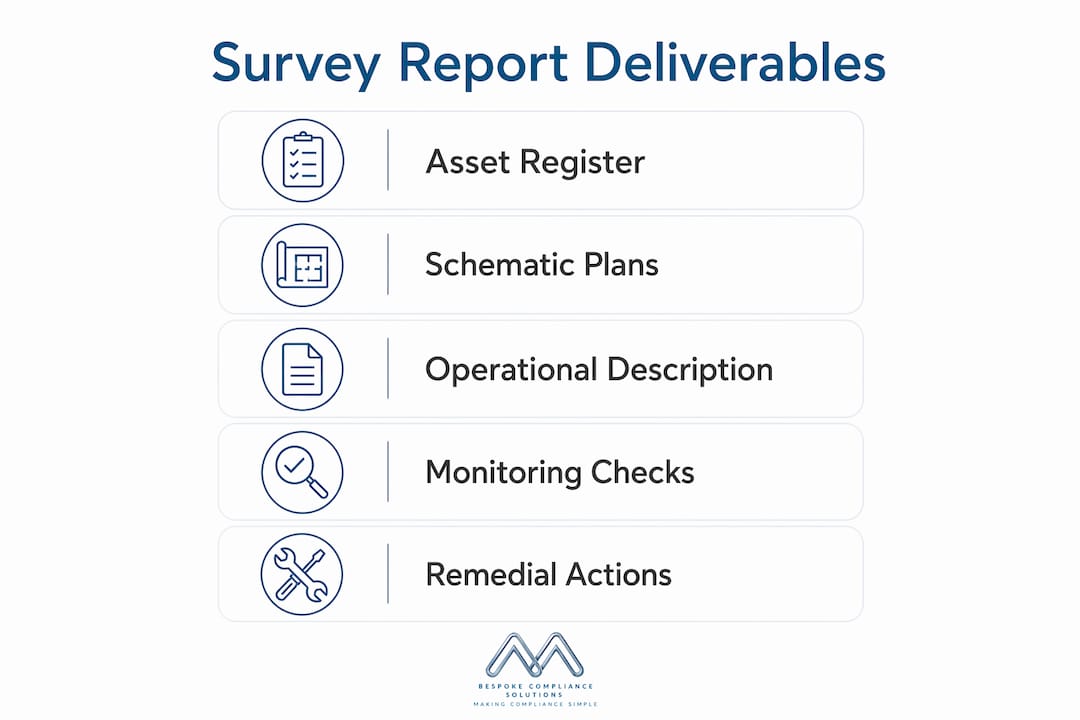
Deliverable | Purpose and immediate use |
Asset register | Complete inventory for PPM scheduling and future surveys |
Schematic diagram | Visual reference for contractors, surveyors, and enforcement officers |
Prioritised action plan | Tells you what to fix now, what to schedule, and what to monitor |
Monitoring schedule | Defines sentinel points, frequencies, and responsible persons |
Written Scheme of Control | Becomes the operational checklist for ongoing compliance |
The asset register and schematic together support every future survey and every PPM task. When a contractor replaces a TMV or cleans a tank, the schematic is updated to reflect it. That version control is what keeps the Scheme of Control current.
Pro Tip: Store survey reports, schematics, and monitoring records in a single, version-controlled logbook, whether physical or digital. Enforcement officers expect to see a clear audit trail showing that findings were acted on and that the Scheme of Control was updated accordingly. Reviewing your risk assessment after each survey cycle is the simplest way to keep records defensible.
What are the common findings and red flags?
Most surveys uncover at least some of the following. Knowing which findings need immediate action and which can be scheduled is the practical skill.
Common findings (schedule for remediation):
Deadlegs and infrequently used outlets with no flushing regime
Inadequate insulation on cold pipework running through warm plant rooms
Scale and sediment in cold water storage tanks
Incorrect or unchecked TMV settings
Poor access to tank lids or inspection hatches
Schematics that no longer match the installed system
Red flags requiring urgent action:
Temperatures in the 20–45 °C range at sentinel cold or hot outlets
Visible biofilm, sludge, or heavy corrosion inside tanks
Malfunctioning circulation pumps leaving hot water circuits stagnant
Aerosol-producing plant (cooling towers, spa pools) operating without documented controls
Evidence of cross-connection between potable and non-potable systems
A red-flag finding at a sentinel point means the Scheme of Control has failed at that point. Remedial work and, where appropriate, disinfection should follow before normal operation resumes.
When should you commission a survey, and how does it fit into PPM?
Certain events make a survey mandatory rather than optional.
New-build or refurbishment handover, before occupation
Change of use or significant change in occupancy patterns
After major pipework alterations or system extensions
Following a prolonged shutdown or seasonal recommissioning
Routine periodic review, typically every two years for standard commercial premises and more frequently for high-risk sites such as healthcare premises
Embedding surveys in a PPM strategy reduces emergency remedial costs and supports asset longevity. Survey outputs map directly to PPM tasks: tank inspections, TMV services, temperature monitoring, and flushing regimes all have frequencies set by the Scheme of Control. For high-risk or complex sites, IoT-based temperature monitoring can provide continuous data between survey cycles, flagging drift before it becomes a compliance failure.
Who is competent to carry out the survey?
Competence is not self-certified. Look for these markers when procuring a surveyor.
Demonstrable experience with ACOP L8 and BS 8580-1, not just awareness of them
Ability to produce site-specific schematics and written Schemes of Control, not generic templates
Clear method of works document describing how the survey will be conducted and recorded
Adequate professional indemnity and public liability insurance
For any microbiological sampling: use of a UKAS-accredited laboratory following BS 7592 methods
References or case studies from comparable building types
Pro Tip: Ask any prospective surveyor for their method of works before instructing them. A competent provider will have a documented process covering pre-visit preparation, on-site recording standards, reporting format, and sampling protocols. If they cannot produce one, that tells you something important.
What affects survey duration and cost?
On-site time varies considerably. A straightforward office building with a simple hot and cold system might take half a day; a large healthcare or hospitality site with cooling towers, multiple plant rooms, and complex circulation loops could take two or more days. Reporting typically follows within five to ten working days, though this varies by provider.
The main cost drivers are:
Number of outlets, assets, and plant rooms to inspect
Presence of cooling towers or other complex systems requiring specialist assessment
Requirement for microbiological sampling and laboratory analysis
Access constraints (working at height, confined spaces, out-of-hours access)
Whether a new schematic needs to be produced from scratch
When requesting quotes, ask each provider to specify exactly what is included: number of outlets surveyed, whether sampling is in scope, reporting format, and what happens if access is restricted on the day. Like-for-like scoping prevents disputes later.
What happens after the survey?
The report is the starting point for a defined workflow.
Prioritise and instruct remedial works: urgent red-flag items first, then scheduled works aligned to the action plan. Contractors should work to the updated schematic.
Disinfection and tank cleaning: required where tanks show contamination, heavy sediment, or where the system has been stagnant. Tank cleaning and disinfection should be followed by validation temperature checks and, where the system warrants it, resampling.
Update the Scheme of Control: every remedial action changes the system. The Scheme must reflect the post-works state, not the pre-survey state.
Implement the monitoring schedule: sentinel-point temperature checks, TMV services, and flushing regimes should start immediately, not after the next survey.
Training: staff responsible for on-site monitoring need to understand what they are looking for and what to do if a reading falls outside the acceptable range.
Relying on testing alone to manage Legionella risk is not compliant. Physical condition management, driven by the survey findings, is the primary control. Testing is diagnostic confirmation, not a substitute for it.
Key takeaways
A water system condition survey is the physical foundation for every element of UK Legionella compliance, and without one, a written Scheme of Control cannot be site-specific or legally sufficient.
Point | Details |
Survey precedes the risk assessment | The physical inspection produces the evidence a Legionella Risk Assessment and written Scheme of Control are built on. |
Red flags need immediate action | Temperatures in the 20–45 °C range, visible biofilm, or failed circulation pumps require remediation before normal operation resumes. |
UKAS labs for sampling | Any microbiological sampling must go to a UKAS-accredited laboratory following BS 7592 methods. |
Integrate findings into PPM | Map every survey output to a scheduled PPM task so findings drive ongoing maintenance, not just a one-off report. |
Bespokecompliancesolutions | Delivers site-specific surveys, written Schemes of Control, and follow-on remedial services for organisations across the UK. |
Why condition surveys matter more than most managers realise
There is a persistent assumption in facilities management that a Legionella risk assessment is something you commission once, file, and revisit when the lease renews. The survey is treated as a box to tick rather than a diagnostic tool. That framing gets organisations into trouble.
The physical condition of a water system changes constantly. Occupancy patterns shift, plant gets modified, insulation degrades, and pipework that was live three years ago becomes a deadleg when a refurbishment reroutes the flow. An assessment that was accurate at the time of the last survey may be describing a system that no longer exists. Enforcement officers know this, and they look for evidence that the Scheme of Control reflects the current installation.
The other underestimated point is the schematic. Outdated as-built drawings are one of the most common serious findings in any survey, and they are also the most consequential. A contractor who cannot see where a deadleg runs, or a surveyor who does not know a cooling tower was added in 2022, cannot assess the risk accurately. The schematic is not a formality. It is the map that makes everything else work.
How Bespokecompliancesolutions can help
Bespokecompliancesolutions works with facilities and compliance managers across commercial, healthcare, housing, hospitality, and retail sites throughout the UK. The service covers the full cycle: site-specific Legionella risk assessments and water system condition surveys, UKAS-accredited water sampling and analysis, tank cleaning and disinfection, TMV servicing, automated temperature monitoring, and Legionella awareness training for your team.
Every engagement begins with a scoping conversation to agree the survey scope, access arrangements, and reporting format. From there, the site visit, photographic record, temperature profiling, and written report follow a documented method of works. The report includes a prioritised action plan and, where required, a written Scheme of Control ready to implement.
To commission a survey or request a scope and quote, contact Bespokecompliancesolutions directly or visit the Legionella risk assessment service page for your area.
Useful sources
The following authoritative references inform UK Legionella compliance duties and are the documents enforcement officers refer to.
ACOP L8 — the Approved Code of Practice setting out dutyholder responsibilities, written scheme requirements, and record-keeping obligations under COSHH and the Health and Safety at Work Act.
HSG274 Part 2 — HSE technical guidance on hot and cold water systems: survey requirements, sentinel point selection, temperature measurement, and record-keeping standards.
HSE testing and monitoring guidance — sets out when sampling is required, UKAS accreditation expectations, and detection limits for culture methods.
BS 8580-1 — the British Standard describing recognised methods for Legionella risk assessment; referenced by HSE as the benchmark for a suitable and sufficient assessment.
UKAS (United Kingdom Accreditation Service) — use the UKAS directory to verify that any laboratory handling your water samples holds current accreditation for Legionella testing.
These documents define what a legally sufficient assessment looks like. Familiarity with them also helps you challenge a survey report that falls short.
This article provides general information on water system condition surveys and UK Legionella compliance. It is not a substitute for professional advice tailored to your specific site and circumstances. Confirm current regulatory requirements with HSE guidance or a qualified water hygiene specialist.
Recommended
Comments