
PPE in water hygiene tasks: what UK dutyholders must specify
- Aug 5
- 10 min read
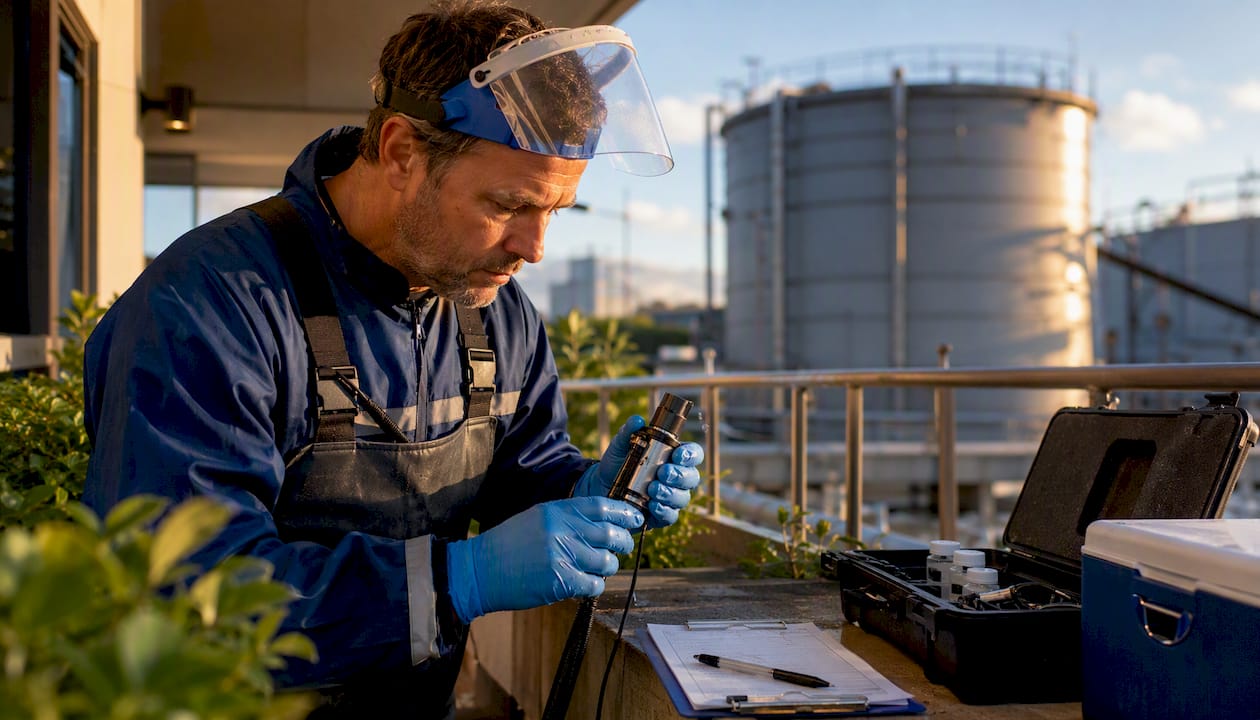
PPE protects operatives during specific water-hygiene tasks but is not a substitute for engineering or administrative controls. Under HSE L8 and HSG274, exposure to Legionella and associated chemical hazards must be avoided so far as is reasonably practicable. PPE sits at the bottom of the hierarchy of controls, deployed only when residual risk remains after every higher-order measure has been applied. Safety Data Sheets (SDS) and manufacturer chemical resistance data determine which PPE is actually appropriate. Bespokecompliancesolutions builds task-aligned PPE requirements into every risk assessment and written scheme it produces.
The most commonly specified items for water-hygiene work are:
Single-use nitrile gloves (chemical compatibility confirmed); gloves chosen per task and chemical SDS; gloves (select according to chemical resistance requirements) (consult SDS for chemical compatibility and suitability)
Chemical splash goggles or safety spectacles (appropriate to splash risk)
Fluid-repellent aprons or coveralls (suitable for the task)
Respiratory protective equipment (RPE) where aerosol generation cannot be fully controlled
Table of Contents
When does water-hygiene work actually require PPE?
Not every water-hygiene task carries the same exposure profile. The decision to specify PPE belongs in the written scheme and task risk assessment, not on a generic site poster.
Tasks that commonly trigger a PPE requirement include:
Chemical dosing and biocide handling
System disinfections using chlorine-based or other oxidising agents
Cold-water tank entry and cleaning
High-aerosol remedial work (e.g. flushing heavily contaminated outlets)
Water sampling at potentially contaminated points
The stepwise decision is straightforward. First, ask whether the exposure can be eliminated entirely through system redesign or scheduling. If not, ask whether engineering controls (closed dosing systems, local exhaust ventilation) can reduce it to an acceptable level. Only where residual risk remains should the written scheme specify PPE. HSE L8 is explicit: the written scheme must include cleaning, disinfection and monitoring procedures, and PPE is part of that scheme, not a replacement for it. HSE legionella regulations set out the full dutyholder framework if you need a quick reference.
Typical PPE by task: a reference matrix
The table below maps common water-hygiene tasks to their likely hazards and recommended protective equipment. Use it as a starting point for method statements; always verify against the SDS for each chemical in use.
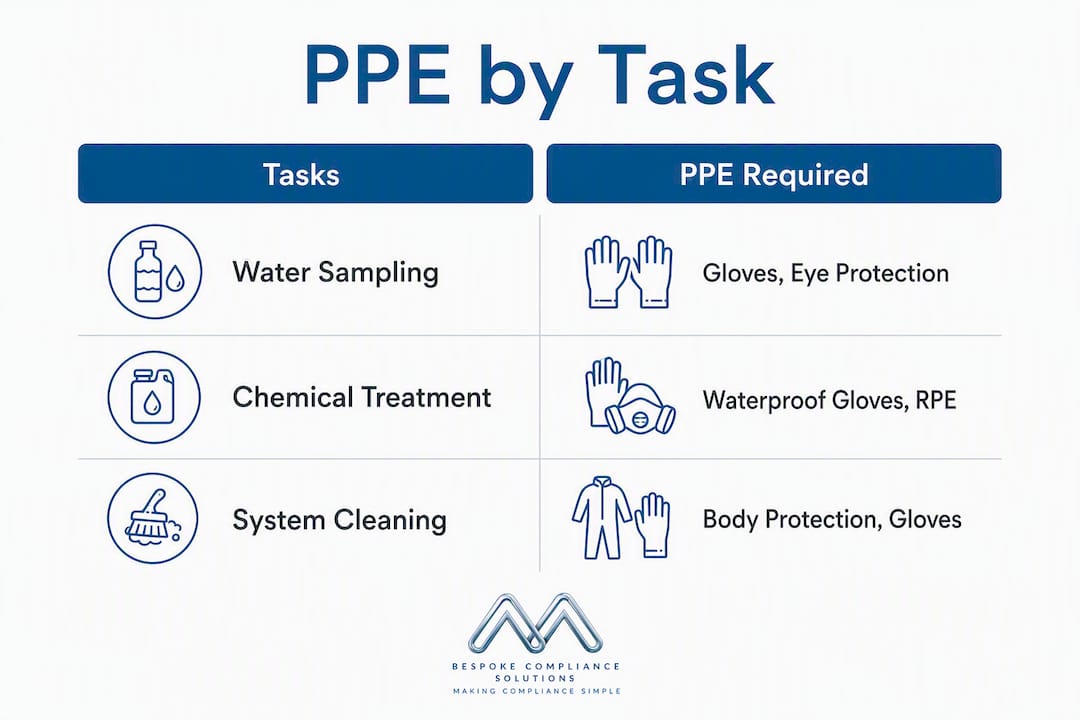
Task | Primary hazards | Gloves | Eye/face | Body | RPE |
Water sampling | Contaminated aerosol, splash | Single-use nitrile gloves (chemical compatibility confirmed); gloves chosen per task and chemical SDS | Safety spectacles or splash goggles as appropriate or chemical splash goggles as appropriate | Disposable aprons for body protection as needed or appropriate body protection | Appropriate respiratory protective equipment where aerosol risk is elevated |
Outlet flushing | Contaminated aerosol | Single-use nitrile gloves (chemical compatibility confirmed); gloves chosen per task and chemical SDS | Safety spectacles or splash goggles as appropriate or chemical splash goggles as appropriate | Disposable aprons for body protection as needed or appropriate body protection | FFP2/FFP3 where aerosol cannot be controlled |
Chemical dosing | Chemical splash, vapour | Nitrile (check SDS breakthrough time) | Chemical splash goggles or eye protection suitable to the hazard | Chemical-resistant aprons or coveralls according to exposure risk | Respiratory protective equipment if vapour or dust exposure likely; fit-testing needed |
System disinfection | Oxidising agents, splash | Gloves selected per SDS recommendations, nitrile or alternative polymers | Chemical splash goggles or eye protection suitable to the hazard | Protective coveralls or suits suitable to contamination risks or aprons suitable to chemical and exposure risk | Respiratory protective equipment specified per SDS; face-fit testing mandatory |
Cold-water tank cleaning | Contaminated water, confined space | Heavy-duty chemical-resistant gloves chosen according to chemical hazard | Full-face protection appropriate to task and chemical exposure | Protective coveralls or suits suitable to contamination risk | Powered air-purifying or supplied-air respirators selected per exposure assessment |
TMV servicing | Splash, contaminated water | Single-use nitrile gloves (chemical compatibility confirmed); gloves chosen per task and chemical SDS | Safety spectacles or splash goggles as appropriate or chemical splash goggles as appropriate | Disposable aprons for body protection as needed or appropriate body protection | Generally not required unless disinfection involved |
HSE SR9 guidance recommends single-use nitrile gloves for most water-treatment chemical tasks, alongside waterproof slip-resistant boots and protective goggles. The critical caveat: No single glove polymer is suitable for all disinfectants; selection must be chemical-specific. Chlorine-based agents, chlorine dioxide and hydrogen peroxide each have different breakthrough profiles. Pull the SDS for the specific product and check the manufacturer’s chemical resistance chart before specifying gloves.

Pro Tip: For sampling tasks, keep a small kit in a sealed bag: two pairs of nitrile gloves, a pair of safety spectacles and a disposable apron. Operatives can grab it at the outlet rather than returning to a van, which removes the temptation to skip PPE on “quick” jobs.
How to choose the right PPE: SDS, standards and RPE fit testing
Getting PPE selection right is a process, not a purchase decision. Follow these steps for each task type:
Obtain the SDS for every chemical in use and identify the hazard classification, required PPE and any specific breakthrough time data.
Match glove polymer and thickness to the active ingredient at the expected concentration and contact time. Choose a glove whose breakthrough time comfortably exceeds the maximum expected exposure duration.
Select eye and face protection appropriate to the splash risk: safety spectacles for low-splash tasks, chemical splash goggles where pressurised systems or concentrated chemicals are involved.
Specify body protection: disposable fluid-repellent aprons for most tasks; chemical-resistant coveralls for tank entry and high-volume disinfections.
Determine whether RPE is needed. If aerosol or vapour cannot be engineered out, specify the correct filter class and face-piece type.
Check CE or UKCA marking on every item. HSE PPE selection guidance requires PPE to carry appropriate marking and be accompanied by instructions on correct use.
Run a compatibility check: wearing safety goggles can break the seal of a tight-fitting respirator, negating the protection factor entirely. Test each new combination on site before high-risk work begins.
Tight-fitting respirators require face-fit testing for every wearer. A mask that does not fit the wearer’s face provides little meaningful protection regardless of its filter rating. Fit tests must be repeated when the mask model changes or when wearer’s facial features change significantly. Record every test result and retain it in the site competency file.
Pro Tip: Build a one-page compatibility checklist into the pre-task brief. Ask operatives to confirm that their goggles do not disrupt their respirator seal before starting. Record the outcome in the site log.
Why PPE alone cannot control Legionella risk
Relying on PPE as the primary control for Legionella is a compliance failure, not just a safety shortcut. The hierarchy of controls places PPE last for a reason: it protects only the operative wearing it, only for the duration of the task, and only if it fits correctly and is used properly.
HSG274 is clear that temperature control, system design to avoid stagnation, and regular monitoring are the primary strategies. L8 reinforces this by requiring plant to be designed with accessible inspection ports and removable components that reduce the need for high-risk manual intervention in the first place.
Where higher-order controls have been properly applied, PPE requirements shrink considerably. The situations where PPE remains genuinely necessary are:
Residual aerosol exposure during remedial flushing that cannot be fully engineered out
Chemical handling where closed dosing is not practicable
Tank entry where confined-space conditions and contamination risk coexist
Any task where the written scheme identifies a residual hazard after all other measures
A persistent aerosol source from a cooling tower, for example, is not a PPE problem. It is a system design, maintenance and biocide programme problem. Specifying an FFP3 mask and calling it controlled is the kind of reasoning that leads to Legionella outbreaks and enforcement action.
Managing PPE for compliance: records, storage and training
PPE programmes fail most often not at the point of purchase but at the point of use. HSE guidance identifies the most common causes: improper storage, lack of maintenance and incompatible combinations that nobody tested before the job started.
Storage and maintenance:
Store PPE per manufacturer instructions, away from UV, heat and chemical contamination
Inspect every item before use; replace immediately if damaged, degraded or contaminated
Disposable PPE should be used only once and disposed of appropriately
Training and competency:
Provide training on proper donning and doffing to prevent self-contamination
Conduct and document fit-testing for RPE wearers, linking records to the control scheme
Set refresher intervals and document them; staff training is a measurable control, not a one-off event
Records to maintain:
Record type | Minimum content | Retention |
RPE fit-test record | Wearer name, mask model, test method, result, date | Duration of employment plus review period |
PPE issue log | Item, quantity, operative, date issued | Per written scheme review cycle |
Inspection checklist | Item condition, pass/fail, action taken | Per inspection cycle |
Training log | Course, date, operative, outcome | Duration of employment |
INDG458 requires dutyholders to retain records of monitoring, checks and the written control scheme. Linking PPE records directly to the written scheme means they are available immediately during an inspection or, more critically, during an outbreak investigation.
Pre-task checklist and SOP snippets for risk assessments
Copy the numbered checklist below into method statements and job packs. Adapt the SOP snippets to the specific task.
Pre-task PPE checklist:
Confirm SDS is available for every chemical on site today.
Verify glove polymer and breakthrough time against the SDS.
Select and inspect eye protection; confirm it does not break RPE seal.
Don RPE; confirm fit check passes before entering the work area.
Confirm body protection is intact and correctly fitted.
Agree decontamination procedure and waste disposal route before starting.
Sign off PPE readiness; record in the site log.
SOP snippet: chemical dosing
Don nitrile gloves (SDS-verified), splash goggles and chemical-resistant apron before opening any chemical container.
Check RPE is fitted and seal-checked if vapour or mist is possible.
After dosing, remove gloves first (inside-out), then apron, then goggles, then RPE. Wash hands immediately.
Bag and label all disposable PPE for disposal per SDS instructions.
SOP snippet: cold-water tank entry
Confirm confined-space entry permit is in place before PPE is donned.
Wear heavy-duty chemical-resistant gloves, full-face protection, coverall and appropriate RPE (powered air-purifying or supplied-air where oxygen depletion is possible).
Designate a standby person outside the tank; they must not enter without their own PPE.
On exit, decontaminate coverall and gloves before removal; bag and seal all disposable items.
SOP snippet: water sampling
Don single-use nitrile gloves and safety spectacles before handling any outlet or sample container.
Where aerosol risk is elevated, add FFP2/FFP3 RPE before opening the outlet.
Remove gloves after capping each sample bottle; do not touch the sample label or paperwork with contaminated gloves.
Responding to exposure, contamination and PPE disposal
When something goes wrong, the response sequence matters as much as the PPE itself.
Immediate actions for exposure:
Stop work immediately and move the affected person away from the source.
Remove contaminated PPE using the correct doffing sequence to avoid spreading contamination.
Flush affected skin or eyes with clean water for at least 15 minutes; seek medical advice.
Record the incident. Where a reportable injury, disease or dangerous occurrence has occurred, assess RIDDOR obligations and report within the required timeframe.
Preserve the contaminated PPE and any chemical containers as evidence for the investigation.
Review the written scheme and control measures before resuming work.
PPE containment and disposal:
Double-bag contaminated disposable PPE and label clearly with the hazard.
Follow SDS disposal instructions for chemically contaminated items; some oxidising agents require specific neutralisation before disposal.
Where chemicals require licensed waste disposal, use an authorised carrier and retain the waste transfer note.
Investigation and follow-up:
Identify whether the failure was PPE selection, training, compatibility or a higher-order control gap.
Update the written scheme, SOP and training records to reflect the learning.
Retrain affected operatives before they return to the same task.
Key takeaways
PPE is a last-line control in water-hygiene and Legionella work: it protects operatives during unavoidable exposures only after engineering and administrative measures have been applied.
Point | Details |
PPE is last in the hierarchy | Specify PPE only after elimination, engineering and administrative controls have been applied and residual risk remains. |
SDS drives glove selection | Match glove polymer and breakthrough time to the specific biocide; one glove type does not protect against all disinfectants. |
RPE requires face-fit testing | Tight-fitting respirators must be fit-tested for every wearer; repeat when mask model or facial features change. |
Records are a legal requirement | Maintain fit-test records, training logs and PPE issue logs linked to the written scheme; INDG458 requires documented monitoring. |
Bespokecompliancesolutions | Builds task-aligned PPE requirements into bespoke risk assessments, written schemes and Legionella awareness training across UK sites. |
PPE decisions belong in the risk assessment, not the van
The part of PPE management that most organisations get wrong is not the purchasing. It is the thinking that happens before the purchase: matching the glove to the biocide, testing the RPE combination before the job, and writing the decontamination sequence into the SOP rather than leaving it to the operative’s judgement on the day.
There is a tendency in facilities management to treat PPE as a compliance checkbox: buy the gloves, put them in the kit bag, done. What HSE L8 and HSG274 actually require is a documented chain of reasoning from hazard identification through control selection to PPE specification, with records that prove the chain held on every occasion. A fit-test record from three years ago for a mask model that has since been discontinued is not evidence of control. It is evidence of a gap.
The other thing worth saying plainly: if your water system is generating enough aerosol to make RPE a routine requirement, the RPE is not the answer. The system design, the maintenance frequency, or the biocide programme needs attention. PPE is there for the residual risk that genuinely cannot be engineered away, not for the risk that nobody got around to addressing properly.
Bespokecompliancesolutions: practical compliance support for your sites
Water-hygiene compliance across a portfolio of sites means different PPE requirements for different tasks, different chemicals, and different risk profiles. Bespokecompliancesolutions works with facilities managers, compliance officers and property managers across the UK to make that manageable.
The core services relevant to PPE and water-hygiene compliance include bespoke Legionella risk assessments that specify task-aligned PPE within the written scheme, water sampling and Legionella testing, tank cleaning and system disinfection, TMV servicing, and Legionella awareness training covering correct PPE use, donning and doffing, and fit-test requirements. Every service is built around your site’s specific hazards, not a generic template. To request a site visit or discuss a bespoke compliance package, contact Bespokecompliancesolutions directly.
Authoritative UK sources and further reading
Legionnaires’ disease: The control of legionella bacteria in water systems (L8): the primary dutyholder document covering written schemes, hierarchy of controls and record requirements.
HSG274 Technical Guidance: operational detail on temperature control, system design and monitoring; the reference for engineering controls that reduce PPE dependence.
INDG458: A guide for dutyholders: concise summary of legal duties, competent person requirements and record retention.
SR9: Using chemicals for water treatment: specific PPE recommendations for water-treatment chemicals, including glove type, eye protection and RPE fit-test requirements.
HSE PPE selection and use guidance: CE/UKCA marking requirements, training obligations and compatibility checks.
Safety Data Sheets and manufacturer chemical resistance charts: the operational documents for every glove and chemical combination; always consult the SDS for the specific product and concentration in use.
Bespokecompliancesolutions services: sector-specific compliance support including risk assessments, training and written scheme implementation across commercial, healthcare, hospitality and residential sites.
This article provides general compliance guidance for UK dutyholders. Confirm current regulatory requirements with HSE primary sources or a qualified water-hygiene professional before implementing control measures.
Recommended
Comments