
4 Steps to Keep UV Effective Against Legionella for UK Facilities
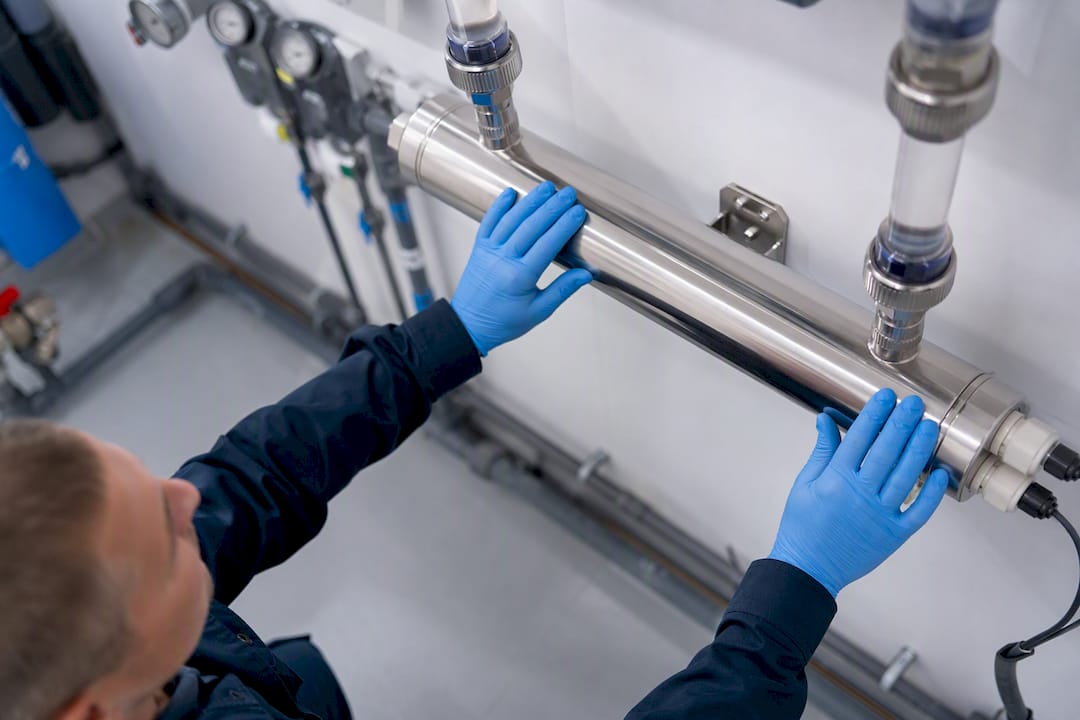
UV disinfection inactivates Legionella at the point in the system where water actually passes through the UV field, but it leaves no residual behind, so it can’t reach bacteria hiding in downstream biofilm. That makes it a genuinely effective point-of-use or point-of-entry barrier, and a useful supplement alongside biocide in cooling systems, but a poor choice as your only line of defence. Skip it if your pipework already harbours established biofilm or scale.
TL;DR:
UV disinfection is effective only at the point of water passage and cannot control bacteria hidden in biofilms or scale within the system.
Validation must account for real water quality, as factors like turbidity, iron, and organics significantly reduce UV transmittance and dose delivery.
Field performance often falls short because existing biofilm, sleeve fouling, or inadequate pre-treatment prevent the UV from achieving required fluence levels over time.
UV is best used as a last line of defense at outlets or entry points, not as a sole solution for system-wide Legionella control.
Proper system maintenance, including sleeve cleaning and continuous monitoring, is critical to sustain UV effectiveness and avoid silent dose shortfalls.
Table of Contents
What is UV disinfection for Legionella and how does it inactivate the bacteria?
What does the evidence actually show about UV against Legionella?
Where UV disinfection fits: point-of-use, point-of-entry and cooling systems
Keeping UV effective: operations and the failure modes that quietly ruin performance
Proving UV performance: validation steps auditors and regulators expect
What is UV disinfection for Legionella and how does it inactivate the bacteria?
UV disinfection works by damaging the genetic material inside a microorganism until it can no longer replicate. Legionella pneumophila absorbs UV energy most strongly around 260 nanometres, in the UV-C band, where DNA absorbance peaks and cross-links form between DNA strands. That’s different from UV wavelengths further from the peak, which cause some protein damage but far less lethal genetic disruption, so wavelength choice genuinely matters when specifying a system.
Two technologies dominate the market. Low-pressure mercury lamps emit almost entirely at 254 nanometres, close to the DNA absorbance peak, and have decades of validation data behind them. UV-LED arrays, typically tuned to somewhere between 255 and 285 nanometres, are mercury-free, switch on instantly with no warm-up lag, and tolerate on/off cycling that would shorten a mercury lamp’s life. The trade-off is that standardised validation protocols for LED reactors are still catching up with the mature mercury-lamp standards, a gap flagged directly in peer-reviewed comparisons of UV-C LED inactivation of Legionella pneumophila serogroups.
Fluence, the UV dose delivered, is measured in millijoules per square centimetre (mJ/cm²). Published bench studies report meaningful log-reductions of L. pneumophila within fluence ranges typically discussed in water-treatment literature, but the exact dose needed varies by serogroup, growth phase, and whether the organism is free-floating or shielded inside a biofilm matrix or an amoeba host. Precise numeric fluence values vary with multiple factors and are not universally established. A dose that performs well against a lab culture in clear water can underperform against a field strain protected by organic matter.
That gap between lab and field is the single biggest reason UV installations disappoint. Fluence figures from clean bench-water trials assume high UV transmittance (UVT), low turbidity, and minimal dissolved organics. Real building water rarely matches that. Iron, manganese, hardness scale, and suspended solids all absorb or scatter UV photons before they reach the target organism, so a reactor validated at 95% UVT in a lab might be delivering a fraction of its rated dose once installed on water sitting at 80% UVT or lower. Any UV specification that doesn’t account for your actual source water chemistry is, frankly, a specification written for someone else’s building.
What does the evidence actually show about UV against Legionella?
Laboratory dose response studies are consistent on one point: UV-C reliably inactivates L. pneumophila when the organism is directly exposed to sufficient fluence in clear water. Bench trials comparing UV-LED arrays against traditional low-pressure lamps have found LEDs tuned near 255 to 265 nanometres achieve strong inactivation rates, sometimes outperforming mercury lamps on a per-photon basis, according to the comparative inactivation study published via PMC. That’s encouraging for reactor design, but it’s a controlled result. It tells you what’s possible under ideal conditions, not what you’ll get on your actual water supply.
Field evidence tells a more complicated story, and it’s the story that matters for anyone specifying a real system. One of the most frequently cited hospital studies followed UV disinfection installed on incoming water mains and found it could prevent Legionella colonisation in a genuinely new, previously uncontaminated distribution system. The same research found that when UV was retrofitted onto an existing system without prior cleaning or chemical remediation, distal outlets recolonised regardless, because the bacteria were already established in scale and biofilm the UV reactor never touched, as detailed in the 1995 study on UV in a hospital water distribution system00048-P). That single finding probably explains more UV disappointments than any other factor in this field.
Three operational issues explain most of the gap between promising lab data and underwhelming field performance:
Biofilm and established colonisation. UV only treats water flowing through the reactor chamber. It does nothing to bacteria sheltering in biofilm on pipe walls, tank surfaces, or dead legs elsewhere in the system, which is precisely why the HSE’s Legionella guidance is explicit that UV creates no residual and cannot be relied on to control a whole distribution system on its own.
Sleeve scaling and fouling. The quartz sleeve protecting the UV lamp accumulates mineral scale and biofilm over time, and that film absorbs UV output before it ever reaches the water. A reactor that was correctly dosed on commissioning day can silently underperform within weeks if the water is hard or iron-rich and sleeve cleaning isn’t scheduled.
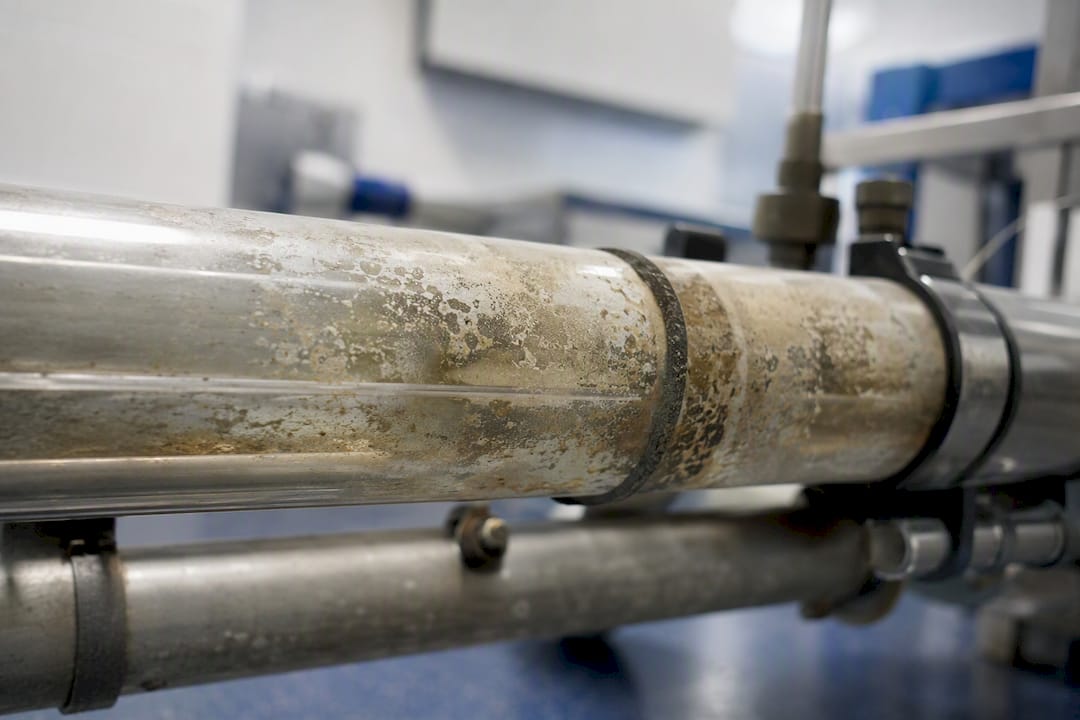
Inadequate pre-treatment. Turbidity spikes, suspended solids, and dissolved organics all reduce UVT, and a reactor sized for one water quality will simply not deliver its rated dose on a dirtier supply.
The practical takeaway for anyone weighing up a UV installation: expect UV to do an excellent job protecting water at the exact point it passes through the reactor, expect it to do nothing for problems that already exist upstream or downstream of that point, and budget for the pre-treatment and maintenance regime that keeps the dose honest over months and years, not just on day one.
Where UV disinfection fits: point-of-use, point-of-entry and cooling systems
Not every application suits UV equally well, and matching the technology to the right role is where most procurement decisions go wrong.
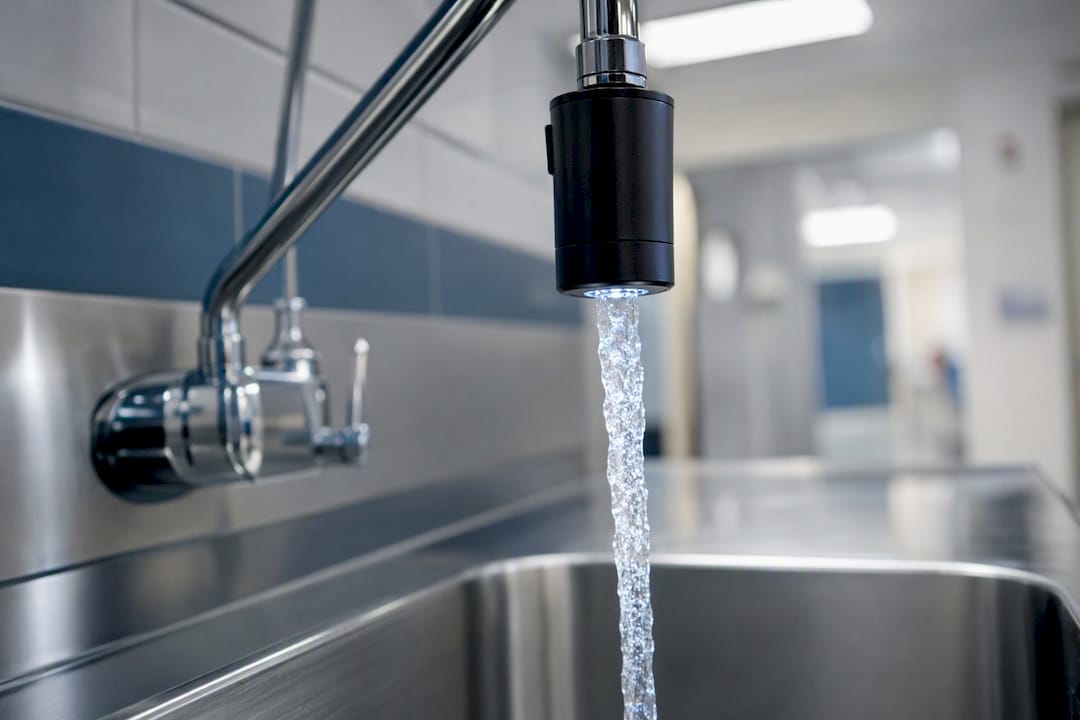
Point-of-use (POU) protection puts a UV unit right at the outlet, typically a shower head or tap, and it earns its keep in exactly the settings where a single contaminated outlet carries the highest consequence: dialysis units, oncology wards, and other areas serving immunocompromised patients. The limitation is structural, not incidental. A POU unit protects only that outlet. It provides zero protection for the metres of pipework feeding it, which is why POU is best understood as a last line of defence layered on top of a wider control programme, not a substitute for one. Facilities managing vulnerable populations should read this alongside dedicated guidance on Legionella risk management for immunocompromised patients.
Point-of-entry (POE) treatment sits where mains water enters the building, and it works best on new-build systems or highly polished incoming water with consistently low turbidity. Treating water before it ever enters your pipework can genuinely prevent colonisation from establishing in the first place, as the hospital case study above demonstrated. POE is far less forgiving of poor pre-treatment, because everything downstream depends on that single treatment point performing correctly, every hour, indefinitely.
Cooling and recirculating systems use UV differently again, almost always alongside a biocide rather than instead of one. HSG274 Part 1 notes that UV performs best in these systems when suspended solids are low and fouling is actively controlled, because cooling towers are inherently dirtier environments than potable water systems. Readers managing HVAC and cooling infrastructure will find more detail in guidance on how to reduce Legionella risk in air conditioning systems.
Before committing to any of these three, check the water quality prerequisites that determine whether UV will actually perform:
UV transmittance (UVT), ideally close to the reactor manufacturer’s rated design point
Turbidity, with DWI guidance pointing to thresholds around 1 NTU for validated public and private supply installations
Iron and manganese content, both of which foul sleeves and absorb UV output
General hardness, which accelerates scale build-up on the quartz sleeve
Existing biofilm or scale presence anywhere in the system the UV won’t reach
Keeping UV effective: operations and the failure modes that quietly ruin performance
A UV reactor that passed commissioning tests can be delivering a fraction of its design dose within months if nobody maintains it, and the failure is usually invisible until a sample comes back positive.
Pre-filtration upstream of the reactor is not optional extra kit, it is the foundation the whole dose calculation rests on. Removing solids and reducing turbidity before water reaches the lamp protects UVT and reduces the scaling load on the sleeve, which is exactly the point HSG274 makes about cooling systems needing clean water to make UV worthwhile at all.
A realistic maintenance schedule needs to cover four things without exception:
Quartz sleeve cleaning on a fixed interval, tightened for hard or iron-bearing water rather than left to a generic manufacturer default
Lamp replacement at the manufacturer’s rated hours, since UV output decays well before a mercury lamp visibly fails
A stocked spares inventory for sleeves, O-rings, and ballasts so a failure doesn’t leave the system unprotected for days
A service contract with a defined response time for sensor faults, flow anomalies, and lamp failures
Monitoring is where a lot of installations quietly fall short. A properly specified system needs continuous UV intensity sensors, flow monitoring, and lamp-status alarms, with data logging that lets you prove dose delivery over time rather than just at commissioning. Fail-safe bypass logic matters too: if UV output drops below the validated setpoint, the system should alarm or divert flow rather than silently continuing to pass under-treated water.
Watch for three failure modes in particular. Scale build-up on the sleeve reduces UV transmission gradually, so intensity sensors are the only reliable early warning. Turbidity spikes, often following mains work or tank disturbance, can drop UVT sharply for hours at a time. Photoreactivation is the subtler risk: some UV-damaged bacteria can partially repair themselves if exposed to visible light afterwards, which is one reason UV dose is typically specified with a safety margin above the minimum lab-derived figure rather than at the bare threshold.
Pro Tip: Log sleeve-cleaning dates against your incoming water hardness readings. If cleaning intervals are stretching out while hardness climbs, that’s the earliest warning sign of a silent dose shortfall, well before a positive sample tells you the same thing the hard way.
Proving UV performance: validation steps auditors and regulators expect
Validation is the difference between a UV system you can defend in an audit and one you’re simply hoping works; using a recognized cleanroom & utility qualification platform ensures best practice for verification and documentation. The concept auditors will ask about is Reduction Equivalent Fluence, sometimes called RED, which uses biodosimetry with a surrogate organism to prove what dose a reactor actually delivers under real flow and water-quality conditions, not just the manufacturer’s laboratory rating. That surrogate-based, full-scale testing approach is what EPA’s technology review points to as the most defensible way to demonstrate treatment credit.
A validation report worth keeping in your compliance file should state the validated fluence achieved, the UVT range across which that fluence was proven, the flow conditions tested, and the calibration record for every sensor relied on to confirm ongoing performance. Without those four elements, a report is essentially a sales document rather than evidence.
Ongoing verification matters just as much as the initial validation, and this is where the DWI’s guidance on UV systems for water supplies is unambiguous: continuous monitoring of flow, lamp status and UV sensor readings has to continue for the life of the installation, with defined alarm setpoints and a scheduled revalidation cycle rather than a one-off commissioning check. It’s also worth flagging a point the same guidance makes about verification organisms: routine indicator bacteria are often more UV-sensitive than the pathogens you’re actually trying to control, so relying on a clean indicator-organism sample as proof of Legionella control can be misleading.
When documenting a UV installation for a compliance file or an HSE inspection, reference DWI’s UV guidance, the EPA’s UVDGM dose-response principles, and HSE’s expectations under the wider Legionella framework together. Auditors respond well to a paper trail that shows validated fluence, a monitoring log, and a revalidation date, in that order.
Should you install UV? A decision checklist for procurement
Start with a site assessment before you get quotes, not after. You need current UVT and turbidity readings, confirmation of whether biofilm or scale is already established anywhere in the system, an understanding of water age at the point you’re treating, and clarity on which uses are critical enough to justify POU protection regardless of cost.
Budget for the whole lifecycle, not just the reactor. Mercury lamps are cheaper upfront but need replacing on a fixed schedule regardless of how the system has performed; UV-LED units cost more initially but switch instantly and tolerate cycling better, a trade-off worth modelling against your actual usage pattern rather than list price alone. Factor in energy draw, consumable sleeves and lamps, and whether you’re buying a service contract or maintaining in-house.
UV should never be the only line item on a Legionella control budget. Plan alongside it:
Pre-filtration sized to your actual water quality, not a generic default
A residual disinfectant strategy for cooling and recirculating systems where UV alone won’t hold
Temperature control, since hot and cold water temperature bands remain a core Legionella control independent of any UV investment
A cleaning and disinfection plan for any system with existing biofilm before UV goes anywhere near it
By facility type: clinical settings with immunocompromised patients justify POU regardless of cost. Hospitality and residential blocks usually get more value from POE on a new build than retrofitting an old system. Cooling towers need UV paired with biocide, never as a replacement for one. New-builds are the single best-value application for UV precisely because there’s no existing biofilm to fail to reach.
Fitting UV into a Water Management Programme
UV disinfection belongs in the risk assessment and control measures section of a Water Management Programme, recorded against specific monitoring locations with defined control limits and a documented corrective action if fluence or flow readings breach setpoint. A well-built site file should hold the sampling plan, sleeve and lamp maintenance logs, the original validation report, and an escalation template for what happens when monitoring flags a fault.
At Bespokecompliancesolutions, we build this documentation as part of implementing bespoke logbook systems and ongoing consultancy across the commercial, healthcare and housing sites we support, so UV sits alongside temperature checks and water sampling rather than as an isolated purchase nobody revisits. When UV appears in a tender document, expect auditors to ask for the validation report, the monitoring log, and evidence of a maintenance schedule, not just a datasheet quoting a lamp’s rated output. Our Legionella Compliance Method of Works sets out how we structure that documentation on client sites.
Guidance and studies worth reading next
For anyone specifying or auditing a UV installation, three sources are worth keeping close at hand:
HSE’s Legionella and Legionnaires’ disease guidance for the operational and legal baseline
DWI’s guidance on UV systems for water supplies for pre-treatment thresholds and validation requirements
EPA’s technology review of Legionella control methods for dose-response data and a fair comparison across disinfection technologies
The PMC study on UV-C LED inactivation of Legionella is the one to read if you’re evaluating LED reactors specifically against traditional mercury-lamp systems.
Why the industry’s UV pitch skips the hard part
The marketing around UV disinfection almost always leads with kill rates and skips straight past the part that actually determines whether an installation succeeds: what’s already living in your pipework before the reactor goes in. That’s backwards. A 99.9% inactivation figure from a bench study tells you nothing about a system with ten years of biofilm behind the shower valves.
The conventional advice treats UV procurement as a technology decision. It isn’t. It’s a water-quality decision first, and only a technology decision second. Two systems could buy the identical reactor, at the identical rated fluence, and get completely different real-world outcomes because one had proper pre-filtration and a sleeve-cleaning schedule and the other didn’t.
If you take one thing from the evidence here, take this: spend your due diligence budget on a water-quality survey and an honest look at existing biofilm before you spend it comparing lamp specifications. Getting the water right before it reaches the UV chamber, and keeping it monitored afterwards, is the 80% that determines whether you’re protected in six months or explaining a positive sample to an auditor.
— Sammi
Sources
FAQ
What is the downside of UV disinfection for water?
UV leaves no residual disinfectant, so it protects only water passing through the reactor at that moment and cannot prevent recolonisation in biofilm, dead legs, or areas downstream of the treatment point.
What disinfectant kills Legionella most effectively?
No single method reliably eradicates Legionella from complex plumbing on its own; EPA’s review recommends combining UV, chlorination or other residual disinfectants, and temperature control within a documented Water Management Programme.
How long does UV light take to inactivate Legionella?
Inactivation happens within seconds as water passes through the reactor, provided the delivered fluence meets the validated dose for that specific water quality and flow rate; performance depends heavily on UVT and turbidity rather than exposure time alone.
Does UV light really disinfect water effectively?
Yes, within the reactor itself UV reliably inactivates Legionella at validated fluence, but its effectiveness depends entirely on pre-treatment, sleeve cleanliness and ongoing monitoring rather than the reactor alone.
Can UV disinfection replace chlorination for Legionella control?
No. UV and chlorination address different risks. UV treats water at a single point with no residual, while chlorination and other biocides maintain protection throughout the distribution system, which is why HSG274 recommends pairing UV with a residual disinfectant in cooling systems rather than using it alone.
Ready to check whether your water system needs UV, filtration, or a full remedial programme? Bespokecompliancesolutions carries out Legionella risk assessments and water sampling and analysis across commercial, healthcare and housing sites, and can advise on where UV genuinely fits your control strategy before you commit budget to a reactor.
Recommended
Comments