
Water compliance management system: a practical guide

If you think a compliance management system for water is just a filing cabinet with a digital skin, you are already exposed to more risk than you realise. A compliance management system water professionals rely on is an active, integrated framework that monitors, records, and demonstrates adherence to water regulatory requirements in real time. Get it wrong and fines start at £25,000 per day. Get it right and you have a system that protects your organisation, your reputation, and the people who depend on safe water in your buildings.
Table of Contents
Key takeaways
Point | Details |
A CMS is more than documentation | It actively monitors, tracks, and records water compliance data as part of daily operations. |
Legal record retention is non-negotiable | Water quality records must be retained for up to 10 years depending on the regulatory framework. |
Digital systems cut audit preparation dramatically | Switching from manual logs to digital CMS can reduce audit prep from weeks to under four hours. |
Implementation requires people, not just software | Managerial capacity and staff training are as critical as the technology you deploy. |
Non-compliance carries serious consequences | Penalties, criminal liability, and loss of funding eligibility are all live risks without a functioning CMS. |
What is a compliance management system for water?
A water compliance management system (CMS) is a structured framework that helps organisations meet their legal obligations under water hygiene and environmental legislation. It brings together documentation, monitoring data, corrective action records, and reporting functions into a single, coherent process. The goal is not to produce paperwork. The goal is to demonstrate, at any given moment, that your water systems are being managed safely and lawfully.
The core components of a well-built CMS include:
Documentation control: Policies, risk assessments, logbooks, and procedural records that are current, version-controlled, and accessible.
Monitoring and sampling: Scheduled water temperature checks, microbiological sampling, and chemical dosing records tied to specific assets.
Reporting and notifications: Automated or manual submission of results to regulators, with evidence trails for each submission.
Corrective actions: Logged responses to any out-of-range result or system failure, with timestamps and responsible persons named.
Digital tools have transformed what a compliance system for water can do. Systems that integrate field, process, and lab data automate sampling schedules, permit tracking, and generate audit-ready reports without manual collation. That means you are not scrambling to pull records together when an inspector arrives. They already exist, organised and timestamped.
Pro Tip: A CMS that only stores documents is not a compliance system. An effective system generates compliance records as a natural byproduct of routine operations, so your audit trail builds itself every day.
Water regulatory requirements you must meet
Understanding what you are legally required to do is the foundation of any effective CMS. In the UK, water compliance sits under a framework that includes the Health and Safety at Work Act 1974, the Control of Substances Hazardous to Health Regulations (COSHH), and the Approved Code of Practice L8 for Legionella. In the US context, the Safe Drinking Water Act (SDWA) and Clean Water Act set the primary federal obligations, with state-level primacy agencies adding their own layers.
Record retention rules are specific and non-negotiable. Water quality records under the SDWA must be retained for at least 10 years, whilst NPDES permit holders must keep monitoring and discharge reports for a minimum of three years. Miss those thresholds and you face enforcement action even if the underlying water quality was fine.
Regulatory requirement | Retention period | Consequence of failure |
SDWA water quality records | 10 years | Enforcement action, fines |
NPDES monitoring reports | 3 years | Permit suspension, penalties |
Legionella risk assessments (UK L8) | Life of assessment plus review period | Prosecution under HSWA 1974 |
Corrective action records | Until next formal review | Loss of audit defence |
The penalty picture is stark. Fines can reach £25,000 per day for significant non-compliance, and wilful violations can result in criminal charges against individuals, not just organisations. That is not a theoretical risk. It is a live exposure for every compliance manager who relies on manual processes and the memory of the person who was on shift last Tuesday.
Compliance documentation must align with overlapping federal and state regulations simultaneously, which is precisely why a CMS configured to your specific permit conditions and site requirements is so much more effective than a generic spreadsheet template.
Manual versus digital compliance systems
Most organisations that have suffered compliance failures were not careless. They were using processes that made consistent compliance genuinely difficult. Manual logs, paper-based temperature records, and spreadsheets managed by a single operator are fragile. They depend entirely on human discipline and institutional memory. When that person leaves, or when records are stored inconsistently across sites, gaps appear.
Many utilities still rely on manual logs and spreadsheets, which results in three to six weeks of preparation before a regulatory audit. A digital CMS reduces that to under four hours. That time difference is not a minor convenience. It represents weeks of staff resource, significant stress, and the persistent risk that something critical gets missed during the scramble.
Feature | Manual approach | Digital CMS |
Audit preparation time | 3 to 6 weeks | Under 4 hours |
Real-time visibility | None | Full, cross-site |
Error risk | High (human transcription) | Low (automated capture) |
Deadline alerts | Operator-dependent | Automated and configurable |
Corrective action tracking | Paper trail, often incomplete | Timestamped and attributed |
Moving to digital water compliance systems reduces administrative workload, cuts human error, and gives you real-time operational visibility across your estate. That visibility matters enormously when you manage multiple sites or have regulatory submissions due at different intervals.

Digital systems also allow you to set automated permit calendars with configurable alerts for critical deadlines, from chemical feed calibration to monthly operating report submissions. That kind of automated deadline tracking prevents lapses that are embarrassing at best and prosecutable at worst.
How to implement a water CMS effectively
Getting a compliance management system up and running is not purely a technology project. It is an organisational change. The organisations that implement CMS successfully treat it as a management programme that happens to be supported by software, not the other way around.
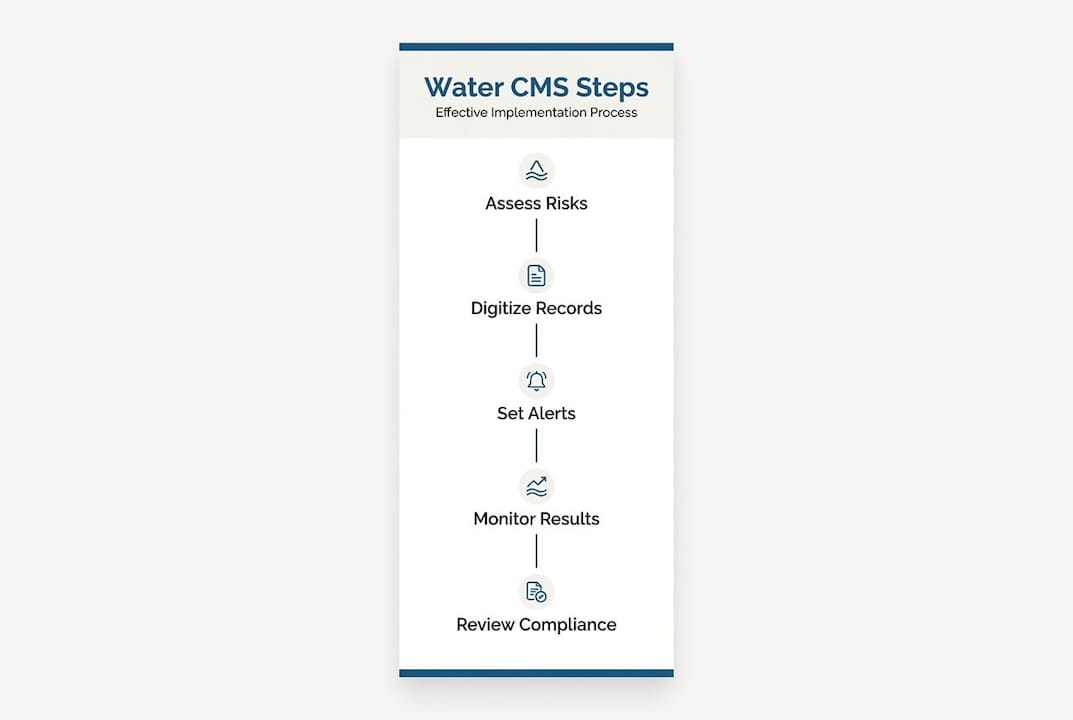
Here is a practical implementation sequence:
Audit your current compliance position. Map every water system on site, identify what records currently exist, and find the gaps. This gives you a baseline and tells you precisely where the risk lies.
Define your regulatory obligations. List every applicable regulation, permit condition, and internal standard that your CMS must address. This shapes what your system needs to track and retain.
Select or configure your CMS. Choose a system that can be configured to your specific site conditions and regulatory requirements, not a generic template. Unifying operational data across facilities reduces the risk of oversight, particularly for multi-site operators.
Assign clear ownership. Every monitoring task, corrective action, and reporting submission needs a named responsible person. Technology cannot create accountability. People do.
Train your team. A CMS is only as good as the people using it. Staff training that reduces compliance risk is not optional; it is the mechanism through which your system functions day-to-day.
Test your audit readiness. Before you face an inspection, run a mock audit. Pull the records you would need to produce and assess whether they are complete, accurate, and retrievable within an acceptable time.
Pro Tip: The most common implementation failure is treating the CMS as an IT deployment. Involve your compliance managers, site operators, and facilities team from day one. They know where the gaps are and they are the ones who will either make the system work or quietly ignore it.
Accurate, digitised water quality data prevents errors, reduces penalties, and supports real-time operational decisions including emergency responses. When a temperature reading falls outside acceptable limits, a well-configured CMS flags it immediately, assigns a corrective action, and timestamps the response. That chain of evidence is exactly what regulators expect to see.
The health and safety manager’s role in water risk extends beyond ticking boxes. Managerial capacity in planning, staffing, and accountability is as critical as any technology tool in making water compliance genuinely effective.
My perspective on water compliance management
I have worked with organisations across healthcare, commercial property, and housing, and the single pattern I keep seeing is this: compliance failures almost never happen because people did not care. They happen because the system they were using made it too easy to miss things.
What I have learned is that a CMS is not a software purchase. It is a management commitment. The organisations that do this well have someone who owns the process, understands the data, and uses the system actively rather than filing records in it reactively. The technology is the infrastructure. The management culture is what makes it live.
I also think the funding angle is underappreciated. Clean compliance records are a prerequisite for infrastructure funding and demonstrate fiscal responsibility to grant and loan assessors. That is a direct business case for getting your compliance house in order, quite apart from avoiding fines.
The organisations I have seen struggle most are those who implemented a CMS because they had to, not because they understood why. The ones who thrive treat compliance data as genuinely useful operational intelligence. When your monitoring tells you a water system is trending towards a problem, that is valuable. When proactive digital stewardship becomes the norm rather than the exception, audit surprises stop happening and public trust follows.
— Sammi
How Bespokecompliancesolutions can support your water CMS
Building and maintaining a water compliance management system takes expertise, consistency, and the right technical support. Bespokecompliancesolutions works with commercial, healthcare, housing, and facilities management organisations across the UK to make water compliance genuinely manageable.
From bespoke legionella risk assessments in Coventry to automated water temperature monitoring, Bespokecompliancesolutions builds solutions around your specific sites and regulatory obligations. The team also delivers bespoke logbook systems, water sampling and analysis, Legionella awareness training, and ongoing consultancy, giving you a complete compliance infrastructure rather than a one-off service. If your current approach to water compliance relies on paper logs or depends on a single person’s knowledge, now is the time to speak to a specialist who can assess where you stand and what you need.
FAQ
What is a water compliance management system?
A water compliance management system is a structured framework that monitors, documents, and reports on water safety and regulatory adherence. It combines record-keeping, scheduled monitoring, corrective action tracking, and reporting to keep organisations audit-ready at all times.
Why is water compliance management important for businesses?
Without a functioning water CMS, organisations face fines starting at £25,000 per day for significant non-compliance, potential criminal liability, and disqualification from infrastructure funding. It also protects occupants from preventable health risks such as Legionella.
How long must water compliance records be retained?
Under the Safe Drinking Water Act, water quality records must be kept for at least 10 years. NPDES permit monitoring reports require a minimum three-year retention period. UK Legionella risk assessments should be retained for the life of the assessment and through subsequent review cycles.
What is the difference between a manual and digital water CMS?
Manual systems rely on paper logs and spreadsheets, often requiring three to six weeks to prepare for an audit. Digital systems automate data capture, deadline alerts, and reporting, reducing audit preparation to under four hours and significantly lowering human error rates.
Can small organisations implement a water compliance management system?
Yes. The scale of the system should match the size and complexity of the water estate, not the size of the organisation. Even a single-site operator benefits from a structured CMS, particularly where Legionella risk assessments, temperature monitoring, and corrective action records are legally required.
Recommended
Comments