
When should you commission water tank chlorination?
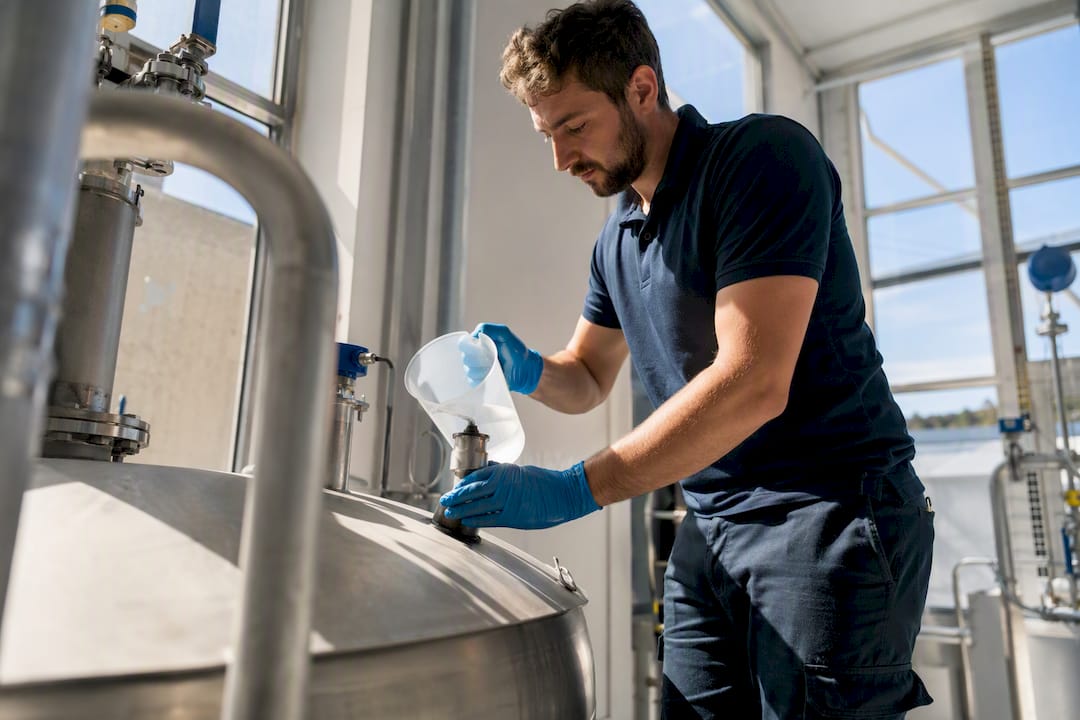
Commission a professional tank clean and chlorination when an inspection, a water sample, or an operational event that shows contamination, or where your written scheme of control already requires it. This is not a job for a caretaker with a hose and a bottle of bleach. It must be delivered, verified, and documented by competent specialists working to recognised standards.
The triggers are specific, not vague:
Annual inspection findings that reveal sediment, biofilm, or corrosion inside the tank
A contamination event, such as debris, vermin ingress, or a burst pipe near the storage vessel
Completion of remedial or maintenance works that opened the system to air or dust
Prolonged disuse without flushing, common after building closures or phased occupation
Unsatisfactory microbiological sampling results, particularly a positive legionella or high total viable count reading
A compliant clean combines four things: physical removal of sediment and biofilm, controlled chemical dosing, a measured contact time, and multi-point verification sampling with a written record. Skip any one of those and you don’t have a defensible compliance file, you have a job someone did once.
TL;DR:
Chlorination must follow a documented process that includes physical cleaning, chemical dosing, contact time, and accredited sampling to ensure compliance.
Triggers for additional chlorination include contamination signs, failed microbiological tests, recent remedial work, flooding, or long disuse, especially in high-risk environments.
Dosing around 50 mg/l chlorine with pH control is recommended, and pH above 7.6 reduces disinfectant efficacy, requiring adjustments during treatment.
Verification requires multiple samples taken from several points and analyzed by UKAS-accredited laboratories, not just at the tank outlet.
Contractors must provide detailed documentation, including method statements referencing standards, chemical logs, photographic records, and lab reports, to prove proper procedures.
Table of Contents
Water tank chlorination guide: legal baseline and when it’s required
The Health and Safety Executive’s guidance on legionella control, known as ACoP L8, alongside its supporting technical document HSG274, sets the floor every dutyholder works from. Cold water storage tanks must be inspected at least annually and cleaned or disinfected whenever that inspection, or the wider risk assessment, indicates it’s needed. That’s a minimum, not a target. Many sites need attention far more often, and the written scheme of control is where your specific triggers should be spelled out rather than left to memory.
Beyond the annual check, several events should push chlorination up the priority list immediately:
Visible contamination during a routine inspection, such as sludge, insect debris, or discolouration
A failed or borderline microbiological sample, especially where legionella colony counts exceed acceptable thresholds
Recent remedial works on the tank, pipework, or roof space that exposed the system to dust or open air
Flooding, or any water ingress event affecting the tank room
Long periods without occupation or flushing, where stagnant water has sat unmoved for weeks
Healthcare settings, care homes, and other high-vulnerability sites carry a lower tolerance for any of the above. A contamination reading that might justify enhanced monitoring in an office block can trigger immediate remedial chlorination in a hospital environment, simply because the population at risk is more susceptible to legionella infection. HSG274 Part 2 reinforces this point: cleaning and disinfection decisions should be proportionate to risk, and risk in clinical or care environments is never treated as routine.
How does the professional chlorination procedure work?
A method statement worth signing off on follows a recognisable sequence. If a contractor can’t walk you through these steps before work starts, that’s a red flag worth acting on.
Pre-clean survey and planning. The technician surveys the tank, identifies sentinel outlets (the nearest and furthest taps from the storage vessel), and prepares a method statement referencing BS8558 and PD855468. COSHH assessments and confined-space entry documentation get finalised at this stage, not on the day.
Isolation and draining. The tank is isolated from the mains and drained down. This step exists so the next one can actually happen properly.
Physical cleaning. Sediment, biofilm, and scale are physically removed from the tank walls, base, and fittings. This matters more than most people assume: chlorine alone doesn’t penetrate biofilm effectively, and dosing a dirty tank wastes chemical and time without addressing the underlying problem.
Refilling and controlled dosing. The tank is refilled and chlorine is dosed to a target concentration, commonly around 50 mg/l according to industry guidance drawing on PD855468, with a defined minimum contact time.
Monitoring during contact time. Technicians check pH and adjust where needed, then test residual chlorine at representative outlets throughout the tank’s distribution runs, not just at the tank itself.
Verification residual check. At the end of contact time, residual chlorine should still sit at a level that confirms the dose reached every part of the system, typically not less than a specified minimum according to industry guidance based on PD855468.
Flushing to potable standards. The system is flushed until chlorine levels drop to normal mains-comparable levels, and disposal of chlorinated waste water is managed to avoid environmental or drainage issues.
Final checks and handover. Outlets are tested one last time, photographic records are taken, and the tank is returned to service with a completion report.
Pro Tip: Ask your contractor to show you the residual chlorine reading at the start and end of contact time, not just the final figure. A drop of more than 40% during contact time can point to heavy fouling that wasn’t fully cleared, and industry practice treats that as a signal the disinfection may need repeating rather than simply logging it and moving on.
Before you sign off any quote, confirm these are explicitly included in the scope:
Isolation and drain-down procedures with disposal arrangements for contaminated water
Physical descaling or biofilm removal, not chemical treatment alone
A stated dosing concentration and contact time, in writing
Sentinel outlet testing at multiple points, not a single reading at the tank
This sequence mirrors the approach described in industry procedure examples for cold water tank cleaning and chlorination, and it’s worth benchmarking any quote you receive against it. A one-line invoice that just says “tank disinfected” tells you nothing about whether the job was done properly.
What verification sampling and records prove compliance?
Verification is what separates a chlorination job from a chlorination job you can actually prove happened. Before-and-after sampling is the minimum standard, and the samples that matter fall into three categories: legionella culture testing, total viable count, and residual chlorine measurement at the point of sampling.
Send samples to a UKAS-accredited laboratory. An in-house or unaccredited test might be cheaper, but it carries no weight if an inspector, insurer, or auditor ever questions your compliance file. BCS’s water sampling and analysis service uses accredited labs specifically because a compliance file built on unverifiable results isn’t really a compliance file at all.
Sampling strategy matters as much as the lab you use. Testing only the nearest and furthest outlets can miss problems on separate risers, different floors, or dead legs elsewhere in the system. Practitioners increasingly emphasise sampling several representative sentinel points across a building’s distribution network, particularly on larger or more complex sites.
Your compliance file should contain, at minimum:
The written method statement referencing BS8558/PD855468
COSHH risk assessments and confined-space entry records where relevant
Chemical logs showing concentration, pH, and contact time at each stage
Photographic evidence of the tank before, during, and after cleaning
A completion certificate signed by the contractor
Laboratory reports for pre- and post-chlorination samples
A bespoke logbook system keeps all of this in one auditable place, which matters far more during an HSE inspection than any individual piece of paper does on its own.
Can chlorination damage tanks, pipework, or valves?
Chlorine efficacy is not a fixed number, it’s a moving target that depends heavily on pH. Above roughly pH 7.6, the proportion of hypochlorous acid (the active disinfecting form of chlorine) drops sharply, meaning the same chlorine dose does less work at higher pH. Competent technicians check pH before and during dosing and extend contact time or adjust the chemical approach when the water chemistry works against them.
The flip side of underdosing is overdosing, and it’s just as much of a risk. PD855468 and practical industry guidance caution against exceeding recommended concentrations, because higher-than-necessary chlorine levels can corrode copper pipework and degrade non-metallic components such as gaskets, seals, and insulation over repeated treatments.
Confirm manufacturer tolerances for tanks, valves, and TMVs before specifying high-level dosing
Ask whether the contractor checks pH as standard, not as an optional extra
Query any dosing figure significantly above the ~50 mg/l guidance without a stated reason
Pro Tip: If your site has TMVs (thermostatic mixing valves) fitted downstream of the storage tank, flag this to your contractor before dosing begins. Some valve seals degrade faster under repeated high-concentration chlorine exposure, and a competent technician will factor this into the method statement rather than treating every outlet identically.
Who is responsible for chlorination, and what should contractors prove?
Legal responsibility never transfers to the contractor. Under ACoP L8, the dutyholder, whether that’s a facilities manager, property owner, or appointed responsible person, must ensure chlorination is included in the written scheme where the risk assessment calls for it, and must be able to demonstrate that competent people carried it out.
Before instructing anyone, check for:
Recognised qualifications and certification in legionella control and water treatment
Confined-space entry training where tank access requires it
Documented COSHH assessments specific to the chemicals being used
A clear chain of custody for samples sent to a UKAS-accredited lab
A method statement that explicitly references BS8558 and PD855468
Public liability insurance and verifiable references from comparable sites
Build your commissioning brief around a fixed order of deliverables: a sentinel sampling plan, the chemical brand and target concentration, a stated approach to pH control, a photographic record, and final UKAS lab reports before the job is signed off as complete.
What does the conventional advice on tank chlorination miss?
Most guidance on this topic treats chlorination as a discrete event: something goes wrong, you dose the tank, the problem is solved. That framing undersells the whole exercise. Chlorination doesn’t fix a dead leg, a pump running below its design flow, or a tank sited somewhere that lets water temperatures creep into the danger zone. Treat it as a reset button and you’ll be booking the same contractor back within a year, wondering why the sample failed again.
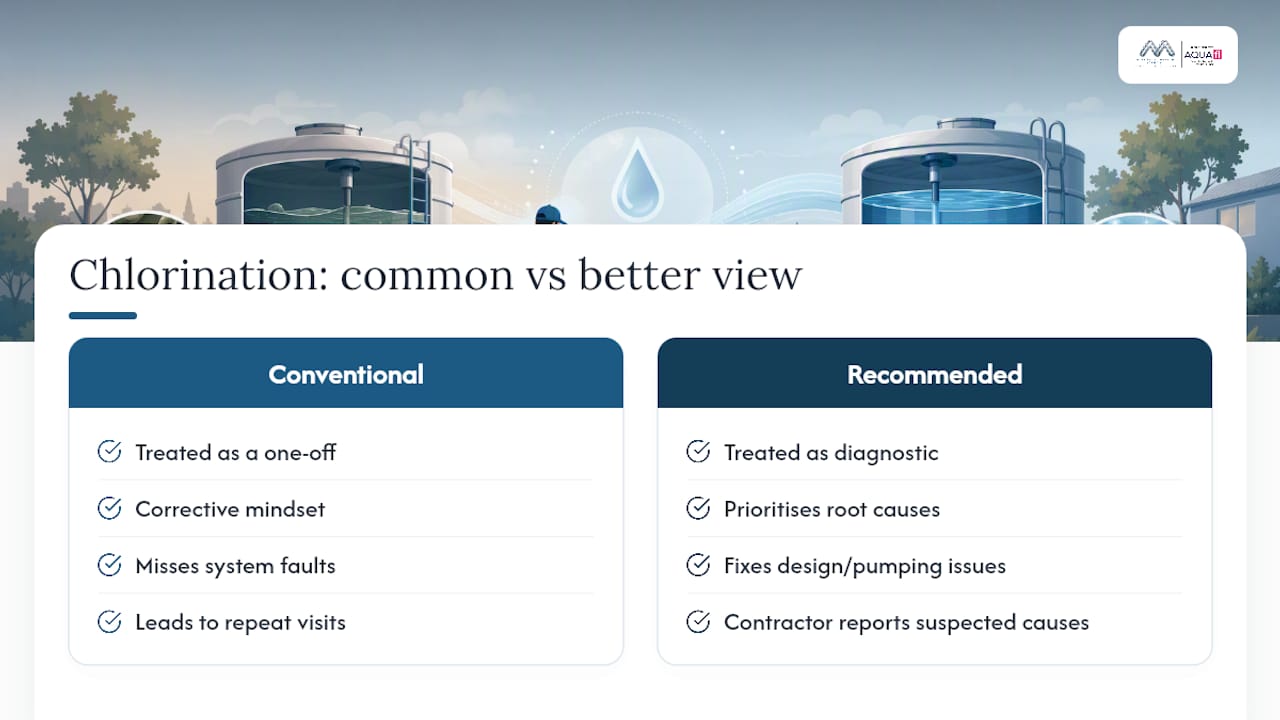
What the evidence actually supports is treating chlorination as diagnostic, not just corrective. A tank that keeps failing samples after competent disinfection is telling you something about the system design, not the disinfection method. Facilities managers who prioritise this line of thinking, and push contractors to report on suspected root causes alongside the clean, get more value from every intervention.
The other gap is documentation discipline. Plenty of sites treat the completion certificate as the finish line, when auditors and inspectors care far more about the chemical logs, the pH readings, and the sentinel sampling spread. A tidy certificate with thin supporting evidence won’t survive scrutiny. Build the paper trail with the same rigour as the clean itself.
— Sammi
How Bespoke Compliance Solutions handles tank chlorination
There are contractors who’ll dose a tank and hand you an invoice, and there’s a more thorough route: a survey-led process that produces a file you could put in front of an HSE inspector without a second thought. Bespoke Compliance Solutions runs exactly that process, and it’s built around what an audit actually requires, not just what gets water flowing again.
[
A typical engagement starts with a site survey, followed by a written method statement and COSHH documentation specific to your tank and building layout. From there, the planned clean and chlorination proceeds against agreed dosing and contact-time targets, with UKAS-accredited sampling and laboratory analysis confirming the result before anything is signed off. Every job produces a final report with photographs, chemical logs, and lab certificates, held in a bespoke logbook system your team can access whenever an inspection lands. If you’re specifying the scope yourself first, BCS’s method of works page is a useful reference point for what a proper brief should include.
If your site is due an inspection, or a recent sample has come back unsatisfactory, get a Legionella risk assessment booked so the chlorination decision is based on evidence rather than guesswork.
Key Takeaways
Compliant tank chlorination combines physical cleaning, controlled dosing, verified contact time, and UKAS-accredited sampling, and it must be documented well enough to survive an audit.
Point | Details |
Know your triggers | Contamination events, failed samples, remedial works, and prolonged disuse all warrant chlorination beyond the annual minimum. |
Clean before you dose | Physical removal of sediment and biofilm must happen before chlorination, since chlorine alone doesn’t penetrate biofilm well. |
Watch pH and residuals | Chlorine efficacy drops above pH 7.6, and a residual drop of more than 40% during contact time signals heavy fouling. |
Verify with accredited labs | Before-and-after sampling through a UKAS-accredited laboratory is the standard that satisfies audits and inspections. |
Commission specialists, not guesswork | Bespoke Compliance Solutions delivers surveyed, method-statement-led chlorination with UKAS verification and full documentation. |
This article is general information, not a substitute for advice from a qualified doctor. Consult a qualified healthcare professional about your own circumstances before acting on anything here.
Sources
FAQ
How often should a water tank be chlorinated?
ACoP L8 and HSG274 require annual inspection as a minimum, with chlorination carried out whenever inspection findings, sampling results, or the written scheme of control indicate it’s necessary, not on a fixed calendar regardless of condition.
What concentration of chlorine is used for tank disinfection?
Industry guidance drawing on PD855468 typically points to dosing around 50 mg/l with a defined contact time, followed by a verification residual of no less than around 30 mg/l at the end of that period.
Can I chlorinate a water tank myself?
Chlorination for Legionella compliance in commercial, healthcare, or institutional settings needs to be carried out by competent specialists with documented COSHH controls, confined-space training where relevant, and access to UKAS-accredited sampling, not an in-house DIY task.
How long does a professional tank chlorination take?
Timing varies with tank size and system complexity, but the process includes a pre-clean survey, physical cleaning, dosing with a monitored contact time, flushing, and verification sampling, so most jobs run across a full working day or longer for larger sites.
What records should I keep after chlorination?
Retain the method statement, COSHH assessments, chemical logs showing concentration and pH readings, photographic evidence, a completion certificate, and laboratory reports, ideally all held together in a system like BCS’s bespoke logbook.
Recommended
Comments