
Water tank cleaning cost: what UK facility managers should budget
- 24 hours ago
- 12 min read
Professional water tank cleaning in the UK typically costs several hundred to a few thousand pounds per tank, though large or complex industrial systems can exceed that range. The range is wide because the price is driven by factors specific to your site rather than a standard tariff. Before you call for quotes, check these four things:
Tank capacity — a 500-litre cold water storage tank (CWST) and a 20,000-litre break tank are entirely different jobs.
Access conditions — roof-mounted tanks, confined-space entry requirements, and the need for scaffolding or a mobile elevated work platform (MEWP) all add cost.
Visible contamination — sediment, biofilm, discoloured water, or vermin evidence will increase the scope of work and the time on site.
Number of tanks — multi-tank sites often attract a mobilisation saving per tank, but each tank still needs its own documented clean.
To get a compliant, site-specific quote from Bespokecompliancesolutions, have your tank size, location, and last inspection date ready before making contact. A contractor who quotes without that information is not pricing your job.
Key takeaways
Professional water tank cleaning in the UK costs between £200 and £2,000+ per tank, with confined-space access, tank size, and the scope of compliance documentation being the primary drivers of where your job sits within that range.
Point | Details |
Headline cost range | Budget £200–£500 for small tanks, £500–£1,500 for medium, and £1,500–£2,000+ for large or confined-space jobs. |
Primary cost drivers | Tank capacity, access conditions, confined-space requirements, contamination level, and sampling/reporting scope. |
Compliance baseline | Every clean must produce a method statement, before/after photos, verification sampling results, and records retained per ACoP L8. |
Inspection cadence | Annual inspection is the minimum; cleaning is triggered by inspection findings, not a fixed calendar. |
Bespokecompliancesolutions | BCS delivers site-specific tank cleaning with confined-space competence, HSG274-aligned disinfection, and full compliance documentation across UK sites. |
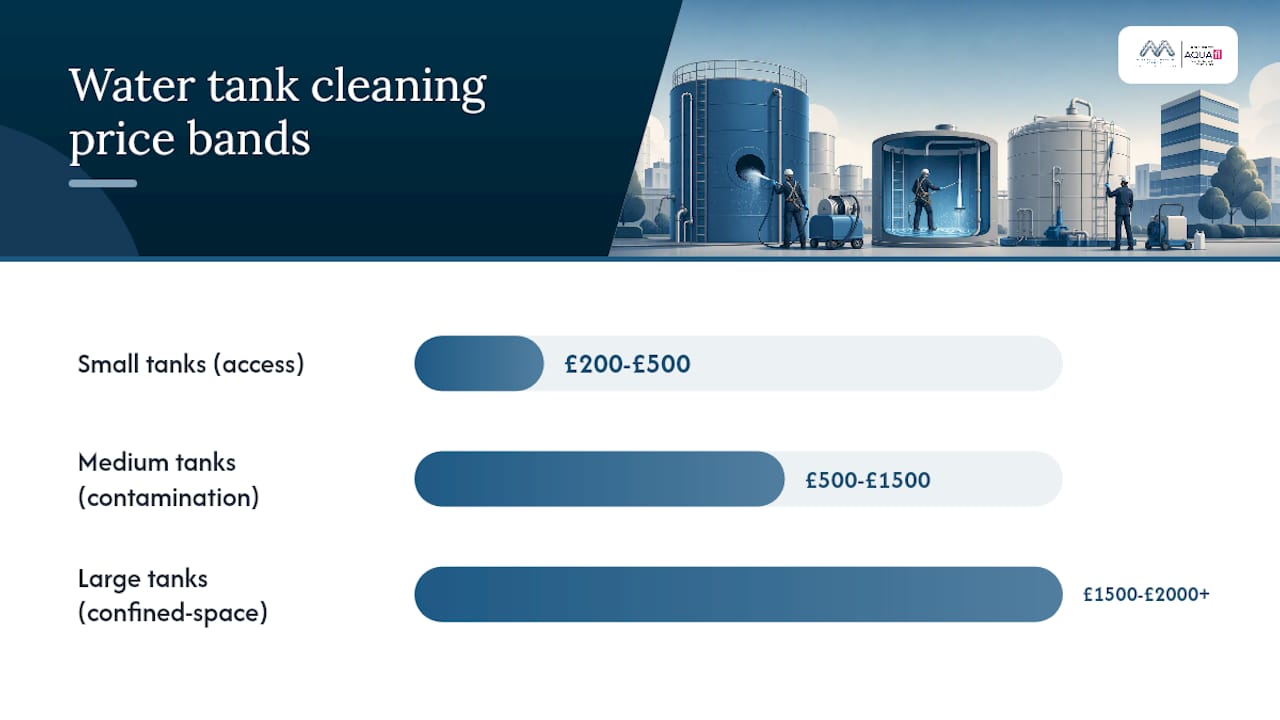
Table of Contents
What does water tank cleaning cost in the UK?
HSE guidance under ACoP L8 makes clear that dutyholders must inspect water systems and act where inspections reveal sediment, stagnation, biofilm, or poor water quality. The cost of that action depends on what the inspection finds and what your tank demands in terms of access and safety.
The three broad price bands below reflect typical UK market rates for a professional clean that includes labour, travel, disinfection, and a compliance report. They are benchmarks, not fixed prices.
Price band | Typical tank capacity | Access type | What is normally included |
£200–£500 | small tanks | Easy roof or plant-room access, no confined-space entry | Drain, physical clean, chlorine disinfection, basic report |
£500–£1,500 | medium tanks | Moderate access, possible confined-space entry | Full clean, disinfection with contact-time monitoring, before/after photos, verification sampling, written report |
£1,500–£2,000+ | large tanks | Confined-space entry, height access, scaffold or MEWP | Full scope plus confined-space safety team, gas monitoring, waste disposal, detailed compliance documentation |
Common extras not always included in a base quote:
Scaffold or MEWP hire (can add several hundred pounds depending on height and duration)
Chemical neutralisation and trade-effluent disposal of contaminated water
Repairs to tank lining, float valves, or inlet screens identified during inspection
Emergency call-out premium (typically 25–50% above standard rates)
Additional water sampling beyond a single post-clean verification
Always ask the contractor to itemise these separately. A quote that bundles everything into one line is difficult to compare against a competitor’s bid.
What does a professional tank clean actually involve?
Understanding the scope of work helps you evaluate method statements across competing quotes. A compliant clean follows a defined sequence; any contractor who cannot walk you through each step in writing should be treated with caution.
Isolation and permit to work — the system is isolated from supply and a permit to work is raised. On confined-space jobs, a confined-space entry permit is issued separately before anyone enters.
Draining — the tank is drained to a safe disposal point. Contaminated water may require trade-effluent consent before discharge to drain.
Inspection — a trained technician inspects the internal surfaces, inlet, outlet, overflow, warning pipe, and lid condition. Photographs are taken at this stage.
Physical cleaning — sediment, scale, and biofilm are removed by scraping, vacuuming, and pressure washing. This is the step most often skipped by underpriced contractors, and it is the step that matters most.
Disinfection — a chlorine-based disinfectant (or chlorine dioxide where specified) is applied at the concentration and contact time set out in HSG274 Part 2. Residuals are monitored at outlets during contact time.
Neutralisation and flush — sodium thiosulphate is used to neutralise residual chlorine before the tank is refilled and flushed. BS EN 806 Part 5 is explicit that incorrect neutralisation or flushing can damage pipework or compromise water quality post-service.
Verification sampling — water samples are taken from the tank and representative outlets and sent to an accredited laboratory. Results confirm the disinfection was effective.
Reporting — a written report is issued covering the method used, chemical concentrations, contact times, before/after photographs, and sampling results. This document is your compliance evidence.
A straightforward small-tank clean typically takes two to four hours on site. A large confined-space job with scaffold access can run across a full day or into a second visit if repairs are needed. Plan for a water supply interruption during the drain and disinfection phases; most contractors can work outside core hours to reduce disruption.
UK regulatory requirements and dutyholder responsibilities
The legal framework is not complicated, but it is firm. ACoP L8 places a duty on the responsible person (the dutyholder) to have a written scheme of control, retain records of all control measures, and use competent contractors with documented methods for cleaning and disinfection. Ignorance of the standard is not a defence.
The key standards your contractor’s method statement should reference:
HSE ACoP L8 — the overarching approved code of practice for Legionella control; sets the dutyholder’s legal obligations.
HSG274 Part 2 — technical guidance on cleaning and disinfection of hot and cold water systems; specifies disinfection methods and monitoring requirements.
BS EN 806-5:2012 — covers installation and testing of protective measures against microbial growth in drinking water installations.
BS 8558:2015 — complementary guidance on maintenance, sampling, and monitoring of water services; links directly to HSE flushing and disinfection recommendations.
Compliance deliverables your contractor must provide: site-specific method statement; risk assessment including confined-space arrangements where applicable; COSHH/MSDS documentation for all disinfectants used; before and after photographs; verification sampling results from an accredited laboratory; a written Method of Works; and records retained in line with ACoP L8 expectations.
Annual inspection is the baseline cadence. Cleaning is required when an inspection identifies fouling, stagnation, biofilm, or poor water quality — not on a fixed calendar regardless of condition. Aligning cleaning with your annual Legionella risk-assessment review keeps the programme coherent and avoids reactive, emergency-rate call-outs.
How often should a water tank be inspected, and what are the warning signs?
Annual inspection is the standard minimum for cold water storage tanks under HSG274 Part 2 and BS 8558:2015. Some higher-risk sites, such as healthcare premises or buildings with vulnerable occupants, warrant more frequent checks. The inspection triggers the cleaning decision; the two should not be confused.
Visible signs that cleaning is needed immediately:
Sediment or sludge visible on the tank floor
Discoloured, cloudy, or malodorous water
Evidence of vermin access (droppings, gnaw marks, damaged screens)
Damaged or missing lid, insulation, or inlet screen
Visible biofilm or slime on internal surfaces
Operational signs that should prompt an inspection:
The system has been shut down or stagnant for more than seven days
Major works have been carried out on the water system or building
A Legionella risk assessment has identified the tank as a risk source
Temperature monitoring shows cold water consistently above 20°C
Pro Tip: Schedule your tank inspection to coincide with your annual Legionella risk-assessment review. A single site visit that covers both avoids a second mobilisation charge and means any cleaning triggered by the inspection can be planned and priced before you leave the site.
When does confined-space entry apply, and how does it affect the price?
A cold water storage tank that a person must enter to clean is, in most cases, a confined space under the Confined Spaces Regulations 1997. That classification triggers a set of legal requirements that directly increase the cost of the job.
A confined-space clean requires:
A written confined-space risk assessment specific to the tank and its location
A permit-to-entry system with a named supervisor
At least one trained rescue operative standing by outside the tank during entry
Gas monitoring equipment (oxygen depletion and toxic gas detection)
Appropriate PPE including breathing apparatus where the atmosphere cannot be confirmed safe
An emergency rescue plan that does not rely on the emergency services as the primary response
Each of these adds time and personnel. A job that costs several hundred pounds for a tank that can be cleaned from outside can cost significantly more when confined-space entry is required, before any access equipment is factored in.
Red flags that suggest a contractor is cutting corners on safety:
No confined-space risk assessment offered or mentioned in the quote
A single operative quoted for a confined-space entry (rescue provision requires at least two people)
No mention of gas monitoring or atmospheric testing
No permit-to-work system referenced in the method statement
A price that is significantly below comparable quotes without explanation
A contractor who cannot produce a confined-space risk assessment before starting work is not compliant with the Confined Spaces Regulations 1997. Do not allow entry.
How to evaluate quotes and choose a compliant contractor
The lowest price is rarely the right price. A quote that omits confined-space safety, skips verification sampling, or provides no written method statement is not cheaper — it transfers the compliance risk to you as the dutyholder.
Request the following with every quote:
A site-specific method statement (not a generic template)
A confined-space risk assessment where entry is required
COSHH/MSDS documentation for all disinfectants to be used
Proof of public liability and professional indemnity insurance
Evidence of technician competence (CSCS card, confined-space training certificates, IPAF where MEWP is used)
Before and after photographs as a contractual deliverable
Verification sampling and a laboratory report as standard
A waste disposal plan for contaminated water
A clear breakdown of costs: labour, travel, chemicals, disposal, sampling, and reporting separately
Comparing quotes like-for-like:
When two quotes differ significantly in price, map each against the list above. A £600 quote that excludes sampling and reporting is not comparable to a £900 quote that includes both. The missing items will either be charged as extras later or simply not done, leaving you without compliance evidence.
Contractor red flags:
Blanket pricing without a site visit or tank survey
No mention of ACoP L8, HSG274, or relevant standards in the method statement
Inability to name the disinfectant, concentration, or contact time they will use
No reference to record retention or compliance documentation
Membership of no recognised trade body or water hygiene scheme
A compliant clean, as ACoP L8 requires, must be documented and retained as evidence of your control measures. A contractor who cannot provide that documentation is not delivering a compliant service, regardless of what they charge.
Worked cost examples for common tank scenarios
These three examples use realistic assumptions to give you a benchmark for your own site. Adjust for your specific access conditions, travel distance, and contamination level.
Assumptions applied across all three examples:
Travel within a reasonable distance of the contractor’s base (longer distances add a mobilisation charge)
No significant repairs required to tank lining, valves, or screens
Contamination is moderate (sediment and light biofilm, not severe fouling)
Scaffold or MEWP hire is included in the large-tank estimate but not the others
Laboratory sampling turnaround of five to seven working days for results
If your tank has not been cleaned in several years, assume the contamination level is higher than moderate and budget accordingly. A heavily fouled tank takes longer to clean physically and may require a second disinfection cycle before verification sampling passes.
How Bespokecompliancesolutions approaches tank cleaning
Bespokecompliancesolutions treats every tank clean as a remedial action within a wider Legionella control programme, not a standalone job. That distinction matters in practice because it changes what gets documented, what gets checked, and what happens after the clean is complete.
The BCS method of works covers:
A site-specific risk assessment before any work begins, covering tank condition, access, confined-space classification, and water system context
Confined-space competence for all technicians entering tanks, with rescue provision as standard
Before and after photographs retained as part of the compliance record
Disinfection carried out in line with HSG274 Part 2, with residuals monitored during contact time
Verification sampling sent to an accredited laboratory, with results issued as part of the written report
Corrective-action planning where the inspection identifies defects beyond the scope of the clean itself
Beyond the clean, BCS offers services that reduce whole-life risk and cost: automated temperature monitoring, emergency disinfection response, water sampling and laboratory analysis, and ongoing Legionella compliance consultancy. For healthcare sites and social housing providers where documentation standards are particularly stringent, that continuity of record-keeping across inspections, cleans, and risk assessments is a practical advantage.
Pro Tip: Ask your contractor whether the post-clean report will be stored in a format compatible with your existing Legionella logbook or compliance management system. BCS implements bespoke logbook systems as part of its service, which means the clean record sits within your wider control programme rather than as a standalone PDF.
Why the cheapest quote is usually the most expensive decision
There is a pattern in water hygiene procurement that repeats itself with uncomfortable regularity: a facilities manager selects the lowest quote, the contractor completes the job without verification sampling or a method statement, and the next Legionella risk assessment reveals the tank was never properly cleaned. The remedial cost, often including emergency disinfection and a full re-clean, exceeds what a compliant first clean would have cost.
The records are the point. ACoP L8 does not simply require that cleaning happens — it requires that it can be demonstrated to have happened, with documented methods, competent staff, and retained evidence. A clean with no paper trail is, for compliance purposes, a clean that did not occur. When an enforcement officer or insurer asks for evidence of your control measures, a verbal assurance from a contractor is not evidence.
Proactive scheduling, aligned with your written Legionella control programme, is also where the real cost saving lies. Emergency call-outs attract premium rates. Reactive cleaning after a positive Legionella sample triggers a far more disruptive and expensive response than a planned annual clean ever would. The price of compliance is predictable; the price of non-compliance is not.
Bespokecompliancesolutions: compliant tank cleaning and Legionella services across the UK
Bespokecompliancesolutions provides water tank cleaning and disinfection as part of a full Legionella compliance service for commercial properties, healthcare premises, schools, housing associations, and hospitality sites across the UK. Every clean is delivered against a site-specific method statement, with confined-space competence, verification sampling, and full compliance documentation as standard.
[
For facilities managers who want a single point of contact for risk assessment, tank cleaning, and ongoing water hygiene monitoring, BCS bundles these into a coherent compliance programme rather than a series of disconnected jobs. That means one set of records, one contractor relationship, and one programme aligned to your ACoP L8 written scheme.
To request a site-specific quote for Legionella compliance at your commercial premises, contact Bespokecompliancesolutions with your tank details, site location, and last inspection date. A site survey can be arranged to confirm access conditions and scope before any price is confirmed.
Sources
The following documents are the primary references for water tank cleaning compliance in the UK. Download or bookmark each one before reviewing contractor method statements.
Method statements and cleaning records are not administrative formalities. They are the evidence that your control programme is working, and they are what protects you if a compliance question is ever raised.
This article is general information, not a substitute for advice from a qualified doctor. Consult a qualified healthcare professional about your own circumstances before acting on anything here.
FAQ
How much does it cost to clean a water tank in the UK?
Professional water tank cleaning typically costs between £200 and £2,000 per tank for most commercial and industrial sites, with the final figure driven by tank capacity, access conditions, confined-space requirements, and whether verification sampling and a compliance report are included.
How often should a water tank be cleaned?
Annual inspection is the standard minimum under HSG274 Part 2 and BS 8558:2015; cleaning is required when that inspection identifies sediment, biofilm, stagnation, or poor water quality, rather than on a fixed schedule regardless of condition.
What are the signs a water tank needs cleaning?
Visible warning signs include sediment or sludge on the tank floor, discoloured or malodorous water, damaged or missing lids and screens, and evidence of vermin access. Operational triggers include system shutdown for more than seven days, recent building works, or cold water temperatures consistently above 20°C.
What should a compliant tank clean include?
A compliant clean must include a site-specific method statement, physical removal of sediment and biofilm, disinfection with documented contact time, neutralisation, verification sampling sent to an accredited laboratory, before and after photographs, and a written report retained as part of your ACoP L8 compliance records.
How much should I expect to pay for a confined-space tank clean?
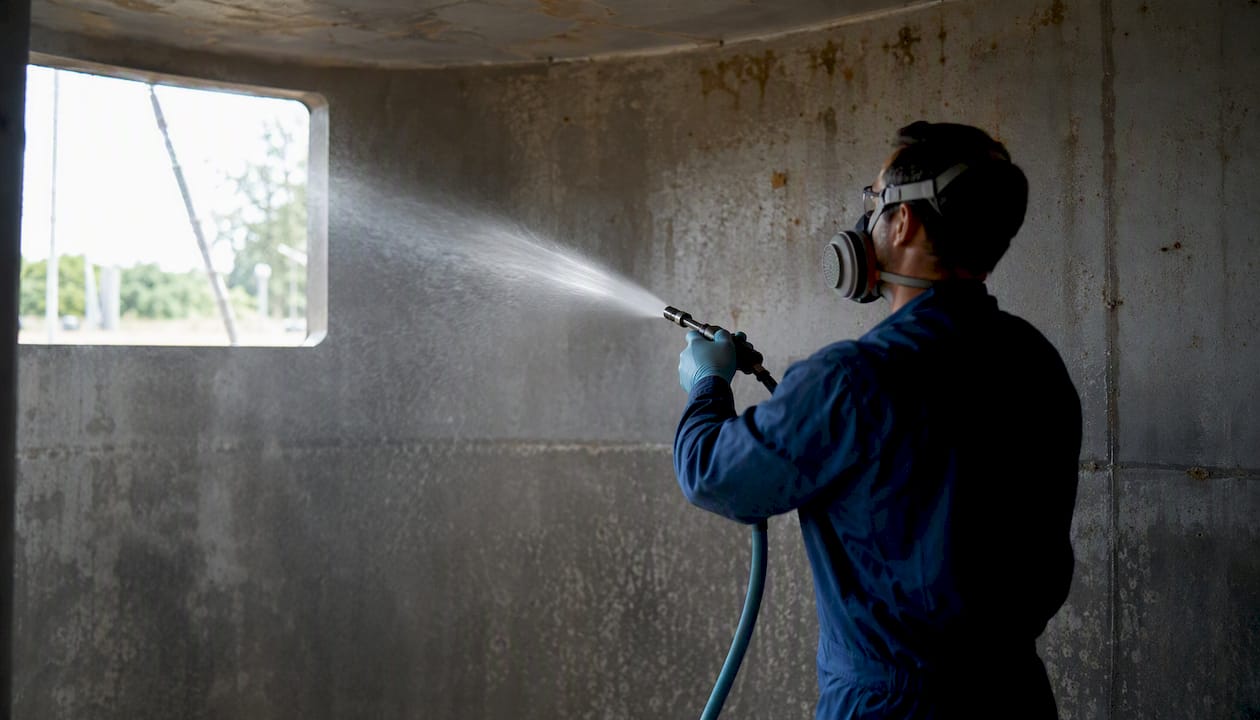
A tank requiring confined-space entry typically costs substantially more than entry-free cleans for a medium-sized system, with the price increasing further for large tanks requiring scaffold or MEWP access, because the job requires additional trained personnel, gas monitoring, a rescue operative on standby, and a confined-space permit to work.
Recommended
Comments