
Dead leg pipe risks in estate management: your compliance guide
- 6 hours ago
- 10 min read
Dead legs are a controllable Legionella risk. The moment water stops moving through a pipe section, temperature drifts into the 20°C–45°C growth range, biofilm forms, and any downstream aerosol-generating outlet becomes a potential exposure point. For UK property and facilities managers, the obligation is clear: identify every dead leg, assess the risk, and apply documented controls.
Immediate actions:
Locate likely dead legs using as-built drawings, temperature mapping, and usage records
Isolate or remove blind ends where it is safe and practicable to do so
Start recorded flushing or temperature controls for any retained branches
Escalate to your Water Safety Group and a competent water hygiene contractor the moment you find microbiological positives or failing temperature controls
Pro Tip: Assign a named owner to each action above before you leave this page. Unowned tasks stay undone.
Key takeaways
Dead leg pipe risks in estate management are a legal compliance issue under ACOP L8 and HSG274, and documented controls are the only evidence that satisfies inspectors.
Point | Details |
No safe length exists | ACOP L8 sets no maximum dead-leg length; risk is assessed by temperature, aerosol potential, and user vulnerability. |
Removal is the permanent fix | Cut back to the live run; capping at the outlet leaves stagnant water in the branch and does not resolve the risk. |
Undocumented controls do not count | Enforcing authorities treat an unrecorded flush as a flush that did not happen; every action needs a logbook entry. |
WSG involvement is mandatory | The Water Safety Group must be involved in assessment, remediation decisions, and commissioning sign-off. |
Bespokecompliancesolutions | Provides risk assessments, remedial works, water sampling, and bespoke logbook systems for estates across the UK. |
Table of Contents
What are dead leg pipes and why do they raise Legionella risk?
A dead leg is any pipe section connected at one end to a live water run but receiving little or no regular flow. Water sits, temperature drifts, and the conditions for Legionella proliferation become ideal. A blind end is a specific variant: a capped stub where flow has stopped entirely.
The mechanism matters. Stagnant water between 20°C and 45°C supports rapid Legionella growth. Add biofilm, which forms on pipe walls within days of stagnation, and you have a reservoir. If a downstream outlet produces aerosols — a shower, a spray tap, a hose reel — the risk of inhalation is real.
Where to look on your estate:
Capped stubs left after appliance removal or refurbishment
Branches serving guest rooms, cleaners’ sinks, or infrequently used washrooms
Pipework above suspended ceilings and in plant rooms
Outside taps and irrigation connections used only seasonally
Sections isolated during phased construction but not yet removed
Dead legs and blind ends create conditions for stagnation, biofilm growth and proliferation of Legionella; the permanent fix is removal back to the live run, and documented flushing is the managed control where removal is not yet practicable.
Pro Tip: Check temperature differentials along suspect runs. A short branch sitting at 30°C is a higher priority than a longer cool stub at 15°C, regardless of its length.
What do ACOP L8 and HSG274 actually require you to do?
The core duty under ACOP L8 is to identify, assess, and control Legionella risks across your water systems. Dead legs are explicitly included. There is no legally permitted maximum dead-leg length. Length alone does not determine risk or compliance.
HSG274 Part 2 and HTM 04-01 go further on the technical side: both recommend removal where practicable and a risk-based flushing frequency for little-used outlets, with regular flushing beginning with weekly intervals as a starting point. These are not suggestions for large estates; they are the benchmark inspectors use.
WRAS design guidance suggests limiting dead legs to a short length based on pipe diameter, but this is a design recommendation, not a statutory safe-length threshold for Legionella control. Relying on a length measurement to justify inaction will not satisfy an HSE inspector. CIPHE confirms this distinction clearly.
Your regulatory checklist:
Risk assessment updated after any system change, refurbishment, or change of use
Written control scheme covering every identified dead leg
Water Safety Group (WSG) constituted, meeting regularly, and involved in decisions
Auditable logbook entries for every flush, temperature check, and remedial action
For managers wanting to confirm their statutory position, the legal obligations and LCA information page sets out what enforcing authorities expect to see.
How do you find dead legs across a large estate?
Start at the desk, not on site. Pull as-built drawings and trace every pipe run from the incoming main to each outlet. Mark any branch that does not terminate at an active, regularly used outlet. That list is your survey scope.
Field inspection steps:
Temperature mapping: probe hot and cold runs at accessible points. Any branch reading between 20°C and 45°C on the hot side, or above 20°C on the cold, warrants immediate attention.
Visual inspection: look for capped stubs, blanked-off tee pieces, and pipework that disappears into voids without a clear destination.
Flow checks: open suspect outlets and observe flow rate and temperature response. A slow temperature rise on a hot branch suggests a long stagnant section.
Usage records and asset registers: cross-reference outlet lists against booking systems, cleaning schedules, and occupancy data to flag outlets used infrequently.
Log every finding: record location, drawing reference, measured temperature, outlet type, aerosol potential, and recommended action before leaving the area.
Temperature mapping is the quickest field test for stagnation; combine it with plan checks and usage logs to build a complete picture. Prioritise using a matrix that combines user vulnerability, aerosol potential, and temperature profile, not pipe length.
Pro Tip: During vacancy or between project handover and occupation, an entire floor or wing can behave as one large dead leg. Treat it accordingly: documented flushing and microbiological sampling until full occupancy resumes.
What are your control and remediation options?
The primary fix is always removal. Cut the redundant pipework back to the tee on the live run. Capping at the outlet does not remove the dead leg; the stagnant section between the cap and the live run remains, and a capped stub still holds stagnant water that presents ongoing risk.
Where removal is not immediately practicable, managed controls apply:
Documented flushing regimes: regular flushing as a minimum for little-used outlets; more frequent where user vulnerability is high. Every flush must be recorded.
Automatic purge devices: timer-controlled valves that flush a branch on a set schedule; useful for remote or inaccessible outlets, but they do not replace the need for verification checks.
Temperature control: maintain hot water above 50°C at the calorifier and cold below 20°C at the outlet; monitor and record regularly.
Periodic disinfection: chlorination or other chemical treatment carried out by a competent contractor with full COSHH documentation and written verification of residual levels.
Decision criteria for each dead leg:
How often is the outlet used? Fewer than three times per week triggers managed controls as a minimum.
Does the outlet generate aerosols? Showers and spray taps raise the stakes considerably.
Who uses the area? Immunocompromised or elderly occupants require a more conservative approach; see guidance on Legionella risk for immunocompromised patients.
Can temperature be reliably maintained? If not, removal or disinfection becomes the only defensible option.
Pro Tip: Temporary managed controls must have a conversion date. Write it into the control scheme and the WSG minutes. “Temporary” measures that run for years are a common audit finding.
What records do inspectors expect to see?
The principle is simple: an undocumented flush is treated as a flush that did not happen by enforcing authorities. Every control action needs a logbook entry.
Minimum fields for each logbook entry:
Date and time
Location and outlet reference (matching the drawing)
Action type (flush, temperature check, disinfection, inspection)
Duration or volume where relevant
Operator name and signature
Verification reading (outlet temperature, residual chlorine, or similar)
Follow-up actions required
Digital logs must include time stamps, operator ID, and exportable reports for audit. Paper logs must be legible, stored securely, and available to the WSG and any auditor on request.
Pro Tip: Store commissioning records, as-fitted drawings, and disinfection certificates alongside the water safety logbook. Auditors routinely ask for all three together, and a gap in any one of them raises questions about the others.
What can water sampling tell you, and what can it not?
Microbiological sampling gives you a snapshot: presence or absence of Legionella at a specific point, at a specific time. It cannot prove that a system is safe, and a negative result does not mean risk is absent.
Where to sample for dead-leg risk:
Downstream of suspect branches, at aerosol-generating outlets
Representative hot and cold runs across the estate
Plantroom outlets and calorifier returns
Any outlet that has returned a positive result previously
Limitations to keep in mind:
Sampling variability is significant; a single negative result carries limited weight without supporting temperature and flushing data
Laboratory turnaround typically runs several days, so results inform retrospective decisions, not immediate ones
Chain of custody must be maintained from sample collection to the laboratory
Use UK-accredited laboratory testing and confirm that your contractor provides clear reporting formats with colony counts, detection limits, and recommended actions. UKAS accreditation is the standard to look for in supplier documentation.
When should you bring in a water hygiene specialist?
Some situations are beyond in-house management. Commission a specialist when:
Any Legionella positive result is returned from sampling
You cannot remove blind ends due to access, asbestos, or structural constraints
The system serves vulnerable users and temperature controls are failing
A refurbishment or change of use has created new dead legs not yet assessed
Your WSG lacks the technical competence to interpret risk assessment findings
When procuring support, ask for:
Evidence of Legionella risk assessment experience in premises similar to yours
Relevant accreditations and method statements
Public liability and professional indemnity insurance documentation
Clear deliverables: written risk assessment, as-fitted drawings, disinfection certificates, and commissioning data
Timescales for each phase of work
Project governance is most effective when the Water Safety Group is involved at the earliest design stage, preventing dead legs from being created during modifications rather than remediated afterwards.
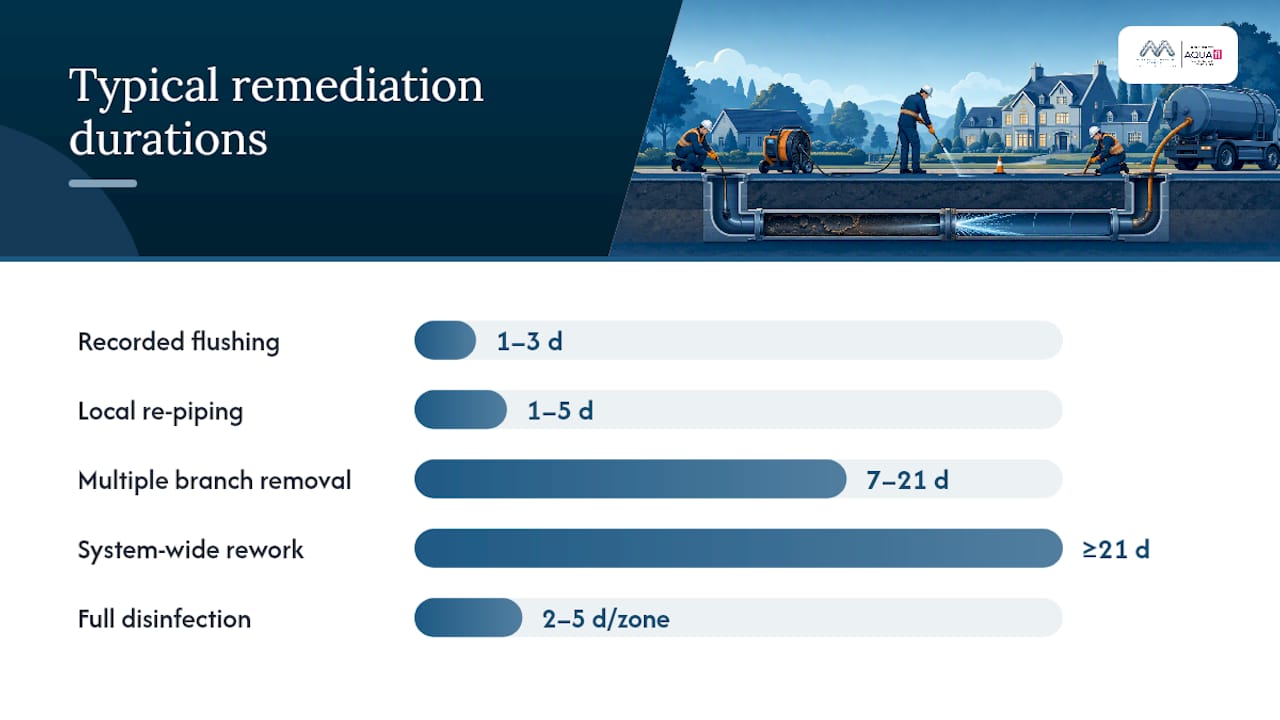
Typical timescales and cost bands for remediation
Remediation type | Typical timescale | Relative cost |
Recorded flushing regime (setup) | 1–3 days | Low |
Local re-piping (single branch) | 1–5 days | Low to medium |
Multiple branch removal (one floor) | 1–3 weeks | Medium |
System-wide rework or major remediation | 3+ weeks | Higher |
Full disinfection and recommissioning | 2–5 days per zone | Medium |
Budget for contingency covering access works, asbestos surveys where required, and the cost of producing updated as-fitted drawings and commissioning records. Package remedial contracts with clear acceptance criteria: no handover without verified disinfection certificates, temperature commissioning data, and updated drawings.
BCS case study: commercial premises Legionella remediation
A multi-tenanted commercial building underwent partial refurbishment. Several branches serving decommissioned kitchenettes were capped at the outlet rather than removed, and the as-built drawings were not updated. A subsequent Legionella risk assessment identified five blind ends, two of which were reading above 28°C on the cold supply.
The remediation approach: remove all five branches back to the live run, carry out a full system disinfection, and commission temperature profiles at every outlet before handover. Updated as-fitted drawings and disinfection certificates were provided to the client’s WSG within five working days of completion.
Key lessons from this project:
Capping at the outlet is not a remediation; it is a deferral
As-built drawings must be updated at every stage of refurbishment, not retrospectively
WSG sign-off of commissioning records before handover protects the client and the contractor
Operational 30/90/365 checklist for facilities managers
Action | Owner | Timeframe |
Survey and document all suspected dead legs | Facilities manager | 30 days |
Start recorded weekly flushes for little-used outlets | On-site team | 30 days |
Isolate or remove highest-risk blind ends | Competent contractor | 30 days |
Complete removal works where practicable | Contractor/FM | 90 days |
Commission disinfection where indicated | Accredited contractor | 90 days |
Update risk assessment and as-fitted drawings | Competent assessor | 90 days |
Annual WSG review of control scheme | WSG chair | 365 days |
Refresher training for on-site team | Training provider | 365 days |
Review automated monitoring performance | FM/specialist | 365 days |
Immediate 30-day priorities:
Run a high-priority survey of all plant rooms, vacant wings, and recently refurbished areas
Document every blind end found, with location, temperature, and outlet type
Start recorded flushing for every little-used outlet before the survey is complete
Bespokecompliancesolutions: specialist support for dead-leg compliance
Dead-leg remediation done properly means more than cutting out a pipe. It means a documented risk assessment, verified disinfection, updated drawings, and a logbook system that stands up to inspection. Bespokecompliancesolutions delivers all of it, across commercial, healthcare, housing, and education estates throughout the UK.
Services directly relevant to dead-leg management include Legionella risk assessments, water sampling and analysis, remedial re-piping and disinfection, bespoke logbook systems, TMV servicing, and Legionella awareness training for in-house teams and Water Safety Groups. Every service is scoped to your site, not a generic template.
To book a site survey or request a risk assessment, contact Bespokecompliancesolutions directly. The assessment covers every dead leg on your estate, produces a prioritised remediation plan, and gives your WSG the documented evidence it needs.
Why dead legs are a design problem, not just a maintenance one
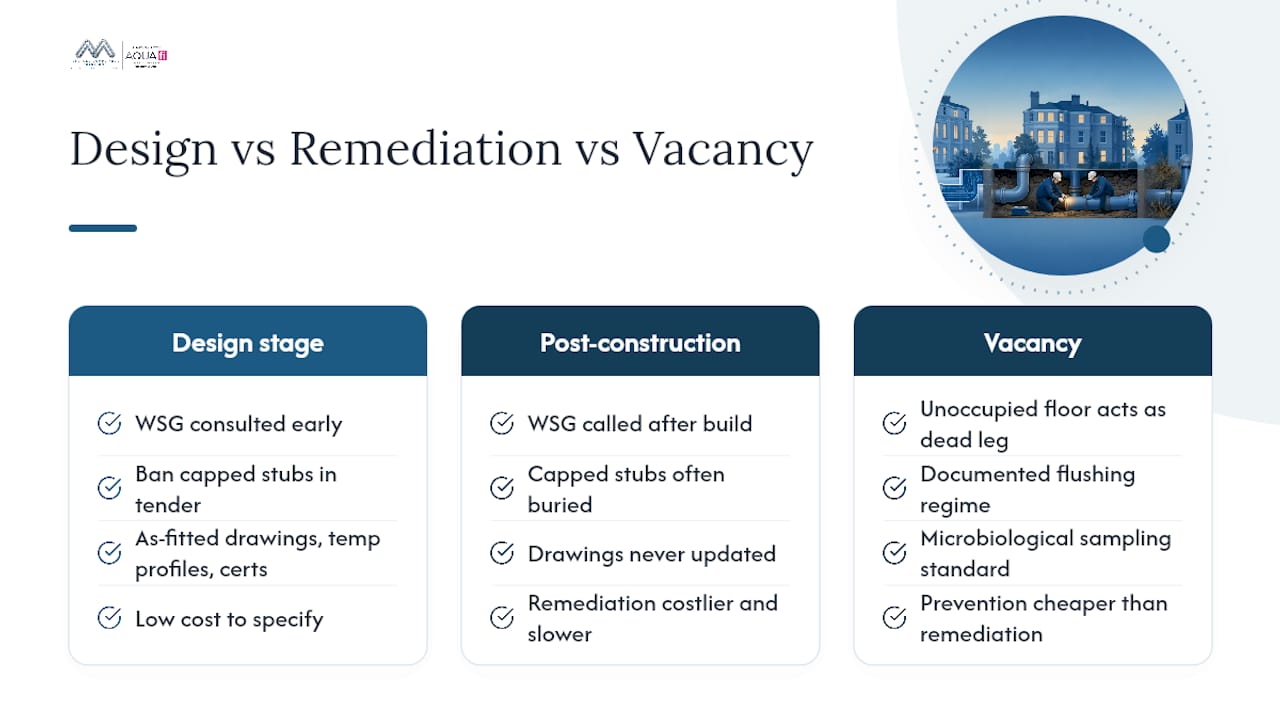
Most dead legs on existing estates were not created by negligence. They were created by refurbishment projects that removed an appliance, capped the supply, and moved on. The pipe stayed. The risk stayed. The drawings were never updated.
The pattern repeats because Water Safety Groups are brought in after the fact, when the contractor has left and the capped stub is already buried above a ceiling tile. By that point, remediation costs more, takes longer, and produces a gap in the commissioning record that auditors notice.
Involving the WSG at the design stage, before a single pipe is cut, changes the outcome. Tender documents can specify no capped stubs, as-fitted drawings on completion, commissioning temperature profiles, and disinfection certificates as handover conditions. Those requirements cost almost nothing to write in and a great deal to retrofit.
The same logic applies to vacancy. A documented flushing regime and microbiological sampling are the standard during vacancy, because an unoccupied floor is functionally a large dead leg. Waiting until occupancy returns to think about water hygiene is the point at which risk accumulates fastest.
Bespokecompliancesolutions works with estates teams at the project stage precisely because prevention is cheaper than remediation. A design review, a pre-handover inspection, and a commissioning sign-off by a competent assessor closes the loop before the building is occupied.
This article is general information, not a substitute for advice from a qualified doctor. Consult a qualified healthcare professional about your own circumstances before acting on anything here.
Sources
Recommended
Comments