
Why third-party water audits add value for facilities managers
- 1 day ago
- 8 min read
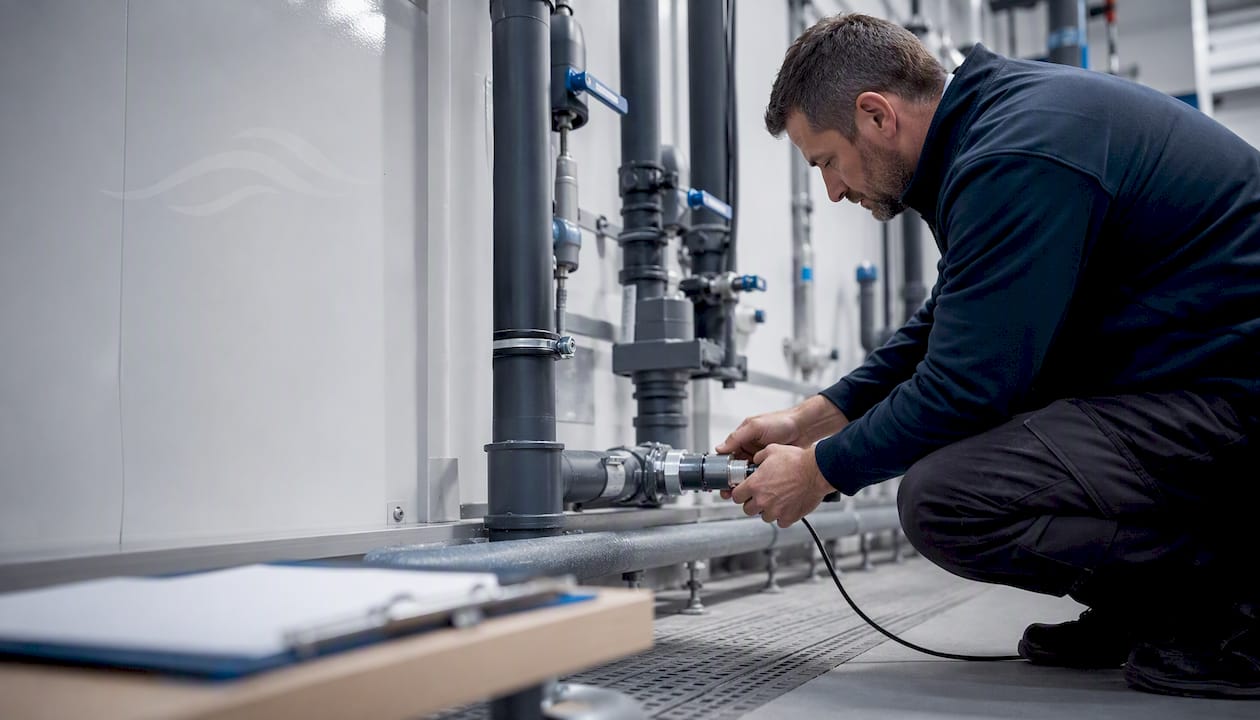
Independent third-party Legionella and water-hygiene audits deliver measurable compliance value for UK dutyholders. They produce an impartial evidence trail, catch technical failures that internal checks routinely miss, and give regulators credible documentation that your control regime is working. For any organisation with a legal duty under the Health and Safety at Work etc. Act 1974, commissioning an independent audit is one of the most defensible steps you can take.
Three reasons stand out:
Impartial evidence trail. An auditor with no prior relationship to your site or your contractors cannot be accused of bias. That independence is exactly what enforcement bodies want to see.
Specialist technical checks. Deadlegs, schematic inaccuracies, and gaps in sampling technique are consistently missed by in-house teams. A fresh pair of expert eyes finds them.
Strengthened governance. A written audit report, with dated findings and corrective actions, gives your board, insurers, and the HSE something concrete to rely on.
Failing to follow ACoP L8 may be treated as evidence of non-compliance with the Health and Safety at Work etc. Act 1974, which can result in significant legal penalties.
Key takeaways
Independent third-party Legionella audits give UK dutyholders the impartial, documented compliance evidence that self-assessment cannot produce and enforcement bodies expect to see.
Point | Details |
Legal duty is yours alone | ACoP L8 non-compliance can lead to unlimited fines; the dutyholder retains liability even when contractors are engaged. |
Independence is the differentiator | Auditors with no prior site knowledge identify schematic errors, deadlegs, and record gaps that internal teams routinely miss. |
Audit scope covers paper and plant | Risk assessment, written scheme, monitoring records, sampling chain of custody, and competency records are all reviewed. |
Act on findings systematically | Triage by risk rating, assign named owners, log actions, and feed outcomes back into your Water Safety Plan. |
Bespokecompliancesolutions | Provides independent risk assessments, UKAS sampling, and ongoing consultancy scoped to your specific sites across the UK. |
Table of Contents
What does a third-party water audit actually inspect?
An independent Legionella audit covers both the physical plant and the paper trail behind it. Auditors check whether your control regime matches what ACoP L8 and HSG274 require, and whether your records prove it.
Audit area | What the auditor checks | Compliance evidence expected |
Risk assessment | Currency, scope, competence of assessor | Signed, dated document; review history |
Written scheme | Completeness, site-specific detail | Approved scheme with version control |
Monitoring records | Temperature logs, flushing records, dosing | Consistent, gap-free logbook entries |
Schematic drawings | Accuracy against installed pipework | Up-to-date, marked-up drawings |
Sampling strategy | Technique, frequency, chain of custody | BS 7592-compliant records; UKAS lab certificates |
Control regimes | TMV settings, calorifier temperatures, biocide dosing | Calibration records; dosing logs |
Training and competency | Responsible persons, authorised operatives | Certificates, CPD records |
Remedial works | Outstanding actions, completion evidence | Dated work orders; re-inspection notes |
BS 7592:2022 sets the code of practice for Legionella sampling, specifying approved technique and chain of custody. UKAS-accredited laboratories are required for processing samples, so confirm your auditor uses one before work begins.
Pro Tip: Gather your written scheme, risk assessment, and at least 12 months of monitoring logs into a single folder before the auditor arrives. Auditors who spend less time hunting for documents spend more time on substantive findings.
Why independence adds more value than in-house checks
The Water Hygiene Centre describes independent audits as proactive “strategic health checks” that validate control schemes and demonstrate duty of care. That framing is useful because it shifts the question from “do we have to do this?” to “what do we get from it?”
An auditor who arrives with no prior knowledge of your site, your maintenance contractor, or your responsible person cannot unconsciously protect existing arrangements. That clean-slate approach is central to audit effectiveness. Internal teams, however diligent, carry assumptions about how the system works. An independent auditor carries none.
Five practical benefits you will see after commissioning an independent audit:
Objective confirmation that your written scheme reflects the actual installed system
Identification of latent failures (deadlegs, infrequently used outlets, missing TMV records) before they become enforcement issues
A credible, dated report that satisfies HSE inspectors and insurers alike
Clear prioritisation of remedial actions, ranked by risk rather than convenience
Stronger governance evidence for your board or Water Safety Group
How UK law and guidance frame the audit requirement
The Health and Safety at Work etc. Act 1974 places the duty on employers and persons in control of premises. ACoP L8 is the HSE’s approved code: follow it and you are presumed compliant; depart from it and you must show an equally effective alternative.
Standard / guidance | What it requires you to hold or demonstrate |
ACoP L8 | Risk assessment, written scheme, monitoring records, competent responsible person |
HSG274 | Technical detail on control for hot and cold water, cooling towers, spa pools |
BS 7592:2022 | Sampling technique, chain of custody, UKAS-accredited laboratory |
— | Healthcare-specific water safety management, Water Safety Plan, Water Safety Group |
UKAS accreditation | Laboratory competence for Legionella sample analysis |
HSE guidance makes clear that dutyholders must keep records of precautions taken and that those records must be available for inspection. An independent audit report, filed with corrective-action evidence, is precisely the kind of record that satisfies this requirement.
The HSE’s INDG458 leaflet confirms that if you are not competent to carry out a risk assessment internally, you must use an external competent person. Critically, legal responsibility stays with you even when a contractor is engaged.
Who is qualified to carry out an independent water audit?
Competence is not self-declared in this field. Look for auditors who meet recognised criteria:
Authorising Engineer (Water): the standard independent auditor role in healthcare settings, expected to conduct at least annual checks under HTM guidance. Relevant for any high-risk premises.
Legionella Control Association members: the LCA’s code of conduct requires members to maintain competence, carry adequate insurance, and operate independently of the works they audit.
Competent Legionella consultants: demonstrable experience, relevant qualifications (City & Guilds, BOHS P901/P902), and verifiable references.
When procuring an auditor, ask these questions directly:
Can you provide a written independence statement confirming no conflict of interest with our existing contractors?
Which UKAS-accredited laboratory will you use for samples, and can you provide the lab’s scope of accreditation?
How do you handle chain of custody from sample collection to laboratory receipt?
What does your report structure look like, and how are findings risk-rated?
Are you a member of the Legionella Control Association or equivalent professional body?
How to prepare your site before the auditor arrives
Preparation cuts audit time and improves the quality of findings. A disorganised site produces a longer, more expensive report with more follow-up visits.
Retrieve the current risk assessment and written scheme. Check both are signed, dated, and reflect any system changes since the last review.
Collate at least 12 months of monitoring logs: temperature records, flushing logs, dosing records, and any corrective-action notes.
Locate up-to-date schematic drawings. If drawings are missing or out of date, flag this to the auditor in advance rather than on the day.
Confirm access to all plant rooms, roof tanks, calorifiers, and sentinel outlets. Locked plant rooms with no key available waste everyone’s time.
Nominate a responsible person to accompany the auditor throughout the visit. This person should know the system and be authorised to answer questions.
Pull together training certificates and competency records for all responsible persons and authorised operatives.
List any outstanding remedial actions from previous audits or risk assessments, with their current status.
Pro Tip: Missing schematics are the single most common document gap auditors encounter. If yours are incomplete, commission a survey drawing before the audit date rather than after. An auditor who can verify pipework against an accurate drawing produces far more precise findings.
What does the audit process look like, and what does it cost?
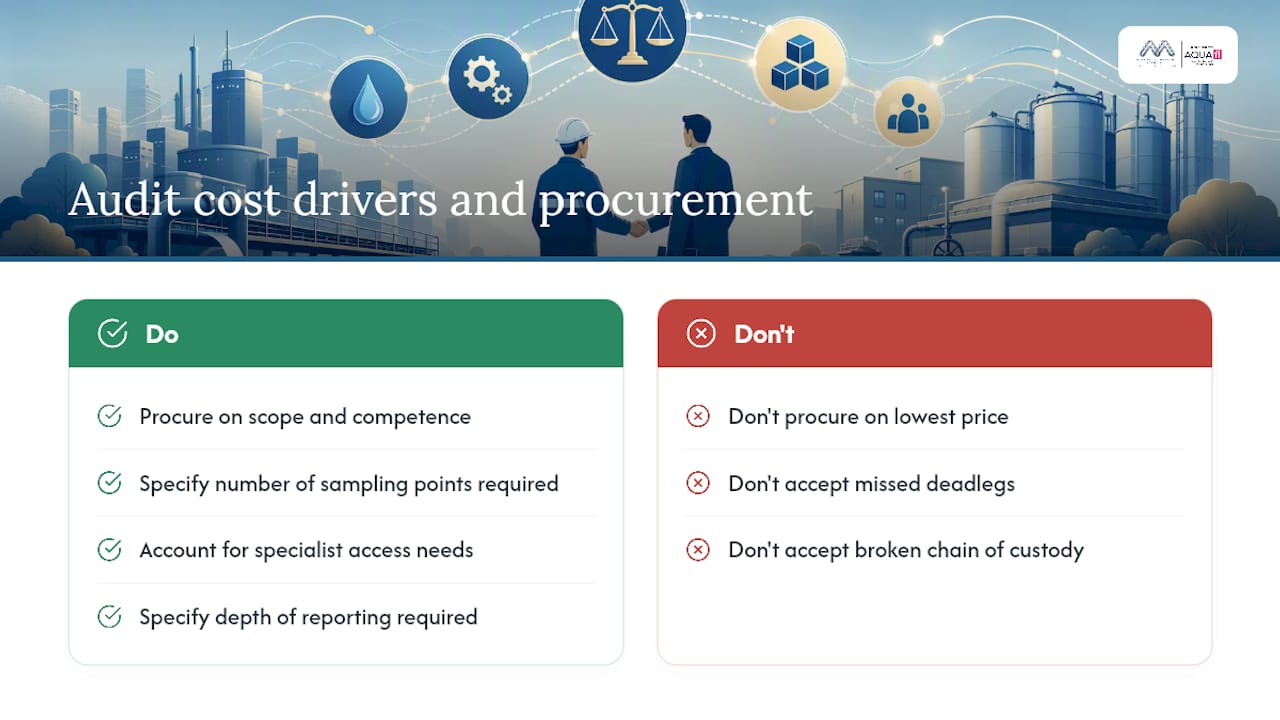
The main cost drivers are site complexity (number of water systems, outlets, and risk areas), the number of sampling points required, specialist access needs (confined spaces, roof tanks), travel, and the depth of reporting required. Auditing laboratory practices follows similar cost logic: scope and sample volume drive price more than any other factor.
Procure on scope and competence, not lowest price. An audit that misses a deadleg or accepts a broken chain of custody is worse than no audit at all.
How to act on audit findings effectively
An audit report is only useful if it drives change. Most reports structure findings by risk rating (critical, high, medium, low) with a named responsible person and a target completion date for each action.
Read the executive summary first, then triage: address all critical and high-rated findings within the timescales the report specifies.
Assign each action to a named individual with authority to commission works or update records.
Log every action in your compliance management system or logbook, with the target date and current status.
Obtain written confirmation of completion for all remedial works, and retain it alongside the original audit report.
Schedule a follow-up review at the next Water Safety Group meeting to confirm all actions are closed or have a revised timeline.
Pro Tip: Use the audit findings to update your Water Safety Plan directly. Annual audits measure how well the plan has been implemented and prompt the Water Safety Group to revise sections that are no longer current. An audit that feeds back into the plan keeps it a living document rather than a shelf item.
When should you commission an independent audit?
Routine scheduling:
Annual audit as a baseline for most premises
Higher frequency (six-monthly) for high-risk sites: healthcare, care homes, hotels, large commercial buildings with complex water systems
Triggers for an unscheduled audit:
Any confirmed or suspected Legionella case linked to your premises
Positive Legionella sample results above action levels
Significant system changes: new pipework, extensions, decommissioned areas, changes in building use or occupancy
Following major remedial works, to verify the work was completed correctly
Change of responsible person, facilities management contractor, or water treatment provider
Extended building closure or low-occupancy periods followed by reoccupation
Align audit scheduling with your Water Safety Plan review cycle and your Water Safety Group meeting calendar. An audit that reports in the week before a governance meeting gives the group something concrete to act on.
The case for independent audits: an editorial perspective
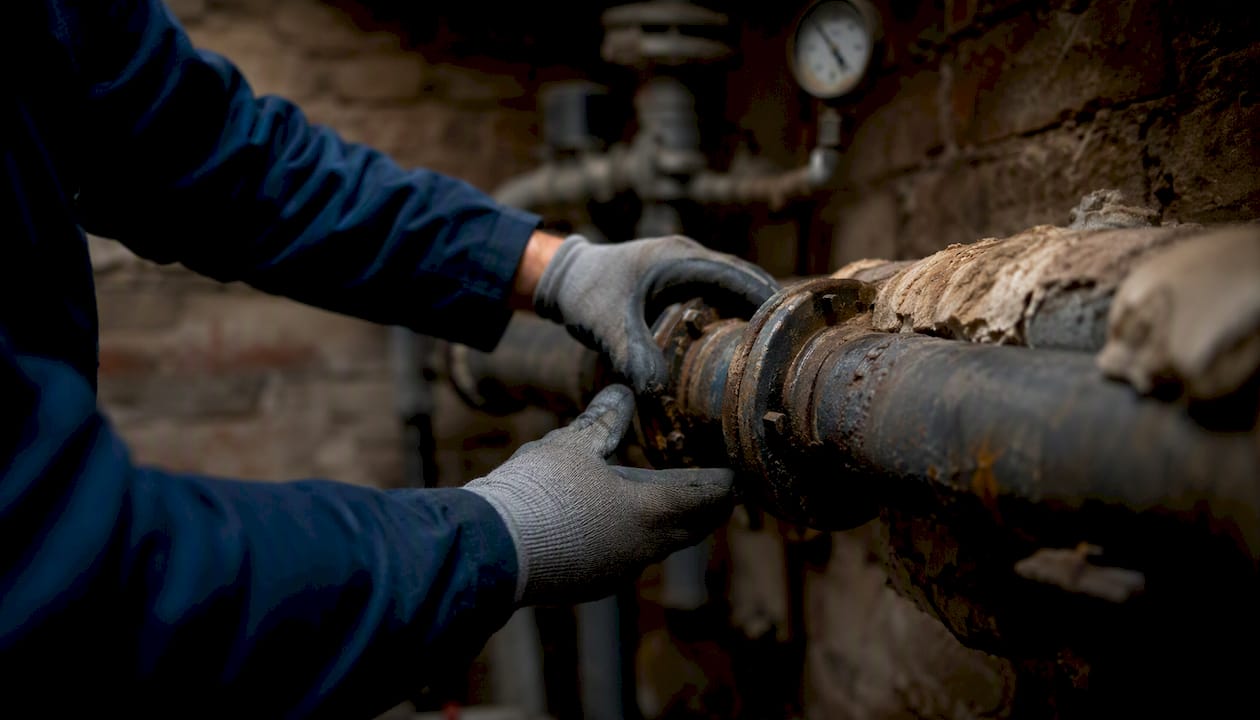
The compliance value of independent Legionella audits is well-established in UK guidance, but the governance value is still underestimated by many facilities and property managers. Organisations that treat audits as a box-ticking exercise miss the point entirely. The real return is what the audit reveals that you did not know: the deadleg nobody mapped, the TMV that was serviced on paper but not in practice, the monitoring log with three months of identical entries that suggest someone was guessing rather than measuring.
Independence is not a formality. It is the mechanism that makes the audit credible to everyone outside your organisation: the HSE inspector, your insurer, your board. A self-assessment, however thorough, cannot provide that. The moment you commission an auditor with no prior relationship to your site, you are producing evidence that stands up under scrutiny.
Bespokecompliancesolutions: independent water-hygiene audits across the UK
Bespokecompliancesolutions delivers independent Legionella risk assessments, UKAS-accredited water sampling and analysis, written scheme reviews, and ongoing compliance consultancy for commercial, healthcare, housing, and facilities management clients across the UK. Every service is scoped to your specific site, not a generic template.
If your last audit is overdue, your risk assessment needs reviewing, or you have outstanding remedial actions with no clear owner, the practical next step is a site-specific conversation. Request a Legionella risk assessment quote or contact Bespokecompliancesolutions directly to discuss the right scope for your premises.
Sources
This article is general information, not a substitute for advice from a qualified doctor. Consult a qualified healthcare professional about your own circumstances before acting on anything here.
Recommended
Comments