
Water storage tank inspection: a guide for UK facilities managers
- 2 days ago
- 12 min read
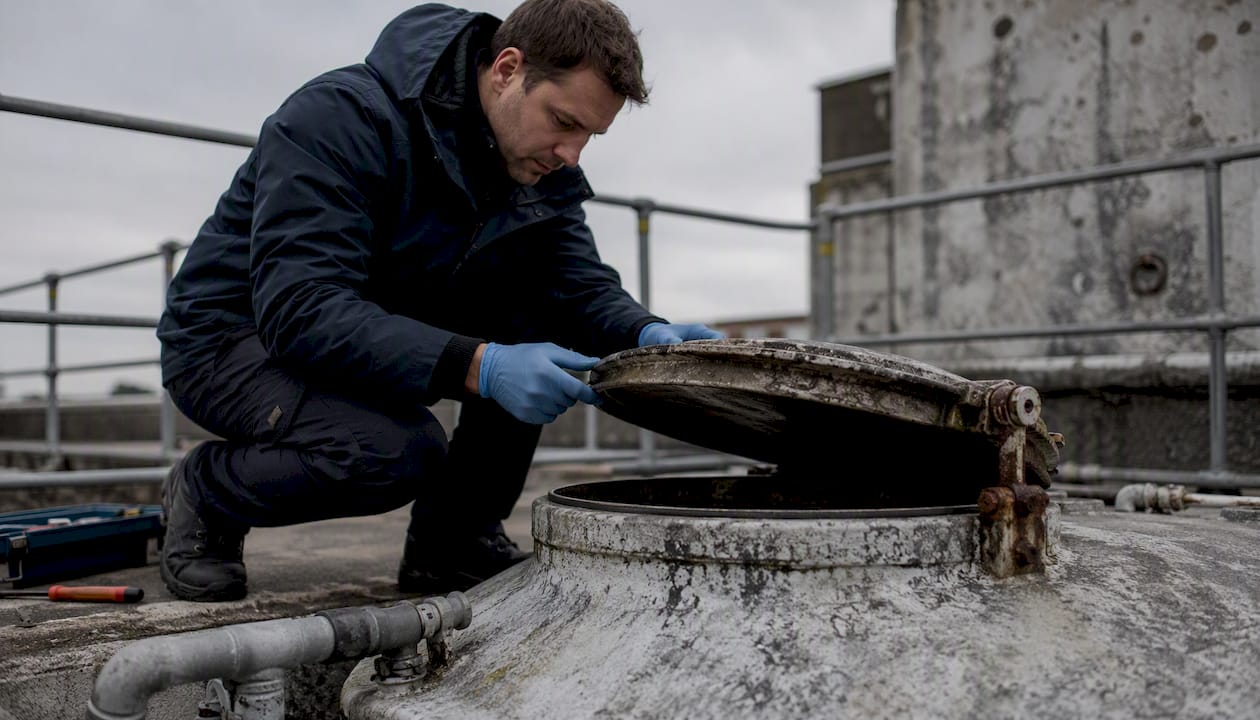
A water storage tank inspection is a systematic, documented assessment of a tank’s physical condition and water quality, carried out to protect public health, confirm structural integrity, and satisfy UK regulatory requirements. The primary outputs are a signed photographic report, remedial recommendations with timescales, and, where sampling is required, certified laboratory results.
Three things matter most to facilities managers and compliance officers right away:
Legionella prevention: poorly maintained tanks create the warm, stagnant, nutrient-rich conditions in which Legionella pneumophila proliferates. HSG274 Part 2 and ACOP L8 place a clear duty on responsible persons to inspect and maintain water systems as part of a Legionella control programme.
Regulatory evidence: the Drinking Water Inspectorate (DWI) requires periodic visual checks to confirm no deposit build-up and that lids and screens are secure. Inspection records are the primary evidence used in sanitary surveys and HSE audits.
Early defect detection: catching a failing coating or a cracked hatch seal during a routine inspection costs a fraction of emergency rehabilitation or a service outage.
Bespokecompliancesolutions carries out tank inspections across UK sites as part of a broader Legionella compliance programme, producing audit-ready reports that link directly to the site’s risk assessment.
Key takeaways
A water storage tank inspection is a documented, photographic assessment of condition and water quality, required under ACOP L8 and HSG274 to control Legionella risk and satisfy UK regulatory obligations.
Point | Details |
Inspection frequency | Monthly operational checks; comprehensive inside-and-out inspection every 3–5 years, risk-adjusted for tank age and water quality history. |
Competent person requirement | The inspector must hold relevant water hygiene and Legionella training; structural defects require a follow-up engineer assessment. |
Photographic evidence | Colour photographs of all areas and defects, including before-and-after shots for any repairs, are the primary audit evidence. |
Link reports to risk assessment | Every inspection report must be cross-referenced in the site logbook and Legionella risk assessment to satisfy HSE and DWI requirements. |
Bespokecompliancesolutions | Provides tank inspections, cleaning, UKAS-accredited sampling, and audit-ready reports across UK sites under a documented Method of Works. |
Table of Contents
Why are water tank inspections essential for health and safety?
Legionella is the most immediate risk, but it is not the only one. A tank that has not been inspected for several years can harbour biofilm, sediment, and microbial contamination that degrades water quality long before anyone notices a problem. The DWI guidance on water storage tanks is explicit: deposits on the tank floor and unsecured lids or screens are sanitary defects that must be identified and corrected. Left unaddressed, they create a direct contamination pathway into the supply.
The structural argument is just as compelling. Corrosion, pitting, and coating failure are progressive. Catching them early means a localised repair; missing them means a full reline or tank replacement. Industry evidence on tank performance consistently shows that early detection of corrosion and coating failure protects assets and prevents service failures that are far more disruptive and expensive than planned maintenance.
From a compliance standpoint, the duty-holder obligations under ACOP L8 and HSG274 are not discharged by intention alone. You need documented evidence that inspections happened, who carried them out, what was found, and what was done about it. Sanitary surveys by the DWI and enforcement visits by the HSE both rely on that paper trail. Organisations that treat inspections as planned maintenance rather than reactive spend tend to have fewer emergency call-outs, more predictable budgets, and a much cleaner audit record.
Understanding why Legionella is a health and safety priority is the foundation for making the case internally for regular inspection cycles.
What does a water storage tank inspection check?
A thorough inspection covers three layers: the exterior, the interior, and the ancillary components. Here is what a competent inspector should be examining at each stage.
External checks
Roof and cover condition: cracks, standing water, debris accumulation
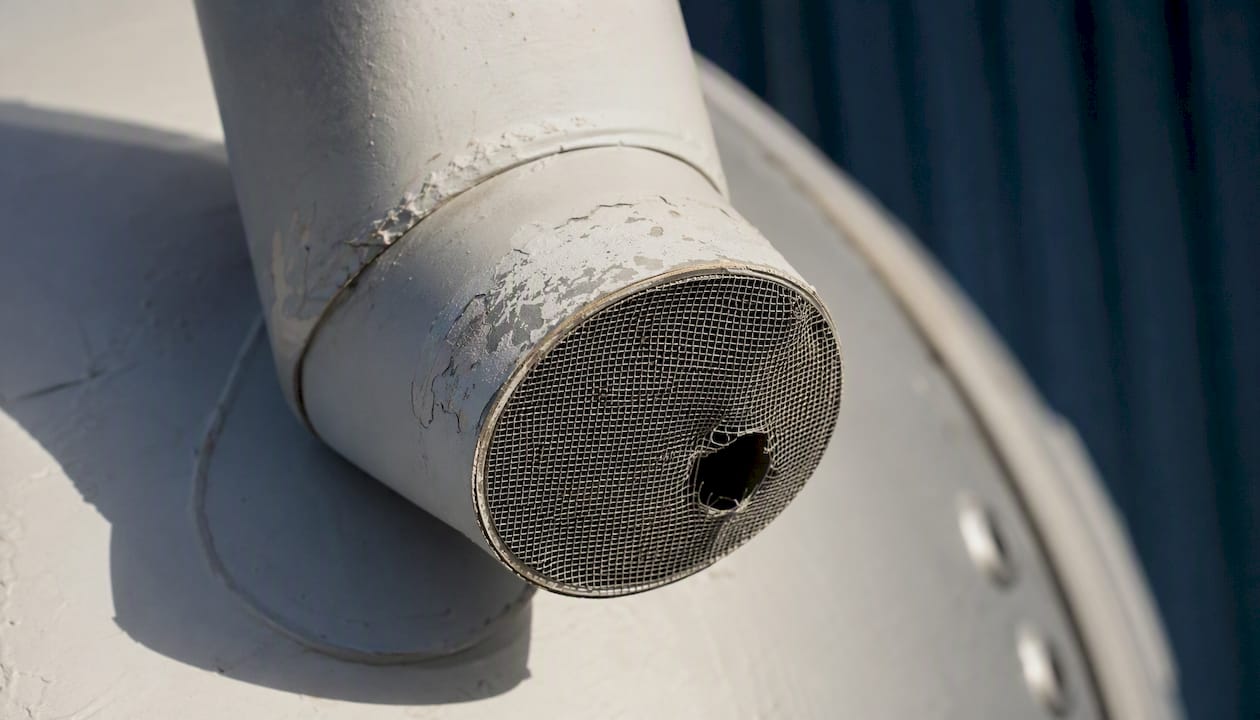
Vent pipes: correct construction, insect-proof screens intact, no evidence of bird or rodent ingress
Overflow and warning pipes: properly terminated, screened, and directed away from contamination sources
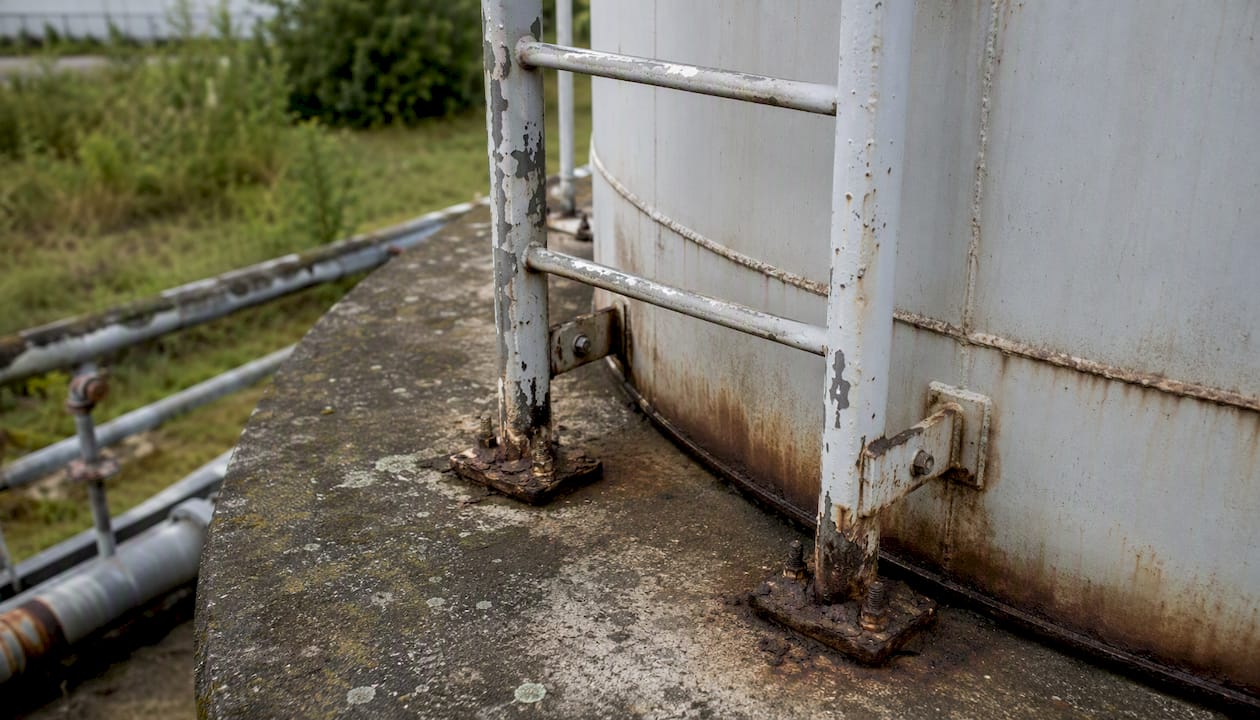
External corrosion on steel tanks: surface rust, weld seam integrity, paint or coating condition
Access hatches: secure, sealed, and fitted with tamper-evident fixings
Ladder and external safety features: anchor integrity, anti-climb guards where required
Surrounding area: drainage, proximity to contamination sources, security fencing
Internal checks
Coating or lining condition: blistering, delamination, pitting, or areas of bare metal
Sediment and biofilm: presence, extent, and location on the floor and walls
Concrete tanks: spalling, carbonation, exposed reinforcement
Anodes (where fitted): condition and remaining life
Stratification or mixing evidence: temperature differential between inlet and outlet zones
Inlet and outlet pipework: condition, isolation valve operation, any signs of backflow risk
Level sensors and float valves: correct operation and physical condition
Water quality checks
Visual assessment of water clarity and colour
Disinfectant residual (free chlorine) measurement
Bacteriological sampling where the risk assessment or previous results indicate a need, sent to a UKAS-accredited laboratory
Pro Tip: The DWI guidance specifically calls out secure lids and screens as a baseline requirement. If an inspector does not check and photograph every vent screen and hatch seal, the report is incomplete.
Sanitary defects that inspectors must not overlook include improper vent pipe construction (wrong diameter, missing screens, or incorrect termination height), degraded hatch seals that allow insects or surface water ingress, and overflow pipes that discharge in a location where backflow or contamination is possible.
How does the inspection process work on the day?
Pre-inspection preparation
Before anyone enters the site, the inspector needs scope agreement, an isolation plan, a permit-to-work, and a site-specific safety brief. The client should provide site drawings, previous inspection reports, water quality history, and confirmation of isolation valve locations. Without these, the inspector is working blind on access and risk.
On-site sequence
The inspection follows a logical order. The inspector begins with an external survey, walking the full perimeter and roof of the tank to record condition, access points, and any immediate safety concerns. Once external checks are complete, the inspector confirms safe access and carries out the interior assessment.
For smaller tanks that can be taken out of service, draining is the most thorough method. For larger tanks where service continuity is critical, float-down inspection (inspector on a raft or float) or underwater inspection by a diver or remotely operated vehicle (ROV) may be used. Each method has different safety requirements. Diver and ROV inspections require disinfected equipment to prevent cross-contamination; PUB2043 technical guidance recommends adherence to AWWA C652 disinfection standards, including equipment treated with a 200 mg/l chlorine solution and dedicated to potable-water use only.
During underwater inspections, maintaining positive flow where possible and monitoring disinfectant residuals closely is standard practice, with bacteriological samples taken if recommended by the inspector or the risk assessment.
Once the interior assessment is complete, the inspector makes immediate advisories to the site representative on any urgent defects, agrees on sampling requirements, and confirms the cleaning or disinfection scope if that work forms part of the visit.
Understanding how stagnant water affects Legionella risk is useful context for the cleaning and monitoring decisions made at this stage.
Which UK standards and guidance apply to tank inspections?
The regulatory framework for water storage tank inspections in the UK draws on several documents, each with a distinct scope.
ACOP L8 (Approved Code of Practice for the Control of Legionella Bacteria in Water Systems): sets the overarching duty-holder obligations and the requirement for a written scheme of control. Non-compliance with ACOP L8 is treated as evidence of a breach of the Health and Safety at Work etc. Act 1974.
HSG274 Part 2: the HSE’s practical guidance on Legionella control in hot and cold water systems. It specifies the role of competent persons, the scope of inspections, and the records that must be kept.
DWI guidance on water storage tanks and cisterns: covers the sanitary requirements for tanks supplying drinking water, including the periodic visual checks and the expectation that lids and screens are secure.
CIRIA C736: a technical reference for the inspection and maintenance of water storage structures, widely used by structural engineers and inspection contractors for condition assessment methodology.
AWWA C652: the American Water Works Association disinfection standard, commonly referenced by UK practitioners for tank disinfection and cleaning procedures, particularly for diver and ROV inspections.
This expectation, reflected in the Arkansas ADH guidance as an example of regulatory practice, mirrors what UK auditors expect: photographic evidence, a signed inspector statement, and documented remedial recommendations. UKAS accreditation is the benchmark for laboratory testing; check the UKAS directory to confirm a laboratory’s scope before submitting microbiological samples.
Who should carry out a tank inspection?
What “competent person” means in practice
ACOP L8 and HSG274 both require inspections to be carried out by a competent person. In the context of water storage, that means someone with relevant technical training in water hygiene and Legionella control, practical experience of sanitary inspection, and the ability to identify structural defects and escalate them appropriately. Credentials to look for include a chartered engineer (CEng), a water hygiene specialist with recognised Legionella competency training (such as City & Guilds 6084 or equivalent), or membership of a professional body such as the Water Management Society.
Questions to ask when procuring an inspection
Can they provide a written Method of Works describing their inspection procedure, safety arrangements, and reporting format?
Do they carry examples of previous photographic inspection reports?
Are their microbiological samples handled under chain-of-custody and analysed by a UKAS-accredited laboratory?
What are their professional indemnity and public liability insurance limits?
Do they have confined-space entry training and current certification for their operatives?
Can they provide references from comparable sites (similar tank type, size, or sector)?
Pro Tip: Minimum mandated inspection forms are often only the baseline. Service-provider guidance consistently stresses that inspectors should provide broader assessments and remediation planning, not just tick the regulatory box. Ask to see a sample report before you commit.
When structural defects are found, a competent water-hygiene inspector should flag them clearly and recommend a follow-up structural engineer assessment. Do not accept a report that notes pitting or concrete spalling without a recommended next step and timescale.
Linking inspection outputs to a reviewed Legionella risk assessment is part of the competent person’s responsibility, not an optional extra.
How often should inspections happen, and what affects the cost?
Recommended inspection frequency
Operational SOPs for water storage recommend monthly operational checks and comprehensive inspections, including cleaning, every 3–5 years. The Arkansas ADH guidance sets a minimum of a full inside-and-out inspection at least once every five years as a regulatory baseline.
In practice, risk-adjustment is necessary. A tank that is older, constructed from a material prone to corrosion, has a history of poor water quality results, or is located in a vulnerable or high-security site may need more frequent checks than the baseline suggests. HSG274 and ACOP L8 both expect the frequency to be proportionate to the risk.
Monthly: operational checks covering water clarity, disinfectant residual (free chlorine), turbidity, and a visual check of accessible external components.
Annually: a more detailed external inspection, review of water quality trends, and confirmation that all ancillary components are functioning.
Every 3–5 years: comprehensive inside-and-out inspection, cleaning and disinfection, structural condition assessment, and full photographic report.
What drives inspection cost
Cost driver | Why it matters |
Tank size and number | Larger tanks and multi-tank sites take longer and require more operatives |
Access method | Draining is straightforward; diver or ROV inspection adds specialist labour and equipment |
Confined-space requirements | Tanks requiring confined-space entry need a trained team, rescue equipment, and a permit |
Sampling and laboratory analysis | UKAS-accredited microbiological testing adds cost but is often required by the risk assessment |
Photographic and video deliverables | High-resolution video documentation of underwater inspections adds time and editing |
Minor repairs on the day | Hatch seal replacement, screen repair, or minor coating touch-up during the visit |
Budget for inspection as part of planned maintenance rather than reactive spend. An unplanned service outage or a Legionella incident will cost orders of magnitude more than a scheduled inspection programme.
What defects do inspectors commonly find?
Sanitary defects
Damaged or missing vent screens, allowing insect or bird ingress
Degraded hatch seals with visible gaps or compression failure
Overflow pipes terminating without screens or discharging in a location where contamination is possible
Evidence of animal activity: droppings, nesting material, or insect larvae in sediment
Unsecured or improperly fitted access covers
Structural defects
Surface corrosion on steel tanks, ranging from surface rust to through-wall pitting
Concrete spalling or carbonation, with exposed reinforcement in older tanks
Weld seam cracking or separation on welded steel tanks
Leaks at pipe penetrations or around the base
For structural defects, the immediate response depends on severity. Minor surface corrosion can often be treated with spot preparation and coating repair during the inspection visit. Through-wall pitting or active leaks require the tank to be taken out of service and a structural engineer assessment commissioned before any repair work proceeds.
Coating and lining failures
Minor blistering or delamination: localised repair using a compatible coating system, with photographic evidence before and after.
Widespread delamination or adhesion failure: full reline required; the tank must be drained, blast-cleaned, and recoated to a recognised standard (BS 6920 for materials in contact with drinking water).
Bare metal with active corrosion: treat as urgent; the tank should be taken out of service until the repair is complete.
A complete inspection is incomplete without before-and-after photography when any repair is carried out on the day. Regulators treat missing photographic records as a significant deficiency, regardless of whether the repair itself was competent.
What does an inspection report contain, and how should you store it?
Minimum report contents
Site identification: address, tank reference, type, capacity, and construction material
Inspection date, method used, and name and credentials of the inspector
Signed inspector statement confirming the scope of work completed
Photographic and/or video evidence of all areas inspected, including close-ups of defects
Condition assessment for each component: exterior, interior, ancillary
Remedial recommendations with priority classification (urgent, within 28 days, planned) and indicative timescales
Sampling results: where microbiological or disinfectant residual samples were taken, the report should include or reference the UKAS-accredited laboratory certificate
Recordkeeping best practice
Digital storage: store reports in a named folder structure by site and date, with version control so superseded reports are archived rather than deleted.
Link to the risk assessment: every inspection report should be cross-referenced in the site’s Legionella risk assessment and logbook. An auditor will expect to trace a defect from the inspection report through to the risk assessment update and the remedial work record.
Retention: retain inspection reports for the life of the tank plus a minimum of five years after decommissioning. HSE enforcement and DWI sanitary surveys can request historical records going back several inspection cycles.
Report element | Minimum standard |
Inspector credentials | Named, with qualification or training evidence |
Photographic evidence | Colour, dated, covering all defects and all areas inspected |
Remedial recommendations | Prioritised with timescales |
Sample results | UKAS lab certificate attached or referenced |
Signed statement | Inspector signature and date |
The inspection details that often get missed
Most inspection reports cover the obvious items. The ones that get missed tend to be the ones that cause problems later.
Vent pipe construction is a recurring gap. The pipe must be correctly sized, terminate at the right height, and be fitted with a durable insect-proof screen that is actually intact. A screen with a single hole is a failed screen. Inspectors should photograph every vent termination, not just note “vent present.”
Ladder anchor integrity is another. External ladders on elevated tanks are subject to corrosion at the fixing points, which are often the last place anyone looks. A ladder that appears sound from the ground can have severely corroded anchor bolts at the top.
Mixing devices, where fitted, need to be checked for correct operation and physical condition. A failed mixer creates dead zones where water stagnates and disinfectant residuals drop, exactly the conditions that favour Legionella growth.
For underwater inspections, the PUB2043 guidance is clear: all diver and ROV equipment must be disinfected before entry, dedicated to potable-water use, and the inspection conducted in accordance with AWWA C652 disinfection protocols. Skipping this step risks introducing contamination into the supply.
The Bespokecompliancesolutions Method of Works standardises how defects are documented, photographed, and prioritised, so every report produced under that framework is structured for audit use from the outset.
What experienced inspectors see most often
The most common finding across sites is not dramatic structural failure. It is the accumulation of small, addressable defects that have been present for years because no one looked closely enough: a vent screen with a tear, a hatch seal that has compressed and no longer closes flush, sediment on the tank floor that has never been removed.
Photographic reports change behaviour. When a facilities manager can see the condition of their tank rather than read a text description, remedial work gets approved faster and the same defects do not recur at the next inspection. Prompt minor repairs carried out during the inspection visit, documented with before-and-after photography, are the most cost-effective form of tank maintenance available.
The Bespokecompliancesolutions Method of Works exists precisely because standardised reporting and remedial prioritisation produce audit-ready records, not just inspection records.
Water tank inspections and compliance support from Bespokecompliancesolutions
Bespokecompliancesolutions delivers tank inspections that go beyond the minimum regulatory baseline, producing photographic reports structured for HSE and DWI audit use from day one. Services include water tank cleaning and disinfection, Legionella risk assessments, water sampling and UKAS-accredited laboratory analysis, remedial works, and ongoing compliance support across UK sites.
Every site quotation covers scope, access method, sampling requirements, and a clear deliverables list so you know exactly what you are getting before work begins. Method of Works documentation and sample inspection reports are available on request. To book a site visit or request a quotation for a tank inspection or Legionella risk assessment, contact Bespokecompliancesolutions directly.
Sources
The following primary guidance documents are the authoritative references for water storage tank inspection in the UK.
This article is general information, not a substitute for advice from a qualified doctor. Consult a qualified healthcare professional about your own circumstances before acting on anything here.
Recommended
Comments