
Water service level agreements: a guide for UK managers
- Aug 10
- 21 min read
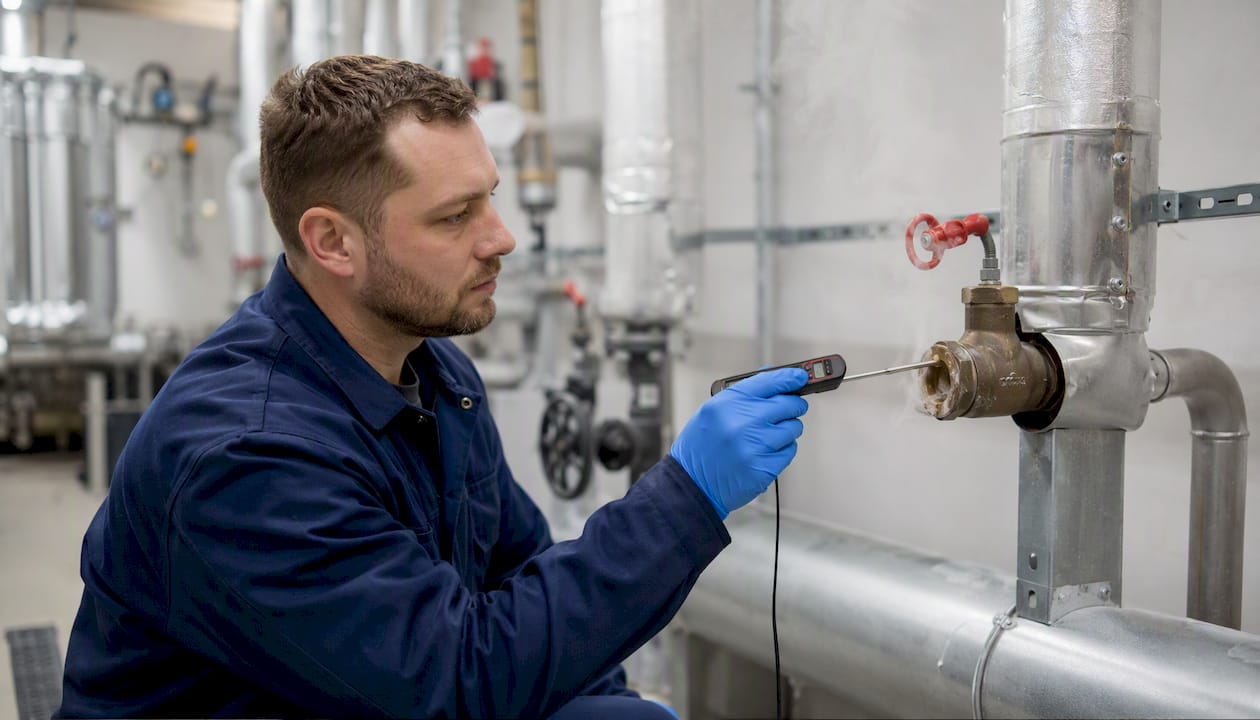
A water-sector service level agreement (SLA) is a binding contract that converts regulatory and operational obligations into measurable service levels, defined KPIs, and enforceable remedies. If you manage water services, commission water hygiene contractors, or hold regulatory oversight, an SLA is the document that turns vague expectations into something you can actually audit and enforce.
The Cambridge Dictionary defines a service level agreement as a contract between a service provider and a customer that specifies the level of service to be provided. In the water sector, that definition carries real weight: it means Legionella control frequencies, hot-water temperature ranges, TMV servicing intervals, and response times to supply failures all need to appear as explicit, measurable commitments rather than general assurances.
Why does this matter to you specifically? Because the Drinking Water Inspectorate (DWI), the Drinking Water Quality Regulator (DWQR), Ofwat, and the Environment Agency all operate within frameworks that assume service providers can demonstrate compliance through documented evidence. An SLA without measurable KPIs leaves you exposed when a regulator asks for proof.
Your immediate next step: pick one high-priority outcome from your current contract, whether that is Legionella control, continuity of supply, or pressure compliance, and check whether it maps to an explicit, measurable KPI. If it does not, that gap is where your SLA revision should start.
Key things a water SLA should do from day one:
Define who is responsible for what, with no ambiguity between provider, contracting authority, and regulator
Set measurable service level objectives (SLOs) for water quality, temperature compliance, and response times
Specify data sources, sampling frequencies, and reporting formats that satisfy statutory regimes
Include staged remedies so minor breaches are corrected before they become enforcement actions
Build in a structured review cycle so the agreement keeps pace with site changes and regulatory updates
Key takeaways
A water-sector SLA is only as strong as its KPIs, its monitoring mechanisms, and the governance habits of the people who manage it day to day.
Point | Details |
Define before you measure | Draft a definitions clause covering every technical term before setting SLOs; undefined terms are the most common source of disputes. |
Start with outcome-based KPIs | Follow AWWA guidance and tie critical SLOs to measurable outcomes (temperature compliance, Legionella sampling results) rather than activity counts. |
Name your SLA manager | Appoint a named individual on each side before signing; a role without a name has no accountability when a breach occurs. |
Align with UK regulators | Ensure sampling schedules and reporting formats reference DWI, DWQR, Ofwat, and Environment Agency requirements directly in the SLA text. |
Bespokecompliancesolutions | Provides risk assessments, water sampling, TMV servicing, and logbook systems that supply the verified data water SLAs require to be enforceable. |
Table of Contents
What does a water SLA actually cover, and how does it differ from related terms?
Which KPIs should a water SLA specify, and how do you measure them?
Drafting checklist and sample clause language for water SLAs
How long does it take to set up a water SLA, and what does it cost?
What can UK managers learn from the DWI service level agreement?
Legionella and water-hygiene SLA checklist from Bespokecompliancesolutions
SLAs work best when both parties treat them as partnership tools
Bespokecompliancesolutions: practical support for water SLA implementation
What does a water SLA actually cover, and how does it differ from related terms?
The scope of a water SLA is wider than most managers initially expect. Webopedia describes SLAs as documents that define responsibilities, quality, and availability, and notes they can be either external agreements between a provider and a customer or internal agreements between departments. In the water sector, both types are common: a facilities manager might hold an external SLA with a water hygiene contractor, while an internal SLA might govern the relationship between an estates team and a building management function.
Core scope items every water SLA should address:
Parties: full legal names, roles, and contact details for each signatory
Assets covered: specific systems, buildings, or sites within scope, with clear exclusions
Service boundaries: what the provider is and is not responsible for (e.g., mains supply vs. internal distribution)
Effective dates, break clauses, and renewal conditions
Review cycles: typically annual, with provision for interim review after a significant incident or regulatory change
SLA vs SLC vs SLG: getting the terminology right
TechTarget draws a clear distinction between an SLA and a Service Level Commitment (SLC). An SLA is bidirectional: both parties carry obligations. An SLC is a one-directional commitment from a provider, with no reciprocal obligation on the customer. A Service Level Guarantee (SLG) adds a financial remedy to the commitment, typically a credit or refund if the provider falls short.
In compliance-critical water services, a full SLA is almost always the appropriate instrument. An SLC alone gives you a promise; an SLA gives you a mechanism to enforce it.
Levels of service (LoS) and asset management
The term “levels of service” (LoS) comes from asset management frameworks and is broader than an SLA. LoS describes the overall standard a utility or organisation commits to delivering, often expressed in strategic plans or regulatory submissions. An SLA operationalises those commitments at the contract level, translating a strategic LoS statement into specific, measurable obligations for a named provider.
Term | Direction | Legally binding | Includes remedies | Typical use in water sector |
SLA | Bidirectional | Yes | Yes | Contractor agreements, regulatory arrangements |
SLC | One-directional | Usually | Rarely | Supplier commitments, framework contracts |
SLG | One-directional | Yes | Yes (financial) | Consumer-facing guarantees |
LoS | Strategic | No (unless embedded in SLA) | No | Asset management plans, regulatory submissions |
Corporate-level vs site-specific SLAs
Mature water-service programmes typically use two layers. A corporate-level SLA sets foundational compliance obligations, such as adherence to HSE ACoP L8, that apply across all sites. Site-specific SLAs then adapt those obligations to local risk factors: building age, system complexity, occupancy patterns, and the presence of high-risk populations. Layering the two avoids repeating boilerplate in every site document while still capturing the detail that makes each agreement enforceable.
What must every water SLA include? A practical checklist
A water SLA that omits any of the following categories is incomplete and likely unenforceable in a dispute. Water Care Services describes SLAs as structured, legally binding documents that outline provider obligations including installation, preventive maintenance, and routine sampling. That framing is useful: think of the SLA as a structured document, not a letter of intent.
Contractual basics
Full names and roles of both parties, plus any named subcontractors
Precise scope of services and assets, with a schedule of sites or systems
Definitions clause covering all technical terms (SLI, SLO, KPI, TMV, ACoP L8, etc.)
Term, break clauses, and conditions for termination with or without cause
Governing law and jurisdiction (for UK water SLAs, English or Scottish law as applicable)
Performance framework
Service Level Indicators (SLIs): the raw measurements (e.g., hot-water outlet temperature in °C)
Service Level Objectives (SLOs): the target range or threshold for each SLI (e.g., ≥50°C at outlets within one minute of running)
Reporting cadence: monthly operational reports, quarterly performance reviews, annual strategic review
Authorised data sources: laboratory certificates, calibrated temperature loggers, telemetry exports, maintenance logs
Measurement methodology: rolling averages, incident counts, or percentage compliance over a defined period
Remedies and incentives
Service credits: a defined formula for calculating credits when an SLO is missed
Rectification timeframes: how quickly the provider must remedy a breach (e.g., 24 hours for a Legionella-positive result, 5 working days for a minor temperature exceedance)
Escalating penalties for repeated or sustained breaches
Termination triggers: conditions under which the contracting authority may exit the agreement without penalty
Governance
Named SLA manager on each side
Dispute resolution procedure: informal resolution first, then formal escalation, then mediation or arbitration
Change control: how scope changes are agreed, documented, and priced
Review cycle and the process for amending KPIs when regulatory standards change
Pro Tip: Draft the definitions clause before anything else. Disputes almost always start with two parties reading the same word differently. Define “compliant sample”, “response time”, “working day”, and “Legionella-positive” in plain English at the outset, and reference the Cambridge Dictionary or the relevant British Standard where a plain-language anchor helps.
Which KPIs should a water SLA specify, and how do you measure them?
AWWA recommends starting with a small number of critical service levels tied to customer priorities, treating them as an integral part of asset management rather than a separate compliance exercise. That principle applies directly to UK water SLAs: resist the temptation to list every conceivable metric. Start with the indicators that carry the highest regulatory and safety risk, then build out as the programme matures.
Typical water-specific KPIs
Water quality: percentage of samples compliant with the Water Supply (Water Quality) Regulations 2016, number of non-compliant tests per quarter
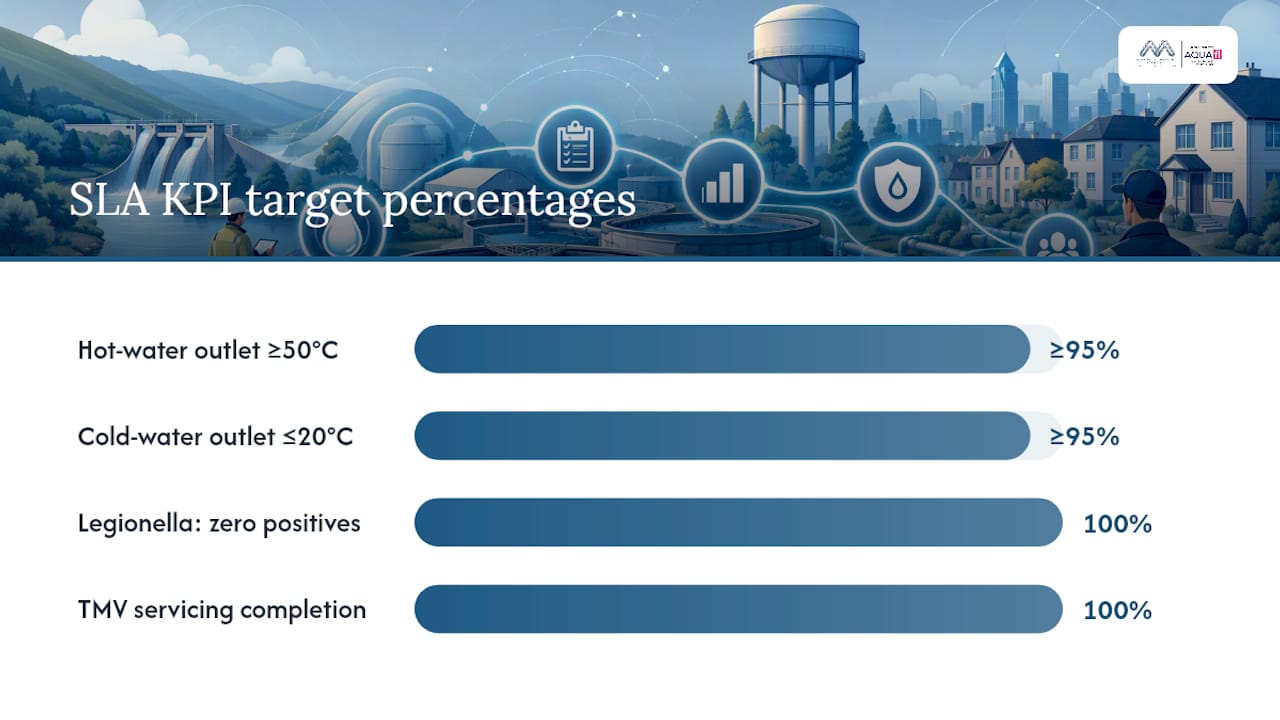
Hot-water temperature compliance: percentage of outlets achieving ≥50°C within one minute of running (ACoP L8 guidance)
Cold-water temperature compliance: percentage of outlets achieving ≤20°C within two minutes of running
Legionella sampling outcomes: number of positive Legionella detections per sampling round, with thresholds triggering immediate action
TMV servicing: percentage of thermostatic mixing valves serviced within the agreed interval (typically six-monthly for high-risk sites)
Response time to repair: mean time to repair (MTTR) for supply failures, pressure loss, or contamination events
Continuity of supply: percentage of contracted hours with uninterrupted supply
Asset condition: percentage of assets inspected on schedule, number of overdue inspections
Measurement notes
The choice between rolling averages and incident counts matters. A rolling 12-month average for temperature compliance smooths out seasonal variation but can mask a cluster of failures in a single quarter. For Legionella-related KPIs, incident counts with defined thresholds are more appropriate: a single positive detection above a specified colony-forming unit (CFU) count should trigger a defined response regardless of the annual average.
Authorised data sources must be named in the SLA. Laboratory certificates from an accredited laboratory (UKAS-accredited for water testing), calibrated temperature logger exports, SCADA or telemetry data, and signed maintenance logs are all acceptable. Verbal reports or unverified spreadsheets are not.
KPI | Measurement method | Example SLO | Data source | Reporting cadence |
Hot-water outlet temperature | Calibrated thermometer or logger | ≥50°C at outlet within 60 seconds, ≥95% of tests | Temperature log, site audit | Monthly |
Cold-water outlet temperature | Calibrated thermometer or logger | ≤20°C within 120 seconds, ≥95% of tests | Temperature log, site audit | Monthly |
Legionella sampling compliance | UKAS-accredited laboratory certificate | 100% of scheduled samples taken; zero positives above action level | Lab certificate | Quarterly |
TMV servicing completion | Signed service record | 100% of TMVs serviced within agreed interval | Maintenance log | Six-monthly |
Response time to supply failure | Incident log, timestamped | MTTR ≤4 hours for critical supply, ≤24 hours for non-critical | Incident log | Monthly |
Scheduled inspection completion | Inspection log | percentage of inspections completed on schedule | Inspection log | Quarterly |
Pro Tip: *Distinguish outcome-based KPIs from activity-based ones. “Inspect all cold-water tanks quarterly” is an activity. “Maintain cold-water tank condition at Grade A or B per BS 8558” is an outcome. Regulators and courts are more interested in outcomes.
Who is responsible for what under a water SLA?
Clear role definitions are what make accountability enforceable. Without them, a breach investigation quickly becomes an argument about whose job it was.
Provider duties
Deliver all contracted services on schedule and to the agreed standard
Maintain records of all activities, test results, and incidents in an agreed format
Employ or subcontract only competent, appropriately qualified staff (e.g., City & Guilds, BOHS, or equivalent for Legionella-related work)
Notify the contracting authority of any breach, near-miss, or regulatory contact within an agreed timeframe (typically 24 hours for serious incidents)
Manage subcontractors as if they were the provider’s own staff, with no reduction in accountability
Contracting authority duties
Provide safe, unobstructed access to all assets within scope
Make timely decisions on remedial works, especially where delay increases risk
Pay invoices within agreed terms so the provider can maintain service continuity
Appoint a named SLA manager with authority to approve changes and sign off reports
Notify the provider promptly of any changes to site use, occupancy, or system configuration that affect risk
Regulator roles
The DWI, DWQR, Ofwat, and the Environment Agency do not typically sign water SLAs, but their expectations should feed directly into SLA clauses. The DWI sets statutory sampling frequencies and quality standards for public water supplies; those standards should appear as minimum SLOs in any SLA covering a regulated supply. Ofwat’s performance commitments for water companies define the baseline against which wholesale and retail service levels are measured. The Environment Agency’s abstraction licensing and discharge consent conditions set environmental limits that an SLA covering abstraction or treatment must respect.
For private water supplies and building water systems, the DWQR (Scotland) and DWI (England and Wales) provide guidance on sampling regimes and risk management that should inform SLA KPIs even where the supply is not directly regulated.
Subcontractor management
The SLA should require the provider to maintain a register of all subcontractors, share their competence evidence on request, and accept liability for their performance. A clause stating that the provider “shall not subcontract any part of the services without prior written consent” is standard in high-risk environments such as healthcare. For Legionella compliance in NHS GP surgeries and similar settings, this clause is not optional.
Governance cadence
A workable governance structure for most water SLAs looks like this:
Monthly: operational meeting between named SLA managers to review KPI data and resolve minor issues
Quarterly: performance review including trend analysis, incident review, and forward planning
Annual: strategic review covering SLO targets, scope changes, regulatory updates, and contract renewal options
Pro Tip: Appoint a named SLA manager on each side before the contract is signed, not after. The most common governance failure is an SLA that names a role rather than a person, so that when a breach occurs, nobody has clear authority to act. Name the individual, include their contact details, and specify a deputy.
How do you monitor, report, and enforce a water SLA?
Monitoring is where most water SLAs fail in practice. Wikipedia’s summary of SLA types highlights that effective management requires not just contract negotiation but active, ongoing compliance monitoring against agreed indicators. Without that, even a well-drafted SLA becomes unenforceable because neither party can prove what actually happened.
Monitoring mechanisms
Telemetry and SCADA: real-time data on pressure, flow, and temperature from automated sensors; particularly valuable for large or complex sites
Laboratory results: UKAS-accredited water testing for microbiological and chemical parameters, with certificates retained as primary evidence
Maintenance logs: signed, dated records of every service visit, inspection, and remedial action
Site audits: scheduled and unannounced inspections by the contracting authority or an independent third party
Third-party verification: independent audit by a specialist (e.g., a water hygiene consultant) to validate provider-reported data
Reporting requirements
Standard reporting should include:
A monthly KPI dashboard showing actual vs target for each SLO
An incident log covering all breaches, near-misses, and regulatory contacts during the period
A corrective action register tracking outstanding remedial works with target completion dates
A trend analysis section identifying deteriorating performance before it becomes a breach
The distribution list should include the named SLA manager on each side, the relevant compliance or estates director, and, where the site is regulated, the relevant regulatory contact. Escalation triggers should be defined: for example, three consecutive months below an SLO threshold automatically escalates to the quarterly review agenda.
Audit and enforcement
Scheduled audits should occur at least annually, with the right to call an unscheduled audit following any serious incident. The SLA should specify:
Data retention: all records retained for a minimum period (typically six years for water quality data, or as required by the relevant regulator)
Independent audit rights: the contracting authority’s right to appoint an independent auditor at its own cost, with the provider obliged to cooperate
Staged remedies: correction notice first, then service credit, then formal breach notice, then termination as a last resort
Staged remedies preserve the working relationship for minor or first-time breaches while giving the contracting authority real leverage for persistent non-compliance. Jumping straight to termination threats for a missed temperature reading damages the relationship and rarely produces better outcomes.
Timely reporting matters because regulatory bodies treat delayed disclosure as an aggravating factor. The DWI’s enforcement approach makes clear that prompt notification of a water quality failure, followed by documented corrective action, is treated very differently from a failure that comes to light through a third-party complaint.

Drafting checklist and sample clause language for water SLAs
Good clause language is specific, unambiguous, and directly linked to a measurable outcome. The WCSP practical SLA examples illustrate how operational clauses for preventive maintenance and routine sampling should be structured: the obligation, the frequency, the standard, and the evidence required.
Prioritised drafting checklist
Essential clauses (draft these first):
Scope and services schedule: list every service, system, and site in scope
Definitions: define every technical term used in the agreement
SLOs and measurement methodology: one clause per KPI, specifying the target, measurement method, and data source
Reporting obligations: format, frequency, distribution, and retention
Remedies: service credit formula, rectification timeframes, and termination triggers
Desirable additions (include where risk warrants):
Data-sharing and cyber obligations: especially where telemetry or SCADA data is shared between parties
Disaster recovery and business continuity: provider’s obligations during a supply emergency
Force majeure: clearly scoped to exclude foreseeable events the provider should have planned for
Intellectual property: ownership of data, reports, and logbook systems generated under the contract
Sample clause fragments
KPI definition template:
“Hot-water outlet temperature compliance” means the percentage of hot-water outlet temperature measurements, taken in accordance with the sampling schedule at Schedule 2, that record a temperature of not less than 50°C at the outlet within 60 seconds of running, expressed as a percentage of all measurements taken in the relevant reporting period. The authorised data source is the calibrated temperature log maintained by the Provider and countersigned by the Contracting Authority’s SLA Manager.
Reporting clause:
The Provider shall deliver a written Monthly Performance Report to the Contracting Authority’s SLA Manager by the fifth working day of each calendar month. Each report shall include: (a) actual vs target performance for each SLO in Schedule 1; (b) a log of all incidents, breaches, and near-misses during the preceding month; © the status of all outstanding corrective actions; and (d) a trend analysis for any SLO that has been below target for two or more consecutive months.
Service credit formula:
Where the Provider fails to achieve an SLO in any reporting period, the Contracting Authority shall be entitled to a service credit equal to [X]% of the monthly service fee for each SLO missed, up to a maximum of [Y]% of the annual contract value in any 12-month period. Service credits shall be applied to the following month’s invoice.
Escalation and dispute resolution:
Any dispute arising from this Agreement shall first be referred to the named SLA Managers for informal resolution within 10 working days. If unresolved, the dispute shall be escalated to the respective senior managers within a further 10 working days. If still unresolved after 30 working days from the initial referral, either party may refer the matter to mediation under the CEDR Model Mediation Procedure before commencing formal legal proceedings.
Adapting clauses for high-risk sites
Healthcare sites, care homes, and facilities with immunocompromised occupants require tighter SLOs and shorter rectification timeframes. A temperature exceedance that warrants a five-day correction window on a commercial office may require a 24-hour response in a hospital ward. The reviewing a Legionella risk assessment process should inform which sites need enhanced SLO thresholds before the SLA is finalised.
What are the common risks and failure modes of water SLAs?
Most water SLAs that fail in practice do not fail because of bad intentions. They fail because the indicators were poorly defined, the monitoring was inadequate, or the administrative burden became unsustainable.
Typical problems
Poorly defined indicators: an SLO that says “water quality shall be maintained to a satisfactory standard” is unenforceable because “satisfactory” is undefined
Activity-focused metrics: counting inspections rather than measuring outcomes means a provider can complete every scheduled visit and still deliver poor water quality
Monitoring gaps: where no telemetry or independent audit exists, the provider’s own records are the only evidence, creating an obvious conflict of interest
Administrative burden: monthly reporting requirements that demand more staff time than the contract value justifies lead to shortcuts and incomplete records
Rigidity: an SLA that cannot be amended without a full contract renegotiation will quickly become out of date as sites change and regulations evolve
Mitigations
Use outcome-based KPIs with precise numerical thresholds, not qualitative descriptions
Invest in telemetry or automated temperature monitoring where the site risk justifies it; the upfront cost is almost always lower than the cost of a single enforcement action
Agree tolerances: a single temperature reading of 49°C is not the same as a systemic failure; the SLA should distinguish between isolated exceedances and sustained non-compliance
Build a structured review timetable into the contract so both parties know when and how KPIs can be updated
Keep reporting proportionate: a two-page monthly dashboard is more likely to be read and acted upon than a 30-page report
Incentives vs penalties
Penalties alone tend to produce defensive behaviour: providers focus on avoiding the penalty rather than improving the service. A balanced SLA includes both penalties for sustained non-compliance and incentives for consistently exceeding SLOs, such as contract extensions or reduced audit frequency. The goal is a provider who wants to perform well, not one who is merely trying to avoid being caught.
Pro Tip: Avoid perverse incentives. If your SLA penalises every Legionella-positive detection without distinguishing between a single low-level result and a systemic outbreak, you create an incentive for providers to under-sample. Set thresholds that trigger action at meaningful levels, and reward thorough sampling even when it occasionally surfaces a positive result that is then properly managed.
How long does it take to set up a water SLA, and what does it cost?
Setting up a water SLA from scratch is rarely a quick exercise, particularly for multi-site organisations or regulated supplies. The following timeline is indicative for a mid-sized organisation with five to fifteen sites.
Typical setup phases
Scoping and stakeholder consultation (4–6 weeks): identify all sites and systems in scope, map existing contracts, and agree priority outcomes with all internal stakeholders
Drafting (3–5 weeks): produce the first draft, including KPI schedules, reporting templates, and governance structure
Legal review (2–4 weeks): review by a solicitor experienced in water or facilities management contracts
Provider negotiation (2–6 weeks): negotiate KPIs, SLOs, and remedies with the service provider; allow more time for competitive tender processes
Mobilisation (2–4 weeks): set up monitoring systems, train staff, establish reporting templates, and confirm data sources
Total: typically 13–25 weeks from initiation to a live, operational SLA.
Ongoing costs to budget for
Monitoring and telemetry: installation and annual maintenance of temperature loggers, SCADA sensors, or automated monitoring systems
Laboratory sampling: UKAS-accredited water testing at agreed frequencies; cost varies by number of sites, parameters tested, and sampling frequency
Staff time: SLA manager time for monthly reporting, quarterly reviews, and incident management
Remedies and credit risk: budget for service credits if the provider misses SLOs; this is a real cost that procurement teams sometimes overlook
Periodic audit: independent audit costs, typically annually or following a significant incident
Where small investments pay off
Telemetry is the clearest example. Installing automated temperature monitoring on a high-risk site costs a fraction of the legal and remediation costs following a Legionella outbreak. Similarly, increasing sampling frequency from quarterly to monthly on a site with a history of temperature exceedances generates more data for a modest incremental cost and dramatically reduces the risk of a sustained undetected failure.
Phase | Typical duration | Key cost driver |
Scoping and consultation | 4–6 weeks | Internal staff time |
Drafting | 3–5 weeks | Consultant or legal fees |
Legal review | 2–4 weeks | Solicitor fees |
Provider negotiation | 2–6 weeks | Procurement staff time |
Mobilisation | 2–4 weeks | Monitoring equipment, training |
Annual ongoing | Recurring | Sampling, telemetry, audit, staff time |
What can UK managers learn from the DWI service level agreement?
The Causeway Coast & Glens Council published a Service Level Agreement with the Drinking Water Inspectorate that provides a concrete, publicly available UK-format example of how a regulatory body structures its obligations and reporting expectations. For UK water managers, this document is worth reading before drafting any SLA that touches a regulated supply.
What the DWI agreement covers
The agreement sets out the respective responsibilities of the council and the DWI, including the DWI’s role in oversight, the reporting formats expected, and the conditions under which the DWI will escalate concerns. It demonstrates that even a regulator-facing agreement needs clear scope, defined responsibilities, and explicit reporting obligations, not just a general statement of intent.
Key lessons for UK SLA drafting
Align terminology with regulator expectations: use the same language the DWI, DWQR, Ofwat, and the Environment Agency use in their guidance documents. Inconsistent terminology creates ambiguity that regulators will exploit during an investigation.
Sampling and reporting must meet statutory regimes: the SLA’s sampling schedule should reference the Water Supply (Water Quality) Regulations 2016 (England) or the equivalent Scottish regulations, not just a generic “industry standard.”
Audit trails are non-negotiable: the DWI agreement makes clear that documentary evidence of compliance is the foundation of the regulatory relationship. Your SLA should specify exactly what records are kept, in what format, and for how long.
Salient clauses to emulate
A clear statement of each party’s responsibilities, with no overlap or gap
Defined reporting formats and submission deadlines
An explicit escalation procedure for cases where the regulator identifies a concern
A review mechanism so the agreement can be updated when statutory requirements change
The DWI example also illustrates something that many commercial SLAs miss: the agreement is written as a partnership document rather than a punitive one. Both parties have obligations, and the tone reflects a shared interest in good outcomes rather than an adversarial relationship.
Legionella and water-hygiene SLA checklist from Bespokecompliancesolutions
For organisations managing building water systems, the SLA needs to go beyond generic water quality metrics and address the specific risks that HSE ACoP L8 and the associated Technical Guidance (TG 08/04) require you to manage. The following checklist reflects the service model that Bespokecompliancesolutions applies across commercial, healthcare, housing, and facilities management clients.
Legionella and water-hygiene SLA checklist
Legionella risk assessment: confirm the current risk assessment is in date (typically reviewed every two years or following a significant change), covers all water systems in scope, and is carried out by a competent assessor
Temperature monitoring: specify hot-water outlet temperatures (≥50°C within 60 seconds), cold-water temperatures (≤20°C within 120 seconds), and calorifier flow and return temperatures (≥60°C flow, ≥50°C return)
TMV servicing: define the servicing interval (six-monthly for high-risk sites, annually for lower-risk), the standard to be met (BS EN 15091 or manufacturer specification), and the evidence required (signed service record)
Legionella sampling: specify the sampling regime (frequency, sample points, laboratory accreditation required), the action levels that trigger an immediate response, and the notification timeframe
Logbook system: require the provider to maintain a site-specific logbook recording all monitoring, servicing, and remedial actions, accessible to the contracting authority on request
Competence evidence: require the provider to supply evidence of staff qualifications and training on request, and to notify the contracting authority of any change in key personnel
Remedial works: define the timeframe for completing remedial actions identified during risk assessments or audits, with escalation if works are not completed on schedule
Implementation tips from Bespokecompliancesolutions’ service model
Start with a current, site-specific Legionella risk assessment before drafting KPIs. The risk assessment identifies which systems and outlets carry the highest risk, which determines where tighter SLOs are needed.
Use the risk assessment findings to set sampling frequencies: high-risk outlets (showerheads, little-used outlets, TMV outlets) should be sampled more frequently than low-risk points.
Implement a bespoke logbook system that records all monitoring data in a format that can be presented to a regulator or auditor without further processing.
Schedule TMV servicing as a named deliverable in the SLA, not as a general maintenance obligation. Unnamed obligations are the first to be deprioritised when a provider is under pressure.
Sample clause for Legionella sampling:
The Provider shall carry out Legionella sampling at the sample points listed in Schedule 3 at the frequencies specified therein, using a UKAS-accredited laboratory. Where any sample result exceeds 100 CFU/L, the Provider shall notify the Contracting Authority’s SLA Manager within 24 hours and implement the immediate actions specified in the Control Programme. Where any result exceeds 1,000 CFU/L, the Provider shall also notify the relevant regulatory authority in accordance with the applicable statutory regime.
SLAs work best when both parties treat them as partnership tools
The most effective water SLAs are not the most punitive ones. They are the ones where both parties understand the shared interest in good outcomes and use the agreement as a framework for continuous improvement rather than a legal threat to be avoided.
This is not idealism. It is practical governance. A provider who fears termination for every minor breach will under-report problems. A contracting authority that uses service credits as a revenue stream rather than a corrective mechanism will find its provider looking for contract exit rather than service improvement. Neither outcome serves the people who depend on safe water.
The Webopedia guidance on SLAs notes that practitioners advocate for SLAs as partnership frameworks with defined communication channels and issue-resolution steps. That framing is exactly right for water services, where the consequences of failure are not just financial but potentially life-threatening.
Practical governance habits that make SLAs work
Joint KPIs: involve the provider in setting KPI targets. A provider who has agreed that 95% temperature compliance is achievable is far more likely to achieve it than one who has had the target imposed.
Regular operational reviews: monthly meetings where both parties review the same data, in the same format, with the same understanding of what the numbers mean
Shared improvement plans: when performance falls below target, the response should be a joint corrective action plan, not an immediate penalty notice
Transparent data: both parties should have access to the same monitoring data in real time where telemetry allows it. Asymmetric information breeds suspicion.
Cultural warnings
Blame culture is the single biggest threat to an effective water SLA. When a Legionella-positive result is treated as an opportunity to issue a penalty notice rather than an opportunity to understand and fix the root cause, providers stop reporting promptly. The SLA should include an explicit “no-blame reporting” clause for near-misses and low-level detections that are reported promptly and managed correctly.
Over-punitive penalties have a similar effect. A service credit structure that penalises every minor exceedance at the same rate as a systemic failure creates perverse incentives and damages the relationship without improving performance. Graduated penalties, tied to the severity and duration of the breach, are both fairer and more effective.
Structuring incentives so both parties benefit
Consider including a performance bonus for sustained over-performance: a provider who consistently exceeds SLOs on temperature compliance and sampling might earn a contract extension or a reduced audit frequency. This costs the contracting authority little and gives the provider a concrete reason to invest in quality beyond the minimum required.
Bespokecompliancesolutions: practical support for water SLA implementation
Getting a water SLA right requires more than a template. It requires current, site-specific data on your water systems, a clear understanding of which risks are highest, and clause language that reflects the actual services being delivered.
Bespokecompliancesolutions works with facilities managers, compliance managers, and property managers across commercial, healthcare, housing, and retail sectors to make exactly that happen. The services that feed directly into SLA design and verification include Legionella risk assessments, water sampling and Legionella testing, TMV servicing, implementation of bespoke logbook systems, and ongoing compliance consultancy. Each of those services generates the documented evidence that an SLA’s KPIs and reporting clauses require.
If your current contract lacks measurable SLOs for Legionella control, temperature compliance, or TMV servicing, a site review is the practical starting point. Bespokecompliancesolutions can assess your existing water systems, identify the highest-priority gaps, and provide clause language tailored to your sites and risk profile. Contact the team to book a site review or request a sample clause pack.
A note on this guidance
This article provides general information about water-sector service level agreements and is not a substitute for legal advice. SLA requirements vary by site, sector, and regulatory regime. Consult a solicitor experienced in water or facilities management contracts and verify current regulatory requirements with the DWI, DWQR, Ofwat, or the Environment Agency before finalising any agreement.
Sources
Regulatory bodies
Technical resources and standards
How to use each source in practice
Use DWI guidance to set minimum sampling frequencies and quality thresholds in your SLA’s KPI schedule. Use AWWA’s framework to design outcome-based KPIs and sequence your rollout. Reference ACoP L8 in every clause covering Legionella control, temperature monitoring, and TMV servicing. Use TechTarget and Webopedia definitions to anchor your contract’s definitions clause in plain, widely accepted language. Review the Causeway Coast & Glens DWI SLA for a concrete UK-format example of clause structure and reporting expectations.
Recommended
Comments