
Why annual water compliance review matters in 2026
- 4 days ago
- 9 min read

Annual water compliance reviews are the single most effective tool a facilities manager or compliance officer has to stay ahead of regulatory enforcement, prevent health outbreaks, and demonstrate that water safety is genuinely managed rather than just documented. Without a structured annual review, organisations drift. Risk assessments go stale, monitoring logs develop gaps, and the gap between what the paperwork says and what is actually happening on site widens quietly until something goes wrong.
The core purpose of an annual water compliance review is to formally evaluate every element of a water safety management system: policies, controls, testing records, Legionella risk assessments, and maintenance logs. It is the mechanism by which organisations catch problems before the Drinking Water Inspectorate or the Health and Safety Executive does.
Here is why conducting one every year is not optional:
Legionella risk is dynamic. Changes in building occupancy, pipework, or water temperature regimes can create conditions for bacterial growth between formal assessments.
Regulatory scrutiny is increasing. The Drinking Water Inspectorate’s Compliance Risk Index rose from 1.171 in 2021 to 3.040 in 2023, reflecting a sharp escalation in enforcement focus.
Documentation gaps are the leading cause of compliance failures at audit, not operational failures alone.
Legal liability falls on the dutyholder. Under the Health and Safety at Work etc. Act 1974 and the Control of Substances Hazardous to Health Regulations 2002, ignorance is not a defence.
Reputational damage from a Legionnaires’ disease outbreak is severe and often irreversible for a business.
Organisations like Bespokecompliancesolutions and the Drinking Water Inspectorate set the standards and provide the frameworks that make these reviews meaningful rather than perfunctory.

What does an annual water compliance review actually involve?
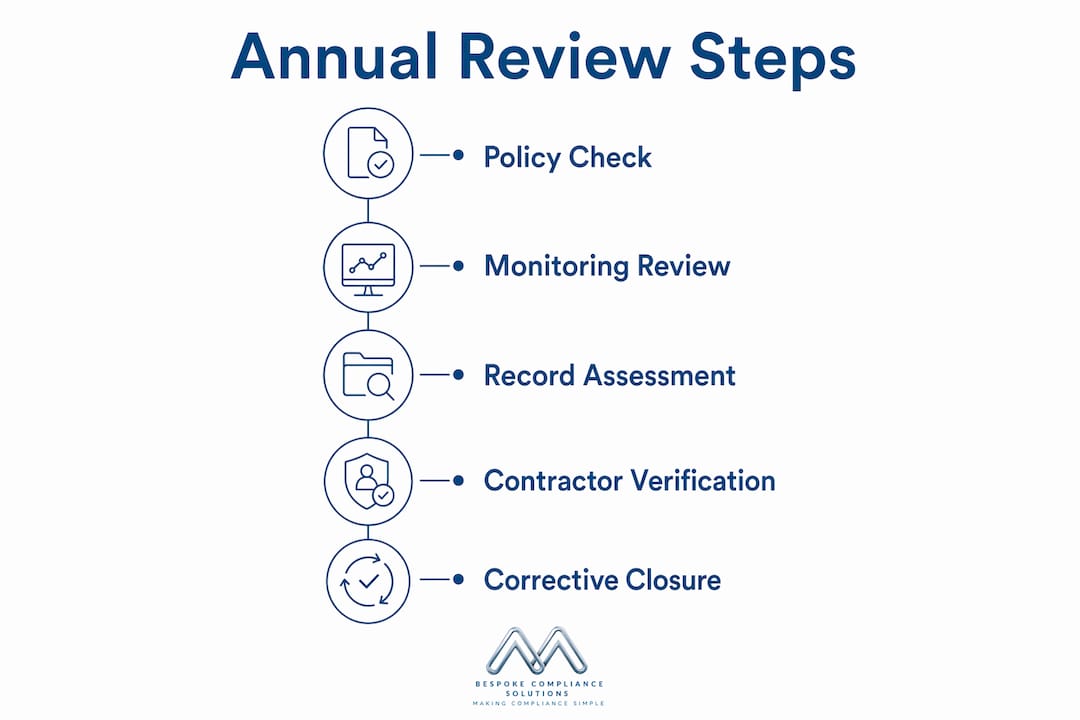
An annual water compliance review is a formal, systematic evaluation of everything that sits within a water safety management system. It is not a single test or a quick walk around the plant room. It covers policies, risk assessments, operational controls, monitoring data, and the records that prove all of the above are functioning.
The review typically encompasses:
Water safety plan review: checking that the written plan reflects current site conditions, occupancy, and any changes to the water system since the last review.
Legionella risk assessment update: confirming the existing assessment remains valid or commissioning a new one where significant changes have occurred.
Monitoring data verification: auditing temperature logs, biocide dosing records, and microbiological test results to confirm they are complete, within specification, and correctly interpreted.
Control measure audit: physically checking that controls such as thermostatic mixing valve (TMV) servicing, sentinel outlet flushing, and chlorination records are current.
Record-keeping review: confirming that logbooks, maintenance records, and corrective action logs are complete and defensible.
Who should conduct it? The review must be led by a competent person with demonstrable knowledge of Legionella risk management and the relevant legislation, specifically the HSE’s Approved Code of Practice L8 and Technical Guidance HSG274. That person may be an in-house water hygiene manager or an external specialist. What matters is that they can identify operational drift, not just tick boxes.
Timing matters too. Most organisations schedule the review annually, often aligned with their financial year or a fixed calendar date. The key is consistency: the same period each year allows meaningful year-on-year comparison of monitoring data.
Pro Tip: Schedule the review at least six weeks before your key regulatory reporting deadline. That window gives you time to commission any remedial sampling, update risk assessments, and close corrective actions before the paperwork is scrutinised.
How annual reviews shift your organisation from reactive to proactive

The most practical benefit of a structured annual review is that it catches problems before they become incidents. Organisations that skip or rush the process tend to discover compliance failures at the worst possible moment: during an enforcement inspection, after a positive Legionella test, or following a reportable illness.
Annual reviews deliver measurable operational gains:
Audit readiness: complete, verified records mean an HSE inspection does not become a crisis.
Early identification of operational drift: undocumented changes to dosing regimes or monitoring frequencies are caught and corrected.
Reduced remediation costs: fixing a gap in a temperature log costs far less than responding to an enforcement notice.
Improved data integrity: continuous data records simplify the review itself, turning it into a validation exercise rather than a rescue operation.
Stronger safety culture: when the review is taken seriously at board level, it signals to all staff that water safety is a genuine organisational priority.
Compliance Risk Index context: The Drinking Water Inspectorate’s industry median CRI rose from 1.171 in 2021 to 3.040 in 2023, before falling back to 1.741 in 2024 as regulatory action took effect. That trajectory tells you exactly where enforcement focus has been directed.
The shift from reactive to proactive risk management is not a philosophical preference. It is the difference between managing your water safety programme and having it managed for you by a regulator.
What the review covers: core components assessed
A thorough annual water compliance assessment works through every layer of the water safety management system. The components below represent the standard scope for most commercial, healthcare, and public-sector premises in the UK.
1. Water management policies Confirm that the written policy is current, signed by a senior responsible person, and reflects the actual site configuration. Outdated policies that reference decommissioned assets or former contractors are a common audit finding.
2. Legionella risk assessment Verify that the assessment covers all water systems, including any additions or modifications made during the year. Under HSE L8, a new or revised risk assessment is required whenever there is reason to believe the existing one is no longer valid.
3. Operational controls Check that all control measures are being implemented as specified. This includes:
Hot water storage temperatures (60°C at the calorifier)
Cold water storage temperatures (below 20°C)
TMV servicing frequencies
Sentinel outlet flushing records
Biocide dosing logs for cooling towers
4. Monitoring and testing records Review microbiological and chemical test results for the year. Confirm that samples were taken at the correct locations, using approved methods, and that results outside specification triggered documented corrective actions.
5. Record-keeping and logbooks A bespoke logbook system that captures all routine tasks, test results, and corrective actions is the backbone of a defensible compliance record. Gaps in the logbook are treated by inspectors as evidence that the task was not done.
6. Contractor and competency records Confirm that all contractors working on water systems hold appropriate qualifications and that their work is documented within the site records.
7. Corrective action closure Review all actions raised during the previous year’s assessment and confirm they have been closed, with evidence. Open actions from prior years are a significant red flag during enforcement visits.
A useful companion resource for structuring this process is a water hygiene audit checklist, which maps each component to the relevant regulatory requirement.
UK water safety legislation and what it demands from your review
Water safety compliance in the UK sits across several pieces of legislation and guidance, and the annual review must address all of them.
The primary framework includes:
The Health and Safety at Work etc. Act 1974: places a general duty on employers to manage risks to employees and others, including waterborne pathogens.
The Control of Substances Hazardous to Health Regulations 2002 (COSHH): requires assessment and control of biological agents including Legionella pneumophila.
HSE Approved Code of Practice L8: the definitive guidance on Legionella control, covering risk assessment, control schemes, and record-keeping requirements.
HSG274 Technical Guidance: provides detailed operational guidance for hot and cold water systems, cooling towers, and spa pools.
The Water Supply (Water Fittings) Regulations 1999: governs the installation and maintenance of water fittings to prevent contamination and waste.
The Drinking Water Inspectorate uses the Compliance Risk Index as its primary tool for directing enforcement activity. A CRI target of 2 has been set as the threshold from which financial penalties apply, making it a concrete benchmark for organisations to understand their exposure.
Key regulatory points to carry into your review:
Failures at water treatment works attract the highest CRI scores because of the large populations served.
The DWI shares CRI data with Ofwat as a common performance measure, meaning poor compliance affects financial regulation too.
Non-compliance with L8 can result in prosecution, unlimited fines, and in serious cases, custodial sentences for responsible individuals.
Regulatory bodies expect defensible documentation with approved methods, correct holding times, and complete quality assurance records.
Understanding how inspectors actually use these tools is covered in detail in Bespokecompliancesolutions’ guide on regulatory inspection assessments.
What industry experts say about the real risks of skipping annual reviews
The compliance community is clear on one point: treating the annual review as a bureaucratic exercise rather than a genuine risk management tool is where organisations get into trouble.
The concept of “process creep” is one that experienced compliance professionals encounter regularly. Small, undocumented changes accumulate: a monitoring frequency quietly drops from weekly to fortnightly, a dosing pump is adjusted without a record being made, a sentinel outlet is missed from the flushing schedule because a wing of the building is temporarily unoccupied. Individually, none of these changes looks catastrophic. Collectively, they represent a water safety system that has drifted from its validated state, and the paperwork will not show it.
Annual reviews that check for operational drift rather than simply verifying that records exist are the ones that actually prevent incidents. The distinction matters because an inspector will look at both.
A well-documented annual review also transforms compliance from a compliance officer’s problem into a shared organisational responsibility. When senior leadership signs off the review, when findings are reported to the board, and when corrective actions are tracked at management level, safety culture becomes embedded rather than bolted on. That cultural shift is what separates organisations that manage water safety from those that merely document it.
Building operators play a central role in sustaining this culture between formal reviews. Resources like this guide on building operator hygiene responsibilities illustrate how day-to-day operational decisions directly affect compliance outcomes.
When non-compliance causes real harm: lessons from enforcement cases
The consequences of failing to conduct adequate water compliance reviews are not theoretical. UK enforcement history provides clear examples of what happens when water safety management breaks down.
In 2012, a Legionnaires’ disease outbreak at an Edinburgh social club killed three people and infected 35 others. The investigation found that the cooling tower responsible had not been properly maintained or monitored, and that no adequate risk assessment was in place. The premises operator was prosecuted under health and safety legislation.
A 2019 case involving a UK hotel resulted in a significant fine after guests contracted Legionnaires’ disease. The investigation revealed that temperature monitoring had not been carried out consistently, records were incomplete, and the Legionella risk assessment had not been reviewed following changes to the water system. The absence of a structured annual review meant that these failures had accumulated undetected over an extended period.
NHS trusts have also faced enforcement action where safe water management in healthcare premises was found to be inadequate, with HTM 04-01 compliance gaps identified during DWI scrutiny of water safety plans. The common thread across all these cases is the same: the absence of a systematic, documented annual review that would have identified the control failures before they caused harm.
The financial consequences compound the human cost. Prosecution costs, remediation works, civil claims, and reputational damage routinely run to hundreds of thousands of pounds. An annual review, by comparison, is a fraction of that exposure.
How often should you review water safety beyond the annual cycle?
The annual review is the minimum, not the ceiling. Several triggers should prompt an interim review or targeted reassessment during the year.
Trigger-based reviews should occur when:
The building undergoes significant refurbishment or changes to the water system.
Occupancy patterns change substantially, for example a building moves from full to partial occupancy or vice versa.
A positive Legionella test result is returned from routine monitoring.
A new water source or treatment process is introduced.
A contractor carries out work on the water system that was not anticipated in the current risk assessment.
There is a reportable incident or near miss involving water quality.
Routine interim checks that sit between annual reviews include monthly temperature monitoring at sentinel outlets, quarterly checks of cold water storage tank conditions, and six-monthly TMV servicing in high-risk premises such as healthcare facilities. HTM 04-01 specifies more frequent monitoring intervals for healthcare settings, reflecting the vulnerability of the patient population.
Pro Tip: Build a simple trigger log into your water safety management system. Any event that could affect the validity of the current risk assessment gets logged immediately, and the compliance officer decides within five working days whether a formal interim review is needed.
The annual review should also assess whether the monitoring frequency itself remains appropriate. A building that has changed in use, size, or water system complexity may need more frequent checks than the previous year’s programme specified. Bespokecompliancesolutions provides ongoing consultancy to help organisations calibrate their monitoring programmes to actual site risk rather than a generic schedule.
Key takeaways
Annual water compliance reviews are the primary mechanism for preventing Legionella outbreaks, maintaining regulatory standing, and ensuring that water safety management reflects actual site conditions rather than outdated documentation.
Point | Details |
CRI as a benchmark | The DWI’s Compliance Risk Index rose from 1.171 in 2021 to 3.040 in 2023, then fell to 1.741 in 2024, signalling sharply increased and then moderated enforcement focus. |
Process creep is the hidden risk | Undocumented operational changes accumulate silently; only a structured review catches them before they cause failures. |
Documentation gaps drive failures | Incomplete records are a leading cause of compliance failures at audit, independent of whether controls were actually applied. |
Trigger-based interim reviews | Significant changes to the building, occupancy, or water system require a review outside the annual cycle. |
Competent person requirement | HSE L8 requires the review to be led by someone with demonstrable Legionella risk management knowledge, not just administrative access to the logbook. |
Recommended
Comments