
Why vacant properties increase bacteria risk: a guide for dutyholders

Vacant and unoccupied properties raise bacterial risk significantly, and Legionella is the primary concern. When a building sits empty, water stagnates in pipes and tanks, disinfectant residuals decay, and temperatures drift into a range conducive to Legionella pneumophila growth. HSE guidance is clear: dutyholders must assess and actively manage that risk, not simply wait until a new occupant moves in.
First actions if your property is vacant property or about to be:
Isolate or reduce flow to unused sections of pipework where it is safe to do so
Log the date the property became vacant property and note any known system changes
Arrange a visual check of tanks, cylinders and accessible fittings
Plan a formal risk review before anyone re-occupies the building
Pro Tip: Date-stamp every check you carry out, even a brief visual inspection. A timestamped log entry is evidence of active management and can protect you if a compliance question arises later.
Bespokecompliancesolutions supports dutyholders at every stage of this process, from initial risk assessment through to re-commissioning and ongoing water hygiene compliance across UK sites.
Table of Contents
How vacancy changes the water environment
The core problem is straightforward: water that moves regularly through a system is harder to colonise than water that sits still. Vacancy removes the daily demand that keeps water circulating, and that change sets off a chain of effects that favour opportunistic bacteria.
Stagnation and disinfectant decay
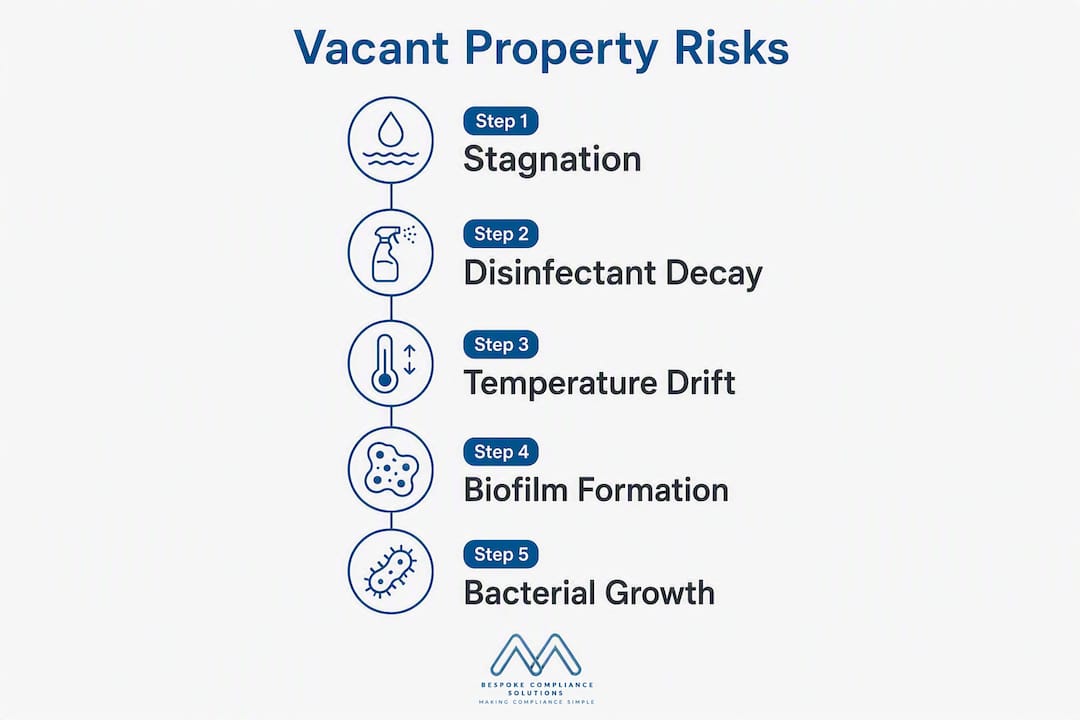
Mains water in the UK carries a residual chlorine or chloramine disinfectant. That residual is not permanent. CDC reopening guidance identifies stagnation, disinfectant loss and temperature drift as the three key hazards when buildings reduce or cease operation. Once the residual drops, biofilm-associated bacteria that would normally be suppressed can begin to proliferate in the pipe wall and in any sediment that has accumulated.
Temperature drift
Hot water systems in occupied buildings are typically maintained above 60 °C at the calorifier and above 50 °C at outlets. Cold water is kept below 20 °C. In a vacant property, both targets drift. Hot water cools as it sits unused; cold water warms, particularly in roof tanks or pipework running through warm voids. The result is a temperature window between roughly 20 °C and 45 °C that is permissive for Legionella growth.
Temperature callout: Legionella amplifies most readily between 20 °C and 45 °C. Above 60 °C, the organism is killed within minutes. Below 20 °C, growth is negligible. Vacancy routinely pushes systems into the danger zone.
Biofilm, dead legs and geometry
Biofilm forms on pipe surfaces in all water systems. In an occupied building, regular flow physically disrupts biofilm and delivers disinfectant to suppress it. In a void, biofilm matures undisturbed. Dead legs — sections of pipework that terminate without a regular outlet, common in refurbished offices or converted properties — are particularly prone because water in them never moves at all. The US EPA notes that stagnation can also accelerate corrosion, releasing metals that act as nutrients for opportunistic organisms and further destabilising water chemistry.
Stagnation alone does not guarantee high bacterial counts. Local biofilm and the specific identity of fittings often determine whether colonisation becomes significant. That nuance matters for proportionate risk management, but it does not reduce the duty to assess.
Which fittings and systems are most vulnerable in vacant properties buildings
Not every part of a water system carries equal risk. Prioritising inspections means knowing where bacteria growth in empty properties is most likely to take hold.
High-priority items
Cold water storage tanks (CWSTs): Any tank with a lid that has warped, corroded or been left open allows debris and insects to enter. Stagnant stored water warms quickly in summer and loses disinfectant residual faster than flowing mains.
Calorifiers and hot water cylinders: These store large volumes of water. If the thermostat has been turned down or the immersion heater switched off during vacancy, the stored volume can cool to within the growth range within days.
Showers: The combination of a spray that creates fine aerosols, a flexible hose that retains warm water, and a showerhead with rubber components that support biofilm makes showers the highest-risk outlet in most buildings.
Infrequently used taps and hose reels: Any outlet that was rarely used even before the property became vacant properties will have established stagnation conditions well before the building closed.
Secondary risk items
Decorative water features and fountains (aerosol-generating and often poorly maintained)
Sprinkler pre-action pipework with stored water sections
Solar thermal systems with stored water loops
External hose connections and garden taps
Sector context
In domestic lettings, the primary concerns are the CWST (where present), the hot water cylinder and showers. In offices and commercial premises, dead legs from previous fit-outs, cooling towers and calorifiers add complexity. Schools and small care settings often have both stored water and a population of vulnerable users, which raises the consequence of any failure. Legionella compliance for schools and colleges requires particular attention to these combined risk factors before a building reopens after a holiday or extended closure.
How quickly risk can develop, and what to look for
The timeline question matters because it determines how urgently you need to act. Guidance and published studies converge on a practical threshold of roughly 2–3 weeks as the point at which water age becomes significant in most systems, though some effects appear much sooner.
Short term (hours to days)
Chlorine residual at a fixture can drop to near zero within hours of flow stopping, particularly in warm pipework. Temperature drift at the outlet level begins within the same timeframe. These early changes do not immediately produce high bacterial counts, but they remove the barriers that prevent colonisation.
Medium term (weeks)
Biofilm communities shift within weeks of reduced flow. Research published in Frontiers in Water found that flushing temporarily improved water quality but that counts rebounded within days to a week under low-occupancy conditions, with fixture identity and biofilm state often governing the outcome. This is the window in which a simple flushing programme may give a false sense of security.
Longer closures
Properties vacant property for months, or those that have been through a full heating season without use, may require more intrusive remediation. Sediment accumulates in tanks, scale builds on heating elements, and biofilm matures to a state where flushing alone will not dislodge it.
Practical threshold: Many industry protocols treat 2–3 weeks of low or zero occupancy as the trigger for a documented flushing or inspection check. Beyond that, a formal risk review is warranted.
Observable indicators without lab tests
You do not need a laboratory result to spot early warning signs. Watch for:
Lukewarm water at hot outlets (suggests cylinder temperature has dropped)
Musty, earthy or metallic taste or odour from taps
Discoloured or cloudy water, particularly from outlets that have not been run recently
Visible deposits, scale or debris in tanks or on showerheads
Reduced flow or unusual pressure fluctuations at outlets
Any of these should prompt a documented check and, depending on the system complexity, a call to a competent water hygiene specialist.
What UK law and HSE guidance require of dutyholders
There is no single statute that mandates Legionella testing in every vacant property. The legal position is more nuanced, and understanding it correctly matters for both compliance and liability.
Under the Health and Safety at Work etc. Act 1974 and the Control of Substances Hazardous to Health Regulations 2002 (COSHH), dutyholders have a duty to assess and control the risk from Legionella in water systems under their control. HSE guidance sets out that this duty applies regardless of whether a building is occupied. ACOP L8 (the Approved Code of Practice) and HSG274 (the associated technical guidance) are the principal references. Compliance with ACOP L8 is not legally mandatory in the same way a regulation is, but departing from it requires demonstrably equivalent or better control, and in practice most enforcement actions reference it.
What “active management” means in a void
A dutyholder cannot simply lock a building and assume the risk disappears. Active management during vacancy means:
Reviewing the existing risk assessment to reflect the change in use
Documenting any flushing, isolation or temperature checks carried out
Recording who carried them out and when
Planning a re-commissioning review before the building is re-let or reoccupied
Compliance note: Failure to document mitigation steps is legally precarious even where no incident occurs. An undocumented void period is difficult to defend if a subsequent Legionella case is traced to the property.
Who is the dutyholder?
In a commercial property, the dutyholder is typically the employer or the person in control of the premises, which may be a landlord, a managing agent or a facilities manager depending on the lease structure. In a domestic letting, the landlord holds the duty. Practical guidance for landlords emphasises proportionality: a short, simple domestic void with no stored water is a very different risk profile from a long-empty commercial building with tanks and calorifiers, and the response should reflect that difference.
Step-by-step checklist before reoccupying a vacant property
Re-commissioning a vacant properties building is the logical compliance moment. The steps below apply to most UK property types; adjust the scope based on system complexity and vacancy duration.
Preliminary steps
Confirm isolation points and valve positions for the cold and hot water systems
Locate and inspect access points to tanks, cylinders and any plant rooms
Update the risk assessment to reflect the vacancy period, any known changes to the system, and the intended new use
Pre-occupation sequence
Visual inspection: Check cold water storage tanks for debris, contamination, lid integrity and signs of corrosion. Inspect calorifier and cylinder condition where accessible.
Controlled flushing: Flush all outlets in a logical sequence, starting from the mains inlet and working outward. Run each outlet until temperature stabilises. Do not simply run all taps simultaneously, as this can reduce pressure and extend the time needed.
Temperature checks: Measure hot water at representative outlets after one minute of running. Cold water should be checked at the inlet and at the furthest outlet. Record all readings.
Tank inspection and cleaning: Where tanks show sediment, biofilm or debris, clean and disinfect before refilling. This is not optional if visual inspection reveals contamination.
Disinfection and sampling: For complex systems, long vacancies or where temperature checks fail targets, chemical disinfection followed by verification sampling is the appropriate next step.
Logbook update: Record every action, the date, the person responsible and the outcome. Photograph tanks, outlets and any remedial work carried out.
Temperature targets
Parameter | Target | Acceptable tolerance |
Hot water at calorifier/cylinder | 60 °C or above | Measured at store |
Hot water at outlet (after 1 min) | 50 °C or above | Within 1 minute of running |
Cold water at inlet | Below 20 °C | Measured at mains entry |
Cold water at outlet (after 2 min) | Below 20 °C | After 2 minutes of running |
Suggested logbook fields
Property address and system reference
Date of vacancy and date of inspection
Name and competency of person carrying out checks
Outlet reference, temperature reading, time of measurement
Visual inspection findings (tank condition, showerhead condition)
Any remedial actions taken and date completed
Signature and date
Pro Tip: Photograph tanks, showerheads and any visible deposits before and after cleaning. A timestamped photograph is faster to produce as evidence than a written description and is harder to dispute.
The tenant safety water hygiene checklist for landlords provides a practical companion to this sequence for domestic letting scenarios.
When should you arrange sampling or call a specialist?
Routine visual checks and flushing are appropriate for simple, short vacancies. Several situations call for Legionella water testing or a competent water hygiene specialist.
Clear triggers for specialist involvement
The system includes cold water storage tanks, calorifiers or any stored water volume
The vacancy has exceeded several months, or the system history is unknown
Temperature checks at outlets consistently fail to reach targets after flushing
Water appears discoloured, has an unusual odour, or visual inspection reveals sediment or biofilm in tanks
The building will be occupied by immunocompromised individuals, elderly residents or children — groups where the consequence of exposure is significantly higher. Legionella risk management for immunocompromised patients sets out why this population warrants a more cautious threshold.
There is a prior record of positive Legionella results in the system
Known dead legs exist from previous fit-outs or alterations
A cooling tower or evaporative condenser is present
Pragmatic thresholds
A short domestic void with a combi boiler and no stored water is a low-complexity scenario. A commercial office block with a roof tank, calorifier, multiple showers and a history of partial occupation is not. The Frontiers in Water research finding that flushing benefits can revert within a week under low-occupancy conditions underlines why complex systems need more than a tap-running exercise.
What to brief a contractor
When you do engage a specialist, have the following ready:
As-built or schematic drawings of the water system (or a description if drawings are unavailable)
The date the building became vacant property and any maintenance carried out since
The last risk assessment and any previous sampling results
Access arrangements for plant rooms, roof tanks and any locked areas
Comparing control measures for vacant properties
No single control measure suits every void. The table below compares the main options on practical criteria so you can weigh them against your system type and vacancy duration.
Control measure | Effectiveness | Labour intensity | Water use | Verification ease |
Routine flushing | Moderate effectiveness for short-term control | Low to medium | Medium to high | Easy (temperature log) |
Thermal regime maintenance | High (sustained) | Low (automated) | Low | Easy (temperature log) |
Shock chlorination | High (point-in-time) | Medium | Low | Requires sampling |
Continuous dosing | High (sustained) | Low (automated) | Low | Requires monitoring |
Tank cleaning and disinfection | High (removes reservoir) | High | Medium | Visual + sampling |
Automated temperature monitoring | High (early warning) | Very low (once installed) | None | Continuous data log |
Practical notes on each approach
Routine flushing is the most common first response and is appropriate for short vacancies with simple systems. Its limitation is that it addresses bulk water quality temporarily without tackling biofilm in pipe walls or sediment in tanks.
Thermal regime maintenance, keeping hot water above 60 °C and cold below 20 °C throughout the void, is the most reliable passive control. It requires the heating system to remain operational, which has energy cost implications, but it removes the temperature window that Legionella needs.
Shock chlorination is effective at point-in-time decontamination but does not provide ongoing protection. It is typically used after a confirmed positive result or as part of a re-commissioning sequence, followed by verification sampling.
Tank cleaning physically removes the sediment and biofilm reservoir that other measures cannot reach. For any system with stored water that has been vacant property for more than a few weeks, it is the most defensible starting point.
Automated temperature monitoring removes the reliance on manual checks and provides a continuous evidence trail. For larger portfolios or buildings with complex systems, it is worth the installation cost.
Safety and competency
Disinfection using biocides requires a competent person. Staff re-commissioning a system after a long void should receive Legionella awareness training before carrying out any work, and the scope of work should be documented in a method statement.
Why “just running the taps” is often not enough
The intuitive response to a vacant property is to run every tap for a few minutes before handing over the keys. Research and practitioner experience both suggest this is frequently insufficient.
The Frontiers in Water building-closure study found that flushing temporarily restored chlorine residual and reduced bacterial cell counts, but that counts rebounded to pre-flushing levels within days to a week in some systems during low-occupancy periods. The study identified fixture identity and biofilm state as often more decisive than the flushing act itself.
What flushing does and does not do
It displaces stagnant bulk water and temporarily restores disinfectant residual at the outlet
It does not remove established biofilm from pipe walls
It does not clean sediment from tanks or cylinders
It does not address dead legs, where water never reaches the outlet regardless of how long other taps run
Repeated weekly flushing may not sustain improved water quality in systems with significant stored volumes
When flushing is appropriate
Flushing is a proportionate first step for short vacancies (days to a few weeks) in simple systems with no stored water, where temperature targets are met and there is no history of problems. It should always be documented with temperatures recorded.
When more is needed
Situation | Recommended action |
Vacancy under 2–3 weeks, simple system | Documented flushing with temperature checks |
Vacancy over 2–3 weeks, stored water present | Flushing plus tank inspection; disinfection if indicated |
Failed temperature targets after flushing | Investigate cause; consider disinfection and sampling |
Prior positive Legionella result | Specialist assessment, disinfection and verification sampling |
Complex system, unknown history | Full risk assessment review before any re-occupation |
Industry practitioners note that “just running the taps” is often a substitute for a tailored risk strategy rather than a genuine control measure. Re-letting is the logical compliance moment to reassess the system properly, not to assume a standard routine is sufficient.
Key takeaways
Vacant properties increase bacterial risk because stagnation, disinfectant decay and temperature drift create the exact conditions Legionella needs to multiply, and UK dutyholders have a legal duty to assess and manage that risk before re-occupation.
Point | Details |
Stagnation drives risk | Disinfectant residuals decay and temperatures drift into the 20–45 °C growth range when water stops moving. |
A few weeks is a practical threshold | Many protocols treat this as the trigger for a documented flushing or inspection check. |
Flushing alone is often insufficient | Research shows bacterial counts can rebound within days; biofilm and tank condition must also be addressed. |
Document every action | Undocumented void management is legally precarious; timestamped logs and photographs are your evidence. |
Bespokecompliancesolutions | Provides risk assessments, tank cleaning, water sampling, and re-commissioning support for vacant properties properties across the UK. |
The part of void compliance most dutyholders underestimate
The conversation around vacant properties and Legionella tends to focus on the dramatic end of the risk spectrum: long-empty buildings, roof tanks full of debris, systems that have not been touched in years. Those cases are real, but they are not where most compliance failures actually occur.
The more common pattern is a property that has been vacant property for several weeks, where someone has run the taps before handover, noted no obvious problems, and moved on. No risk assessment review. No temperature records. No tank inspection. The building looks fine, the water runs clear, and the dutyholder feels they have done what is reasonable.
What that approach misses is that the absence of visible symptoms is not evidence of safety. Biofilm does not announce itself. A calorifier that has cooled to 45 °C looks identical to one at 60 °C. The Frontiers in Water research makes this point precisely: flushing can temporarily mask a problem without resolving it, and the system reverts within days.
The dutyholders who manage this well are not necessarily the ones with the most complex systems. They are the ones who treat re-occupation as a compliance trigger, not an afterthought. They review the risk assessment, they record what they did, and when the system is beyond their competence they call someone who knows it properly. That habit, applied consistently, is what separates defensible compliance from a liability waiting to surface.
Bespokecompliancesolutions: specialist support for vacant properties-property water hygiene
Vacant property compliance is one of the most time-pressured situations a facilities manager or landlord faces: the building needs to be re-let, the clock is running, and the water system has been sitting idle for weeks or months. Getting it right quickly, with a clear evidence trail, is exactly what Bespokecompliancesolutions is built for.
The services most relevant to void and re-commissioning scenarios include:
Legionella risk assessments — reviewed and updated to reflect the vacancy period and any system changes
Whether you manage a single domestic let or a portfolio of commercial premises, Bespokecompliancesolutions works across all sectors in the UK. To request a site assessment or quote, contact the team with your property address, a brief description of the water system, and the date the building became vacant properties. That information is enough to scope the work and get you a clear next step.
Useful sources and further reading
The sources below are the primary references for the claims and guidance in this article. Each is worth bookmarking if you maintain your own compliance records.
Managing legionella in hot and cold water systems (HSE): The principal UK reference for dutyholder obligations, ACOP L8 principles and HSG274 technical guidance. Use this to confirm your legal position and recordkeeping requirements.
Reopening Buildings Guidance: Control Legionella (CDC): US federal guidance that identifies stagnation, disinfectant loss and temperature drift as the core hazards when buildings reduce or cease operation. Useful international corroboration for the mechanism explanations in this article.
Legionella in the indoor environment (US EPA): Covers the water chemistry effects of stagnation, including corrosion and metal release, which can encourage opportunistic organisms beyond Legionella.
Is flushing necessary during building closures? (Frontiers in Water): The key peer-reviewed study on flushing efficacy during extended building closures. Supports the argument that flushing is a temporary measure and that fixture identity and biofilm state often govern outcomes.
Legionella during void periods: what landlords should do before re-letting (Manchester EICR): Practitioner guidance emphasising proportionality and the re-let moment as the primary compliance trigger for landlords.
The impact of vacant properties and abandoned property on health and well-being (PMC): Peer-reviewed research on the broader public health consequences of vacancy and building neglect, providing wider context for the health risks of vacant properties homes.
Recommended
Comments