
24 Hour Cold Water Storage Turnover Checklist for UK FM Teams
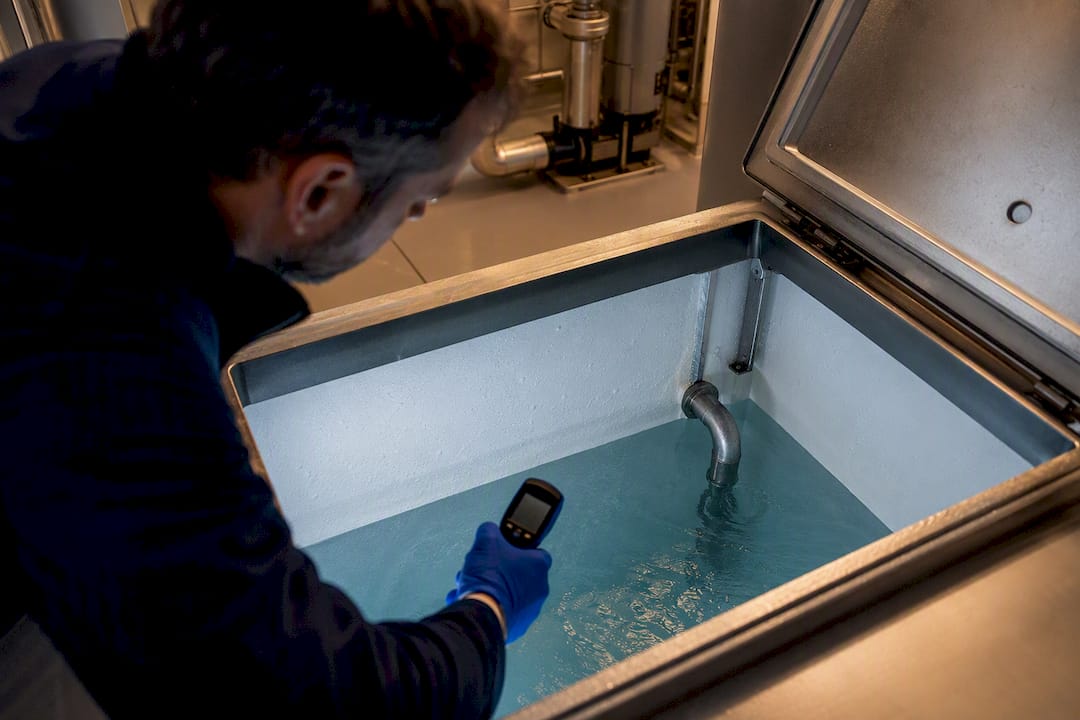
Cold water storage turnover is the rate at which stored water is replaced by fresh supply, expressed as water age. The practical target is a full tank turnover within 24 hours and a cold water temperature below 20°C wherever the system allows it. If either target is being missed, the first checks are stored volume, inlet and outlet position, and sentinel temperature readings.
TL;DR:
Tanks oversized for current demand or with poor internal design can have water ages six times longer than the recommended 24 hours, increasing microbial risks.
A tank with less than 40% daily drawdown or no full drain in a month likely experiences slow turnover, even if calculations suggest compliance.
Installing inlet and outlet diagonally, with internal baffles, can permanently improve water flow and reduce stagnation without ongoing intervention.
Routine sentinel temperature checks and sediment inspections, conducted regularly and logged, can identify stagnation before it becomes a safety issue.
A site survey from a specialist can determine whether a remedial fix, such as re-sizing, insulation, or internal modifications, is needed to ensure safe turnover rates.
Table of Contents
What is cold water storage turnover, and why does it matter for microbial risk?
Water age is how long water sits in a tank before it’s drawn off and replaced. Turnover is the inverse: how often the whole volume gets refreshed. A tank that never fully empties between fills has poor turnover no matter how big or clean it looks, and that stagnant water is exactly where problems start.
Legionella bacteria multiply fastest between roughly 20°C and 45°C, which is why HSE guidance sets the target for stored and distributed cold water below 20°C. Stagnant water in a tank sitting in a warm plant room or exposed roof space can drift into that band even in a British winter, let alone during a heatwave. Slow turnover gives bacteria the time and warmth they need to establish a biofilm on internal surfaces, and once that biofilm forms, routine flushing alone often won’t shift it.
Two design faults cause most of the stagnation problems facilities managers encounter:
Oversizing — a tank sized for peak demand decades ago, or for a building that never reached its planned occupancy, sits mostly full and barely turns over.
Short-circuiting — water enters near the outlet and leaves again quickly, so a large portion of the tank volume never actually gets drawn on, regardless of the theoretical turnover rate.
Both faults produce the same result: a tank that looks compliant on paper but harbours a stagnant reserve you can’t see from the hatch.
How do you calculate water age and tank turnover?
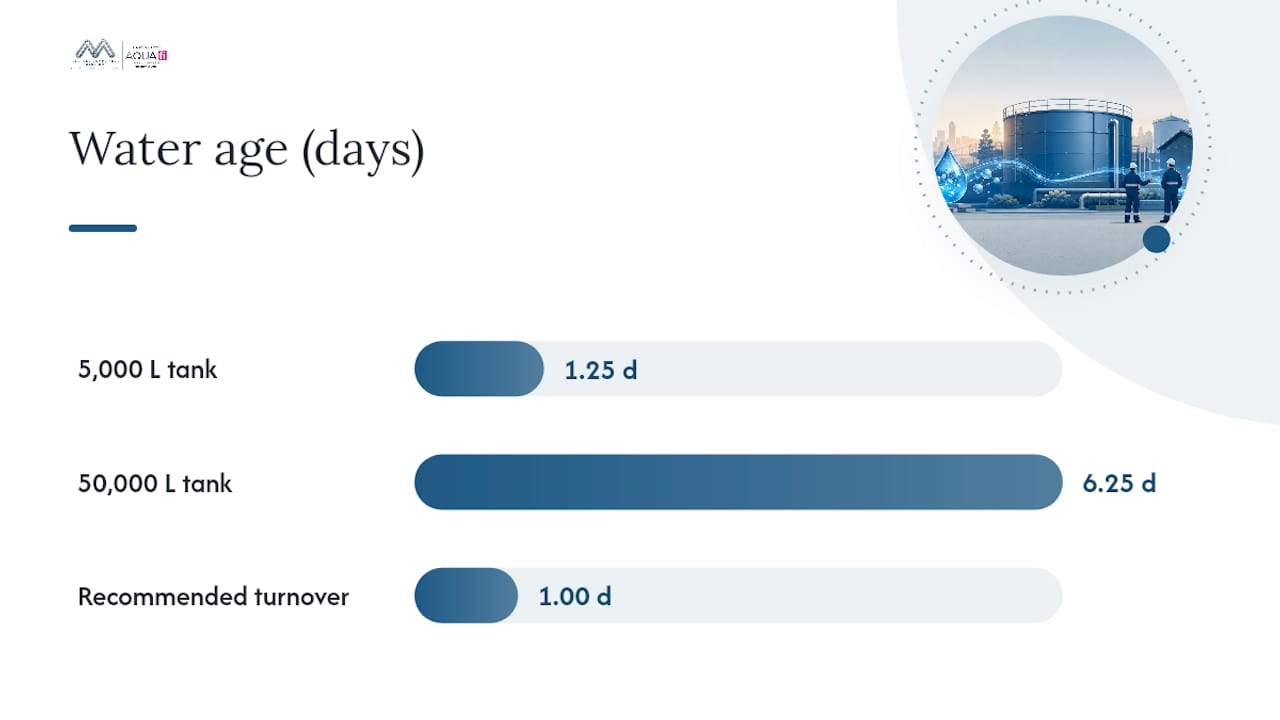
The formula is straightforward: water age (days) = storage volume (litres) ÷ average daily demand (litres/day). Tank sizing guidance from Tricel Water UK recommends checking this figure against actual usage, not the design assumption from the building’s commissioning documents.
Two worked examples show how quickly this goes wrong:
5,000 litre tank, 4,000 litres/day demand — water age is 1.25 days (30 hours). This sits close to the 24 hour target and probably needs only minor adjustment, such as trimming stored volume slightly or confirming there’s no dead zone.
50,000 litre tank, 8,000 litres/day demand — water age is 6.25 days. That’s roughly six times the recommended turnover period, and it’s a common scenario in buildings where occupancy dropped after the tank was installed, or where a fire reserve was never separated from the domestic supply.
Three quick on-site checks tell you whether the theoretical number matches reality:
Percentage drawdown per day — measure the depth drop over 24 hours against total tank depth; anything under 30% to 40% suggests slow turnover regardless of what the calculation says.
Frequency of full drawdown — ask whether the tank has ever visibly emptied close to its float valve cut-off in the last month; if not, water age is likely worse than the formula suggests.
Temperature stratification — take readings at the top, middle, and bottom of the tank; a gap of more than a degree or two often points to poor mixing rather than a demand problem.
Low-flow fittings installed to cut water bills can quietly worsen turnover by reducing daily demand without anyone adjusting the tank size, as engineering reviews of domestic cold water systems have found — worth remembering before you assume the tank itself is the problem.
Which design measures actually improve turnover?
Design fixes solve stagnation permanently, without the ongoing water waste that comes with flushing regimes. They cost more upfront but need no operator intervention once installed, which makes them the better investment for any tank expected to stay in service for years.
Inlet and outlet placement is the single biggest lever. Positioning the inlet and outlet diagonally opposite each other forces water to travel the full length of the tank, dragging the whole volume through rather than skimming a shortcut between two adjacent connections.
Baffles and compartmentation break up large tanks into sections that force sequential filling and draining, which is particularly important above roughly 5,000 to 10,000 litres, where a single open volume almost always develops dead zones. Multi-compartment tanks also let you take one section offline for cleaning without losing supply entirely.
Sizing discipline matters just as much as internal geometry:
Size storage to realistic current demand, not the design occupancy from a decade ago.
Separate any firefighting reserve from the domestic cold water volume; combining them is one of the most common causes of oversized, slow-turning tanks.
Route pipework and insulate the tank fabric to limit heat gain from plant rooms, direct sunlight on roof-level tanks, or nearby hot water pipework.
Larger or multi-compartment tanks need temperature sensors at more than one level and location, because a single sentinel point at the outlet will miss a warm pocket forming near an unused inlet leg.
Pro Tip: Before specifying baffles or a second tank, get an actual demand profile over two to four weeks. Sizing a fix around an assumed usage pattern is how tanks end up oversized twice.
How do you monitor and flush a tank to keep turnover on track?
Monitoring catches deterioration before it becomes a compliance failure; flushing buys time when a design fix isn’t yet possible. HSG274 Part 2 sets out sentinel monitoring and inspection expectations that most UK schemes are built around.
Sentinel points: a “near” sentinel close to the tank outlet and a “far” sentinel at the furthest point of use both need checking, because a healthy reading near the tank can mask a warm dead leg elsewhere in the system.
Monitoring frequency: HSG274’s technical guidance is built around regular sentinel checks with results logged, not spot-checked occasionally when someone remembers.
Temperature thresholds: readings consistently above 20°C at a cold water sentinel point should trigger investigation, not just a note in the logbook.
Flushing strategy: manual flushing works for low-risk, infrequently used outlets, but automatic temperature-triggered flushing responds faster to genuine deviations — the trade-off is water consumption, which can spike sharply during hot weather if flushing triggers fire repeatedly.
BMS integration: automated monitoring flags a drifting sentinel reading immediately rather than waiting for the next scheduled manual check, which matters most in buildings with vulnerable occupants.
Our guide to temperature monitoring checks covers sentinel selection and logging practice in more depth, and automated temperature monitoring is worth a look if manual checks keep slipping.
What inspection and cleaning regime prevents stagnation?
A tank that passes its annual inspection on paper can still be breeding a biofilm if the checklist only covers the obvious visual points. The Drinking Water Inspectorate’s guidance on storage tanks and cisterns sets the baseline most UK operators work to.
Annual internal inspection — check the lid seals securely, insect and vermin screens are intact, there’s no light ingress, and sediment hasn’t accumulated on the base; any of these failing warrants immediate action rather than waiting for the next scheduled visit.
Cleaning and disinfection triggers — visible sediment, discoloured water, a failed bacteriological sample, or more than roughly a year since the last clean all justify a full clean and disinfection, carried out by a competent contractor rather than in-house maintenance staff.
Recordkeeping — keep inspection dates, sample results, sentinel temperature logs, and any corrective actions in one auditable record; this is what an environmental health officer or insurer will ask for first.
Commissioning advice — avoid filling and commissioning a large tank months before a building reaches full occupancy; a tank sitting mostly static from day one starts accumulating risk before anyone has moved in.
When should you reduce storage or add remedial engineering?
Three triggers point to remedial action rather than continued monitoring: water age consistently above 24 hours, repeated sentinel readings between 20°C and 24°C, or persistent sediment and contamination despite regular cleaning. Any one of these on its own is worth investigating; two together usually means the current setup can’t be fixed by flushing alone.
The remedial options sit on a rough spectrum of cost and permanence. Reducing stored volume is the cheapest fix and often the most overlooked, particularly where a fire reserve was never separated out. Fitting baffles or compartments costs more but solves short-circuiting permanently. Secondary or cooled circulation suits buildings where insulation and turnover alone can’t hold cold water below target, since circulating cooled water reduces both flushing volumes and microbiological growth without relying on constant manual intervention. Biocide dosing is a last resort for persistent contamination, not a substitute for fixing the underlying stagnation.
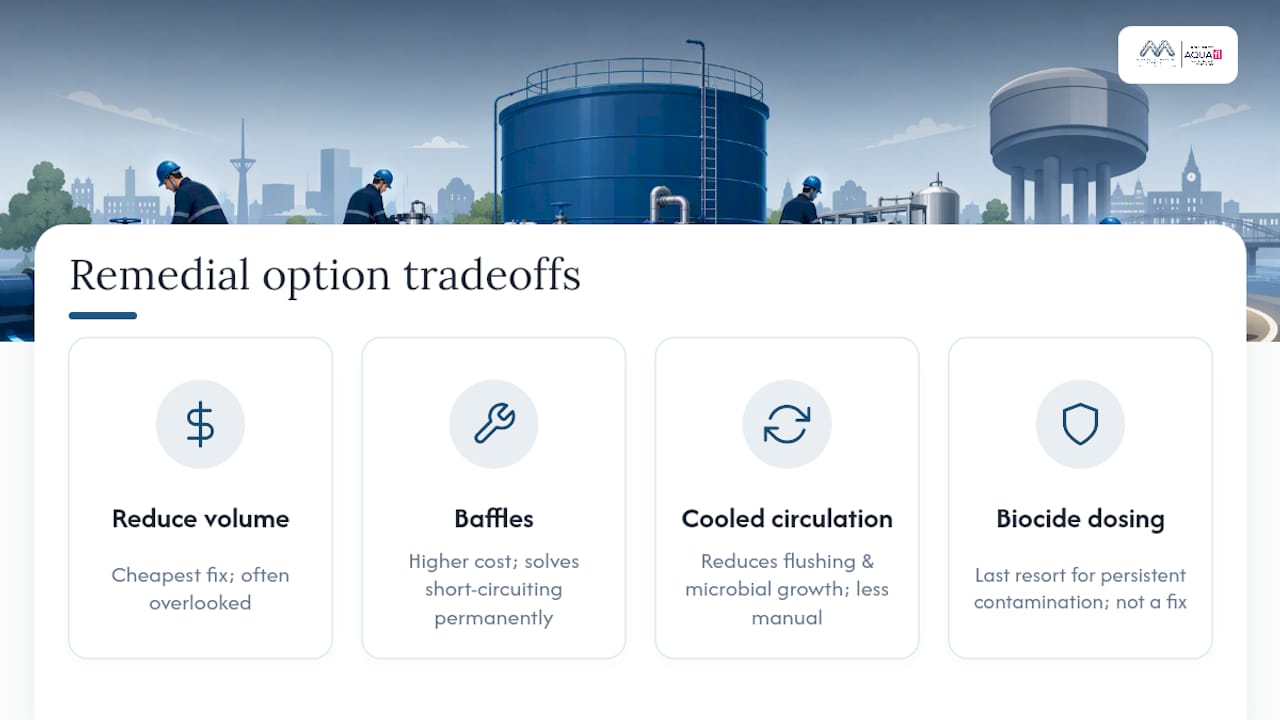
Weigh water waste against capital cost, and weigh regulatory exposure against occupant vulnerability, before committing to a route, then engage a contractor who can survey the specific tank rather than apply a generic fix.
What does a facilities manager’s quick reference checklist look like?
A practical site checklist covers three things every visit: sentinel temperatures at near and far points, visible tank condition through the hatch, and a comparison of actual drawdown against the calculated water age.
The pitfalls that catch experienced operators out are rarely the obvious ones. Assuming a tank is “well mixed” because it’s fitted with an inlet and outlet is the most common mistake. Without opposing geometry or baffles, large tanks develop dead volumes that no amount of theoretical calculation will reveal. Short-circuit zones near unused legs or old firefighting connections are equally easy to miss on a routine walk-round. Commissioning storage before a building reaches occupancy is the third recurring trap.
Bespokecompliancesolutions structures interventions around this sequence: a risk assessment to establish the baseline, monitoring to confirm where the problem actually sits, targeted remedial works, then verification sampling to close the loop.
Pro Tip: If a tank has never fully emptied in living memory, treat that as a red flag before you even run the water age formula.
Prioritising turnover fixes when budgets are tight
Not every tank needs the same level of urgency, and pretending otherwise wastes money you could be spending on the tanks that genuinely need it. Triage by three factors: who uses the water (a care home carries far more risk than a lightly used storage unit), what the sentinel readings actually show over several visits rather than one snapshot, and what the water age calculation says once you’ve checked it against real drawdown.
For rapid risk reduction on a limited budget, monitoring comes first because it’s cheap and tells you where the real problem is. Insulation and inlet or outlet repositioning usually follow, since design fixes solve stagnation without ongoing intervention once they’re in place. Structural changes and cooled circulation come last, reserved for tanks where the cheaper fixes have already failed.
Bespokecompliancesolutions supports clients through this exact sequence, from initial survey through to remedial works and verification, across sites where budgets rarely stretch to fixing everything at once.
— Sammi
Get a site survey from Bespoke Compliance Solutions
Bespokecompliancesolutions gives facilities managers something most agencies don’t: a single team that surveys the tank, fits the sentinel monitoring, carries out the clean, and verifies the fix, rather than handing you off between separate contractors for each stage.
[
If your tank is showing a water age above 24 hours or sentinel readings creeping past 20°C, a site survey is the fastest way to find out whether you need a design fix, a cleaning cycle, or just a monitoring adjustment. Our Legionella risk assessments establish the baseline, and where a tank needs attention, water tank cleaning and disinfection and remedial engineering follow from the same survey rather than a separate quote round. Water sampling and analysis then confirms the fix has actually worked. Get in touch to book a survey and find out what your tank’s actual water age looks like.
Primary guidance and standards to consult
For audit and compliance purposes, cross-reference site records against HSG274 Part 2 for turnover targets and inspection frequency, the Drinking Water Inspectorate’s guidance on tanks and cisterns for lid, screen and cleaning requirements, and CIBSE Guide G alongside BS 8558 for sizing and design.
Sources
FAQ
What is a safe water age for a cold water storage tank?
Aim for turnover of the whole tank volume within 24 hours, which HSG274 Part 2 sets as the working target; water age much beyond that increases the risk of temperatures drifting into the range where Legionella can multiply.
How big should a cold water storage tank be?
Size it to realistic current daily demand rather than historic design occupancy, using the water age formula (volume ÷ daily demand) to check the result stays close to 24 hours; oversized tanks are the leading cause of poor turnover.
What are the regulations for cold water storage tanks in the UK?
HSG274 Part 2 governs turnover, temperature and inspection expectations for Legionella control, alongside the Water Supply (Water Fittings) Regulations and Drinking Water Inspectorate guidance on tank construction, lids and screening.
What are the requirements for storage cisterns over 1,000 litres?
Larger cisterns need secure, insect proof lids, annual internal inspection, and typically warrant multiple temperature sensors and baffles to prevent the dead zones that develop more readily once volume passes a few thousand litres.
How much does a 5,000 litre tank cost?
Cost varies by material, insulation specification and installation complexity, and isn’t fixed publicly; a site survey from a compliance specialist is the most reliable way to get a figure matched to your building’s actual demand and layout.
Recommended
Comments