
Health and Safety at Work Act: water safety explained

The Health and Safety at Work Act 1974 is the primary UK law placing a legal duty on employers and premises controllers to manage water safety risks, including waterborne hazards such as Legionella bacteria and unsafe drinking water. Sections 2, 3, and 4 of the Act impose specific obligations that extend to every water system under your control. This article explains what those obligations mean in practice, who holds legal accountability, and what steps you must take to demonstrate compliance. If you are an employer, facilities manager, or health and safety officer, this is the legal framework you are working within every day.
What water-related risks does the Health and Safety at Work Act cover?
The Act covers a broader range of water risks than most employers realise. Legionella bacteria thrive in workplace water systems such as cooling towers, hot water tanks, and calorifiers, and can cause Legionnaires’ disease, a potentially fatal form of pneumonia. That makes Legionella one of the most serious waterborne hazards the Act addresses.
Beyond Legionella, the Act also covers:
Contaminated drinking water. Employers must provide safe drinking water that is readily accessible at suitable points throughout the workplace.
Working near open water. Employees who work near rivers, canals, or other open water face risks including drowning, cold water shock, and waterborne disease. Employers must implement safe systems of work and provide appropriate training and emergency procedures.
Poorly maintained water systems. Stagnant water, incorrect temperatures, and inadequate flushing all create conditions where bacteria multiply rapidly.
Inadequate welfare facilities. The Act requires sufficient sanitation and washing facilities, which depend on a functioning and safe water supply.
The secondary guidance documents ACOP L8 and HSG274, published by the Health and Safety Executive (HSE), provide the technical detail on how to control these risks. The Act sets the legal duty; ACOP L8 and HSG274 explain how to meet it.
Pro Tip: If your premises has a cooling tower, a spa pool, or a complex hot and cold water distribution system, your Legionella risk profile is significantly higher than a standard office. Treat those systems as a priority within your risk assessment programme.
How does the Act assign responsibility for water safety at work?
The primary duty holders under the Act are employers and those who control non-domestic premises. If you manage a building, you hold legal accountability for the water systems within it, regardless of whether you occupy the premises yourself. Section 3 extends this duty to protect non-employees, including visitors, contractors, and members of the public, from risks arising from your work activities.

This is a point that facilities managers and landlords frequently underestimate. Section 3’s duty to protect non-employees plays a critical role in premises controller liability during water safety prosecutions. A tenant falling ill from Legionella in a building’s shared water system is a Section 3 matter, not just a Section 2 one.
Employees also carry responsibilities. They must cooperate with water hygiene protocols and report any concerns about water systems to their employer. That cooperation duty does not, however, shift legal accountability away from the employer.
The most common misconception in this area is that appointing a contractor to manage water systems removes the employer’s legal liability. Hiring contractors does not absolve the employer of their duty. Ultimate accountability remains with the employer or premises controller at all times. Contractors carry out the work; you remain responsible for ensuring it is done correctly and documented properly.
Pro Tip: When appointing a water hygiene contractor, obtain written confirmation of their competence, check their methodology, and retain all service records. These documents form part of your legal defence if enforcement action is taken.
What practical steps are required to comply with the Act on water safety?
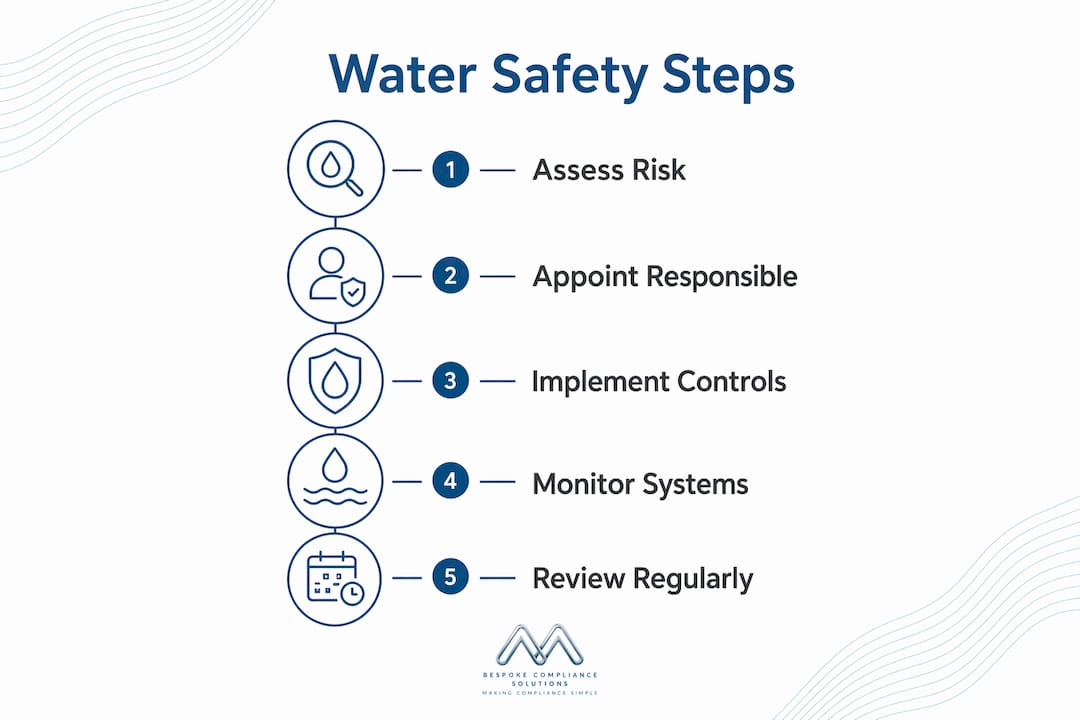
Compliance with the Act’s water safety duties follows a clear sequence. Each step builds on the last, and each must be documented.
Conduct a written Legionella risk assessment. The risk assessment must cover all water systems on site, identify potential sources of Legionella proliferation, and assess the likelihood and severity of exposure. If the assessment is not written down, inspectors treat non-compliance as the default position.
Implement a water safety control scheme. Based on the risk assessment findings, establish a control programme covering temperature management, biocide dosing where applicable, and regular system flushing. ACOP L8 provides the technical benchmarks for each control measure.
Maintain safe drinking water provision. Drinking water must be readily available, clearly labelled, and protected from contamination. This applies to every workplace, regardless of size or sector.
Monitor and test water systems regularly. Temperature checks, water sampling, and microbiological testing must be carried out at defined intervals. Results must be recorded and reviewed.
Train relevant staff. Anyone responsible for managing or monitoring water systems needs sufficient knowledge to carry out their duties. Legionella awareness training is the recognised standard for this purpose.
Review and update the risk assessment. The assessment is not a one-off exercise. Reviewing your Legionella risk assessment after significant changes to the building, water systems, or occupancy is a legal requirement, not optional best practice.
The controls you apply must be proportionate to the risk. The reasonably practicable test requires you to balance risk reduction against cost, time, and effort. A hospital with complex water systems requires a far more extensive programme than a small office with a simple cold water supply. The key is that your documented assessment justifies the level of control you have chosen.
Workplace type | Typical risk level | Minimum control measures |
Small office, simple plumbing | Low | Written risk assessment, temperature checks, drinking water provision |
Hotel or leisure facility | Medium to high | Full Legionella control scheme, regular sampling, staff training |
Hospital or healthcare premises | High | Comprehensive water safety group, monthly monitoring, detailed logbooks |
Industrial site with cooling towers | High | Biocide dosing, monthly microbiological testing, HSE notification |
What are the legal consequences of failing water safety obligations?
The HSE and local authorities enforce the Act, and they take water safety breaches seriously. Enforcement action can result in unlimited fines and, in serious cases, imprisonment for individuals. These are not theoretical outcomes. Prosecutions following Legionella outbreaks have resulted in substantial penalties for both organisations and named individuals.
The most common triggers for enforcement action include:
No written risk assessment, or one that is clearly inadequate or out of date.
Failure to implement control measures identified in the risk assessment.
Poor maintenance records, showing that monitoring tasks were not completed.
Inadequate response to known problems, such as elevated Legionella counts in water samples.
Failure to notify the HSE of certain high-risk systems, such as cooling towers.
Documented evidence of a thorough, proportionate approach is your primary legal defence. Inspectors look for written assessments, monitoring logs, training records, and contractor reports. If those documents exist and are credible, you can demonstrate that you acted so far as was reasonably practicable. If they do not exist, the burden of proof shifts firmly against you.
The ‘so far as is reasonably practicable’ standard is not a get-out clause. It is a structured legal test that requires you to show you identified the risks, weighed the controls available, and implemented those that were proportionate. Vague intentions do not satisfy it. Written records do.
How does the Act’s goal-setting approach shape water safety management?
The Health and Safety at Work Act 1974 is a goal-setting piece of legislation. It defines what must be achieved, specifically a safe working environment free from health risks, but it does not prescribe exactly how to achieve it. That flexibility is deliberate, and it is what makes the Act still relevant in 2026, more than fifty years after it came into force.
The technical detail is delivered through secondary legislation and Approved Codes of Practice. ACOP L8 and HSG274 sit beneath the Act and translate its broad duties into specific controls for water systems. Practitioners warn against using the Act itself as a technical manual. The Act establishes the legal framework; ACOP L8 and HSG274 tell you what to actually do with your water systems.
Document | Role | Legal status |
Health and Safety at Work Act 1974 | Sets the overarching legal duty | Primary legislation |
Management of Health and Safety at Work Regulations 1999 | Requires formal risk assessment | Secondary legislation |
ACOP L8 | Approved Code of Practice for Legionella control | Quasi-legal: following it provides a legal defence |
HSG274 | Technical guidance for specific water system types | Guidance: best practice standard |
The goal-setting nature of the Act also means it adapts to new technologies without requiring legislative change. Automated water temperature monitoring, for example, is not mentioned in the 1974 Act. It does not need to be. The Act’s duty to manage risk applies regardless of the method used. What matters is that the method is effective, proportionate, and documented.
Pro Tip: Do not treat ACOP L8 as optional reading. In enforcement proceedings, departing from ACOP L8 without an equivalent or better alternative puts you in a very difficult legal position. Follow it unless you can clearly demonstrate a superior approach.
Key takeaways
The Health and Safety at Work Act 1974 places a legal duty on employers and premises controllers to manage all water-related risks, with written risk assessments and documented controls forming the essential evidence of compliance.
Point | Details |
Legal duty under the Act | Sections 2, 3, and 4 require employers and premises controllers to manage water risks for employees, visitors, and the public. |
Legionella is the primary waterborne risk | Cooling towers, hot water tanks, and complex distribution systems require proactive control under ACOP L8. |
Accountability cannot be delegated | Appointing contractors does not remove the employer’s legal responsibility; documentation of oversight is required. |
Written records are your legal defence | Inspectors treat the absence of a documented risk assessment as evidence of non-compliance. |
Proportionality governs controls | The reasonably practicable test means controls must match the risk level, with hospitals requiring far more than small offices. |
Water safety compliance: what I have learned from the field
The Act is often treated as background noise by facilities managers who are focused on day-to-day operations. That is a mistake I have seen cause real problems. The legal framework is not complicated, but it demands consistent attention. The duty holders who get into trouble are rarely those who ignored water safety entirely. They are the ones who started well, then let documentation slip, or assumed a contractor was handling everything without checking.
The most underestimated risk I encounter is Section 3 liability. Landlords and property managers routinely focus on their direct employees and overlook the fact that tenants, visitors, and contractors are equally protected under the Act. A Legionella outbreak affecting a tenant is just as much a legal exposure as one affecting a member of your own staff.
The goal-setting nature of the Act is genuinely useful once you understand it. It means you have flexibility in how you achieve compliance, but that flexibility requires you to make informed, documented decisions. A bespoke risk assessment that reflects your actual water systems is far more defensible than a generic template. The Act rewards those who think carefully about their specific risks and respond proportionately.
— Sammi
Water safety compliance support from Bespokecompliancesolutions
Bespokecompliancesolutions works with employers, facilities managers, and health and safety officers across the UK to make water safety compliance straightforward and legally defensible.
From Legionella risk assessments tailored to your specific site and water systems, through to water sampling, temperature monitoring, and staff training, every service is built around your actual risk profile. Bespokecompliancesolutions supports commercial premises, healthcare facilities, housing associations, hotels, and more. If you need a clear, documented compliance programme that satisfies the Health and Safety at Work Act and ACOP L8, the team at Bespokecompliancesolutions is ready to carry out a full site assessment and build a control programme around your needs.
FAQ
What is the Health and Safety at Work Act’s duty regarding water?
The Health and Safety at Work Act 1974 requires employers and premises controllers to manage water systems safely, preventing risks such as Legionella and contaminated drinking water under Sections 2, 3, and 4.
Does the Act apply to drinking water provision?
Yes. Employers must provide safe, readily accessible drinking water as part of their duty to maintain a safe working environment, supported by the Workplace (Health, Safety and Welfare) Regulations 1992.
Who is responsible for Legionella compliance under the Act?
The employer or person in control of the premises holds primary legal responsibility. Appointing a contractor to manage water systems does not transfer that legal duty.
What happens if a risk assessment is not in place?
HSE inspectors treat the absence of a written Legionella risk assessment as evidence of non-compliance, which can lead to enforcement notices, unlimited fines, or prosecution.
How often should a Legionella risk assessment be reviewed?
A Legionella risk assessment must be reviewed whenever there are significant changes to the water systems, building layout, or occupancy, and as a minimum on a regular basis in line with ACOP L8 guidance.
Recommended
Comments