
Set an Audit Defensible Water Tank Cleaning Frequency With HSG274
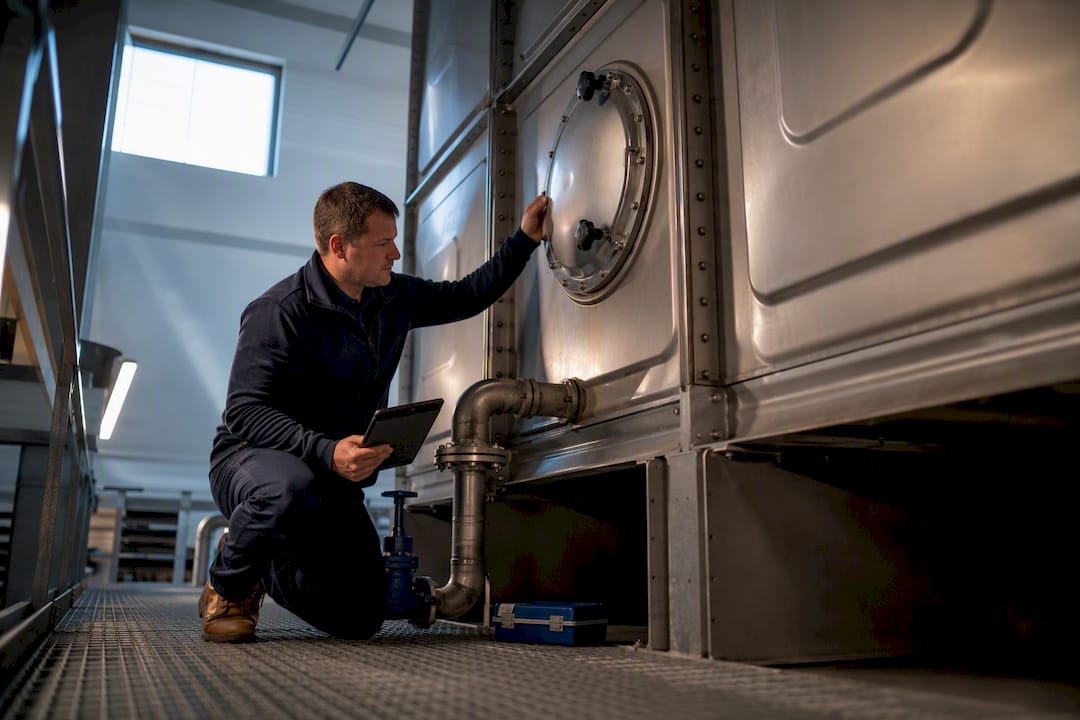
Inspect every cold water storage tank at least annually as required by regulations under HSG274/ACoP L8. For commercial and multi-residential potable tanks, inspections every six months are often the practical standard followed by many compliance teams. Clean and disinfect whenever an inspection shows fouling, contamination, or after remedial works, extended shutdowns, or a failed water sample. Frequency isn’t fixed. It’s a decision, backed by evidence.
TL;DR:
Inspection frequencies should be tailored to building type, occupant vulnerability, and site-specific risks, with healthcare and care homes requiring quarterly checks.
Immediate cleaning is mandatory if there is visible sediment, discoloured water, vermin evidence, or failed microbiological samples.
Proper cleaning involves draining, debris removal, surface scrubbing, disinfection, flushing, and verification sampling, with pH and contact times carefully monitored.
Maintaining detailed records of inspections, cleaning, sampling, and decisions for at least five years is essential for audit compliance.
Technology like continuous temperature monitoring and digital logbooks can enhance risk detection but do not replace professional judgment and tailored scheduling.
Table of Contents
Water tank cleaning frequency by system type and risk profile
There’s no single number that fits every building. HSG274 Part 2 sets annual inspection as the regulatory minimum for cold water storage tanks, with cleaning and disinfection carried out “as necessary” based on what that inspection finds. That’s a baseline, not a ceiling. Most commercial and multi-residential operators now inspect every six months, because a twice-yearly look catches sediment build-up and early biofilm before it becomes a sample failure.
How you translate that into a real schedule depends on the building. Here’s a working matrix:
Domestic or single-occupancy private tanks: annual inspection is usually sufficient, provided there’s no history of contamination and turnover is good.
Small commercial premises (offices, retail units): annual inspection, moving to six-monthly if the tank feeds vulnerable outlets like showers or if occupancy is intermittent.
Large residential blocks and HMOs: six-monthly inspection as standard, given the number of unmonitored outlets and variable occupant behaviour.
Healthcare settings and care homes: inspection frequency should be set higher still, often quarterly, because residents are more susceptible to Legionella infection and any lapse carries greater consequence.
Emergency or standby water tanks: these need inspection before and after any period of disuse, since stagnation is the whole risk here, not gradual fouling.
A 40 bed care home with a single roof tank and constant turnover might sit comfortably on a six-monthly cycle. The same tank serving a building with several unused wings, low occupancy, and older insulation probably needs quarterly checks and a lower threshold for triggering a clean. Site complexity and occupant vulnerability, not calendar convenience, should drive the number.
When does a water tank need cleaning right away?
Certain inspection findings remove any discretion. When you see these, cleaning stops being a scheduling question and becomes an immediate action.
Visible sediment or biofilm on the tank base, walls, or float valve mechanism.
Discoloured, cloudy, or odorous water at outlets or within the tank itself.
Evidence of vermin or insect ingress, including droppings, carcasses, or damaged screens and lids.
Failed microbiological sample results, particularly for Legionella or total viable count.
Corrosion or structural faults in the tank shell, ball valve, or overflow pipework.
Recent significant remedial works on the tank or its immediate pipework.
Extended shutdown or stagnation, roughly seven days or more without normal draw off, which HSG274 flags as a point where recommissioning should include flushing and disinfection before the system returns to normal use.
Treat recommissioning after a shutdown the same way you’d treat commissioning a new installation: clean, flush, disinfect, sample, and only then bring it back into service.
Documentation matters as much as the trigger itself. An inspection report that notes sediment but doesn’t say whether a clean was ordered, and why, leaves a gap an auditor will find. Write the finding, the decision, and the reasoning in the same entry. “Light sediment observed, below action threshold, next inspection brought forward to three months” is defensible. A blank box next to “sediment: yes” is not.
What does a compliant tank clean actually involve?
A proper clean and disinfection follows a fixed sequence, and any contractor worth hiring should be able to walk you through each stage without hesitation following the clinic hygiene protocol guide that outlines key hygiene practices.
Isolation and draining: the tank is taken offline and drained fully, with downstream outlets protected or shut off.
Debris removal: sediment, scale, and biofilm are physically removed from the base, walls, and fittings.
Surface cleaning: internal surfaces are scrubbed and rinsed to remove residual contamination before disinfection begins.
Disinfection: chlorine or chlorine dioxide is applied at a specified concentration for a defined contact time, following the commissioning approach set out in BS EN 806 and BS 8558.
Flushing and refill: disinfectant is flushed through, the tank refilled, and the system checked for residual chlorine at safe levels.
Verification sampling: water samples are taken and lab-tested before the tank is signed off as fit to return to service.
Pro Tip: Chlorination efficacy decreases above a pH of about 7.6, so it is important to confirm pH readings along with contact time during disinfection. A disinfection run that “looks” complete on paper can still under-perform if pH wasn’t checked.
Verification samples are essential as objective evidence that cleaning was effective, rather than relying solely on contractor claims. Waste water and chemical residue from the process also need proper disposal, in line with local trade effluent rules, and anyone handling chlorine or chlorine dioxide on site needs appropriate PPE and training. A clean carried out without documented pH checks, contact times, and post-clean sampling isn’t a compliant clean, whatever the invoice says.
Records and audit readiness: what you must keep
ACoP L8 places a clear duty on the dutyholder to maintain a written scheme of control and to retain records evidencing that inspections, cleaning, and remedial actions actually happened. In practice, most organisations keep these records for at least five years, which covers typical insurance and litigation timeframes.
Your file should hold:
Inspection reports with dated findings, not just tick boxes.
Photographs taken at each inspection, particularly of sediment, corrosion, or fittings in poor condition.
Cleaning and disinfection certificates from the contractor, including chemicals used and contact times.
Verification sample lab results, cross-referenced to the date of the clean.
Risk assessment updates reflecting any change in frequency or site conditions.
Commissioning notes for any tank brought back into service after a shutdown.
Pro Tip: Write every inspection report as if an auditor will read it in isolation, with no other context. If the reasoning behind a “no clean needed” decision isn’t in the document itself, it doesn’t exist as far as the audit is concerned.
Using a site risk assessment to set your own cleaning schedule
A generic schedule is a starting point, not an answer. The site risk assessment is where you turn HSG274’s baseline into a number that fits your building, and it’s the document that justifies your frequency if anyone ever asks why.
Factors that should push frequency up: low occupancy or intermittent use, older tanks with poor insulation, previous sample failures, vulnerable occupants, or a history of vermin issues. Factors that can justify holding at annual: consistent good turnover, clean sample history, and a well-maintained tank with no structural concerns.
Check turnover using a 24 hour cold water storage log before assuming frequency alone will fix a fouling problem.
Pair any clean with remedial works where needed. Correcting poor insulation, oversized tanks, or missing upstream filtration addresses the cause, not just the symptom.
A clean carried out without fixing the underlying issue, as seen repeatedly in social housing case studies, tends to produce only a temporary improvement before fouling returns.
Specialist providers can support this process end to end, from the initial risk assessment through to sampling and logbook implementation, so the schedule you land on is one you can actually defend.
How tank material and design change your cleaning schedule
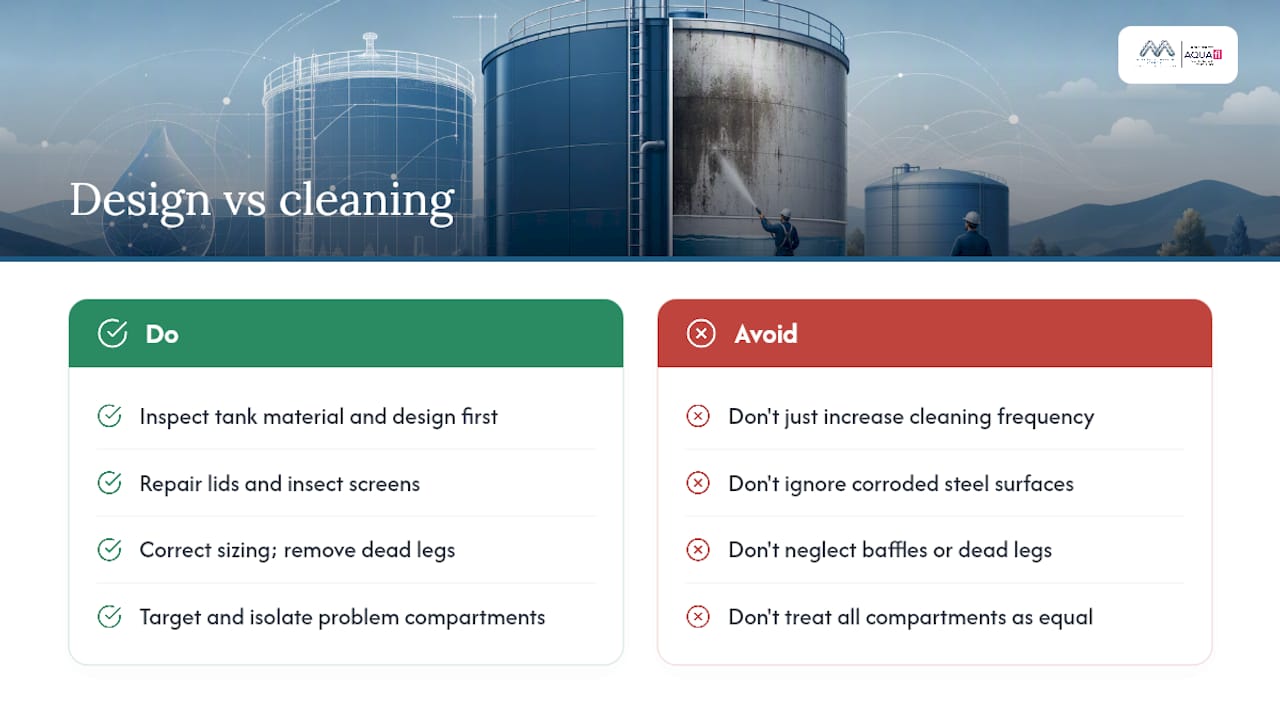
The tank itself dictates part of the answer. Older galvanised steel tanks corrode internally over time, creating rough surfaces that trap sediment and biofilm far more readily than smooth GRP (glass reinforced plastic) panels, which is why many older steel tanks need closer inspection intervals even when water quality looks fine on the surface.
Design matters as much as material. A tank with a poorly fitted lid or missing insect screen invites contamination regardless of how often it’s cleaned, while a tank with awkward internal baffles or dead legs creates pockets of stagnant water that never see proper turnover. Oversized tanks relative to actual demand are a common culprit here: water sits far longer than it should, giving biofilm time to establish even in an otherwise well-maintained system.
Sectional tanks with multiple compartments also complicate the picture, since one section can turn over well while another sits largely static behind a divider. If your inspection reports keep flagging one corner of a multi-cell tank and not the others, that’s a design problem, not a cleaning frequency problem, and no amount of extra disinfection will fix it permanently.
The practical takeaway: before increasing cleaning frequency to chase a persistent fouling issue, check whether the tank’s material condition or internal design is the actual cause. Sometimes the fix is a new screen, corrected sizing, or removing a dead leg, and cleaning frequency can then return to a more normal cadence.
Do temperature and humidity affect how fast tanks get contaminated?
Yes, and the effect is significant enough to change your inspection calendar seasonally. Legionella bacteria proliferate fastest in stored water sitting between roughly 20°C and 45°C, which means loft-mounted tanks in summer, or tanks near heat sources such as boiler rooms, deserve closer attention during warmer months than the same tank in midwinter.
Humidity plays a secondary but real role, particularly around tank surrounds and access hatches. Damp, poorly ventilated plant rooms encourage condensation on tank exteriors and can accelerate corrosion on steel fittings, indirectly raising the risk of internal contamination as seals degrade.
Seasonal swings are worth building into your written scheme rather than treating as background noise. A tank that passes every winter inspection without issue can still develop sediment and biofilm rapidly across a hot summer if turnover drops during a quiet period, such as a school holiday or office closure. If your building has predictable seasonal occupancy dips, that’s exactly when stagnation risk peaks, and it’s worth scheduling an inspection to coincide with the return to normal use rather than waiting for the next fixed date on the calendar.
What happens if you don’t clean a water tank often enough?
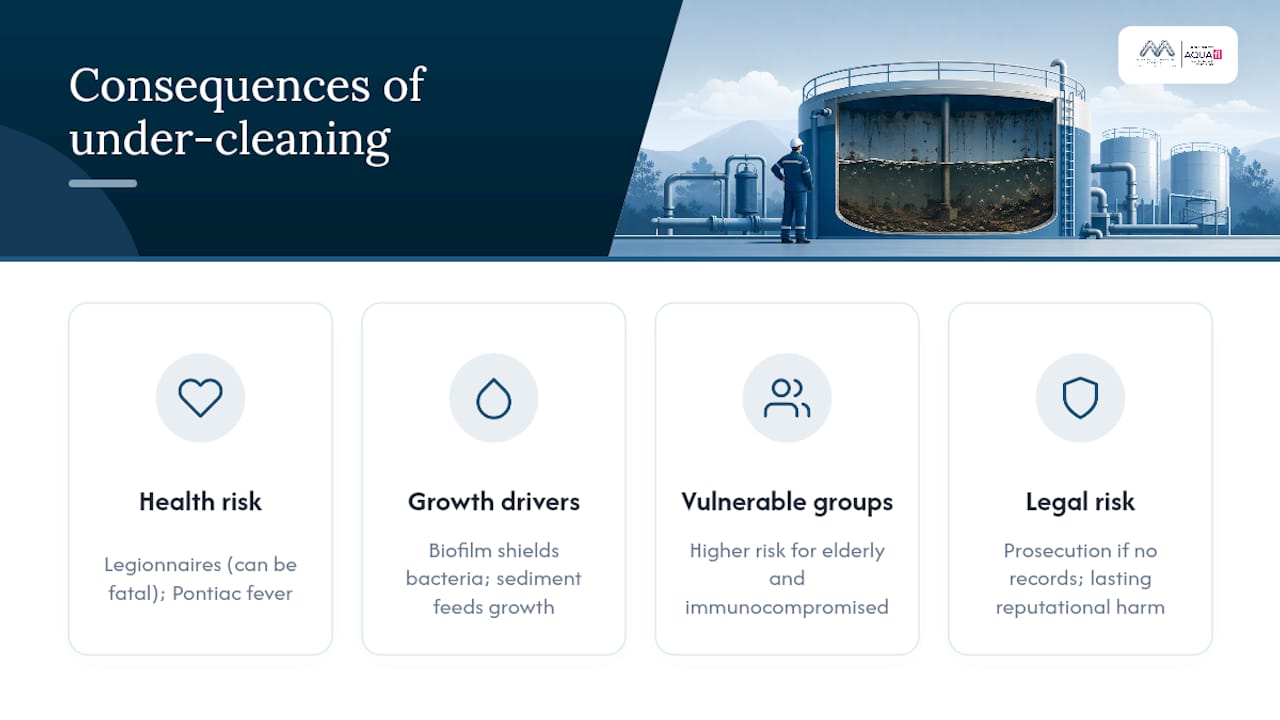
The health consequence of under-cleaning is Legionnaires’ disease, a potentially fatal form of pneumonia caused by inhaling contaminated water droplets, along with the milder but still serious Pontiac fever. Both are entirely preventable through routine tank maintenance, which is precisely why the regulatory framework exists.
Sediment and biofilm aren’t just cosmetic problems. Biofilm acts as a protective layer where Legionella bacteria can multiply relatively undisturbed by chlorine residuals in the mains supply, and sediment provides the nutrients that sustain that growth. Discoloured water and unpleasant odours are often the first visible sign, but by the time you notice these, bacterial concentrations can already be well established.
Vulnerable populations carry the sharpest consequences. Care homes, hospitals, and any building housing elderly or immunocompromised occupants face a materially higher risk from the same level of contamination that might pass largely unnoticed in a healthy working-age population. That’s the entire justification for setting inspection frequency higher in healthcare settings than the general commercial baseline.
There’s also a legal dimension worth being direct about. A dutyholder who can’t produce inspection records and cleaning evidence after an outbreak faces prosecution under health and safety law, and the reputational damage to a housing association, hotel, or healthcare provider tends to outlast any fine. Under-cleaning isn’t a minor compliance gap. It’s a direct line to a preventable illness with a name and a paper trail.
What does tank cleaning frequency actually cost you?
More frequent inspections and cleaning cost more in the short term, but the maths flips quickly once you factor in what a failure actually costs. A routine six-monthly inspection and occasional clean is a predictable, budgeted expense. An emergency clean triggered by a failed sample, plus the retesting, remedial works, and potential downtime while a tank is isolated, costs considerably more and arrives without warning.
There’s a harder cost too, one that doesn’t show up on an invoice. An outbreak investigation, regulatory scrutiny, and any resulting legal action dwarf the cumulative cost of years of routine six-monthly inspections. Insurers increasingly ask for evidence of a written scheme of control before renewing cover on larger commercial or residential portfolios, and a thin paper trail can affect premiums or even cover itself.
The most cost-effective approach isn’t the cheapest one on paper. It’s the one that matches frequency to actual risk, so you’re not overspending on unnecessary quarterly cleans for a low-risk domestic tank, nor underspending on a care home tank that genuinely needs closer attention. Getting that balance right, through a proper site risk assessment rather than a flat industry rule of thumb, is where most of the real savings sit.
Can technology reduce how often you need to physically clean a tank?
Automated temperature monitoring systems are changing how quickly problems get spotted between physical inspections. Sensors placed at sentinel points can log temperature continuously and flag deviations in real time, rather than relying solely on the monthly manual checks HSG274 describes, which means a developing problem, such as a dead leg losing turnover, can surface weeks before it would show up at a scheduled inspection.
This doesn’t reduce the regulatory requirement for physical inspection, and it shouldn’t be treated as a substitute for it. What it does is sharpen the timing. A facilities team running continuous monitoring across a large portfolio can prioritise physical inspections at the sites showing early warning signs, rather than working through every tank on a fixed calendar regardless of actual risk.
Digital logbooks are the other significant shift, replacing paper records that are easy to lose and hard to audit at scale. A properly implemented digital logbook system timestamps every inspection entry, attaches photographs directly to the record, and makes five year retention straightforward rather than a filing cabinet problem. For an organisation managing dozens or hundreds of sites, that shift from paper to structured digital records is often the difference between a smooth audit and a stressful one.
None of this replaces judgement. Technology narrows the gap between inspections and gives you earlier warning, but the decision to clean still rests on someone reading the evidence and making a defensible call.
Why the “set and forget” approach to tank cleaning fails
Most guidance on this topic treats frequency as a fixed number to memorise: annual, or six-monthly, done. That’s a reasonable starting point, but it’s not a strategy, and it’s the single biggest gap between the compliance most organisations think they have and what an inspector would actually find defensible.
The uncomfortable truth is that a rigid calendar schedule can quietly under-protect a high-risk site and over-spend on a low-risk one at the same time. A care home on a fixed annual cycle, chosen because that’s the legal minimum, is running real risk if occupancy or turnover has changed since the schedule was set. Meanwhile a well-maintained small office tank on a needlessly aggressive quarterly clean is burning budget for no measurable safety gain.
What actually works is treating the risk assessment as a living document, not a box ticked once a year. Frequency should move when the evidence moves, sediment findings, sample results, occupancy changes, and the paper trail should always show that reasoning, not just the decision. That’s the part conventional advice glosses over: the schedule matters less than your ability to justify it after the fact.
— Sammi
Get your tank cleaning schedule right with expert support
Working out the correct interval for your specific site, and being able to defend it later, is best done with expert help. Rather than a generic annual reminder service, you get a site-specific risk assessment that accounts for your tank’s design, occupancy pattern, and sample history, then a written scheme of control that holds up to scrutiny.
[
That matters most for facilities managers juggling multiple sites, where a one-size schedule either wastes budget on low-risk buildings or quietly under-protects a vulnerable one. Specialist compliance services can build the assessment, set the frequency, and support the sampling and logbook work that turns a decision into evidence. If you manage a healthcare setting, housing portfolio, or commercial property and aren’t confident your current schedule would survive an audit, book a Legionella risk assessment in Coventry and get a schedule built around your actual risk, not a generic calendar.
Sources
FAQ
What are the signs a water tank needs cleaning?
Visible sediment or biofilm, discoloured or odorous water, vermin traces, corrosion, and failed microbiological samples are all direct signs that a clean is overdue, and any one of them should trigger action rather than waiting for the next scheduled inspection.
How often should you clean a fresh water tank?
Inspect at least annually under HSG274/ACoP L8, with six-monthly inspections common practice for commercial and multi-residential potable tanks. Clean whenever an inspection shows fouling, contamination, or after remedial works.
How frequently must a water tank be emptied for inspection?
There’s no separate emptying requirement beyond inspection; the tank should be inspected at the frequency your risk assessment sets, at minimum annually, and only fully drained and emptied when a clean or disinfection is actually needed.
What triggers an unscheduled tank clean outside the normal schedule?
Sediment, biofilm, discoloured water, vermin evidence, failed samples, structural faults, recent remedial works, or an extended shutdown of roughly seven days or more all justify cleaning and disinfection immediately, regardless of where you are in the normal cycle.
Who can help set a defensible tank cleaning schedule?
A site-specific Legionella risk assessment, such as those provided by Bespoke Compliance Solutions, turns the regulatory baseline into a frequency you can justify to an auditor with documented reasoning.
Recommended
Comments