
TMV Servicing in England: Avoid Audit Failures, Annual or Six Monthly
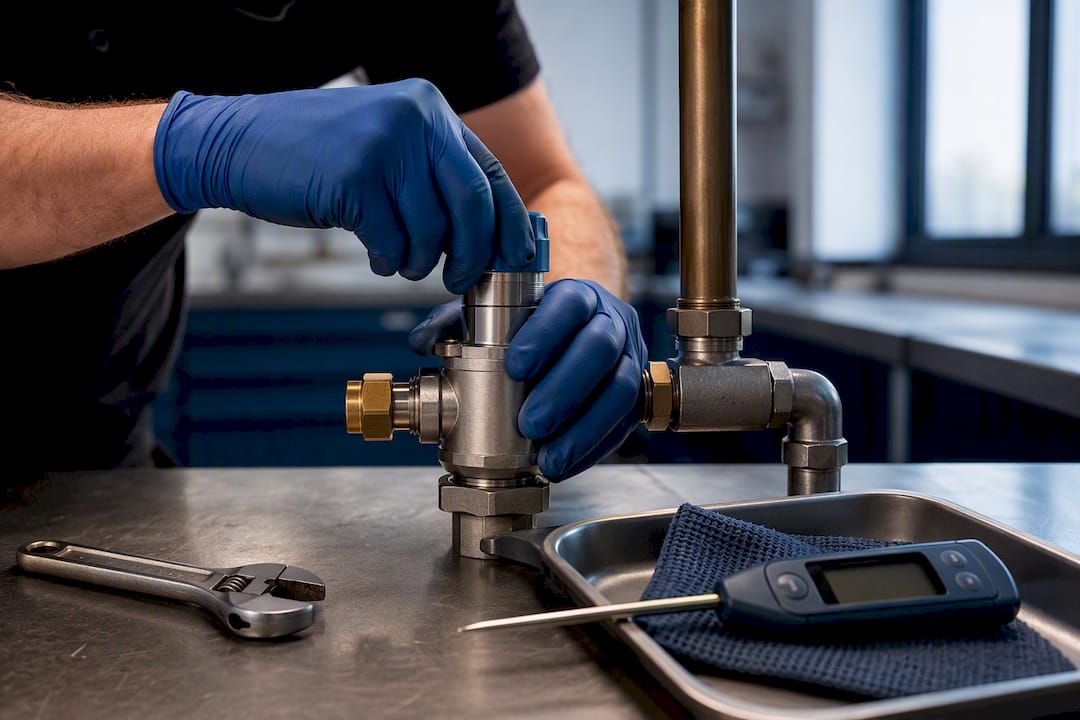
At minimum, TMVs should be serviced at least once a year. In healthcare settings and other high-risk environments, servicing every six months is common in healthcare settings and other high-risk environments. The exact interval must ultimately be set by your written scheme of control, following HSG274 Part 2, and every service visit needs a fail-safe test, recorded inlet and outlet temperatures, and a signed service sheet to prove it happened.
TL;DR:
Servicing frequency should be tailored to site-specific risk factors, with healthcare and vulnerable settings requiring six-monthly visits, while lower-risk premises may suffice with annual checks.
Proper TMV maintenance includes a comprehensive service encompassing cleaning, disinfection, physical inspection, and functional testing, not just a temperature check at the outlet.
Regular interim checks for signs of drift, scale build-up, or fail-safe failure are essential to catch issues before scheduled servicing and should be documented in an indexed logbook.
Compliance depends on establishing and following a written scheme of control, based on Legionella risk assessments, with records kept for at least five years to demonstrate ongoing management.
Using qualified, water hygiene-aware technicians and integrating TMV servicing into a coordinated water safety programme reduces legal, safety, and insurance risks significantly.
Table of Contents
Do new or replaced TMVs need extra checks before routine servicing starts?
How does TMV servicing interact with your Legionella control programme?
When does a TMV need attention before its scheduled service?
How do you set the right TMV service interval for your site?
How Bespoke Compliance Solutions builds TMV servicing into a working compliance programme
How long should you keep TMV service records and how do you prepare for an audit?
Do servicing requirements differ for commercial, residential, and other building types?
How Bespoke Compliance Solutions can help with TMV servicing and compliance
What does HSE guidance actually require for TMV servicing?
There’s no single statutory number written into law that says “service your TMV every X months.” That surprises a lot of facilities managers who expect a clean legal figure they can drop into a policy document. Instead, HSG274 Part 2 sets an annual inspection as the baseline expectation, then hands responsibility to the dutyholder to fix the actual frequency through a written scheme of control, informed by a Legionella risk assessment.
Table 2.1 in HSG274 Part 2 provides guidance on inspection and maintenance frequencies for components of hot and cold water systems, including TMVs, as baseline recommendations. Healthcare premises, care homes, and sites serving vulnerable users often opt for more frequent servicing due to higher risks. A scald risk in a care home bathroom is a different order of problem to one in a staff kitchen.
Where the site is an NHS or healthcare building, HTM 04-01 layers on additional expectations, particularly around TMV3 valves, which carry stricter fail-safe performance requirements than the TMV2 valves typically found in commercial washrooms. HTM 04-01 doesn’t replace HSG274 Part 2; it sits alongside it as sector-specific guidance for the NHS estate.
None of this works in isolation from temperature control. HSE’s guidance on hot and cold water systems sets out the regime that has to run in parallel with any TMV programme:
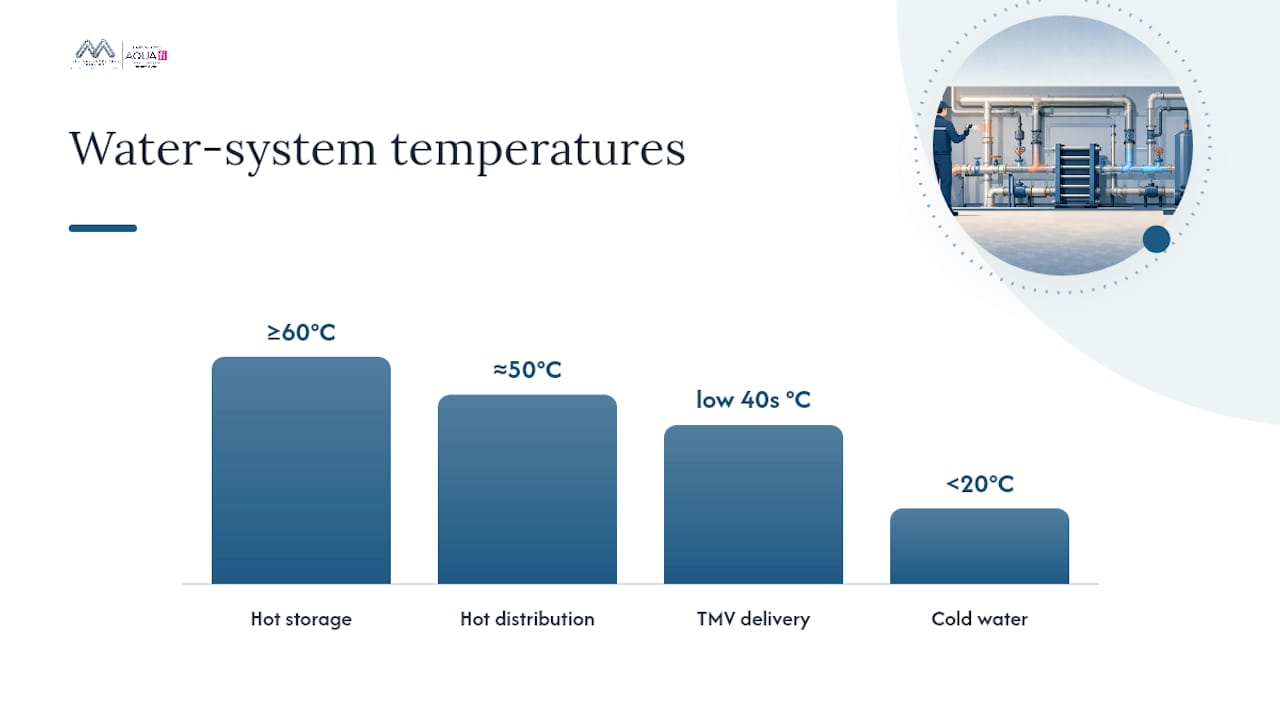
Hot water should be stored and distributed at temperatures recommended to control Legionella, with hot water storage commonly at or above 60°C, distribution around 50°C, and cold water kept below 20°C. TMVs blend water to delivery temperatures that prevent scalding, usually in the low 40s °C range.
Get the storage and distribution temperatures wrong, and no amount of TMV servicing fixes the underlying Legionella risk. The valve is the last line of defence for scald prevention, not a substitute for a properly managed hot water system.
How often should you actually service a TMV?
Turning the guidance into a working schedule means starting from the baseline and adjusting for risk. Here’s how that typically breaks down across property types.
Annual servicing covers the majority of lower-risk commercial premises: offices, retail units, standard hotel bathrooms, and general workplace washrooms where the user population is fit, aware, and able to react to a temperature fault.
Six-monthly servicing becomes the norm in healthcare, care homes, nurseries, and any setting where users are less able to move away from scalding water quickly, whether through age, mobility, or cognitive impairment.
Commissioning checks run before either cycle starts. A newly installed or replaced valve needs short-term verification that it’s holding its set temperature and failing safely, rather than being left to run untested until the next annual visit.
Interim inspections get added where site factors demand it, regardless of the formal service date.
That last point matters more than most written schemes give it credit for. A handful of site conditions push intervals shorter even within an otherwise low-risk building. Hard water areas accelerate scale build-up inside the valve and on the strainer, which affects both flow and fail-safe response. Sites with a high number of outlets on a single system see more wear from cycling. Ageing valve stock, particularly anything approaching or past its manufacturer’s recommended service life, tends to drift out of calibration faster than newer units.
The written scheme of control is where all of this gets decided in writing, not guessed at during an inspection. If your scheme still says “annual” for a care setting, that’s worth revisiting against HSG274 Part 2 before an inspector raises it for you.
What should a full TMV service actually include?
A temperature reading at the outlet is not a service. It’s a check, and a fairly shallow one at that. A proper TMV service, aligned with sector guidance from sources such as LegionellaCheck, covers a fuller sequence of tasks:
Pre-service checks: confirm inlet hot and cold temperatures, isolate the valve safely, and verify access before starting work
Physical inspection: examine the valve body for leaks or damage, check strainers for blockage, and inspect seals and O-rings for wear
Cleaning and descaling: strip and clean internal components, particularly on hard water sites where limescale is the main cause of premature failure
Disinfection: disinfect components in contact with water in line with water hygiene protocols
Functional testing: confirm outlet temperature is within tolerance and run the fail-safe test by shutting off the cold supply to check the valve closes the hot side
Recording: log every reading, action taken, and part replaced on a service sheet before leaving site
Service costs depend on region and the number of valves serviced per visit, with bundled service visits generally more cost-effective than single valve call-outs.
Pro Tip: Ask any contractor for the actual fail-safe test result on paper, not just a verbal “it passed.” A valve that closes slowly, or only partially, on the cold-off test is a defect waiting to cause a scald, even if the outlet temperature reads correctly at the point of service.
Who is qualified to service a TMV?
HSE guidance talks about a “competent person” carrying out this work, and that phrase does real work in an inspection. It’s not a formal certificate scheme in the way gas safety work is regulated, so the burden falls on you to establish and document competence before you hire.
Look for evidence of water hygiene and Legionella awareness training, not just general plumbing experience. TMVs behave differently to standard mixer valves, and an engineer unfamiliar with fail-safe mechanisms can miss a fault that a general plumber wouldn’t think to test for. Ask specifically about experience with disinfectant handling and dosing, since incorrect concentrations either fail to disinfect properly or damage valve seals.
When you’re comparing quotes, request:
Evidence of relevant water hygiene or Legionella training
A sample service sheet showing what gets recorded
Confirmation of manufacturer-specific training where the valve brand requires it
Public liability insurance details
Some manufacturers require their own authorised technicians for warranty-covered servicing, particularly on TMV3 units used in healthcare. Check this before booking a generalist contractor on a healthcare site, or you risk voiding cover on a valve that then needs full replacement. Keep competence evidence on file for every contractor you use. It’s one of the first things an inspector asks for when a service record looks thin.
What records do you need to keep for TMV servicing?
An inspector doesn’t take your word that a valve was serviced. They want the paperwork, and they want it findable in under a minute. A proper service sheet should record:
Date of service and name of the engineer or company
Inlet hot and cold temperatures at the time of service
Outlet blended temperature
Fail-safe test result
Cleaning, descaling, or disinfection actions taken
Any parts replaced or defects identified
Follow-up actions and their target date
Where these records live matters almost as much as what’s in them. Service sheets sitting in a contractor’s own filing system, disconnected from your site’s Legionella logbook, create exactly the kind of gap an inspection finds. Keep TMV service records in the same logbook as your temperature monitoring and flushing records, indexed by system and by sentinel outlet, so an inspector can trace one valve’s full history in one place. Bespoke Compliance Solutions structures its method of works around exactly this kind of single, indexed logbook, because a scattered paper trail is one of the most common findings in a failed audit.
Do new or replaced TMVs need extra checks before routine servicing starts?
Yes, and this is one of the more overlooked steps in TMV servicing requirements. A newly installed or replaced valve gets commissioned first, meaning it’s checked and documented before it goes into use, confirming it delivers a safe blended temperature and passes its fail-safe test from day one.
For TMV3 valves specifically, common practice runs short-term in-service checks in the early weeks after commissioning, well before the valve settles into its routine six-monthly or annual cycle. The logic is simple: a valve can pass commissioning cleanly and still drift within its first few weeks in service, particularly if it’s bedding into a system with variable inlet pressure. Catching that early avoids relying on a fresh installation for months without verification.
Document the commissioning result, including both temperatures and the fail-safe outcome
Schedule early follow-up checks rather than waiting for the next scheduled service
Sign off only once the valve has demonstrated it holds its setting consistently
Treat any early failure as a defect requiring investigation, not a one-off blip to retest later
Get this step right, and the routine servicing cycle that follows has a genuinely stable baseline to work from.
How does TMV servicing interact with your Legionella control programme?
TMVs solve a scald problem and create a small infection-control problem at the same time. That tension is worth understanding properly rather than glossing over. Downstream of the valve, hot and cold water blend into a lukewarm mix, and that blended pipework can sit in the temperature range where Legionella bacteria multiply most readily, roughly 20 to 45°C.
HSG274 Part 2 addresses this directly: the practical fix isn’t to avoid TMVs, it’s to manage the design and location so the warm zone stays as small as possible. That means locating valves close to the outlet they serve rather than at a distant manifold, and keeping blended pipe runs short so water doesn’t sit lukewarm for long stretches between uses.
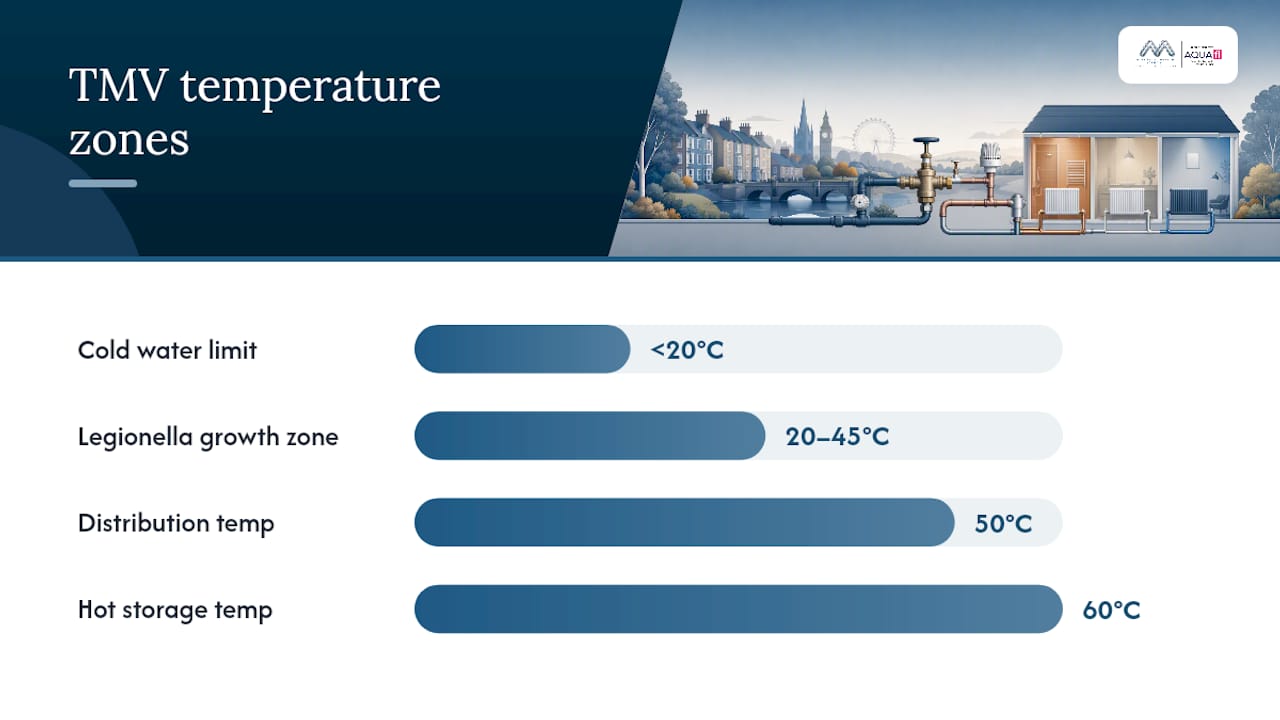
The temperature regime around the valve still has to hold. Hot water storage at 60°C, distribution at 50°C, and cold water below 20°C remain non-negotiable, because a TMV downstream of an under-heated system has nothing safe to blend in the first place.
Servicing alone doesn’t cover the full picture. A handful of complementary measures reduce risk around TMVs between service visits:
Regular flushing of low-use outlets to prevent stagnation
Descaling showerheads and outlet fittings, which also protects the valve from scale ingress
Periodic water sampling where the risk assessment indicates it, particularly after any period of reduced occupancy
Sentinel outlet temperature checks run more frequently than the full valve service, catching drift early
A TMV serviced perfectly on schedule but sitting downstream of stagnant, under-flushed pipework still leaves you exposed. The valve and the wider water system have to be managed as one programme, not two separate compliance boxes.
When does a TMV need attention before its scheduled service?
Waiting for the calendar date isn’t always good enough. Estates and facilities teams are usually the first to notice something’s wrong, long before the next booked visit.
Temperature drift at the outlet, where water runs noticeably hotter or colder than usual, even if still within a rough comfort range
Visible scale build-up on the outlet fitting or a drop in flow rate, both signs the valve’s internals may be affected
A failed or sluggish fail-safe response, noticeable if cold water briefly continues to flow after a hot supply interruption
Unusual noise or vibration from the valve body during operation, often an early sign of a worn cartridge
Any of these warrants an interim check rather than a wait-and-see approach. Estates staff can safely run a basic outlet temperature check with a simple thermometer without needing to open the valve. If the reading is clearly outside the expected range, or if the fail-safe test seems doubtful, take the outlet out of use and tape it off until a competent engineer attends.
Pro Tip: Log every interim finding, even a “checked, no issue” result. A logbook showing you actively monitor between services is far more persuasive to an inspector than one that only shows annual entries, because it demonstrates ongoing management rather than a box-ticking exercise.
How do you set the right TMV service interval for your site?
Building a defensible interval isn’t guesswork, and it shouldn’t be copied wholesale from a template written for a different type of building. Start from the HSG274 Part 2 Table 2.1 baseline, then apply modifiers based on your own site’s specific risk factors.
The decision runs roughly like this:
Step 1: Identify user vulnerability. Healthcare, care, and similar settings point straight to six-monthly servicing regardless of other factors.
Step 2: Assess water quality. Hard water areas justify shorter intervals or added interim descaling checks even in lower-risk buildings.
Step 3: Check valve type and age. TMV3 units and any valve approaching manufacturer end-of-service-life warrant closer monitoring than a recently installed TMV2.
Step 4: Factor in usage intensity. High-traffic outlets, such as shared washrooms in busy retail units, wear faster than low-use fittings.
Step 5: Set interim monitoring. Decide how sentinel checks between full services will be scheduled and who owns them.
A simple risk matrix helps make this concrete: low-risk, low-use commercial sites with soft water and newer valves sit comfortably at annual servicing. Moderate-risk sites, meaning commercial premises with hard water or high outlet counts, move to annual servicing plus quarterly interim checks. High-risk sites, covering healthcare, care homes, and vulnerable-user settings, move to six-monthly full servicing with monthly sentinel monitoring in between.
Write the outcome into the scheme of control explicitly, including the reasoning, not just the resulting number. That reasoning is what an inspector actually wants to see.
How Bespoke Compliance Solutions builds TMV servicing into a working compliance programme
TMV servicing rarely works well as a standalone task bolted onto an existing maintenance contract. Bespoke Compliance Solutions folds it into the same written scheme of control and logbook structure used for the wider Legionella risk assessment, so the service interval for every valve on site is set with the same risk logic as the rest of the water system, not decided in isolation by whoever happens to be doing the plumbing that year.
In practice, that means every service visit produces a service sheet with inlet and outlet temperatures, the fail-safe test result, and any remedial action, filed into the same indexed logbook as temperature monitoring and flushing records. When a client’s site is inspected, or when an internal audit runs, the full history of any single valve is traceable in one document rather than scattered across separate contractor paperwork. For sites managing multiple properties across a portfolio, that consistency across locations tends to matter more than any single service visit on its own.
How long should you keep TMV service records and how do you prepare for an audit?
There’s no single statutory retention period written specifically for TMV service sheets, but the sensible working rule is to keep them for the life of the valve, plus a further period covering at least two full risk assessment review cycles, typically five years as a working minimum for most commercial sites. Healthcare and higher-risk premises often extend this further, aligning retention with the broader estates record-keeping policy already in place for other statutory compliance documents.
The point of retention isn’t just having paperwork to hand over. It’s being able to demonstrate a pattern over time, showing an inspector that a valve’s performance has been consistent, or that a developing fault was caught and corrected before it became a hazard. A single service sheet proves one visit happened. A run of records across several years proves the system is actually managed.
Audit preparedness comes down to three habits done consistently rather than one big effort before an inspection. Keep every TMV service sheet filed in the same logbook as temperature and flushing records, indexed by valve or outlet reference. Review the written scheme annually and note explicitly whether service intervals still match current risk factors. Cross-check that every valve listed in your asset register has a corresponding, unbroken run of service records, since a gap in the sequence is one of the fastest ways an inspection finds fault. Sites that treat this as routine filing rather than a pre-audit scramble consistently produce cleaner inspection outcomes.
What happens if you don’t meet TMV servicing requirements?
Non-compliance with TMV servicing carries real enforcement weight, not just a theoretical risk. The Health and Safety Executive can issue improvement notices requiring specific corrective action within a set timeframe, and in more serious cases, prohibition notices that stop use of a water system or facility until the risk is addressed. Where a Legionella outbreak or a scalding incident is linked to inadequate TMV maintenance, the consequences escalate to prosecution under health and safety legislation, with penalties that can include unlimited fines for organisations and, in the most serious cases, custodial sentences for individuals found to have breached their duty of care.
Beyond formal enforcement, there’s a quieter but equally damaging consequence: insurance exposure. Public liability cover can be challenged or voided where an organisation cannot demonstrate a maintained, documented compliance programme following an incident. For healthcare providers specifically, the Care Quality Commission treats water safety management as a core inspection area, and gaps in TMV servicing evidence can affect a provider’s overall rating, not just a single finding in a report.
The pattern across enforcement cases is consistent: it’s rarely the servicing failure alone that triggers the harshest outcome, it’s the absence of records proving any attempt to manage the risk. A site that serviced a valve late but documented the delay and the remedial action taken is in a fundamentally different position to one with no records at all.
Do servicing requirements differ for commercial, residential, and other building types?
Healthcare gets the most attention in TMV guidance, but the requirements don’t disappear for other building types, they simply scale down in frequency while keeping the same core obligations. Commercial premises such as offices, retail units, and hospitality venues sit at the annual baseline under HSG274 Part 2, with the written scheme of control still required regardless of building size. A single-site office with three washrooms needs a scheme just as much as a large retail complex, only the complexity of the documentation differs.
Residential settings bring their own variation. Social housing and housing association properties with communal hot water systems typically follow the same annual commercial baseline, but individual TMVs fitted within private tenanted flats on a shared heating system often fall under landlord health and safety obligations rather than a formal written scheme, which can create confusion about who is actually responsible for servicing. Housing providers managing multiple blocks generally benefit from treating these valves under one consistent scheme rather than leaving servicing to ad hoc tenant reporting.
Hospitality and leisure premises, including hotels, gyms, and spas, sit closer to the higher end of commercial risk given high outlet turnover and variable occupancy, and often benefit from more frequent interim checks even where the full service remains annual. Schools and education settings, similarly, tend to warrant closer monitoring given the age profile of some users, without necessarily requiring the full six-monthly healthcare standard.
Why the “annual is enough” mindset misses the point
The most common mistake facilities teams make with TMV servicing requirements isn’t skipping the service. It’s treating the interval as the whole answer. An annual visit that produces a clean service sheet feels like compliance, but a valve can drift, scale up, or develop a sluggish fail-safe response in month four and sit undetected until month twelve if nothing else is checked in between.
What the guidance actually supports, once you read past the headline interval, is a layered approach: a baseline service frequency set by risk, backed by interim sentinel checks that catch drift early, all sitting inside a written scheme that explains the reasoning rather than just stating a number. Conventional advice tends to stop at “service annually, or six-monthly for healthcare” and leaves it there, which is technically correct and practically incomplete.
If there’s one thing worth prioritising above the rest, it’s the logbook. A site with imperfect service intervals but a complete, honest record of what was checked and when is in a stronger position, both operationally and in front of an inspector, than one with a technically correct schedule and patchy paperwork. Get the documentation habit right first. The interval decisions get much easier once you can actually see your own data.
— Sammi
How Bespoke Compliance Solutions can help with TMV servicing and compliance
Using a single point of contact for TMV servicing instead of juggling separate plumbing contractors, risk assessors, and logbook systems can simplify management. That matters most at renewal time, when an inspector wants one coherent story about how your water system is managed, not three disconnected paper trails.
[
Book a site survey and you’ll get a proper Legionella risk assessment that sets defensible TMV service intervals for your specific building, not a generic annual default copied from a template. From there, TMV servicing, water sampling, tank disinfection, and logbook implementation can run as one coordinated programme rather than separate line items you have to chase individually. If you already have a compliance contract running elsewhere, adding TMV servicing into it is usually a straightforward conversation rather than a full re-tender.
Get in touch to book a Legionella risk assessment and find out exactly what interval your site should be working to, backed by a written scheme that holds up under inspection.
Sources
Start with HSG274 Part 2 for the statutory baseline, HSE’s hot and cold water systems guidance for temperature regimes, and the HSG274 Part 2 checklist for a facilities-focused summary. Use Bespoke Compliance Solutions’ method of works page when structuring your own logbook and service records.
FAQ
Is TMV servicing a legal requirement?
There’s no single law naming a fixed TMV service interval, but dutyholders have a legal duty under health and safety legislation to manage Legionella and scald risk, and HSG274 Part 2 requires this to be documented through a written scheme of control.
How often should a TMV be serviced?
At least annually for most commercial premises, with six-monthly servicing common in healthcare and other high-risk settings, though the precise interval must be set by your site’s written scheme of control.
Is TMV a legal requirement in the UK?
TMVs themselves are required in specific settings, particularly healthcare and where vulnerable users are present, under guidance such as HTM 04-01; outside those settings, they’re a widely recommended scald-prevention control rather than a blanket legal mandate.
Do I need a TMV with a mixer tap?
A standard domestic mixer tap doesn’t automatically need a TMV, but any outlet serving vulnerable users, or any commercial washroom where scald risk needs formal control, typically should have one fitted and included in your servicing schedule.
Recommended
Comments