
6-step HSG274 Part 2 checklist for England FM and safety managers
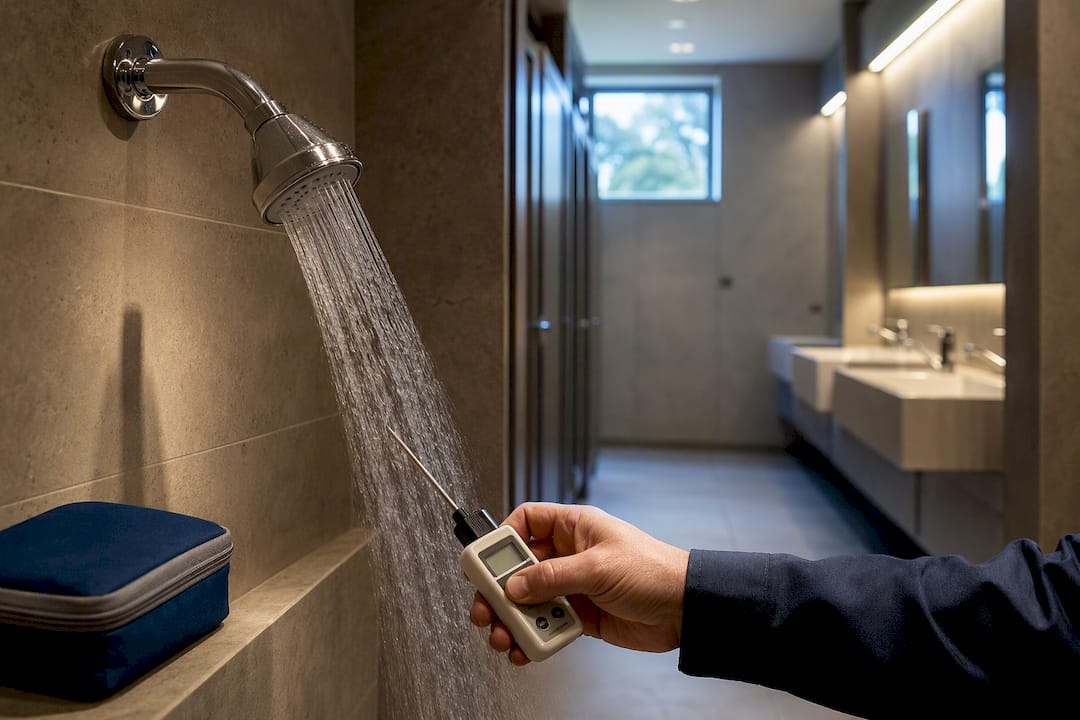
HSG274 Part 2 sets the technical controls for hot and cold water systems, and it requires dutyholders to hold a documented risk assessment, name a competent responsible person and maintain a written scheme of control. The primary control is the 60/50/20 temperature regime, but where that’s impractical, you must document an equivalent alternative and justify it within the same scheme.
TL;DR:
Maintaining proper documentation, including risk assessments and control schemes, is crucial to avoiding enforcement action, especially if monitoring records reveal gaps or outdated information.
Achieving and recording the correct temperature regime of 60°C in storage, 50°C within one minute at outlets, and cold below 20°C is essential for controlling legionella growth across the system.
Regular sentinel outlet checks, along with zero-tolerance for out-of-spec results, help detect system failures early and prevent waterborne outbreaks.
Proper system design and commissioning, such as avoiding dead legs and properly balancing flow, significantly reduce future remedial work and system failure risks.
If maintaining the temperature regime is impractical, documented alternative measures such as increased flushing, frequent disinfection, or point-of-use filtration are acceptable, provided they are justified and monitored rigorously.
Table of Contents
How does HSG274 relate to ACOP L8, and what are your legal duties?
Design and commissioning: the maintenance essentials that prevent problems
What if temperature control isn’t practical? Alternative measures explained
How Part 2 fits with the rest of HSG274 and other regulations
Communicating with occupants and stakeholders during routine management and incidents
What does HSG274 Part 2 cover, and who does it apply to?
HSG274 Part 2 deals specifically with hot and cold water systems used for ordinary domestic purposes across a building, not cooling towers or spa pools, which fall under Parts 1 and 3 respectively. If your premises have calorifiers, storage tanks, showers or taps supplied through a hot or cold water loop, Part 2 is the section you need.
It applies broadly to anyone with control over water systems in non-domestic premises. That means:
Employers with staff or visitors using on-site water systems
Landlords and property managers in control of shared building services
Anyone with health and safety responsibilities for a site, including facility managers acting on an organisation’s behalf
The guidance sits within the wider HSG274 technical guidance, which is split into three parts covering hot and cold systems, cooling towers and evaporative condensers, and other risk systems such as spa pools. A hotel with a cooling tower on the roof and a hot water loop feeding guest bathrooms needs both Part 1 and Part 2. Most commercial, retail and healthcare buildings, however, will find Part 2 does the bulk of the work.
How does HSG274 relate to ACOP L8, and what are your legal duties?
ACOP L8, formally Legionnaires’ disease: The control of legionella bacteria in water systems, sets the legal duty. HSG274 Part 2 is the technical guidance that tells you how to meet that duty in practice. The Approved Code of Practice has special legal status: if you follow it, you’re taken to have complied with the law it relates to on that point, unless you can show equally effective compliance by another route. HSG274 itself is advisory guidance, but following it is one of the strongest ways to demonstrate that “another route” if you’re ever challenged by an inspector.
In practice, the mandatory management elements dutyholders must have in place are:
A documented legionella risk assessment covering every relevant water system
A named, competent responsible person accountable for day to day control
A written scheme of control setting out who does what, and how often
Monitoring records and remedial logs kept up to date and available for inspection
Skipping the paperwork is the single most common enforcement trigger. An inspector rarely needs to find a legionella outbreak to issue an improvement notice; a missing written scheme or an out-of-date risk assessment is often enough. Reviewing your existing risk assessment after any system change, and understanding exactly what a responsible person is expected to do, closes most of the gap on its own.
What is the 60/50/20 temperature regime?
This is the technical heart of HSG274 Part 2. The guidance sets out a temperature-based strategy because Legionella pneumophila struggles to survive or multiply outside a fairly narrowband, and keeping water either hot enough or cold enough starves the bacteria of the conditions it needs.
The HSG274 Part 2 guidance specifies three temperature targets:
Parameter | Target | Notes |
Hot water storage | 60°C minimum | Measured at the calorifier or storage vessel |
Hot water delivery | 50°C within one minute | 50°C within one minute |
Cold water | Below 20°C | Measured after running the outlet |
60°C stored, 50°C delivered within a minute, cold below 20°C. That’s the whole regime in one line, and it’s worth pinning to a wall in the plant room.
Sentinel outlets are how you check the regime is actually working across a whole system rather than at one convenient tap. HSE guidance on hot and cold water systems describes sentinel outlets as the nearest and furthest taps or showers on each hot and cold loop, chosen because they represent the temperature extremes that loop can produce. Practitioners commonly check these sentinel outlets regularly, often monthly, on the logic that if the nearest and furthest points on a loop both hit the temperature target, everything between them almost certainly does too.
Pro Tip: Fit a permanent temperature pocket or immersion sensor at each sentinel point rather than relying on a probe pressed against pipework. Surface readings on lagged pipes are notoriously unreliable, and a five-second contact reading can be several degrees off the true water temperature.
Record every sentinel check with the date, time, outlet reference and reading, not just a tick box. When an environmental health officer asks to see twelve months of monitoring data, a logbook full of ticks with no numbers looks exactly like a logbook nobody actually checked.
Monitoring schedule, sampling and action levels
Temperature checks are only one part of a routine monitoring calendar. HSE’s guidance on sentinel checks and sampling frequency builds around a few recurring tasks, most of which map onto a simple annual rhythm:
Monthly — sentinel outlet temperature checks, hot and cold
Weekly to monthly — flushing of any outlets used infrequently, to stop stagnant water sitting in the pipe
Quarterly — calorifier draining and inspection where the risk assessment calls for it
Annually — tank inspections, TMV servicing and a full review of the written scheme
Microbiological sampling isn’t something you do routinely on every system. It’s typically triggered by the risk assessment itself, by a system that’s difficult to control on temperature alone, or by an out-of-spec reading that needs confirming. HSE’s hot and cold water guidance sets out how sampling results feed into action levels: a result below the relevant threshold usually means continue routine monitoring, while a result above it triggers a documented remedial response, which can range from re-sampling and enhanced flushing through to disinfection of the affected section.
If a sentinel reading comes back out of spec, don’t wait for the next scheduled check to see if it was a fluke. Re-check the outlet immediately, flush it, and if the second reading confirms the problem, escalate to your competent person or a specialist contractor before the next occupant uses that outlet.
Pro Tip: Log every out-of-spec reading even after you’ve fixed it. A pattern of repeated failures at the same outlet, even minor ones, is often the first sign of a dead leg or failing TMV long before it becomes a serious risk.
Design and commissioning: the maintenance essentials that prevent problems
Design decisions made once, at commissioning, tend to determine how much ongoing remedial work a system needs for the rest of its life. Getting this right early is consistently the most cost-effective way to control legionella risk, because a well-designed system needs far less intervention later.
The main things to get right at design and commissioning stage:
Avoid dead legs and areas of stagnation. Any length of pipe that doesn’t see regular flow is a place bacteria can establish
Keep branch pipework short and properly insulated so hot water reaches 50°C at the outlet within one minute, and cold water stays cool enough not to warm in transit
Flush and disinfect new pipework before it’s brought into use, and balance the system so flow reaches every outlet as designed
Carry out microbiological checks on complex systems before handover, particularly where construction dust or standing water may have contaminated pipework
HSG274 Part 2 cross-references several British and industry standards for this stage, including BS EN 806 for the design and installation of water systems inside buildings, BS 8558 for supplementary guidance, and CIBSE Guide G for building services design, alongside the Water Fittings Regulations. For anyone commissioning new or refurbished water services, particularly in hospitality settings where guest bathrooms multiply the number of outlets fast, these water saving practical guidance standards are worth having on file alongside the risk assessment. Sector-specific pitfalls, such as those seen in hospitality and leisure premises, tend to repeat across similar buildings, so learning from a comparable site saves time.
What if temperature control isn’t practical? Alternative measures explained
Some systems simply can’t hold 60/50/20 reliably, low-flow ring mains in older buildings, systems with unavoidable long branches, or premises where scalding risk limits how hot water can run. HSE doesn’t demand the impossible; it demands you prove an equivalent level of control and write down how.
Acceptable alternative measures typically include:
Enhanced flushing regimes for outlets that can’t reach target temperature
More frequent cleaning and disinfection of the affected section
Point-of-use filtration or treatment at specific outlets
Increased monitoring frequency to compensate for the weaker temperature control
The evidence trail matters as much as the measure itself. You need records showing why temperature control wasn’t achievable, what alternative was chosen, how often it’s applied, and the monitoring results proving it’s working. That justification belongs in the written scheme of control, not as a side note, and the risk assessment should reference it explicitly so an inspector can see the logic in one place.
Pro Tip: Never treat an alternative measure as a permanent workaround. Revisit it every time you review the risk assessment, because a pragmatic fix for a system limitation this year can look like negligence in five years if nobody’s checked whether it’s still the best option.
Practical compliance checklist for HSG274 Part 2
A facilities manager walking into a new site can use this as a quick audit against Part 2 expectations.
Confirm a documented risk assessment exists and covers every hot and cold water system on site
Check a named, competent responsible person is formally appointed, not just implied
Locate the written scheme of control and confirm it lists monitoring tasks, frequencies and who’s responsible for each
Verify monthly sentinel temperature logs exist with actual readings, not just sign-offs
Check remedial action logs for any out-of-spec results and confirm they were closed out
Confirm TMV servicing and calorifier inspection dates are current
Who typically does what varies by site size. In-house estates teams usually handle routine flushing and temperature logging, while a specialist contractor or competent person carries out risk assessments, calorifier inspections and any remedial disinfection work. A written scheme should name both.
Trigger | Action required |
New system commissioned | Full risk assessment before use |
Remedial works completed | Re-check and update the written scheme |
Outbreak or suspected case | Immediate review and specialist involvement |
No changes | Routine annual review is still expected |
Housing associations managing multiple similar blocks often find the same faults recurring across sites, which is why practical examples from social housing settings tend to translate well from one property to the next.
Training and competency: who needs to know what
HSG274 Part 2 assumes the people carrying out monitoring and remedial tasks actually understand what they’re looking at, not just following a checklist by rote. The responsible person needs a working grasp of how the water system is laid out, why the temperature regime matters and what an out-of-spec reading means for immediate action.
Competency isn’t a one-off certificate. Anyone taking temperature readings needs enough training to use equipment correctly and spot an obviously wrong result, such as a probe reading affected by ambient heat rather than water temperature. Anyone managing the written scheme needs a broader understanding covering risk assessment logic, monitoring schedules and when to escalate to a specialist.
Refresher training matters more than most sites budget for. Staff turnover in facilities teams is high, and a responsible person who was trained three years ago on a system that’s since been extended or altered may not understand the current risk profile at all. Building refresher intervals into the written scheme, rather than leaving training to happen only when someone new starts, closes a gap that inspectors notice often.
Contractors carrying out sampling, disinfection or calorifier work should hold recognised competency for that specific task, and your written scheme should record their qualifications alongside the work they’ve done. Legionella awareness training aimed specifically at dutyholders and responsible persons is the usual route to closing this gap without pulling estates staff off site for days at a time.
How Part 2 fits with the rest of HSG274 and other regulations
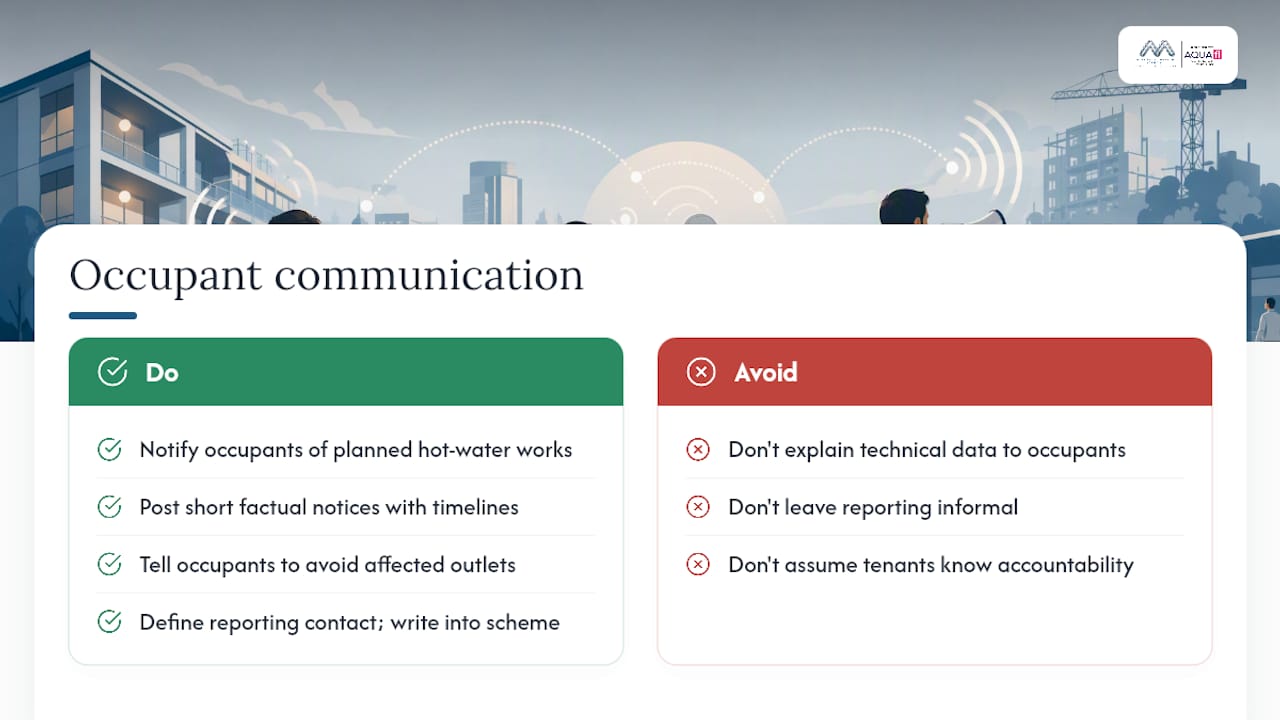
Part 2 rarely operates in isolation. Most non-domestic buildings have more than one type of water system, and the guidance is deliberately split so each part covers the specific risk profile of a system type rather than trying to write one set of rules for everything.
If your site has a cooling tower or evaporative condenser alongside your domestic hot and cold water, Part 1 governs that equipment, and its risk assessment sits alongside, not instead of, your Part 2 assessment. Spa pools, hydrotherapy pools and similar systems fall under Part 3, which has its own temperature and disinfection profile because pool water behaves very differently to a domestic hot water loop.
Beyond HSG274 itself, Part 2 connects to wider legal frameworks. The Health and Safety at Work etc. Act 1974 provides the underlying duty of care, the Control of Substances Hazardous to Health Regulations classify legionella as a biological agent requiring risk assessment, and the Water Supply (Water Fittings) Regulations govern the physical installation standards referenced in the design section above.
For most commercial buildings, a single written scheme of control can reference all the relevant systems and parts in one document, provided it’s clear which control regime applies to which system. Trying to run separate, disconnected schemes for hot water, cooling towers and any spa facilities tends to create the exact record-keeping gaps that inspectors flag first.
Communicating with occupants and stakeholders during routine management and incidents
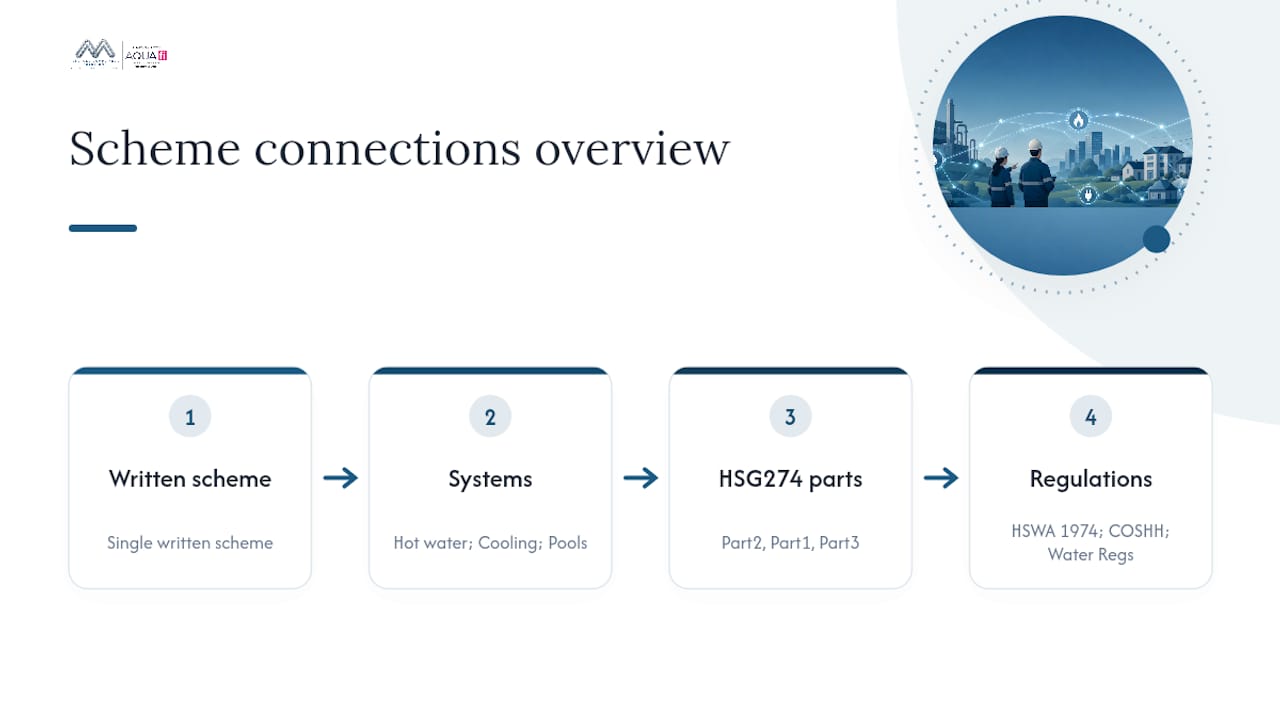
Routine monitoring rarely needs much communication beyond the estates team and the responsible person, but a few situations demand it. Planned works that will interrupt hot water supply, such as calorifier draining or disinfection, should be flagged to building occupants in advance, particularly in healthcare or housing settings where residents may have limited alternative facilities.
An out-of-spec sampling result that triggers remedial action is a different situation. Occupants using affected outlets need clear, calm instructions, typically to avoid using showers or taps in the affected area until cleared, rather than technical detail about action levels or bacterial counts they have no context for. Overexplaining the science tends to cause more alarm than the situation warrants; a short, factual notice with a clear timeline works better.
Internally, the responsible person should have a defined point of contact for reporting anything unusual, a cold tap running warm, discoloured water, unusual smell, so staff on the ground know exactly who to tell rather than assuming someone else has noticed. That reporting line should be written into the scheme of control, not left as an informal understanding that falls apart when someone’s on leave.
For multi-tenant or leased buildings, landlords and managing agents need a clear agreement on who communicates with occupants and who’s accountable for the underlying water system, particularly where responsibility is split between a landlord’s common areas and a tenant’s fit-out.
What most sites get wrong, and how to fix it
The most common failing isn’t ignorance of the temperature regime. It’s inconsistency: sentinel checks done for eight months of the year, then a gap nobody notices until an audit. Poor commissioning is the second recurring issue, systems handed over without proper flushing or balancing, which then need years of remedial flushing to compensate for a design fault that could have been fixed once, at the start.
A common pattern across many sectors is a risk assessment that’s technically present but hasn’t been updated since a refurbishment, paired with monitoring records that exist but don’t tell a coherent story. The fix isn’t complicated. Assess the system properly, build a written scheme that actually matches how the building operates, remediate the specific gaps that assessment finds, then train the people responsible so the next twelve months of records look different from the last twelve.
One housing association client had exactly this profile: technically compliant on paper, but sentinel logs with obvious gaps and a written scheme that hadn’t been touched since a boiler replacement two years earlier. Rebuilding the scheme around the current system, closing the monitoring gaps and running a short refresher session for the on-site team turned a document nobody trusted into one that held up under review.
— Sammi
Get your HSG274 Part 2 compliance sorted properly
Reading a summary is one thing; having someone independently check your system against it is another. Specialist compliance providers can be an alternative to piecing compliance together yourself from HSE PDFs and old spreadsheets; they map every Part 2 requirement onto your actual site and hand you a scheme you can defend at audit, not just a document that looks the part.
[
Our process is straightforward: a site visit to assess your systems, a written report identifying gaps against the temperature regime and monitoring expectations, a proposed schedule for ongoing checks, and a clear quote for any remedial work needed. Services map directly onto what Part 2 asks for, legionella risk assessments, water sampling and analysis, TMV servicing, tank disinfection and awareness training for your responsible person.
If you’re a facilities or compliance manager in Coventry, Binley or the surrounding area and want a straight answer on where your systems stand, request a legionella risk assessment quote and we’ll take it from there.
Primary sources to consult
Keep these documents close when reviewing or building your compliance file:
HSG274 Part 2 — full technical detail on temperatures, commissioning and standards
HSG274 product page — overview of all three parts and how ACOP L8 relates to them
HSE hot and cold water systems guidance — sentinel outlets, monitoring frequency and sampling
HSG274 explained (LegionellaCheck) — plain-English overview of scope and inspection cadence
This article is general information, not a substitute for advice from a qualified doctor. Consult a qualified healthcare professional about your own circumstances before acting on anything here.
Sources
FAQ
What is HSG274 Part 2?
HSG274 Part 2 is HSE’s technical guidance for controlling legionella in hot and cold water systems, covering calorifiers, storage tanks, taps and showers. It sets out the 60/50/20 temperature regime, sentinel monitoring practice and commissioning standards dutyholders used to meet their legal duty under ACOP L8.
What is the relationship between ACOP L8 and HSG274?
ACOP L8 sets the legal duty to control legionella risk, and following it gives you a defence in enforcement action. HSG274, including Part 2, provides the detailed technical steps, like temperatures and monitoring frequencies, that show you how to meet that duty in practice.
What is the British standard for sampling for Legionella?
There isn’t a single standalone British Standard purely for legionella sampling; sampling and action levels are addressed within HSG274 and HSE’s hot and cold water guidance, which set out when to sample and how to interpret results against action levels.
Can I do a DIY Legionella risk assessment myself?
You can carry out your own risk assessment provided you, or a nominated responsible person, have the competence to do it properly, which HSG274 expects to include a working understanding of the system layout, control measures and monitoring requirements. Many dutyholders choose a specialist assessor instead, particularly for complex or multi-building sites, to ensure the assessment holds up under inspection.
Recommended
Comments